A plane turnaround is everything that happens on the ground between one flight arriving and the next one leaving: passengers and bags off, the cabin cleaned, the aircraft refuelled and loaded, then boarding, doors closed and pushback. Airlines measure it from on-block to off-block, and most short-haul turns are planned around 30 to 45 minutes.
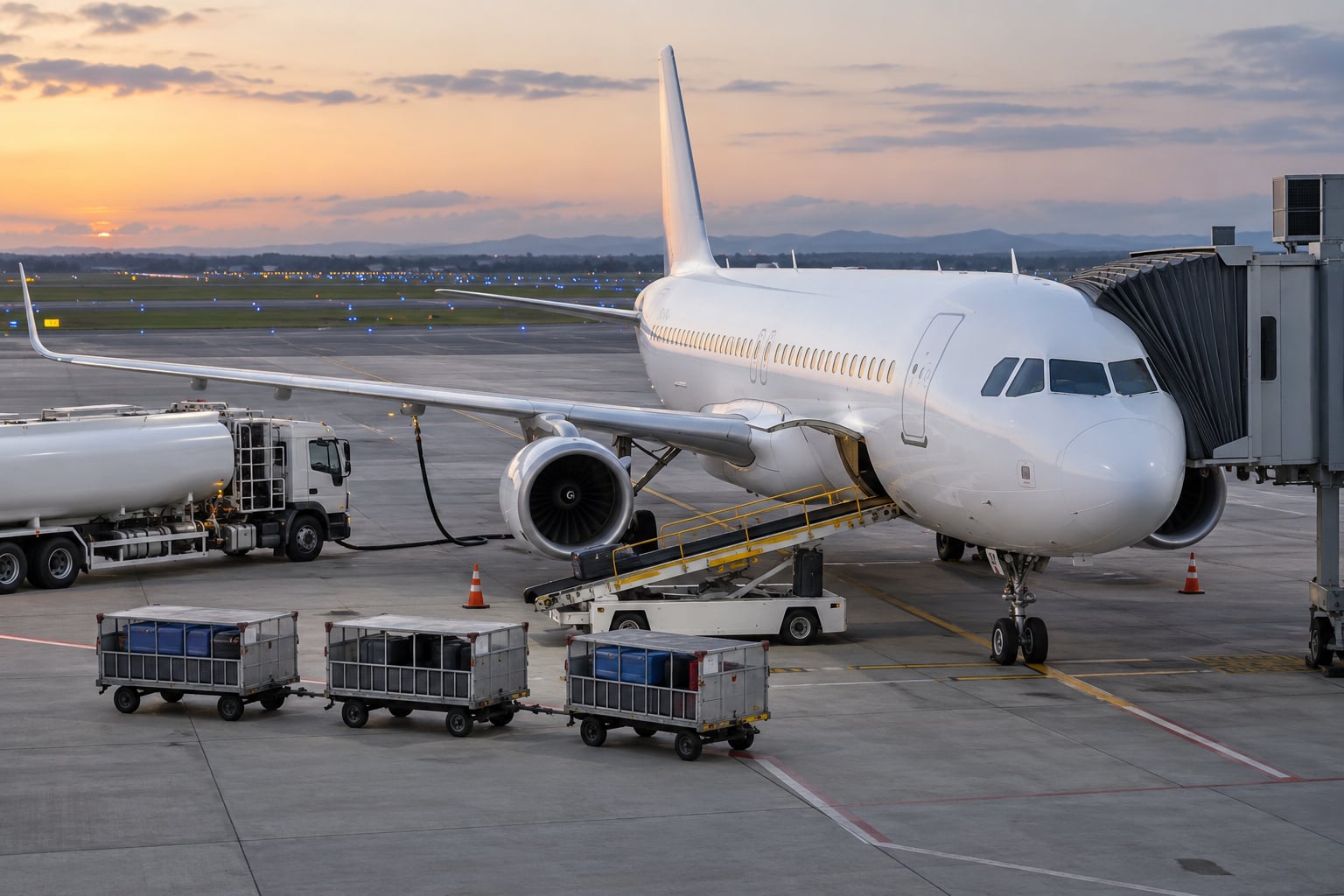
It is a strange thing to watch from a window seat. The aircraft stops, the bridge swings across, and then a dozen vehicles converge at once. Fuel trucks, a catering van, belt loaders, a baggage tug, cleaning carts. Everyone moves at the same time, and none of them are waiting for each other, except in a few places where a single missing detail can stop everything.
Below is the whole sequence, the people behind it, and the reasons a turn that was scheduled for 35 minutes ends up taking an hour. Nothing here is secret to frequent flyers — it is just rarely explained in plain language.
Table of Contents
- 1What Happens During a Plane Turnaround at a Glance?
- 2When Does the Turnaround Start and End?
- 3What Are the Main Steps in a Plane Turnaround?
- 4How Do Ground Teams Prepare the Aircraft?
- 5What Happens During Boarding and Final Checks?
- 6What happens during a plane turnaround in the last 20 minutes
- 7Why Does a Plane Turnaround Sometimes Take Longer?
- 8How Does the Turnaround Vary by Aircraft and Airport?
- 9Frequently Asked Questions
- 10How long does a plane turnaround usually take?
- 11What is the shortest part of an aircraft turnaround?
- 12Why do passengers board before baggage loading is finished?
- 13Can a plane leave if cleaning is not completed?
- 14What happens if maintenance finds a problem during the turnaround?
- 15Does the airline perform the turnaround with the same crew after pushback?
- 16Key Takeaways
What Happens During a Plane Turnaround at a Glance?
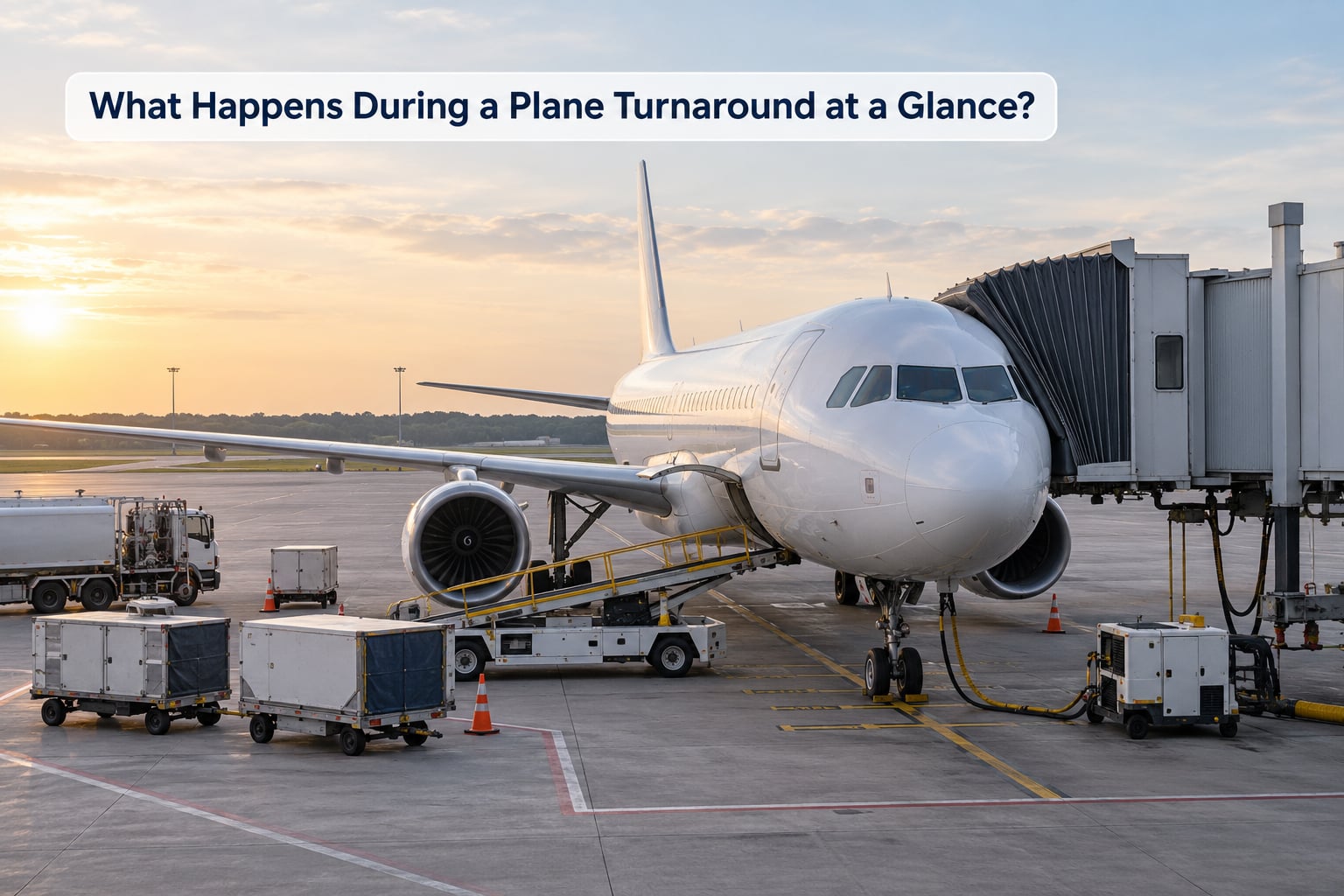
Here is the shape of the process. The column on the right matters most for passengers, because it explains what you are waiting for.
| Stage | Typical timing | Who owns it | Why it matters |
|---|---|---|---|
| On-block and chocks in | Minute 0 | Pilot and ramp agent | Marks the official start of the measured turn |
| Shut down and power up | Minutes 0 to 3 | Pilots, ground power unit | The aircraft needs electrical power and air while engines are off |
| Deplaning | Minutes 3 to 12 | Cabin crew, ground staff | Frees the seats and aisles for cleaning and boarding |
| Unloading bags and cargo | Minutes 5 to 20 | Baggage and ramp crews | Everything off the aircraft has to come off before the next load goes in |
| Cabin cleaning and lavatory service | Minutes 8 to 25 | Cleaning contractor | Lavatories are the hard constraint, not the seats |
| Refuelling | Minutes 8 to 20 | Fueling operator | Often the longest single task and rarely the delay |
| Catering and potable water | Minutes 10 to 25 | Catering contractor | Galley trucks work from the front door to the back |
| Loading and load sheet | Minutes 15 to 30 | Ramp, load controller, pilots | Weight and balance must be signed before doors close |
| Boarding and final checks | Minutes 22 to 33 | Cabin crew, pilots, marshaller | Last chance to catch a missing bag or a walkaround finding |
| Doors closed, pushback, off-block | Minutes 33 to 35 | Flight crew and pushback crew | The aircraft is only free to leave once everything is signed |
Read that table as overlapping work, not a queue. The point of a well-run turn is that refuelling, cleaning, catering and unloading are all in progress at once, with the aircraft held at the gate until the slowest one finishes.
When Does the Turnaround Start and End?
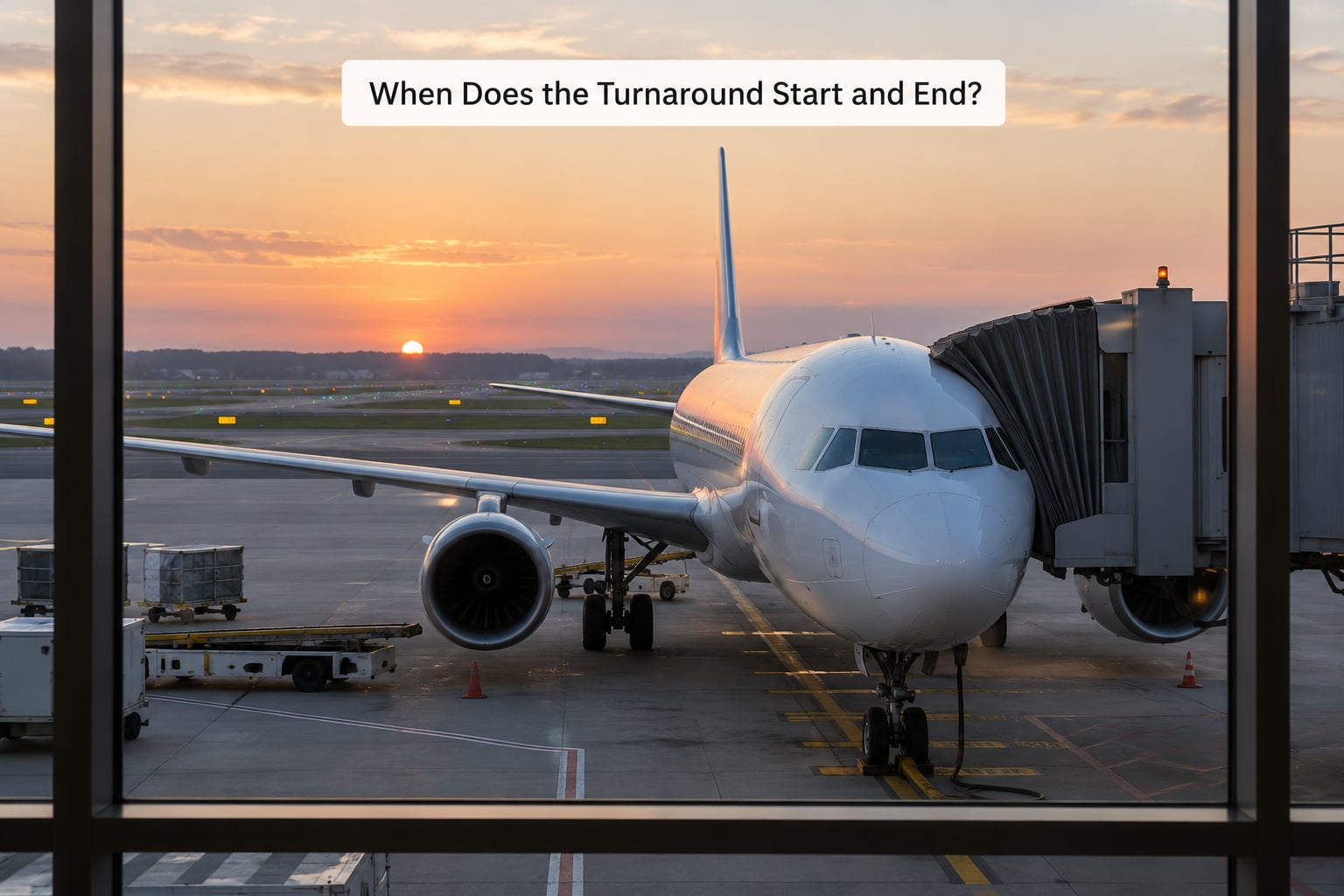
The turn starts at on-block, which is the moment the aircraft is stationary with its parking brake set and the chocks are in, and it ends at off-block, when the pushback tug pulls it away from the gate. Everything in between is measured against those two points.
That measured turn is narrower than the planning behind it. The turnaround process actually begins much earlier, when the airline builds the aircraft rotation: which tail flies the route, how many minutes it needs on the ground at each stop, and how much slack is left when the previous leg runs late. Airlines treat ground time as a cost, because an aircraft only earns its keep in the air.
It also runs into what happens next. Cabin crew, pilots and cleaners may all start preparing for the following leg while the current one is still loading. On a short rotation, the same people, the same trucks and the same bags turn around the same aircraft several times a day, which is why a turn that looks chaotic from the window is actually a repeated, tightly rehearsed routine.
One thing is worth separating clearly: a turnaround is not a technical stop, and it is not an irregular operation. A technical stop is a fuel or crew break on a long route where the aircraft may not even unload. An irregular operation is what happens when something breaks the plan.
What Are the Main Steps in a Plane Turnaround?
Nine steps, in the order they usually start. Several overlap, and the whole sequence is usually run against a checklist that every contractor on the ramp shares.
1. On-block, marshalling and chocks. A marshaller guides the aircraft to the stand with hand signals, and the ramp team places chocks and safety cones. Ground power is connected and the anti-collision beacon stays on until engines are shut down.
2. Engines stop, systems power up. The auxiliary power unit starts, or a ground power unit is plugged in, which keeps the aircraft electrical systems and air conditioning running. Air bridges or stairs are positioned against the doors.
3. Doors open and deplaning begins. Passengers come off first through the front bridge, usually by row group. Special assistance passengers are off first or last depending on the airline, and they are the ones who take the longest on the ramp.
4. Unloading bags and cargo. Belt loaders open the forward and aft cargo holds, and the baggage team starts pulling bags off the belt. Cargo and mail are counted as they come out.
5. Cabin cleaning and lavatory service. Cleaning crews enter once the aisles clear, working from the back of the aircraft forward. At the same time lavatory trucks empty waste tanks and refill potable water, and water and waste servicing often sets the pace for the whole cabin.
6. Refuelling. The fuel truck connects at the wing or under the wing, and the operation is planned to the kilogram rather than to the minute. Crews working near the aircraft stay clear of the engine intake and exhaust danger areas for the whole of it.
7. Catering, restock and boarding preparation. Galley trucks load food, drinks and cabin supplies, a cabin safety check runs, and the cabin crew completes their own checks. The pilots work in parallel on paperwork, performance calculations and the walkaround.
8. Loading and the load sheet. The previous bags are already off, so the new load goes in. Once loading finishes, the load controller computes weight and balance from the load sheet, and the flight crew verifies it. No doors closed without a valid load sheet.
9. Boarding, doors closed, pushback. Passengers board, usually by zone. The pilots run the final walkaround and cabin checks, the doors are closed and armed, the beacon is turned off, and the tug connects. Once air traffic control clears the aircraft, pushback starts, the engines fire, and the turn is over.
The elapsed timings for a typical 35-minute short-haul turn look like this. They shift by a few minutes either way depending on the airport, but the order does not change.
| Elapsed time | What is happening |
|---|---|
| T+0 | On-block, chocks in, engines shut down, ground power connected |
| T+2 | Doors open, jet bridge connected, deplaning starts |
| T+5 | First bags on the belt, cleaning crew starts at the rear galley |
| T+8 | Refuelling begins, lavatory and potable water servicing starts |
| T+12 | Last inbound passenger off, catering truck loads forward galley |
| T+18 | Lavatories finished, cleaning sign-off, hold inspection |
| T+22 | Boarding starts by zone while the last bags are still being loaded |
| T+28 | Load sheet finalised and signed, pilots complete walkaround |
| T+32 | Boarding complete, doors closed and armed, beacon off |
| T+35 | Pushback, engine start, off-block |
How Do Ground Teams Prepare the Aircraft?
More than a dozen teams can touch one aircraft in 35 minutes, and none of them work for the same employer. A single turnaround coordinator, often wearing a high-visibility vest and headset, is the person keeping the sequence honest.
The ramp agent owns the aircraft on the ground. They marshal it in, place chocks, confirm the doors are clear and call the milestone times that the airline reports as the official turn. The baggage handlers load and unload both the passenger bags and the cargo underneath, and they are the ones who can tell you exactly where your suitcase is when it goes missing.
The cleaning crew and the catering crew usually work for separate contractors. Cleaning is the task passengers notice most, because it is the one that happens in front of them; lavatory servicing is the part that actually decides whether the cabin is ready on time. Catering restocks the galleys from the front of the aircraft backwards.
The fueling operator and the maintenance team handle the two things a passenger never sees. Fuel is uplifted to the figure the flight crew needs for the next sector plus a reserve. Maintenance performs the walkaround, checks the oil level and tyre pressures, and handles anything written up by the inbound crew.
All of it runs inside safety rules that most passengers never notice. Vehicles keep out of the engine intake and blast zones, a beacon means engines are running, and no equipment moves under a raised door unless the crew has cleared it. That last rule is why you sometimes see a belt loader sitting still beside a hold that is obviously empty.
What Happens During Boarding and Final Checks?
What happens during a plane turnaround in the last 20 minutes
Boarding overlaps with loading rather than following it. Baggage crews are still building the hold while the first passengers are walking down the aisle, because the load sheet and the passenger count do not have to be finished at the same moment.
Cabin crew check safety equipment, restock the galleys that are not blocked by catering, and verify the cabin is secure. Boarding usually runs in zones from the rear forward, so the front rows board last and fill last, which is why the queue at the front door moves slowest.
Meanwhile the pilots are closing their own loop: performance and fuel figures, the load sheet, and a final walkaround outside the aircraft looking at tyres, doors, panels and fluid leaks. Any discrepancy stops the sequence until it is resolved or the flight departs with it recorded and signed.
Passengers still on board during refuelling is a separate question, and the answer depends on the aircraft, the exit layout and the rules in force at that airport. When it is not permitted, fuel trucks stay back until everyone is off, which is one reason wide-body turns take longer.
Doors closed is the real milestone. After that the aircraft waits for its pushback slot, which depends on the taxiway, the runway sequence and air traffic control, not on the turn itself.
Why Does a Plane Turnaround Sometimes Take Longer?
There is no fixed turnaround time for every flight, and the scheduled figure is a target rather than a promise. These are the reasons a turn that was planned for 35 minutes runs longer.
Late or missing passengers. A passenger who is not at the gate when the door closes is still officially on board. The flight cannot push back until the seat is confirmed empty, and agents keep working the gate, the connecting banks and the airline’s control room.
Connecting passengers on a late inbound. When most of the aircraft is arriving from one delayed flight, the gate will hold for them, often past the scheduled off-block time. This is a deliberate choice, and it is the most common reason a crew says the plane is waiting on people rather than on equipment.
Baggage that will not come off, or a bag that goes on late. Bags are counted against the load sheet. A mismatch stops the doors closing until every piece is accounted for, and reconciliation rules in most markets require a physical search rather than an assumption.
Cleaning or lavatory problems. A spilled drink, a blocked galley or a lavatory that will not service adds time that no amount of coordination recovers.
A maintenance finding. Anything written up by the inbound crew is checked during the turn. A tyre change or a system reset is the difference between a 35-minute turn and a two-hour one.
Weather and de-icing. In winter, fluid application and holding for holdover time sit between boarding and pushback, and they happen on the ramp rather than at the gate.
Gate, crew or aircraft changes. A new stand, a late-arriving inbound aircraft, or a swapped tail means the plan is rebuilt while passengers watch. Air traffic restrictions add delay after pushback, which is separate from the turn but usually gets counted with it.
Ramp staff describe the turn as the most demanding part of the day, mostly because of the timing: several contractors, vehicles moving at once, and a schedule that assumes everything finished on the minute.
How Does the Turnaround Vary by Aircraft and Airport?
Turnaround time scales with the size of the job, not with a fixed rulebook. As a rough planning guide, airlines build in roughly 25 to 40 minutes for a regional jet, 30 to 45 minutes for a short-haul narrow-body, around 60 to 90 minutes for a long-haul narrow-body, and 90 to 150 minutes for a wide-body. Wide-bodies carry more lavatories, more galleys, more bags and more fuel, and every one of those is a task with a duration.
The airport matters as much as the aircraft. A contact stand with a jet bridge and a fixed ground power position is the fast case. At a remote stand, buses move passengers to and from the aircraft, stairs are wheeled out and back, and the trucks approach on foot-guided routes, which adds real minutes to every stage.
Big hubs with heavy connecting banks run slower turns on paper, because the airline accepts a longer gate time rather than risk a misconnection. Smaller airports often turn faster for the same aircraft, with fewer passengers to board and a simpler load.
Contact stands also decide who you fly with next. If the stand is occupied by the arriving aircraft, passengers may board at a remote stand or wait on the bus, which is a common source of gate-side confusion.
Frequently Asked Questions
How long does a plane turnaround usually take?
Most short-haul narrow-body turns are planned at 30 to 45 minutes, regional jets at 25 to 40, and wide-bodies at 90 to 150 minutes. Those figures are targets, not guarantees: a late connecting passenger, a maintenance finding or weather can extend a turn well past the scheduled time.
What is the shortest part of an aircraft turnaround?
Chocking and powering down is usually the fastest, taking only a couple of minutes. Pushback itself is short too, but it depends on the tug and the slot. The tasks that actually consume the schedule are the slow ones: cleaning, lavatory servicing and waiting for the load sheet to be signed.
Why do passengers board before baggage loading is finished?
Boarding and loading run in parallel because the two tasks use different parts of the aircraft. Bags go into the holds while passengers walk the aisles, so neither has to wait for the other. The doors still cannot close until every bag is counted on the load sheet and the weight and balance are signed.
Can a plane leave if cleaning is not completed?
A flight cannot depart with an incomplete safety-critical task, and an aircraft cannot legally be dispatched with a cabin security issue unresolved. A missed vacuuming or a water spill might only cost a few minutes. An unresolved defect in a door, lavatory or galley appliance is different and usually grounds the departure until it is cleared.
What happens if maintenance finds a problem during the turnaround?
The turn pauses while the fault is assessed. A minor item may be signed off as a deferred defect that is fixed at the next base, allowing the flight to depart as scheduled. Anything affecting safety, and anything that could delay the next sector, means the aircraft is swapped for a spare and the turn extends.
Does the airline perform the turnaround with the same crew after pushback?
On a short rotation the same pilots and cabin crew usually turn the aircraft around again, which is why frequent flyers recognise a tail and its crew from one sector to the next. On longer routes the crew changes at a base, and the incoming team arrives before the aircraft does to prepare the cabin for the next flight.
Key Takeaways
A turnaround is a set of overlapping tasks with one finish line: doors closed, load sheet signed, pushback cleared. Refuelling, cleaning, catering and baggage work all run at once, and the aircraft waits for whichever one is slowest, which is why a clean cabin is no sign that departure is close.
The three things that actually delay most flights are late passengers, a bag that will not reconcile and a maintenance finding, in that order. Weather and air traffic come after the turn is already done.
If you want to know where a flight stands, check boarding progress and the flight status updates rather than watching the cleaners. That is the fastest way to tell whether you are waiting on a clean cabin, a load sheet or people who are still walking in.