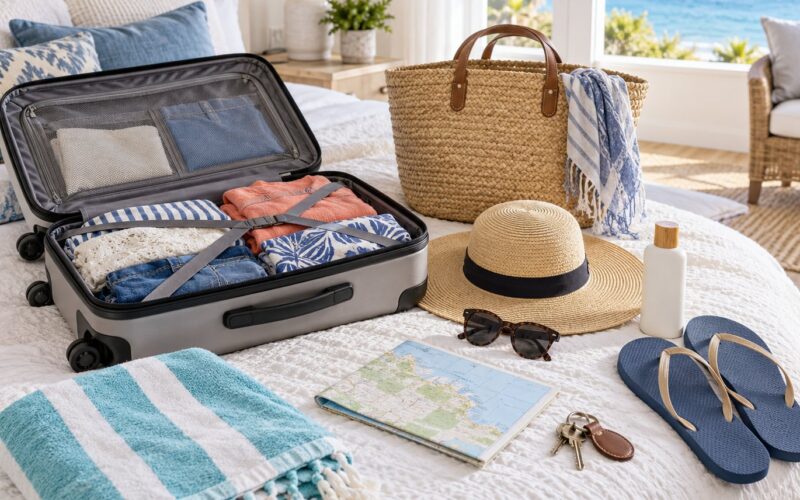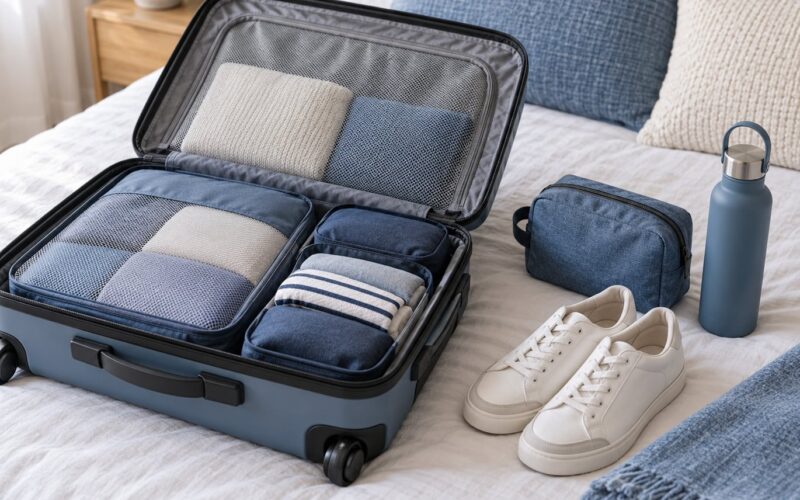
Packing cubes work because they turn a loose pile of clothing into four or five movable blocks. Sort by category, load the heaviest cubes at the bottom, keep one small cube accessible at the top, and the whole bag repacks in a few minutes. Ten minutes of sorting saves an hour of digging at the hotel.
I use the same routine for a two-night city break and a week in the Mediterranean, so nothing about it depends on how long the trip is. That is the honest answer to how to organize a suitcase with packing cubes: there is no clever trick, just a fixed sequence you repeat until it feels automatic.
Table of Contents
- 1What You Need to Organize a Suitcase with Packing Cubes
- 2Step-by-Step Packing Cube System
- 31. Choose Cubes That Match Your Luggage
- 42. Sort Everything Before You Pack
- 53. Assign a Category to Each Cube
- 64. Pack Bulky and Heavy Items First
- 75. Fill Smaller Gaps With Rolled Clothing
- 86. Keep Frequently Needed Items Accessible
- 97. Separate Toiletries and Damp Items
- 108. Close, Check, and Label the Suitcase
- 11Common Mistakes and Easy Fixes
- 12Frequently Asked Questions
- 13Do packing cubes really make packing easier?
- 14Can packing cubes be compressed in a carry-on suitcase?
- 15How many packing cubes are enough for one trip?
- 16Are packing cubes allowed in carry-on luggage?
- 17Should packing cubes be used for checked luggage or carry-ons?
- 18Conclusion: Start With Three Core Cubes
What You Need to Organize a Suitcase with Packing Cubes
You need five things, and four of them are things you probably already own.
- A suitcase with real capacity for your trip. Cubes organize a bag, they don’t enlarge it. If your clothes only fit in a week of packing before cubes, they will still only fit a week after.
- A coordinated set of cubes in three or four sizes. Matching sizes matter more than brand. Sets sold by Eagle Creek, Matador, Away, Globite and Peak Design all follow the same small / medium / large logic.
- A toiletry bag. Liquids need to be reachable and contained, and a cube is the wrong tool for that job.
- A laundry bag or compression sack for dirty clothes. Decide where the worn clothes go before you leave.
- A simple inventory. A note on your phone listing every category is enough. No app required.
Volume is the number people get stuck on, so here is roughly what the sizes mean. A small cube is 2 to 3 liters and holds underwear, socks and accessories. A medium cube is 4 to 6 liters and holds about five shirts, or a few shirts plus a pair of shorts. A large cube is 6 to 8 liters and takes jeans, sweaters or a full outfit.
Step-by-Step Packing Cube System
The logic underneath the steps is fourfold. Category keeps things findable, size keeps the load dense, weight keeps the bag balanced, and access keeps you from unpacking everything for a clean shirt. Every step below serves one of those four.
1. Choose Cubes That Match Your Luggage
Measure the interior of the suitcase first, then buy cubes that fit inside it rather than beside it. A set that looks generous laid out on a bed can leave two inches of dead space at each end once the cubes are loaded.
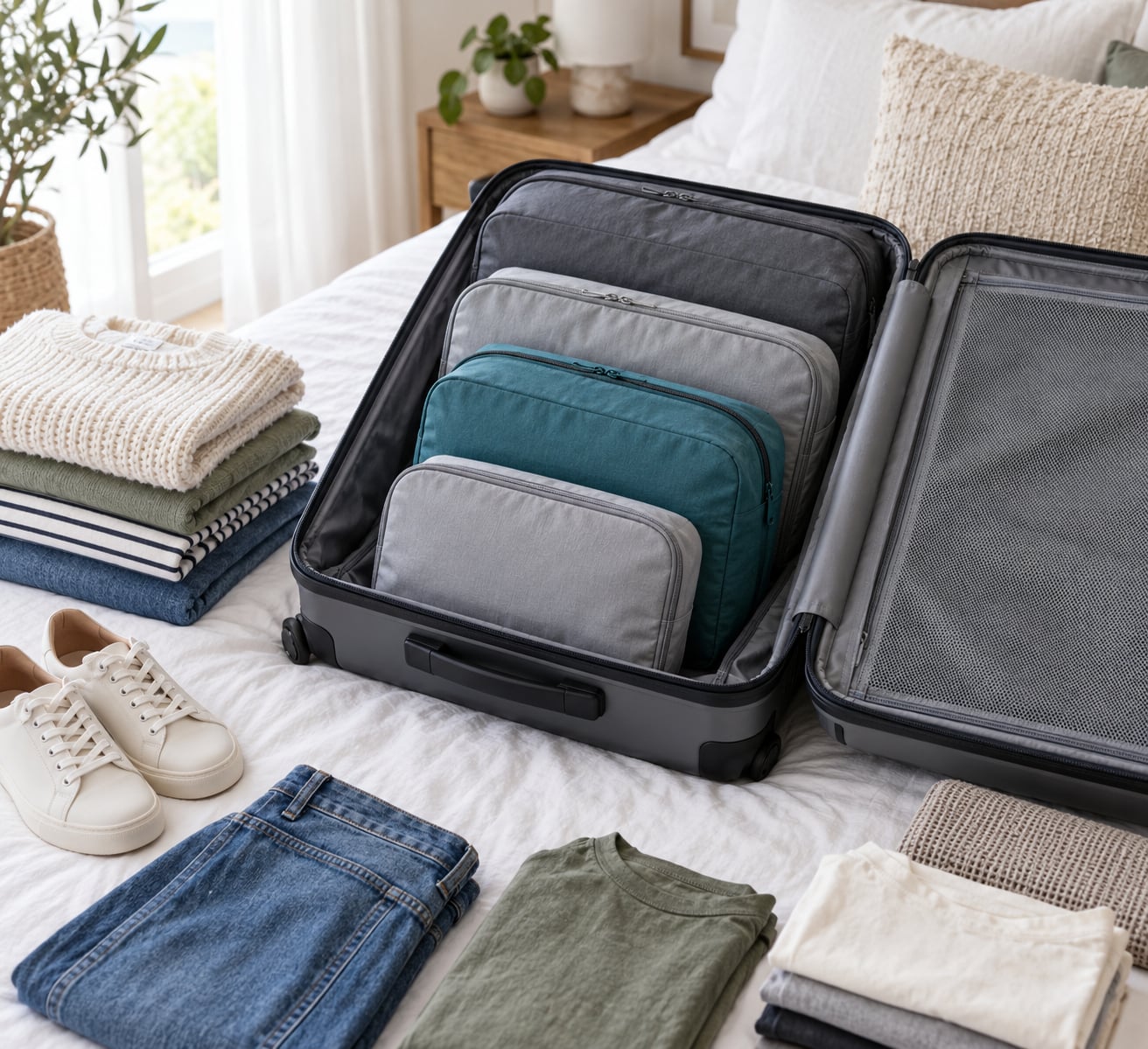
Match large cubes to bulky or dense clothing, medium cubes to everyday outfits, and small cubes to accessories and undergarments. When the cubes are laid out next to the open suitcase in descending size order, you should be able to see at a glance which ones go where.
2. Sort Everything Before You Pack
Empty the suitcase onto the bed or the floor and sort by category. Tops in one pile, bottoms in another, underwear and socks together, sleepwear, layers, shoes. Pull out anything you have not worn in the last month.
Sorted piles on an open surface catch the things you would otherwise remember at 5 a.m. in a hotel room. Nothing goes into the suitcase until the piles are decided.
3. Assign a Category to Each Cube
To organize a suitcase with packing cubes properly, give every cube one job and write the job on the outside if your cubes have a label panel. Tops, bottoms, underwear and socks, sleepwear, shoes, accessories. Six cubes is plenty for most trips.
Sort by outfit instead if you want to dress without thinking, which suits business travel. Sort by person if several travelers share a bag, and pick a different color per traveler so nobody unpacks the wrong cube at 6 a.m.
Use lightweight mesh cubes for delicate items so nothing presses against a zip, and a water-resistant cube for damp towels or swimwear. A breathable cube for sweaters is worth the extra one, too.
4. Pack Bulky and Heavy Items First
Place shoes, jeans, jackets and sweaters at the bottom of the suitcase, pressed toward the sides and near the wheel end. Weight at the bottom and against the walls keeps the bag upright on a luggage carousel instead of tipping onto its side.
Distribute the density evenly. A single heavy lump on one corner makes the bag lopsided and leaves the other half soft and collapsible.
5. Fill Smaller Gaps With Rolled Clothing
Roll T-shirts, socks, scarves and casual trousers and wedge them into the spaces around the larger cubes. A rolled layer plugs a three-inch gap and stops the cubes from shifting when the bag is tipped upside down in an overhead bin.
The packing advice that circulates on r/travel holds up: roll shirts and socks, fold underwear and anything delicate. Rolling genuinely uses the corner space better, but forcing a silk blouse into a roll just creates a crease that lasts the whole trip.
6. Keep Frequently Needed Items Accessible
Build one small top-access cube with underwear, socks, medication, chargers, a plug adapter and a single change of clothes. Zip it and lay it face up on top of everything else, closest to the zipper pull.
This is the cube that saves you. On a r/onebag thread a traveler described the same idea: one small cube you can pull out at the airport security line without emptying the bag. Forums also note the small cube gets used as a daypack once it is empty, which is a nice second life.
7. Separate Toiletries and Damp Items
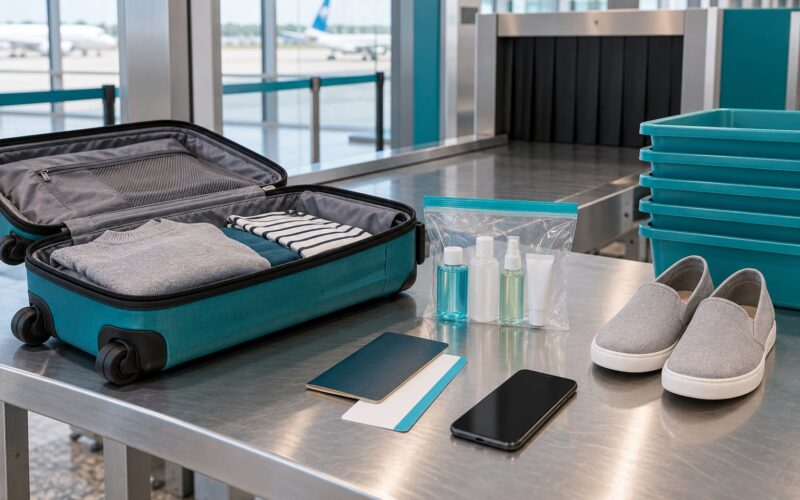
Liquids go in a toiletry bag, not a cube, and the bag needs to follow the liquid rules your airline or border authority applies. In the United States that is the familiar 3-1-1 rule: containers of 100 milliliters or less, inside a single clear quart-sized bag.
Damp or wet items belong in a sealed or water-resistant cube, ideally with a plastic liner so it cannot leak into dry clothes. One person on the Tom Bihn forum keeps a dedicated small cube for cords and plug adapters rather than clothing, which keeps the cables from tangling into a knot at the bottom of the bag.
8. Close, Check, and Label the Suitcase
Zip everything and close the case without forcing the zipper. If it will not close, something is overpacked and the fix is to remove an item, not to lean on the zipper.
Weigh the bag if your airline publishes a weight limit, then measure it against the carry-on dimensions for your specific route, since limits vary by carrier and by aircraft. Put contact details on an identification tag inside the handle loop and keep a copy of your address and local phone number with your documents.
Worth remembering: cubes do nothing about baggage rules or about protecting a laptop or camera. Hard-edged gear and electronics belong in padded sleeves, not squashed under a compression cube.
Common Mistakes and Easy Fixes
Overpacking because cubes make it easy. A cube hides the volume of what it holds, which is exactly why people overfill them. Fix: cap each cube. If it will not zip without straining, take something out.
Buying eight sizes and using two. Forum buyers repeatedly say the small and medium cubes do the work and the huge ones sit empty. Fix: three sizes, one of each, matched to your usual suitcase.
Mixing categories. One cube for “clothes” is no system at all. Fix: one category per cube, written down before you fill anything.
Burying the important items. Medication and a spare phone charger at the bottom means unpacking the whole bag at an airport. Fix: the small top-access cube, always.
Compressing the wrong fabrics. Compression cubes flatten volume by squeezing air out of clothing. Formal shirts and delicate knits come out with sharp new creases. Fix: compression for t-shirts, jeans and knit layers only.
Assuming cubes are waterproof. They usually are not, and they are not designed for spills or wet shoes. Fix: a water-resistant cube for damp items, and a dry bag inside the suitcase if you expect rain or a swimming stop.
Leaving no room for the return trip. A perfectly full case going out has nowhere to put the laundry bag coming home. Reserve about a quarter of the volume for dirty clothes, or pack the laundry bag and leave it empty on the way out.
Forgetting that security opens everything. Cruise travelers report small cubes sliding out of split-side suitcases when the bag is opened in an overhead bin. Zip every cube fully and pack the small ones high.
A few extras that cost nothing: a folded plastic bag for wet swimwear, a bandana or buff in the top cube for an unexpected cold evening, and one photo of your medications and doses on your phone in case you cannot read the label.
Frequently Asked Questions
Do packing cubes really make packing easier?
Yes, mostly by removing decisions rather than saving space. Cubes give every item a fixed home, keep clean clothes away from dirty ones, and let you load a hotel dresser without unpacking the case. They do not make a bag hold more than the bag holds, and compression versions add a little weight, which matters on weight-limited routes.
Can packing cubes be compressed in a carry-on suitcase?
Only for sturdy, wrinkle-tolerant fabrics such as t-shirts, jeans and knit layers. Compression cubes squeeze air out of the bundle, which buys a few liters and can leave sharp creases in formal shirts, silk and delicate knits. Fold those instead, and note that compression cubes weigh slightly more than standard ones.
How many packing cubes are enough for one trip?
Three to six covers almost every trip. One large cube for bulky clothing, one or two medium cubes for everyday outfits, and one small cube for underwear, socks and transit essentials. Add a seventh only for shoes or a shared family bag, and a laundry bag for anything longer than four nights.
Are packing cubes allowed in carry-on luggage?
Yes. Cubes are ordinary fabric containers, not restricted items. What matters is what is inside them: liquids must follow your airline’s liquid rules, typically the 3-1-1 rule of 100 milliliter containers in a single clear quart-sized bag in the United States. Check the rules for your specific carrier and country before you fly.
Should packing cubes be used for checked luggage or carry-ons?
Both, but the reason differs. In a checked bag, cubes keep the case organized through handling and let you find one item at arrival instead of emptying everything. In a carry-on, they make overpacking visible, since the closed case either fits the airline’s limits or it does not.
Conclusion: Start With Three Core Cubes
Do this on your next trip. Sort everything into three piles, pull one large cube for bulky clothes, one medium cube for everyday outfits and one small cube for underwear, socks and your chargers. Then load the large cube at the bottom, the medium on top of it, and the small cube at the very top near the zipper.
That is how to organize a suitcase with packing cubes in its simplest form, and it works the same for a carry-on and a checked bag. Add cubes only when a real pile shows up that has nowhere to live, and leave a quarter of the case empty for the trip home.