The cheapest way to exchange currency without losing money is to pay the mid-market rate — the number you see on Google, XE or your card network — and strip away every fee stacked on top of it. In practice that means a card with no foreign transaction fee for most spending, a bank-owned ATM for cash, and as little pre-converted money as you can get away with.
Rates and bank fees shift around, and rules differ by country, so treat the figures below as typical rather than fixed. They were last reviewed in October 2026.
Table of Contents
- 1What You Need
- 2Step-by-Step: How to Exchange Currency Without Losing Money
- 3Compare the real exchange rate before you exchange
- 4Calculate the total cost, not just the advertised rate
- 5Choose the lowest-cost method for your situation
- 6Complete the exchange safely and confirm the result
- 7Common Mistakes
- 8Tips for Getting a Better Rate
- 9Frequently Asked Questions
- 10What is the safest place to exchange money when I travel?
- 11Is it cheaper to exchange currency at home or abroad?
- 12How much foreign cash should I bring with me?
- 13How can I tell if an exchange rate is bad?
- 14Should I accept dynamic currency conversion when a terminal offers it?
- 15Conclusion
What You Need
Before you exchange anything, get these five things sorted. It takes twenty minutes and it is the difference between paying the real rate and quietly paying five percent more.
- Photo ID and the account details for your bank. You will need the card PIN for any ATM withdrawal, and some exchange offices ask for a passport or a local address proof.
- Two cards on different networks — one Visa, one Mastercard, for instance — stored in separate places. Fraud systems freeze cards abroad more often than people expect.
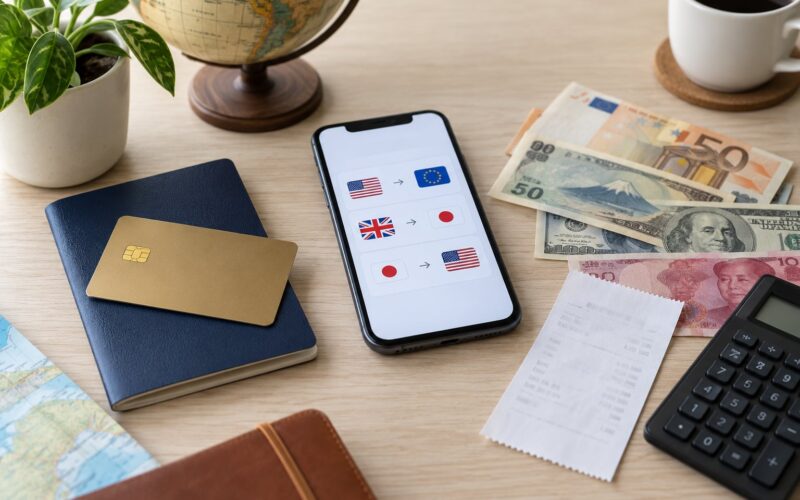
- A live rate source. Google, XE or your bank’s own app. Whatever you use, it has to show the mid-market rate right now, not a rate from this morning.
- A calculator on your phone. You are going to divide a quoted rate into the mid-market rate. That one division tells you whether the quote is fair.
- A rough cash budget. Decide how much physical cash you actually need for arrival costs, tips and small vendors before you convert anything. Most travelers overestimate this badly.
The bank app matters more than it sounds. Nearly every major bank now has a travel notification you can switch on in a few taps, and turning it on before you fly is the single cheapest thing in this whole guide.
Step-by-Step: How to Exchange Currency Without Losing Money
Compare the real exchange rate before you exchange
The mid-market exchange rate is the rate at which currencies trade between banks on the open market. It moves all day, every day, and no shop, kiosk or bureau can give it to you at cost — their profit is built into the rate they print on the board.
Type your currency pair into Google or XE and write down the mid-market number before you walk up to any counter. Then divide the provider’s rate by the mid-market rate. Multiply by 100 and the result is your effective markup: a 1.09 answer means they are charging about 9% over the real rate.
Travelers on forums like r/travel and the Rick Steves community keep landing on the same conclusion: a “no-fee exchange” is never free, because the rate itself is the profit. If someone advertises 0% commission, the money moved into the price of your currency instead.
One wrinkle worth knowing. Providers often quote the rate the other way round — how much of your home currency you get per unit of foreign currency — so check the units before you do the maths. Divide the wrong way round and a bad rate looks great.
Calculate the total cost, not just the advertised rate
Four costs stack on top of the mid-market rate, and any one of them can be the biggest. Knowing all four by name is how you spot a bad deal quickly.
1. The markup. The gap between the mid-market rate and what the provider charges. Kiosks, airport counters and hotel desks typically run somewhere between four and ten percent. Banks are usually better, closer to two to five percent, though that varies widely by bank and by currency.
2. Commission or service fee. A flat charge per transaction. These sting on small amounts — a three-pound fee on a forty-pound exchange is over seven percent — and they are the reason to batch your transactions instead of making several small ones.
3. Foreign transaction fee. A percentage your card issuer adds when you spend or withdraw abroad, commonly three percent. It is charged on top of whatever rate the card network gives you, and no rate negotiation removes it. In some markets more cards now charge nothing, so check your own card’s terms rather than assuming.
4. Dynamic currency conversion. This one hides in plain sight at the terminal or the ATM. You are asked whether to pay in the local currency or in your home currency. Choosing your home currency sounds safe and convenient, and it is the single most expensive decision most travelers make.
Here is what that looks like with real numbers. Spend 800 euros on a trip. At a mid-market rate of one euro to 0.86 pounds, the true cost is 688 pounds. Now take the terminal’s offer to charge you in pounds at 0.94 per euro — that sounds convenient, and it is 752 pounds for exactly the same shopping. You just handed over 64 pounds extra, roughly nine percent, because the terminal set the rate rather than the card network.
Choose the lowest-cost method for your situation
No single method wins everywhere. Match the method to how much you are spending, how cash-dependent the destination is, and how much cash you actually need on arrival.
No-foreign-transaction-fee card — best for most spending. Usually within a percent or two of the mid-market rate, and you avoid carrying anything. This is the default for hotels, restaurants, shops and anything you can tap or swipe.
Bank-owned ATM — best for cash. Withdraw in the local currency, decline the machine’s offer to convert into your home currency, and your card network rate does the work. You may pay a small issuer fee plus whatever the ATM operator charges. Always decline dynamic currency conversion at an ATM; that single tap of “yes” costs more than every other fee combined.
Your bank before you leave — best for unusual currencies or a big cash need. Pre-ordering from a bank or credit union gives you a predictable rate and physical cash in your hand, which is genuinely useful where cards are rarely accepted. The flat fee makes it a poor deal for small amounts, and read the rate: some banks apply an effective cost in the four to ten percent range, so a flat fee can hide a large markup.
A reputable digital multi-currency account — best for holding and spending several currencies. These typically show the mid-market rate and charge an explicit, visible fee. Useful if you travel often or spend part of the year abroad. Read the fee rather than assuming it is free.
Airport kiosks, hotel desks and tourist-area exchange offices — the worst option. These carry the widest markup and the smallest selection of currencies. Travelers on r/backpacking and r/personalfinance repeat the same warning: converting your whole travel budget at the airport is the most expensive way to start a trip. Use them only for a small amount on arrival when you need cash in the first hour, not as your main strategy.
Street and informal exchangers — avoid entirely. A better rate than the bureau down the road is the clearest sign you are being robbed. Countersfeit notes, shorted stacks and plain theft are all reported, and you have no recourse.
Skip converting the whole budget. If a rate moves against you after you convert, you have locked in the loss. Convert a small buffer, then top up from a bank-owned ATM once you are in the country and can see the real rate.
Complete the exchange safely and confirm the result
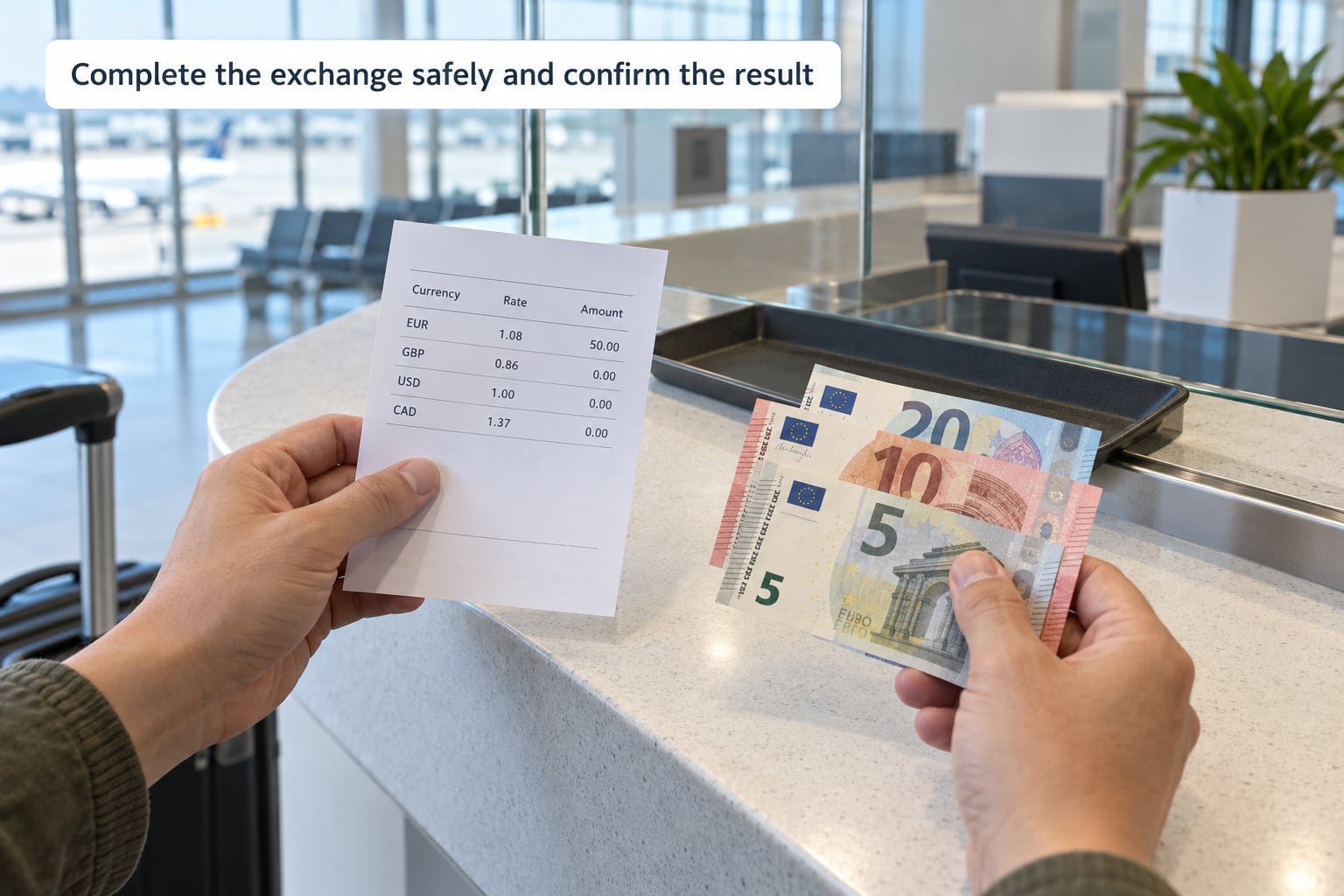
Run a few checks before any money moves. At an ATM, confirm the machine is operated by a bank — look for the institution’s own logo on the screen — and check whether it charges a per-transaction or per-withdrawal fee before you insert your card.
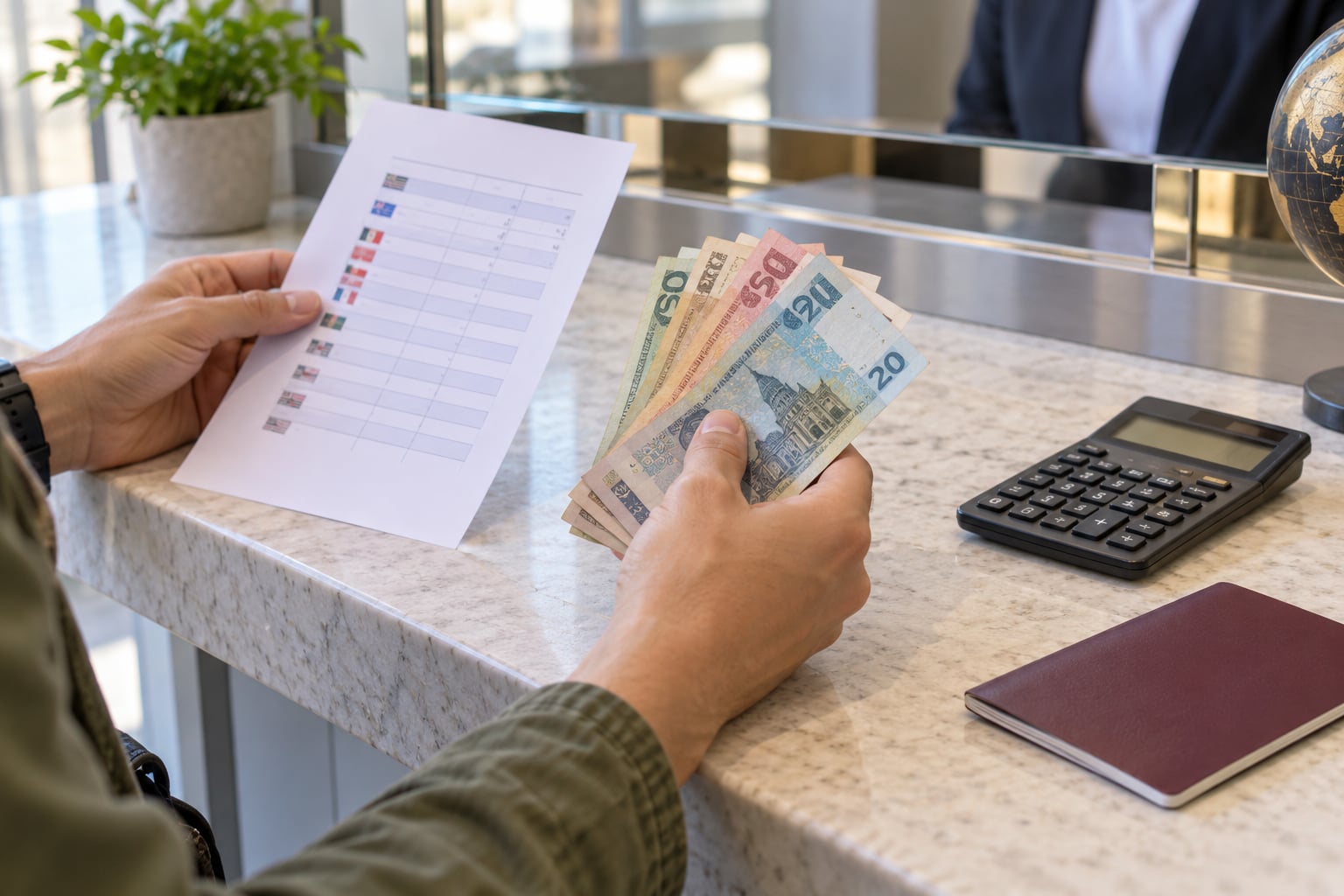
At a counter or bureau, ask for the total amount in your home currency in writing, including every fee, before you hand over cash. If they will not show a breakdown, walk away. You have just learned that their rate is the product.
Once the transaction completes, three quick verifications close it out:
- Count the cash before you leave the counter. Errors happen at busy exchange desks, and they are far easier to fix while you are still standing there.
- Divide the rate you actually got by the mid-market rate. If the answer is above one, that gap is your real cost on this exchange.
- Keep the receipt. You may need it for a bank query later, and it is the only record of the rate you were given.
Common Mistakes
Almost every avoidable loss in this area comes from one of a handful of repeated errors.
Accepting the first quote. The board at an exchange office is a negotiation anchor, not an offer you are obliged to take. Convert the rate, do the division, and know what the mid-market number was before you hear theirs.
Converting more cash than you need. This is the big one. Money you convert before a trip carries risk twice: the rate might move the other way, and whatever you do not spend is stranded in a currency you have to sell back at a worse rate on return. Take the smallest useful buffer.
Paying in your home currency at the terminal. Saying yes to dynamic currency conversion is quiet permission to add four to eight percent to your bill. If you see a prompt offering to charge you in dollars while you are in euros, decline it and choose the local currency every time.
Declining nothing at the ATM. When the machine asks whether you want the amount converted into your home currency, that is dynamic currency conversion in disguise. Say no, take the local currency, and let your own bank do the conversion at its own rate.
Ignoring per-transaction fees. Four withdrawals of forty pounds each with a flat fee per withdrawal can cost more than one two-hundred-pound withdrawal. Small, frequent withdrawals are the standard trap.
Using an unfamiliar informal exchanger. A rate dramatically better than the bank down the road is a warning, not a deal. Stick to bank counters, established bureaus, bank-owned ATMs and regulated apps.
Skipping the final check. Compare what you received against your benchmark before you leave. This takes thirty seconds and catches most mistakes immediately.
Letting unspent foreign currency go to waste. People reliably lose money here without realising it. Keep it for the next trip in a labelled envelope, spend it in a shop on the way home, or sell it back through your bank rather than letting it sit in a drawer. A Rick Steves forum regular put it plainly: it is not an exchange, it is a purchase of currency sold to you at a profit.
Tips for Getting a Better Rate
Withdraw in modest amounts, not tiny ones. Two or three batched withdrawals beat a daily routine of small ones, because most ATMs charge per transaction rather than per pound.
Use bank-owned machines and skip the standalone ones in tourist districts. Airport and hotel lobby ATMs are run by third-party operators and routinely add a surcharge on top of your bank’s fee.
Set a rate alert on your phone and check it once a week if you like. Waiting for a perfect rate is a losing habit — currency moves in small daily increments, not in one dramatic move you can wait out. Convert on a schedule, not on a prediction.
Keep two cards on separate networks in separate places, plus a small emergency reserve in cash that you never touch for ordinary spending. On r/AusFinance the repeated advice is a second currency reserve held locally, so a card failure abroad is an inconvenience rather than a crisis.
Ask your bank for a no-foreign-transaction-fee card well before you need one. It is not the card you should use for everyday spending, but it changes the arithmetic completely when you are spending in a foreign currency for weeks.
And plan for the trip home, not just the trip out. Decide in advance what happens to any cash you do not spend — that habit alone stops a guaranteed loss.
Frequently Asked Questions
What is the safest place to exchange money when I travel?
Your own bank, a regulated exchange bureau away from airports and tourist strips, and bank-owned ATMs are the safest options. All three use verified notes and keep a record of the transaction, so a bad note or a disputed rate can be challenged. Informal street exchangers and unlicensed kiosks carry no such protection. Many travelers also prefer to carry as little converted cash as possible, which reduces the amount exposed in the first place.
Is it cheaper to exchange currency at home or abroad?
Usually abroad, and specifically from a bank-owned ATM on arrival. Rates at home often carry a markup plus a flat service fee, and the currency sits in your account at a rate you locked in before seeing the market. Withdrawing locally avoids the pre-conversion markup and lets you convert in smaller pieces. Home exchange only makes sense for unusual currencies or destinations where cards are rarely accepted.
How much foreign cash should I bring with me?
Enough for arrival costs, tips, transport and a few small vendors, and no more. For most trips that is a couple of days of spending, not the whole budget. Cash-first markets need more; card-first cities need very little. Withdraw the rest from a bank-owned ATM when you arrive. Converting more than you will actually spend is the most reliable way to lose money on a trip.
How can I tell if an exchange rate is bad?
Divide the quoted rate by the live mid-market rate from Google or XE and multiply by 100. Anything well above 100 means a markup, and airport or hotel desks commonly land several points above it. Check the units too, because many providers quote the inverse. If the provider will not explain how a rate was reached or will not itemise fees, treat that as part of the answer.
Should I accept dynamic currency conversion when a terminal offers it?
No, decline it every time and choose the local currency. Dynamic currency conversion lets the terminal or ATM set the rate, which typically runs four to eight percent worse than the card network rate. It feels safer because you see a familiar currency, but the exchange itself costs more. If your bank charges a foreign transaction fee, check whether a no-foreign-transaction-fee card makes the comparison cleaner.
Conclusion
Do one thing before you fly: check whether your card charges a foreign transaction fee, and turn on your bank’s travel notification. Then travel with one no-fee card, one backup on a different network, and just enough arrival cash to get you to a bank-owned ATM. Learn to exchange currency without losing money by comparing every quote against the live mid-market rate, declining dynamic currency conversion every single time, and never converting more than you will actually spend.