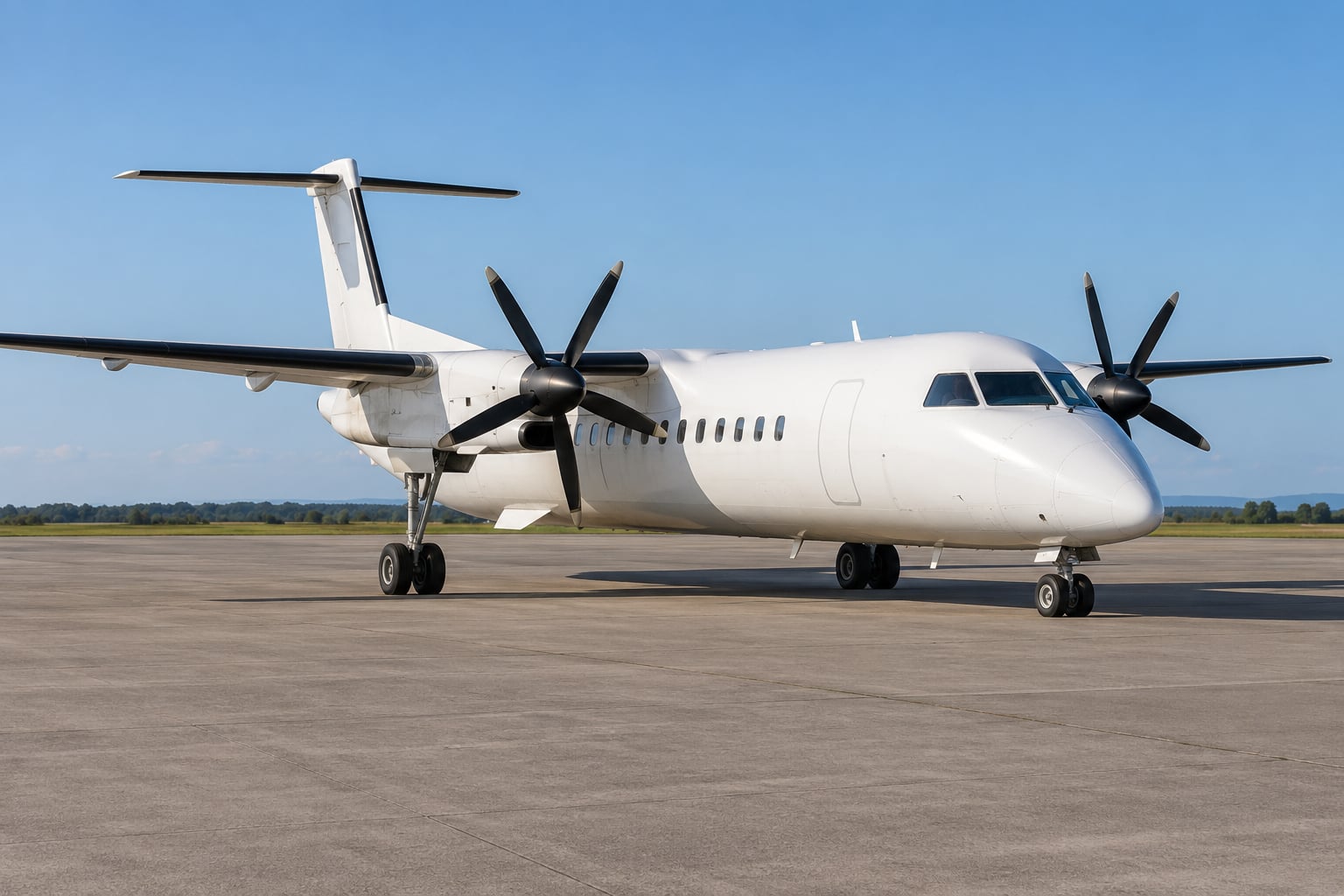
You open the booking and the flight is operated by a smaller airline, or you look out the terminal window and a propeller plane is parked at the gate. Your first thought is that you have been downgraded onto something old and risky. That reaction is common, and it is built on a mix-up: turboprop is a word for an engine, not a description of an aircraft’s size or age.
So, to answer the question directly: what is a turboprop and is it safe? It is an aircraft whose power comes from a modern gas turbine spinning a propeller, and yes, these aircraft are safe to fly on scheduled regional services. Below is how the engine works, where you will meet one, what the accident numbers actually show, and what to do if the word on your boarding pass makes you uneasy.
Last updated: October 2026. Safety figures are dated in the text where they appear, because aviation statistics age quickly and readers should always be able to see which year a number comes from.
Table of Contents
- 1What Is a Turboprop and Is It Safe?
- 2How Does a Turboprop Engine Work?
- 3What Is the Difference Between a Turboprop and a Jet?
- 4Where Are Turboprop Planes Commonly Used?
- 5Are Turboprop Aircraft Safe?
- 6What Safety Features Do Turboprops Have?
- 7Are Older or Small Turboprop Planes Less Safe?
- 8What Do Turboprop Flights Feel Like?
- 9How to Choose a Turboprop Flight
- 10Frequently Asked Questions
- 11Which is safer, a turboprop or a jet?
- 12Are turboprops safer than jets?
- 13Why don’t US airlines fly turboprops?
- 14What are the disadvantages of a turboprop engine?
- 15What is the safest turboprop plane?
- 16Is flying safer than driving?
- 17Conclusion
What Is a Turboprop and Is It Safe?
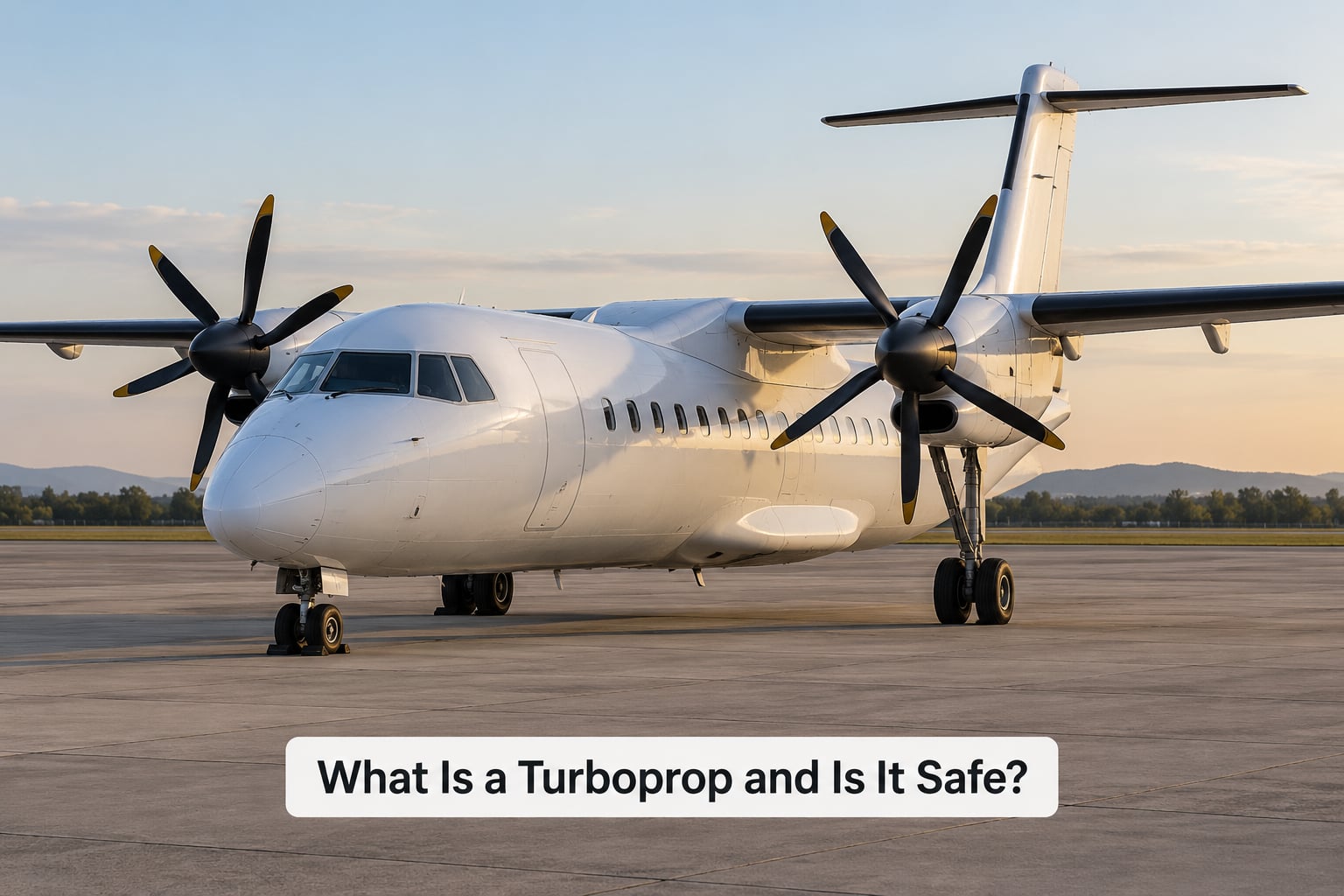
A turboprop is an aircraft powered by a gas turbine engine that drives a propeller through a reduction gearbox, much the way a turbofan drives a fan. Yes, turboprops are safe: they use the same certified turbine technology, maintenance standards and pilot training as jet airliners, and where their accident statistics look worse, the cause is the airports and routes they serve rather than the engine.
Here is the part that surprises people. The same family of engine that turns the propeller on a 19-seat commuter aircraft also turns the propellers on the Airbus A400M military transport and the Lockheed C-130 Hercules cargo plane. The word tells you how thrust is produced, nothing about how big the aircraft is or how old it is.
What people are usually picturing when they feel unsafe is something else entirely: the older piston-engine propeller plane, the kind that bounces and lumbers. That is a different engine type with a genuinely different reliability history. Conflating a piston plane with a turboprop is the single most common error in this conversation, and it drives most of the anxiety.
Regional turboprops you are most likely to be booked on today — the ATR 72, the Dash 8 Q400, the Saab 340 — are the same technology generation as the jets they sit beside on the same airline’s route map.
How Does a Turboprop Engine Work?
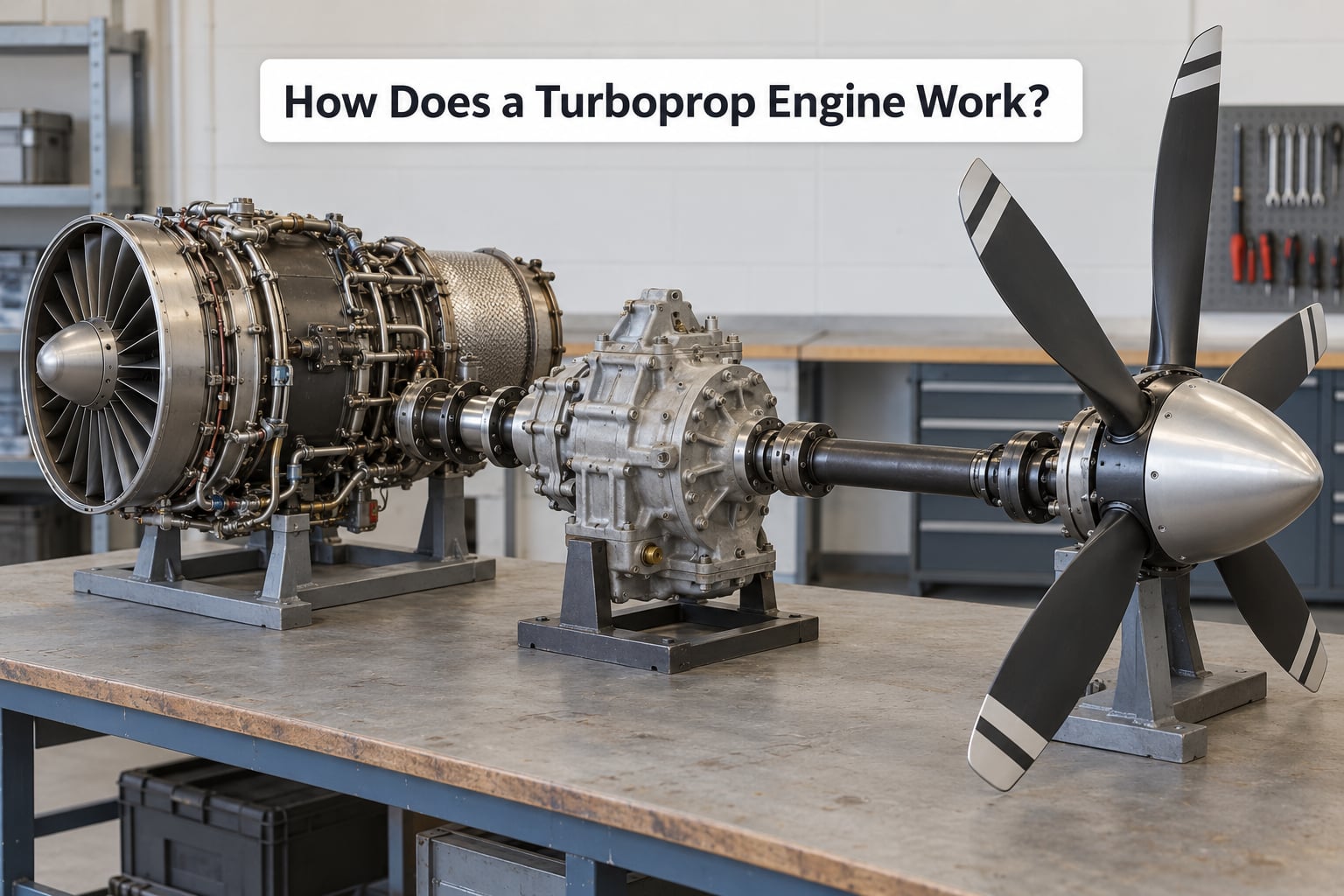
It runs on the same principle as a jet engine, with one difference at the end of the line: instead of pushing hot exhaust backwards to make thrust, the turbine sends its power down a shaft to a propeller.
- Intake. Air is drawn into the front of the engine. What comes in is a mixture of oxygen, nitrogen and whatever the airport is that day.
- Compressor. A stack of spinning blades squeezes that air, raising its pressure and temperature. The compressor is driven by the turbine further back, so it is part of one continuous loop.
- Combustor. A measured spray of jet fuel is ignited and burns continuously. The burning is steady, not explosive — controlled combustion, not an explosion.
- Turbine. The hot gases expand through turbine blades and spin them. Part of that power runs the compressor; the remainder is what actually moves the aircraft.
- Reduction gearbox. A turboprop shaft spins at tens of thousands of revolutions per minute. A propeller needs a few hundred. The gearbox is the piece that turns high speed and low torque into low speed and high torque.
- Propeller. Typically four to six blades, and almost always variable-pitch and constant-speed, meaning the engine’s governor holds a fixed rpm while the blades change angle for takeoff, climb and cruise.
- Feathering. When an engine shuts down or fails, the blades rotate to lie edge-on to the airflow. A feathering propeller presents almost no resistance to the wind, which is the main thing that lets an aircraft with a dead engine keep flying.
Engines come in two layouts. A free-turbine design, such as the widely used Pratt & Whitney Canada PT6, sends gas down a separate exhaust duct and leaves the main shaft to do nothing but drive the propeller. A fixed-shaft design, such as the Honeywell TPE331, routes the exhaust through the power turbine. Free-turbine engines are easier to inspect for hot section damage, which is why a lot of small turboprops use them.
What Is the Difference Between a Turboprop and a Jet?
On safety the two are near equals; on speed, altitude and fuel use they are nothing alike. This is where the physics matters, because it is the part that actually settles the argument for most nervous readers.
- How thrust is made. A turboprop accelerates a large mass of air by a small amount. A turbofan accelerates a smaller mass of air by a large amount. Accelerating a lot of air a little beats accelerating a little air a lot, and that advantage fades as speed climbs.
- Cruise speed. Regional turboprops sit around 250 to 300 knots, with the Dash 8 Q400 at the fast end as the quickest commercial turboprop in service. Regional jets fly roughly 440 to 470 knots.
- Cruise altitude. Turboprops generally cruise between about 15,000 and 25,000 feet. Regional jets climb to 30,000 to 40,000 feet, which is above a lot of weather and is pressurised for the cabin.
- Speed ceiling. Propellers lose efficiency sharply as they approach the speed of sound, so conventional turboprops top out around Mach 0.6 to 0.7. A swept-wing propfan or a rocket-boosted design such as the Russian Tu-95 breaks that pattern, which is why the rule is not absolute.
- Fuel burn. On short sectors, a turboprop per seat commonly uses around 45 percent less fuel than a comparable regional jet. On a 30-minute hop with a small cabin, that difference is the whole business case.
- Runways. Turboprops use less runway to take off and land, which is what makes short, unpaved or mountain strips possible.
- Cabin and noise. Smaller cabin, lower ceiling, more headroom noise from the propellers, and a louder take-off and landing than a jet.
- Route length. Under roughly 400 to 500 kilometres, a turboprop usually wins on cost. Beyond about 1,000 kilometres, a jet’s speed takes over and the turboprop is no longer the sensible choice.
None of that is a safety scale. It is an efficiency and geography scale, and the efficiency advantage is the reason these aircraft are still being built and still being ordered by airlines today.
Where Are Turboprop Planes Commonly Used?
You will find turboprops almost exclusively on short routes into smaller airports, for reasons that have more to do with pavement than with passengers.
- Short domestic and regional services. Three-hour-or-under sectors where the airport is small and the traffic is thin. Widerøe across Norway, Air Baltic across the Baltics, Loganair across Scotland.
- Island networks. Greek and Spanish island services, Caribbean and Pacific hops, where runways are short and weather windows are narrow.
- Mountain airports. Short, steep runways that a regional jet cannot use.
- Remote and bush flying. The de Havilland Canada DHC-6 Twin Otter and the Dornier 328 are built to land on gravel strips and serve small communities with no other link.
- Feeder routes. Short sectors that feed passengers into a regional airline’s hub, which is exactly the role a 50-seat ATR 72 is built for.
Common passenger turboprops include the ATR 72 and ATR 42, the Dash 8 Q400 and Dash 8-300, the Saab 340, the Twin Otter and the Dornier 328. Aegean, Olympic Air, Air New Zealand, Binter Canarias, Contour and Horizon Air all operate them on scheduled services. In North America, passenger turboprop service has largely disappeared from the trunk routes and persists at the edges, which is why the question comes up so often for European and Asian travellers booking connections in the US.
Are Turboprop Aircraft Safe?
Yes. Scheduled turboprop operations run under the same regulatory regime as jets, with the same airworthiness standards, the same maintenance programme structure and the same pilot training requirements. The part worth being straight about is that turboprop accident rates are higher than mainline jet rates in the aggregate, and pretending otherwise loses trust. The useful part is knowing where that gap comes from.
IATA’s annual safety report for 2023 recorded 30 accidents across jet and turboprop operations combined, roughly one accident per 1.26 million flights. The only fatal turboprop accident that year was a Yeti Airlines ATR 72 in Nepal, which the reporting attributed to human factors rather than to the aircraft or its engines. Figures age, so treat that as a dated data point rather than a live count.
The Australian Transport Safety Bureau’s turboprop reliability study, covering 2012 to 2016, recorded 417 occurrences — about 83 a year, or 2.2 events per 10,000 flight hours. It rated 96 percent of those occurrences as low risk. Of three events it classified as high risk, all three were single-engine Cessna 208 Caravans, not twin-engine airliners.
What actually drives risk on any flight is the operator’s record, the maintenance programme and how it is executed, the airport, the runway, the weather, the route and the regulatory oversight in that country. On routes where turboprops accumulate a worse record than jets, the pattern that shows up is short or poorly maintained runways, limited airport fire and rescue capability, remote terrain and thinner regulatory enforcement. Propulsion type is not the variable doing the work.
What Safety Features Do Turboprops Have?
The equipment itself is not where the reassurance comes from. It is in the systems around it.
- Feathering propellers. A failed engine’s blades turn edge-on to the airflow, so the aircraft keeps flying with far less drag and can climb away or land on one engine.
- Constant-speed, variable-pitch propellers. The governor holds a chosen engine speed automatically, so the pilot is managing thrust rather than a needle that climbs and falls.
- De-icing systems. Modern turboprops carry electric propeller heat and wing and tail de-ice boots. Icing is the one genuinely turboprop-specific technical hazard, since propellers can shed ice that then strikes the airframe — which is why certified anti-ice is standard on passenger types, and why SKYbrary treats turboprop airframe icing as a dedicated briefing topic.
- Engine redundancy on airliner types. Every passenger turboprop on a scheduled airline is a twin. A single-engine turboprop is a bush plane, a charter aircraft or a trainer, not a scheduled airliner.
- Standard airliner equipment. Pressurisation, oxygen, transponders, weather radar, terrain awareness, cabin emergency equipment and crew training are the same systems you would find on a regional jet.
- Ground discipline. Propeller aircraft get firm training around prop clearance and brake use during taxi. It is a specific hazard that a propeller creates and a jet does not, and airlines drill it for that reason.
Are Older or Small Turboprop Planes Less Safe?
Not on account of being small or old. Aircraft age correlates weakly with safety once airworthiness is enforced, and the two things readers usually mean by “small” carry very different risk.
The real distinction is single-engine against twin-engine. Nearly every fear-of-flying story about turboprops traces back to a mental image of a small aircraft with one engine and a bush plane, and that configuration does carry more risk — which is exactly why the ATSB’s high-risk cases were all single-engine aircraft. Scheduled airliner turboprops are not that aircraft. They have two engines, they are flown by airline crews, and they are held to airline maintenance programmes.
What does affect the risk is the operator’s history, whether maintenance is done on schedule and to standard, whether the aircraft is configured for the operation (over-water equipment, cabin pressurisation, weather radar), and whether the flight is scheduled or charter. A cargo charter in a remote region and a scheduled regional service to a capital airport are not the same risk category, and treating them as one is where most of the confusion lives.
What Do Turboprop Flights Feel Like?
If the word on the itinerary unsettles you, the sensory side is usually the part that actually lands, so it is worth setting expectations honestly.
Noise. The take-off roll is loud. That is airflow across large blades and the pitch change through the climb, not anything wrong. In cruise the cabin is quieter than a jet but lower pitched, and you will hear the propellers as a constant rhythmic sound rather than a jet’s whine.
Bumps. Turboprops cruise lower, around 15,000 to 25,000 feet instead of 30,000 to 40,000, and they fly slower. Both mean you encounter more of the air’s movement. The bumps are felt more, not because the flight is more dangerous but because the aircraft has less energy stored in it to absorb them, and because the air below the jet’s cruise level is less settled.
Descent. A turboprop comes down steeply and slowly, and passengers often describe it as an elevator rather than a fall. A poster on a fear-of-flying forum, describing a connection out of a small regional airport, wrote that steep descents felt like going down in an elevator and that the flight was perfectly fine — which matches what most people report afterwards.
Cabin and baggage. Smaller windows, a lower ceiling, sometimes a single class rather than separate classes, and tighter carry-on and checked-baggage allowances than a mainline jet. Boarding is often by stair rather than jet bridge, which is also why connections can be tighter on time.
Pilots themselves tend to end up on these aircraft early. A regional airline pilot quoted on the SOAR Fear of Flying forum, with several thousand turboprop flight hours, pointed out that a turboprop delivers power instantly and in quantity while a jet’s power arrives with a lag, which is why regional pilots start on turboprops and jets are considered the harder handling. Airframe, the same pilot told the forum, has nothing to do with the size of the aeroplane.
How to Choose a Turboprop Flight
If you would rather avoid the turboprop or you simply want to know what you are booking, these are the checks that actually get you an answer.
- Check the operating carrier, not the ticket brand. Codeshares hide which airline flies the sector. Look for the operator’s name, then read its safety record and regulatory oversight in that country.
- Check the route, not the equipment. Remote or short-runway destinations are the routes where turboprops are unavoidable. On those, choose the operator with the best record rather than avoiding the aircraft type.
- Ask the airline about the aircraft. Most regional operators will confirm the type for a specific flight, and it can change on the day, so ask close to departure.
- Watch your connection time. Small turboprops often arrive between bigger hubs, and a 30-minute connection at a regional airport is tight. Build in more slack than you would at a major hub.
- Check baggage rules and cabin layout. Regional cabins are smaller and baggage allowances are frequently tighter than the marketing airline’s mainline fleet.
- Build in weather reality. Small airports can close or divert in conditions that a large hub would absorb, so leave room the night before an onward connection.
And if it is anxiety rather than logistics: pick a window seat, bring earplugs, tell a flight attendant you are a nervous flyer, and remind yourself that the aircraft type is a certified turbine airliner operated by an airline that has to answer to a regulator. Plenty of nervous passengers have flown these aircraft and reported back that the reality was quieter and steadier than the word suggested.
Frequently Asked Questions
Which is safer, a turboprop or a jet?
On comparable scheduled routes, a well-operated turboprop is not meaningfully less safe than a regional jet. Both use certified gas-turbine engines, airline maintenance programmes and the same regulatory oversight. Where turboprop accident statistics look worse, the difference traces to runway condition, airport facilities and local enforcement, not to propulsion type.
Are turboprops safer than jets?
No. Turboprops as a category are not safer than jets. They carry a somewhat higher accident rate in the aggregate, largely because they serve smaller and more remote airports. The important question is not the engine type but the operator’s record, the airport and the route.
Why don’t US airlines fly turboprops?
They largely stopped, and mostly on the trunk routes where traffic and airports are dense enough for regional jets to pay off. Turboprops still run in North America on short routes to small and remote airports, where their short-field performance and lower fuel burn make them the sensible aircraft. Europe, Asia and Oceania use them far more widely.
What are the disadvantages of a turboprop engine?
Slower cruise, a lower ceiling than a jet, more noise in the cabin and on the climb, and a smaller cabin with tighter baggage allowances. The engineering limit is the propeller, which loses efficiency as it approaches the speed of sound, capping conventional designs around Mach 0.6 to 0.7. Airframe icing is the one hazard specific to propeller aircraft.
What is the safest turboprop plane?
There is no meaningful single answer, because the same model is flown by careful and careless operators. If you want a type to look for, the widely used ATR 72, Dash 8 Q400 and Saab 340 are all modern twin-engine airliner turboprops. The operator’s safety record and the airport it serves matter more than the model.
Is flying safer than driving?
By a wide margin. IATA’s 2023 annual safety report put the global rate at roughly one accident per 1.26 million flights, while road fatality statistics are orders of magnitude worse per journey. The comparison is not exact, because a flight and a car trip cover different distances, but the direction is not in doubt.
Conclusion
A turboprop is a modern gas turbine engine driving a propeller, and scheduled turboprop aircraft are safe to fly. The word describes the powerplant, not a small or ageing aeroplane, and that single distinction resolves most of the worry it creates.
What is worth checking, in order, is the operating airline’s safety record, the airport and route the aircraft serves, and the operator’s maintenance and training standards. Propulsion type comes well down that list. Where turboprops have accumulated a worse accident record than jets, the pattern points at runway conditions, airport facilities and regional enforcement rather than at the engine that makes the noise outside your window.
If a turboprop is on your itinerary, book it knowing what to expect: a louder take-off, a lower and sometimes bumpier cruise, a small cabin, and a very ordinary descent. Then get on board.