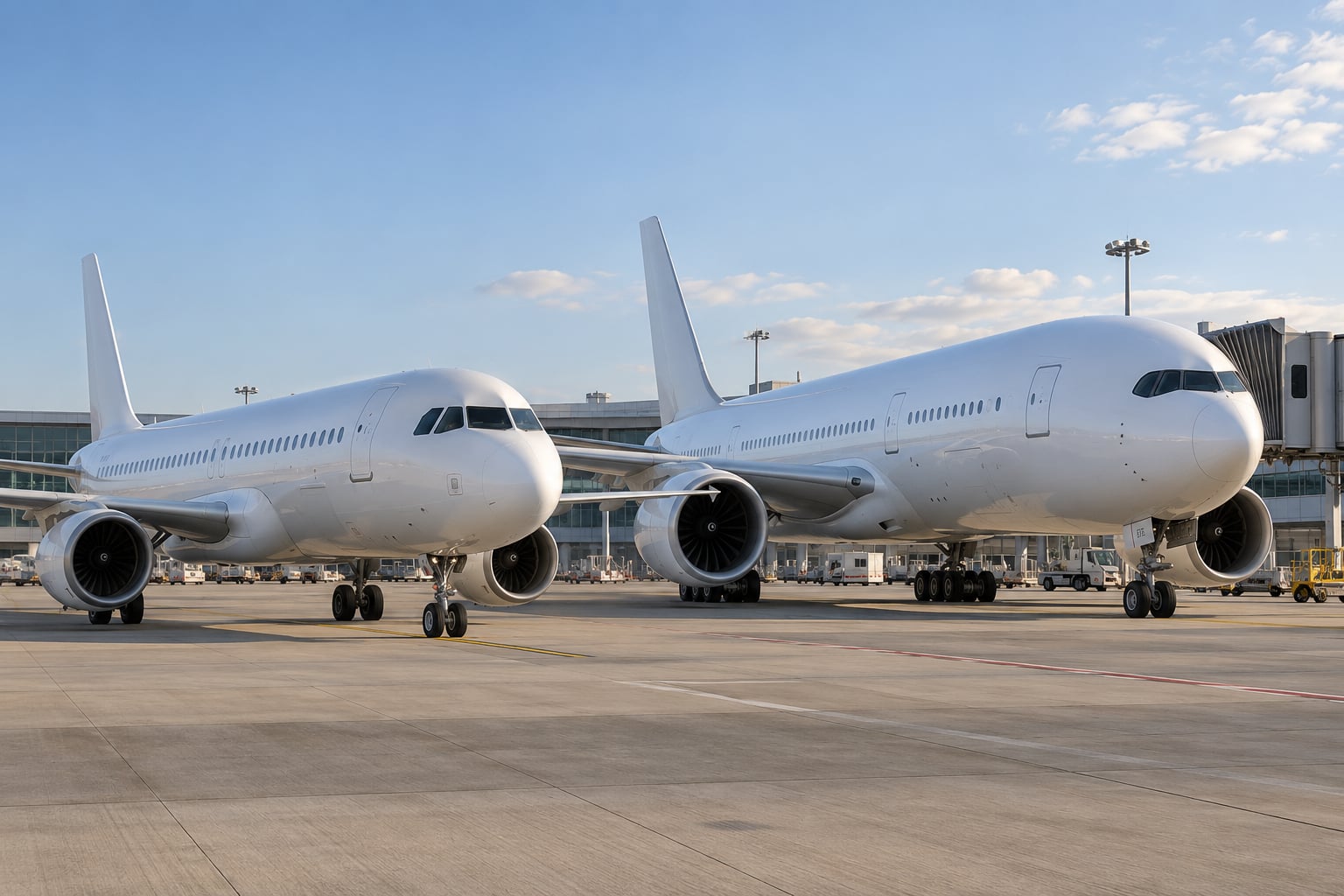
If you have ever looked at a booking screen and wondered whether you are about to fly a cramped tube or a roomy cabin, the answer comes down to one number: the width of the fuselage. A narrow-body aircraft has a single aisle in a fuselage roughly 3 to 4 metres wide, while a wide-body aircraft has two aisles in a fuselage roughly 5 to 7 metres wide. Almost everything else, from seats per row to range to fuel burn, follows from that diameter.
The jargon trips people up constantly, so this guide is written from the seat rather than the flight deck. You will find out how to tell the two apart from the apron, why an eight-hour hop to Boston might get you a narrow-body, and which layout to pick when you have a choice. Updated for 2026, and still accurate even as fleets keep shrinking.
Table of Contents
- 1What Is the Difference Between a Wide Body and Narrow Body Aircraft at a Glance?
- 2How Aircraft Size Changes the Passenger Experience
- 3What the difference between wide-body and narrow-body seating feels like in the cabin
- 4Why Wide-Body Aircraft Are Used for Long-Haul Flights
- 5How Narrow-Body Aircraft Are Used for Short- and Medium-Haul Flights
- 6Cargo Capacity and Airline Operations
- 7Wide Body vs Narrow Body: Cost, Comfort, and Efficiency
- 8Examples of Wide-Body and Narrow-Body Aircraft
- 9Which Should You Choose?
- 10Frequently Asked Questions
- 11Is a Boeing 737 a wide-body or narrow-body aircraft?
- 12Does every wide-body aircraft have two aisles?
- 13Which type of aircraft is more fuel efficient?
- 14Can a narrow-body aircraft operate on a long-haul route?
- 15Are wide-body and narrow-body classifications based only on wingspan?
- 16Conclusion: Start With the Route and Cabin Layout
What Is the Difference Between a Wide Body and Narrow Body Aircraft at a Glance?
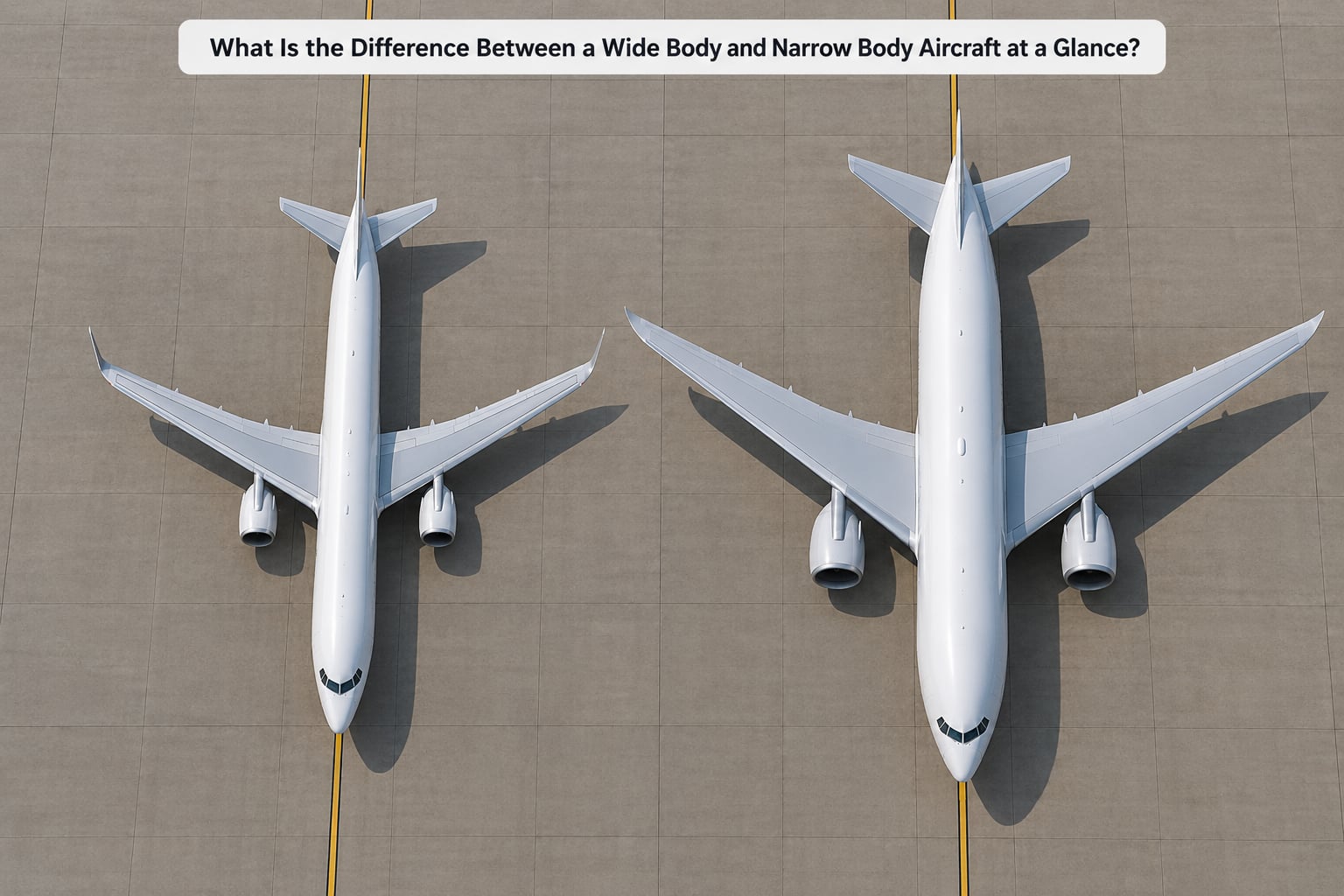
This is the whole difference in one table. The names come from the fuselage, not the wings, and everything below the width line is a consequence of it.
| Feature | Narrow-body (single-aisle) | Wide-body (twin-aisle) |
|---|---|---|
| Number of aisles | One | Two |
| Fuselage diameter | About 3.6 to 3.95 m (10 to 13 ft) | About 5.4 to 7.1 m (16 to 23 ft) |
| Seats per row | 3 to 6 | 7 to 11 |
| Common layouts | 3-3, 2-3, 2-2 | 3-4-3, 3-3-3, 2-4-2 |
| Typical cabin capacity | 100 to 240 passengers | 250 to 550 passengers |
| Typical range | 3,000 to 7,400 km depending on variant | 8,000 to 15,000 km |
| Engine thrust class | About 20,000 to 33,000 lbf | About 71,000 to 115,000 lbf |
| Typical routes | Domestic, regional, many transatlantic | Transoceanic, dense long-haul |
| Operating role | High-frequency, right-sized to demand | Concentration of seats on busy long routes |
| Comfort profile | Narrow seats, one aisle, quicker boarding | Wider seats, two aisles, premium cabins, some lie-flat |
| Cost efficiency | Lower fuel per seat on short sectors | Lower fuel per seat only when the cabin fills |
| Examples | Boeing 737, Airbus A320, A321neo, 737 MAX | Boeing 777, 787, Airbus A330, A350, A380 |
Two quick answers while we are here, because these come up constantly. The Boeing 777 is a wide-body. The Boeing 747 is a wide-body too, and always was, hump and all.
How Aircraft Size Changes the Passenger Experience
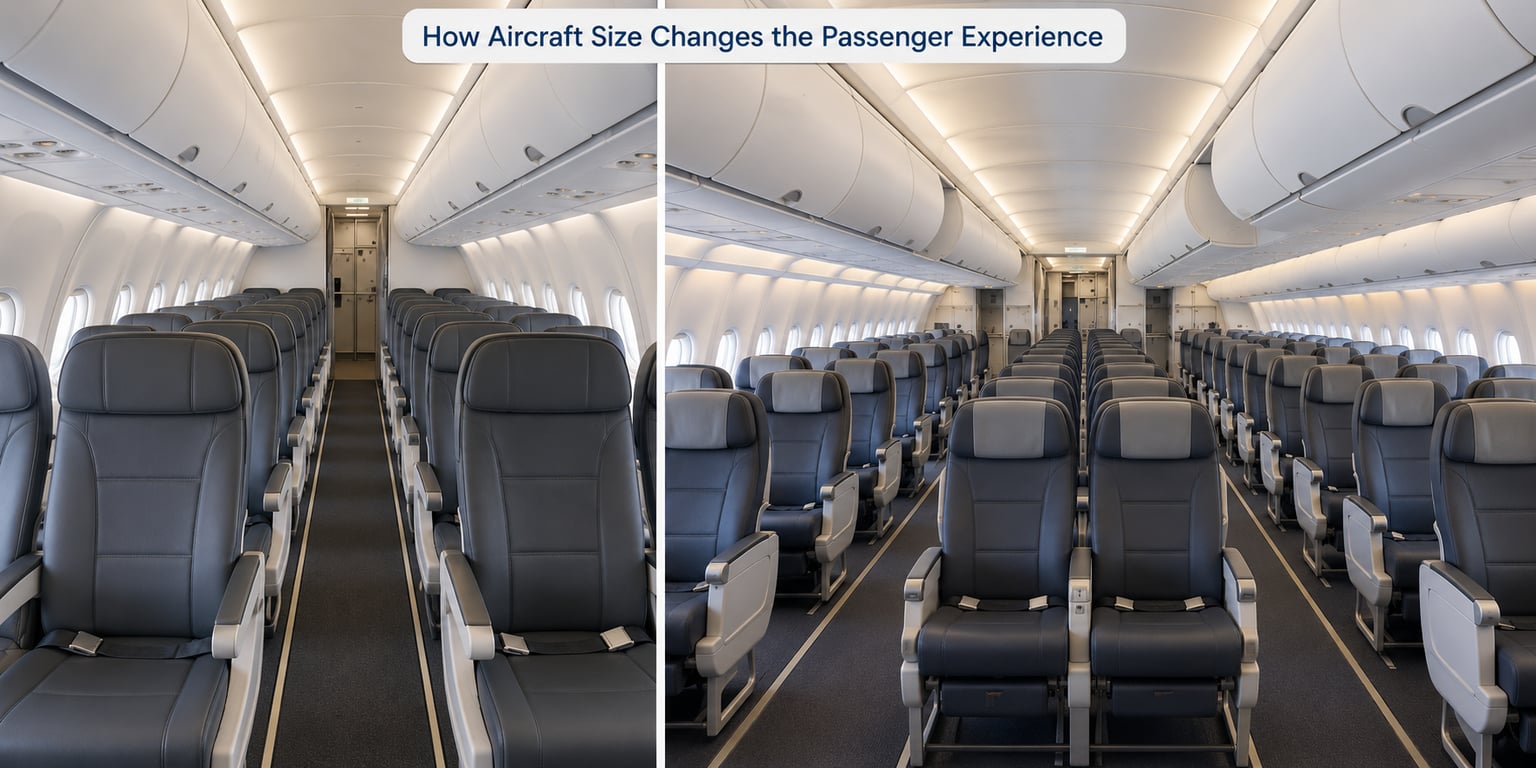
What the difference between wide-body and narrow-body seating feels like in the cabin
On a narrow-body, the standard economy layout is 3-3. You sit in a three-seat block on each side of a single aisle, and the person in the middle has to climb over two strangers to reach the window or the lavatory. Seat widths commonly run in the region of 17 to 18 inches, and on the 737 in particular passengers complain about thin padding and short pitch.
A wide-body cabin splits into three or four blocks, so the usual patterns are 3-4-3 or 2-4-2. The two middle blocks get their own aisle, which cuts walking time across the cabin, and the outer blocks get windows without a climb over anybody. Seat width in a standard wide-body economy cabin is usually a couple of inches more per seat than on a narrow-body, and the cabin ceiling is higher.
Overhead bins scale with the fuselage. A narrow-body bin takes a cabin bag and a bit of overhead; a wide-body bin is deep enough for a larger case laid flat, which is why the carry-on rules look different on a Boeing 777 than on an A320.
Boarding is where the size difference becomes time. A single-aisle cabin fills from the front door in one flow, so everyone is seated roughly in order. A twin-aisle cabin loads through two doors at once, but the service carts and the lavatory queues down the middle block can slow down the walk back, and on a full wide-body flight the deplaning can take noticeably longer.
Cabin crew ratios are denser on a narrow-body, with roughly one flight attendant per 6 passengers, against about 5 on a wide-body. On a 3-3 layout the single aisle also means crew and passengers compete for the same walkway during service, which is the cabin congestion regular flyers complain about most.
Premium product is the clearest passenger-facing difference. A wide-body is where premium economy, business class and, on some airlines, lie-flat seats exist at all. A narrow-body long-haul flight usually means one cabin, and at best a blocked middle seat for a lie-flat lie-down on a much shorter route.
Why Wide-Body Aircraft Are Used for Long-Haul Flights
Range follows from capacity, and capacity follows from width. A wide-body carries two to three times the passengers of a narrow-body, so it can carry far more fuel for the same number of departures, and that is what lets it stay airborne for 8,000 to 15,000 km instead of a few thousand.
On transoceanic routes, that extra reach is the point. A narrow-body would need a stop, and a stop on a 15-hour itinerary is three hours you spend on the ground twice. Airlines solve the long-haul problem with gauge, and the A350-1000, 777-300ER and 787-9 are all built around 8,000-plus km of range and a two-class or three-class cabin.
Wider cabins also absorb long hours better. Ceiling height, seat width and the option of a lie-flat bed matter far more at hour nine than at hour two, and premium cabins let airlines charge a premium for a flat bed. That revenue is a large part of the economics of flying a big metal tube across an ocean.
Wide-bodies also concentrate seats. On a dense business route, one 400-seat 787-900 can be replaced by two or three 180-seat narrow-bodies, which means more takeoffs, more gate time and more runway demand at the busiest airports. Where demand justifies it, the big aircraft is the simpler operation.
Newer wide-bodies are also the greener option per seat on a long sector. A twin-aisle composite airliner burning one large engine is more efficient per passenger-kilometre than two smaller narrow-bodies flying the same route and time.
How Narrow-Body Aircraft Are Used for Short- and Medium-Haul Flights
A single aisle is the right shape for a lot of flying. Domestic hops, feeder routes and regional services in Europe or Asia rarely need more than a few hours of air time, and a narrow-body gets the aircraft back on the ground sooner so it can fly three or four more sectors a day.
That frequency is the real reason narrow-bodies dominate. Airlines have thousands of them because each one can turn around in 30 to 45 minutes, and the daily departure list at a mid-sized airport is mostly narrow-body rotations. Wide-bodies are the exception, not the rule.
Airport infrastructure is the other reason. Twin-aisle aircraft need longer runways, taller gates, bigger jet bridges and stronger pavement, which rules out hundreds of smaller regional airports. A narrow-body can use a 2,000-metre strip and a single boarding bridge, which is why they serve places a 777 never could.
Demand matching is the quiet reason. A short route between two regional cities might only fill 90 seats a day. Putting a 350-seat wide-body on it wastes fuel, parking space and crew, so airlines size the aircraft to the route.
The line is blurring at the top end. The A321LR and 737 MAX stretch far enough for several transatlantic routes, and plenty of carriers now sell multi-hour transatlantic sectors on a single-aisle aircraft. For a traveller, that means an eight-hour flight in a 3-3 cabin is a real possibility, with no lie-flat seat and a thinner seat cushion.
Cargo Capacity and Airline Operations
Everything below the floor is hold cargo, and a wide-body has a proportionally enormous belly. A 777-300ER can carry well over 30 tonnes of freight in its holds, several times what a full A320 can take, which is why cargo airlines and passenger airlines with strong freight demand both like big twin-aisle aircraft.
Belly cargo is the quiet revenue line that makes long-haul economics work at all. On a transatlantic flight, freight in the hold can offset a real share of the operating cost, so the aircraft that carries the most passengers also carries the most freight, and losing the belly means losing that income.
Fleet flexibility cuts the other way. A narrow-body can be swapped between a trunk route, a feeder and a seasonal charter in a single season. A wide-body assignment is a much heavier commitment, and a single downturn on one long route hits a big aircraft harder.
Route economics drive the choice. On a thin long-haul route with weak demand, a wide-body burns fuel carrying empty seats. On a busy short route where the aircraft fills every time, a narrow-body flying twice as often can be both cheaper and more profitable.
Wide Body vs Narrow Body: Cost, Comfort, and Efficiency
The bigger aircraft is not automatically cheaper, more comfortable or greener. Each of those depends on how full the plane is and how long it is in the air.
On operating cost per seat, a narrow-body wins on short sectors because the fuel is divided across fewer hours of flying. On a long sector, the wide-body pulls ahead, because the cost of carrying that fuel is spread over a much longer revenue flight.
Emissions per passenger-kilometre tell the same story. Industry figures for transatlantic services put an A321LR Neo at roughly 57 to 72 g of CO2 per passenger-kilometre, against roughly 74 to 105 g for an A350-1000, 787-9 or 777-300ER. The narrow-body is lighter on a thin route, the wide-body is lighter per seat when the cabin is full.
Comfort is not a size ranking either. A 3-3 narrow-body with 20-inch pitch on a short hop can beat a dense 3-4-3 wide-body on a long sector, and passengers on aviation forums make exactly that argument: a nonstop in a narrow-body usually beats a connection in a wide-body when the seats are acceptable. What the wide-body adds is choice, since a second aisle, more headroom and a real premium cabin are on offer. What it does not add is space, since some operators pack ten seats abreast in a 777.
Layout is an airline decision, not just an aircraft trait. The same 777-300ER can be flown 3-4-3 by one carrier and 3-3 by another, and the middle seat nobody wants exists in one and not the other. If seat comfort matters, check the seat map rather than assuming from the aircraft type.
Examples of Wide-Body and Narrow-Body Aircraft
The convention is simple: most twin-aisle jets are called wide-body aircraft, and most single-aisle jets are called narrow-body aircraft. The table below places the common types, including two that have left passenger service.
| Aircraft | Classification | Typical layout | Typical capacity |
|---|---|---|---|
| Boeing 737-800 / 737 MAX | Narrow-body | 3-3 | 160 to 189 |
| Airbus A320neo / A321neo | Narrow-body | 3-3 | 150 to 220 |
| Airbus A321LR (long-range narrow-body) | Narrow-body | 3-3 | 150 to 200 |
| Embraer E175 / CRJ900 (regional jet) | Smaller single-aisle | 2-2 | 76 to 90 |
| Boeing 777-300ER | Wide-body | 3-4-3 or 3-3 | 300 to 396 |
| Boeing 787-9 Dreamliner | Wide-body | 3-3-3 | 250 to 296 |
| Airbus A330-300 | Wide-body | 2-4-2 | 257 to 440 |
| Airbus A350-1000 | Wide-body | 3-4-3 | 300 to 410 |
| Boeing 747-8 (retired from passenger service) | Wide-body, part double-deck | 3-4-3 | 410 to 467 |
| Airbus A380 (retired from service) | Wide-body, full double-deck | 3-4-3 | about 555 typical, 853 max |
Regional jets sit just below the narrow-body category. An E175 or CRJ900 is a single-aisle aircraft with a 2-2 layout and around 80 seats, so most people call them small narrow-bodies, but at a domestic terminal you will often see them treated as a separate tier.
Two aircraft that the older web pages still present as current are not. The 747 and the A380 have both finished their passenger careers, which is a useful reminder that a fleet category is a moving target. The trim, the layout and even the classification of a given type can change over a model’s life.
Which Should You Choose?
Choose by trip type, not by the size of the metal.
For a short or medium haul, a narrow-body is usually the right pick. A two-hour hop has nowhere to use a second aisle, a premium cabin or a lie-flat bed, and a single aisle usually means a faster boarding and a walk straight to the gate. If the same route is served several times a day, the narrow-body options are often more frequent, which is worth more than cabin size when you are trying to get somewhere.
For a long-haul trip, a wide-body gives you more: a second aisle to walk down, a higher ceiling, wider seats, a premium cabin and a real bed on some airlines. That is worth having at hour eight. The exception is a nonstop narrow-body on a thin route, which beats a connection in a wide-body every time for most people.
If you want to be deliberate about it, check three things in this order: the seat map for your exact flight, the cabin layout (3-3 or 3-4-3, and the middle seat question), and whether a nonstop exists at a time you can use. The aircraft type is a useful hint, but the seat map is what you actually sit in.
Frequently Asked Questions
Is a Boeing 737 a wide-body or narrow-body aircraft?
The Boeing 737 is a narrow-body, or single-aisle, aircraft. Its fuselage is about 3.76 m wide, it has one aisle, and the standard economy layout is 3-3, giving six seats per row. Typical capacity runs from roughly 150 to 189 passengers depending on the variant, and a full 737 MAX is rated for well under 7,000 km. The 737-800 and the 737 MAX both fall on the narrow-body side of the line.
Does every wide-body aircraft have two aisles?
Almost. A twin-aisle wide-body has two aisles for most of the cabin, and superjumbo designs such as the A380 add a third. The Boeing 747 is the awkward one: the main deck is twin-aisle, but the hump upstairs is a single narrow aisle, which is why the upper deck feels like a regional cabin bolted to a wide-body. Definitions that count aisles still class the 747 as wide-body.
Which type of aircraft is more fuel efficient?
It depends on the sector. A narrow-body burns less total fuel and gives better fuel per seat on short routes, and a tight narrow-body can beat a wide-body on emissions per passenger-kilometre when demand is thin. On a long sector with a full cabin, the wide-body usually wins, because one big engine burning for twelve hours costs less per seat than two smaller aircraft flying the same distance. Empty wide-body seats reverse that result entirely.
Can a narrow-body aircraft operate on a long-haul route?
Yes, and more often than most people expect. The Airbus A321LR and the Boeing 737 MAX have enough range for several transatlantic routes, and low-cost carriers now sell multi-hour nonstop services on single-aisle aircraft. The trade-off is the cabin: a 3-3 layout in a single class, no lie-flat beds, and no premium economy. Several airlines treat these as their flagship transatlantic offering.
Are wide-body and narrow-body classifications based only on wingspan?
No. The classification follows the fuselage diameter, not the wingspan. A narrow-body fuselage is roughly 3 to 4 m across and a wide-body roughly 5 to 7 m, and the aisle count follows from that diameter. Wingspan matters for other reasons, such as runway requirements and airport gates, but it plays no part in deciding which category an airliner belongs to.
Conclusion: Start With the Route and Cabin Layout
Wide body versus narrow body comes down to fuselage width: one aisle in a 3 to 4 m tube or two aisles in a 5 to 7 m one, and every other difference flows from that. Narrow-bodies win on short routes, on thin long-haul sectors and on frequency. Wide-bodies win on long journeys, on busy transoceanic routes and on anything where a premium cabin or a real bed matters.
Before you book, check the nonstop options and the seat map for your exact flight. The layout decides your middle seat, and the layout is the airline’s choice, not just the aircraft’s. That is where the answer actually is.