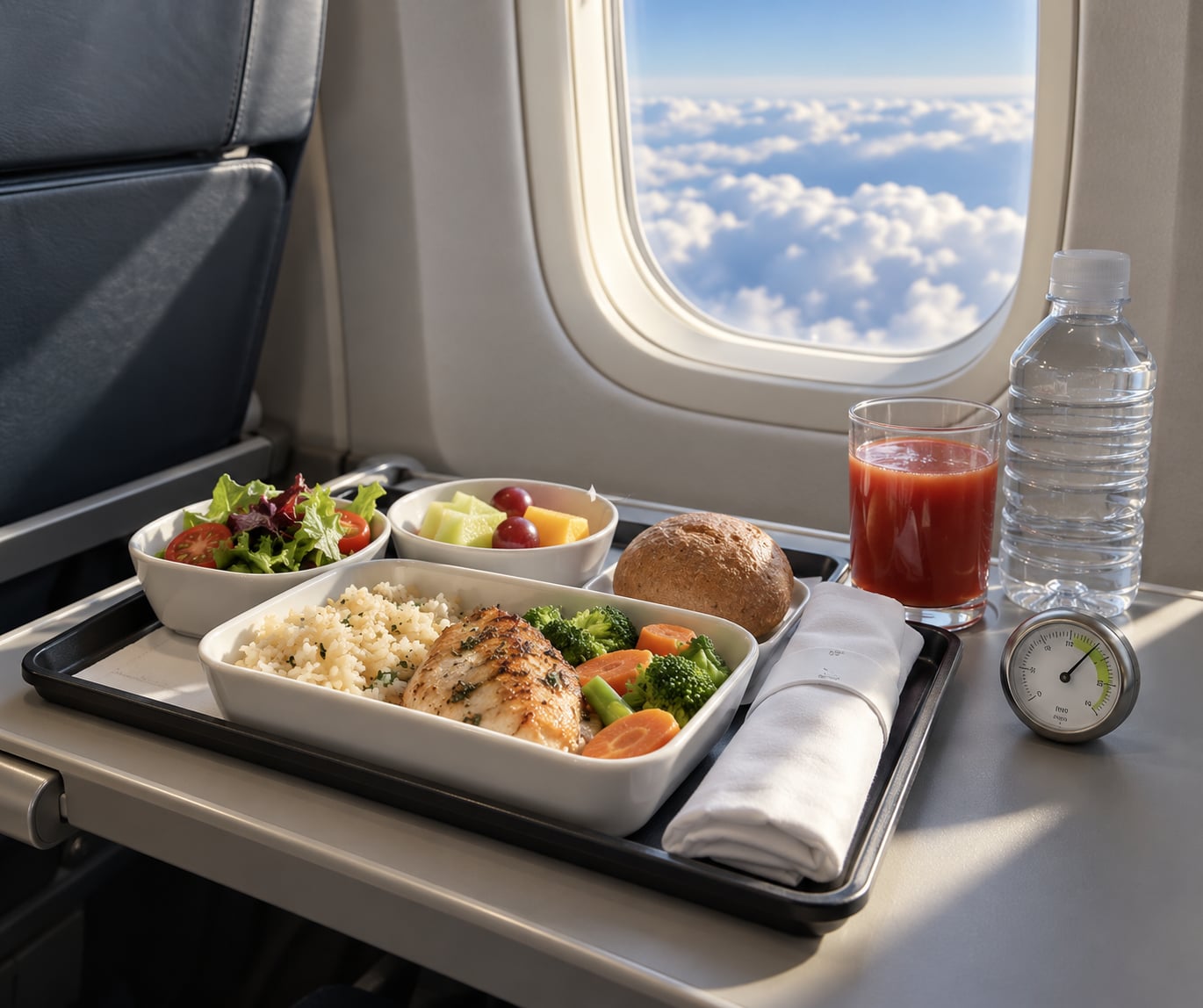
I have eaten the same sandwich on a tray at 35,000 feet and at a kitchen table, and the difference is not imaginary. Why does food taste different on airplanes? Because the meal barely changes while your ability to perceive it does. The cabin is dry, pressurized and loud, and the food itself is cooked hours earlier on the ground. Those three things stack up, and no amount of seasoning fully compensates.
Table of Contents
- 1Why Does Food Taste Different on Airplanes?
- 2How Cabin Pressure Changes Taste and Smell
- 3Does it get worse on longer flights?
- 4Why does food taste different on airplanes when humidity is not the culprit?
- 5What Low Humidity Does to Food
- 6Why Airline Meals Can Seem Bland or Unusual
- 7How Food Texture and Temperature Change the Experience
- 8Simple Ways to Make Airplane Food Taste Better
- 9Can You Improve Your Taste Before and During a Flight?
- 10Frequently Asked Questions
- 11Does altitude change your taste buds?
- 12Why do sweet drinks and salty foods taste different on a plane?
- 13Is dehydration the main reason food tastes bland on airplanes?
- 14Which airplane foods usually taste the best?
- 15Does airplane cabin pressure permanently change your sense of taste?
- 16Conclusion
Why Does Food Taste Different on Airplanes?
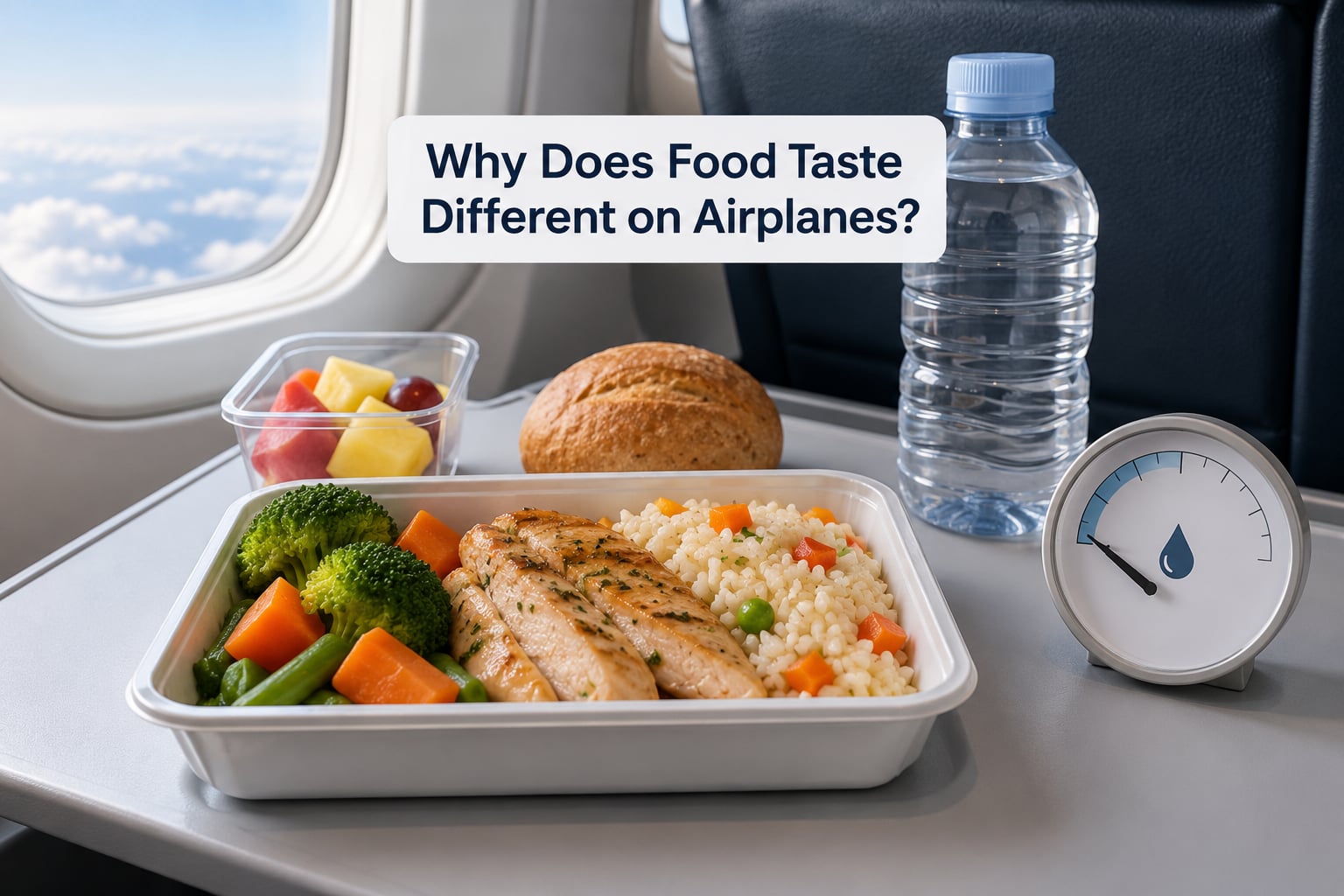
Food tastes different on a plane mainly because of the cabin, not the meal. Low cabin pressure and humidity reduce your sense of smell and dull sweet and salty taste, while engine noise, motion and background odors make familiar dishes seem blander or just odd.
The short version breaks into four parts:
- Low humidity: cabin air holds roughly 10-20 percent relative humidity, which dries the lining of your nose and mouth.
- Low cabin pressure: the cabin is pressurized to something like 6,000-8,000 feet while the aircraft cruises far higher, and oxygen partial pressure drops with it.
- Loud noise: engine and airflow noise sits around 85 decibels, a level that measurably weakens sweet and salty perception.
- Food preparation: most meals are cooked, blast-chilled, stored and reheated hours before you touch them, often with extra seasoning added to compensate.
It is worth saying plainly that the food is not being sabotaged by altitude. The chicken is the same chicken. Your palate is just working with degraded inputs.
How Cabin Pressure Changes Taste and Smell
Cabin pressure changes flavor mostly by weakening your sense of smell, because smell supplies most of what people call taste. A pressurized cabin is set to mimic roughly 6,000-8,000 feet of altitude, not the 33,000-35,000 feet the plane is actually flying at, which limits how dramatic the pressure effect is.
Taste and smell are separate systems that meet in the brain. Your tongue registers basic tastes — sweet, salty, sour, bitter and umami — while odor molecules released into the back of the mouth add the detail that turns “salty” into “salty chicken with rosemary.” When odor detection weakens, everything narrows toward its basic taste, and dishes start to taste flatter than they should.
Researchers at the Fraunhofer Institute wanted to separate these variables rather than guess, so in 2011 they suspended a model of an aircraft cabin inside a low-pressure chamber and varied temperature, humidity and pressure independently. Their finding was the useful one: the drying effect of low humidity did far more damage to perceived flavor than reduced pressure did on its own.
Lower partial oxygen pressure plays a smaller role than most people assume. You are not hypoxic on a routine flight, and pilots who work these cabins full-time do not report permanently dulled taste. If you ever do feel unwell, breathless or have a persistent headache at altitude, treat that as a medical matter and talk to a doctor, not as a flavor problem.
Ground and cabin conditions are easy to compare, and the gaps are wide enough to explain most of what passengers notice:
| Condition | On the ground | In a cruising cabin |
|---|---|---|
| Relative humidity | Typically 30-60 percent indoors or outdoors | Roughly 10-20 percent |
| Equivalent altitude | Sea level | About 6,000-8,000 feet |
| Cruising height | Not applicable | Often 33,000-35,000 feet |
| Background noise | Quiet room, roughly 40-50 dB | Engine and airflow, around 85 dB |
| Sweet and salty sensitivity | Baseline | Reduced by up to about 30 percent under cabin-like conditions |
| Umami and spice | Baseline | Largely unchanged |
One caution about the oft-repeated figure that you lose around 30 percent of your taste on a plane. That number comes from trials carried out under cabin-like humidity, pressure and noise, and it refers specifically to sensitivity to sweet and salty tastes. It is not a general 30 percent loss across every sense and every flavour, and the effect reverses quickly after landing.
Does it get worse on longer flights?
Yes, mostly because of exposure time rather than height. The cabin condition itself is roughly constant from the moment the doors close, so what compounds on a long-haul route is dryness in your nose and mouth and the number of holding hours a tray has already spent in a warm cart.
That means a short-haul passenger eats a meal closer to fresh and has spent less time in dry air. A long-haul passenger eats a meal that has been reheated at the far end of a long trip, on a palate that has been drying out for six hours. Forum regulars describe the difference as real and easy to feel once you have taken both kinds of flight.
Longer flights do bring one advantage: more time to hydrate, and more options to eat in two smaller servings rather than one sitting. Passengers who split a long-haul meal into two parts, with water between them, generally report a better experience than those who force the whole tray down at once.
Why does food taste different on airplanes when humidity is not the culprit?
Humidity is the biggest factor, but three more change what you taste. Constant noise, motion, fast service and the unfamiliar setting all shift your judgment, and so do expectations you bring from previous flights.
Noise. A 2015 study from the Cornell University Food and Brand Lab looked at what low-frequency vibration and sustained cabin noise do to flavour perception. Sustained loud sound measurably reduced participants’ sensitivity to sweet and salty, while umami and spice were left alone. Researchers at the lab even suggested tasting menu options while playing aircraft cabin noise, so designers knew what passengers would actually perceive once the doors closed.
Motion and pressure in the ear. The eustachian tubes that connect your middle ear to your throat struggle to equalise as cabin pressure changes. A blocked ear feels like a blocked nose, and when smell drops, flavour drops with it. This is the single most under-discussed mechanism, and it explains why a plane often tastes worse on descent than during cruise.
Fast service and expectation. Meals arrive in a rush, you eat in minutes, and the tray sits under a reading light with an engine hum behind you. Passengers on travel forums describe the same pattern: airline food that would be unremarkable on the ground feels genuinely disappointing at 30,000 feet. The counter-view is also common there — plenty of regular flyers argue the effect is real but far smaller than the reputation suggests.
What Low Humidity Does to Food
Low humidity dulls flavor because it dries the mucosa in your nose and mouth, and moisture is what keeps smell receptors working. At 10-20 percent relative humidity you are sitting in air drier than most deserts, and within an hour or two your mouth and throat start to feel dry.
Two things follow from that. First, saliva gets thick and sticky, which makes it harder to dissolve food and carry taste molecules to your receptors. Second, your nose begins to crust and stuff up, sometimes without you noticing. Dryness also increases thirst, and a person who is mildly thirsty finds plain water less satisfying than they would on the ground.
The taste effects are not evenly distributed. Sweetness and saltiness are the first things to fade, which is why desserts, sweet coffee and bread with butter disappoint most. Sour, bitter, spicy and savory notes survive far better. This is also why a tomato juice or a Bloody Mary at cruising height can genuinely taste more vivid than the same drink in a bar.
Texture suffers in the same air. A roll or a slice of bread that was soft on the ground turns leathery in a dry cabin, and a sauce that was glossy separates and thickens. Dryness is the reason sauce-heavy dishes disappoint faster than oven-baked ones.
Why Airline Meals Can Seem Bland or Unusual
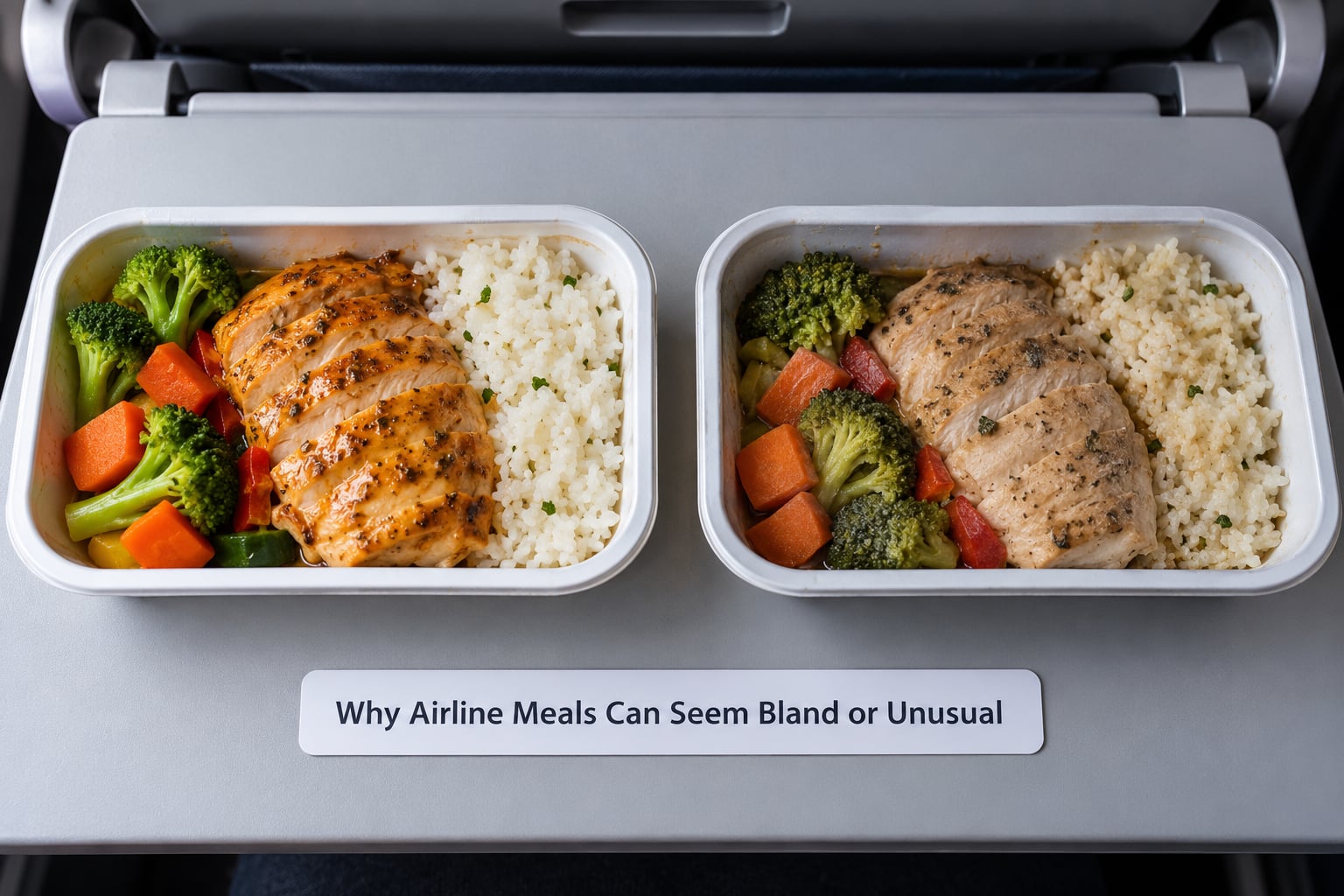
Airline meals can seem bland because they are cooked, blast-chilled, held and reheated far from the moment you eat them. Every one of those steps costs aroma, moisture and texture.
The process usually looks like this:
- The dish is cooked on the ground, often at a central facility hours before departure.
- It is blast-chilled, which locks in food safety and shelf life but drives off volatile aromatics.
- It is loaded, then sits on a cart or in a hold for however long the route takes.
- It is reheated in a convection oven, usually to a core temperature set for safety rather than for flavor.
Convection heating is even and fast, which is exactly the problem for texture: the edges go dry and rubbery while the center is still only warm. Airlines compensate with seasoning and spice that is stronger than you would use at home — cardamom, lemongrass, curry and chili are common choices — and with extra salt and sugar, because those two are the hardest to notice being heavy.
Long-haul flights stack more holding time onto the same process, so the same dish usually fares worse on a 14-hour route than on a three-hour one. Short-haul meals often come out closer to fresh, and the difference is easy to notice once you know to look for it.
Two popular explanations do not hold up. Cabin radiation is not what makes food taste bland, and neither is fear of flying on its own. Culinary mismatch matters more than either: a menu built around delicate aromatics and layered seasoning will suffer in the cabin, while dishes built on spice, acid, salt and umami travel well.
How Food Texture and Temperature Change the Experience
Temperature and texture change the experience because flavor is not only chemistry — it is mouthfeel and aroma release, and both depend on how wet and how warm the food is.
A meal that arrives lukewarm is a double penalty. Cool food releases fewer aroma molecules, and congealed fat reads as waxy rather than savory. That is why the first useful move with any airline tray is simply to eat it while it is still warm, rather than chatting through the first ten minutes.
Crisp items have the opposite problem. Crackers, crisps and bread crusts are designed to stay crunchy in humid conditions; in a dry cabin they go soft within an hour, and a soggy crisp is more disappointing than no crisp at all. Foods that depend on moisture fail the same way. A rich stew or a saucy curry that would be excellent at 8,000 feet arrives thick, sticky and dull.
On the drinks side, carbonated drinks lose carbonation faster at low pressure because gas comes out of solution more readily. Coffee is a common complaint because it is served at a lower temperature, hits a palate already dulled by dryness, and often travels badly from the pot. Warm, aromatic drinks and anything with acid tend to hold up best.
Simple Ways to Make Airplane Food Taste Better
You can make airplane food taste better with a handful of habits that work within the limits of a seat and a tray. None of them require anything special in your carry-on, and none of them need medical treatment.
- Drink water steadily from before boarding. Slow, frequent sips keep your mouth and nasal lining moist. Save the whole glass for service, not the whole flight.
- Eat a normal meal before you board. Hunger plus a dry cabin is a bad combination, and it makes everything taste harsher than it is.
- Choose savory and aromatic dishes over sweet ones. Umami, spice, toasted aromatics and acid survive the cabin; frosting and custard do not.
- Add condiments early and lightly. Pepper, lemon, herbs and a splash of something acidic restore aroma before the meal has sat for twenty minutes.
- Use noise-canceling headphones for the first few minutes of eating. Reducing sustained cabin noise is the cheapest taste improvement available to a passenger.
- Eat the meal promptly and skip the hours of salty crackers beforehand. Salt makes dryness worse and dulls what you taste next.
- Ask for a freshly loaded meal when the option exists. On routes that offer hot meal choice rather than a pre-loaded tray, the difference is immediate.
A few popular remedies are not worth your time. Holding a menthol sweet, breathing through your nose to “restore smell,” or eating a handful of unsalted nuts right before the meal does not change cabin conditions. Special meal requests such as vegetarian, kosher or gluten-free are worth making for dietary reasons, not as a flavor trick — they follow the same cook-chill process.
If you are bringing your own food, forum consensus is consistent: choose solid, low-moisture, protein-rich items such as nuts, cheese, fruit and a sturdy sandwich, and skip anything delicate or crisp. Very spicy homemade food is described as travelling well, which fits the finding that spice perception barely changes in the air.
Can You Improve Your Taste Before and During a Flight?
Yes, and the steps work best in this order. Start before you leave the house, since you cannot re-moisturize a cabin after two hours of dry air.
Before you travel, eat and drink normally rather than skipping meals or flying on empty. Eat a proper meal in the two hours before boarding, and start drinking water at the airport rather than waiting for the service cart to come around.
At the gate and on board, keep sipping water steadily and skip the salty snack piles in case you want to actually enjoy the meal later. Manage your ears as you always would on a flight, since equalising helps more than most people expect. If a sense of blockage builds during descent, swallowing, chewing gum or yawning can help relieve it.
At meal service, compare options rather than assuming every tray will be bland. A hot main with aroma beats a cold sandwich, and a dish built on spice or umami beats one built on delicate seasoning. Eat while it is hot, add condiments early, and put the headphones on if the cabin is loud.
On the longer route, raise the stakes: pick up something with strong aroma from an earlier stop, or choose the special meal if one appeals. Nothing restores your palate to what it was on the ground, but these steps close most of the gap.
Frequently Asked Questions
Does altitude change your taste buds?
Altitude does not damage or alter your taste buds. The cabin is pressurized to roughly the equivalent of 6,000-8,000 feet, and it is the dryness at that pressure, not cruise height itself, that dulls smell and sweet and salty perception. Your taste returns to normal once you land and rehydrate. Anyone who still feels unwell after a flight should speak to a doctor rather than assume it is flavor.
Why do sweet drinks and salty foods taste different on a plane?
Dry cabin air dries the lining of your nose and mouth, and the aroma that carries most of what we call flavor depends on moisture. Sustained cabin noise around 85 decibels also measurably reduces sweet and salty sensitivity while leaving umami and spice largely intact. So cake, sweet coffee and buttered bread fade first, while tomato, cheese and chili stay vivid.
Is dehydration the main reason food tastes bland on airplanes?
Dryness is the main factor, but it is not the same thing as dehydration. The cabin runs at roughly 10-20 percent relative humidity, so your nose, mouth and saliva thicken within hours whether or not you have skipped water. On top of that, reduced cabin pressure and constant noise each dull perception on their own. Drinking steadily helps, but a wet mouth in dry air only goes so far.
Which airplane foods usually taste the best?
Foods built on umami, spice, acid and toasted aroma hold up best in a cabin. Tomato-based dishes, hard cheeses, soy-based dishes, roasted meats and heavily seasoned stews travel well, which is why tomato juice has such a following on flights. Delicate pastries, plain bread, butter and sweet coffee fare worst. For your own food, forum travelers consistently recommend nuts, cheese, fruit and sturdy sandwiches.
Does airplane cabin pressure permanently change your sense of taste?
No. The effects of low cabin pressure and dryness are temporary and typically fade within hours of landing once you rehydrate and your nasal lining recovers. Long-term cabin crew report habituation rather than lasting damage. The only lasting influences are behavioral ones, like leaning on salty snacks out of boredom. If a change in taste persists for days after landing, see a doctor.
Conclusion
Why does food taste different on airplanes? Mostly because your senses are working in the driest, loudest, pressurized environment you will visit that day, and because the meal was cooked hours before you touched it. The food is not bad. Your palate is just running degraded.
Start with water before you board, then pick a dish that has aroma, moisture and texture. Everything else — condiments, headphones, eating early — is fine-tuning on top of those two moves.