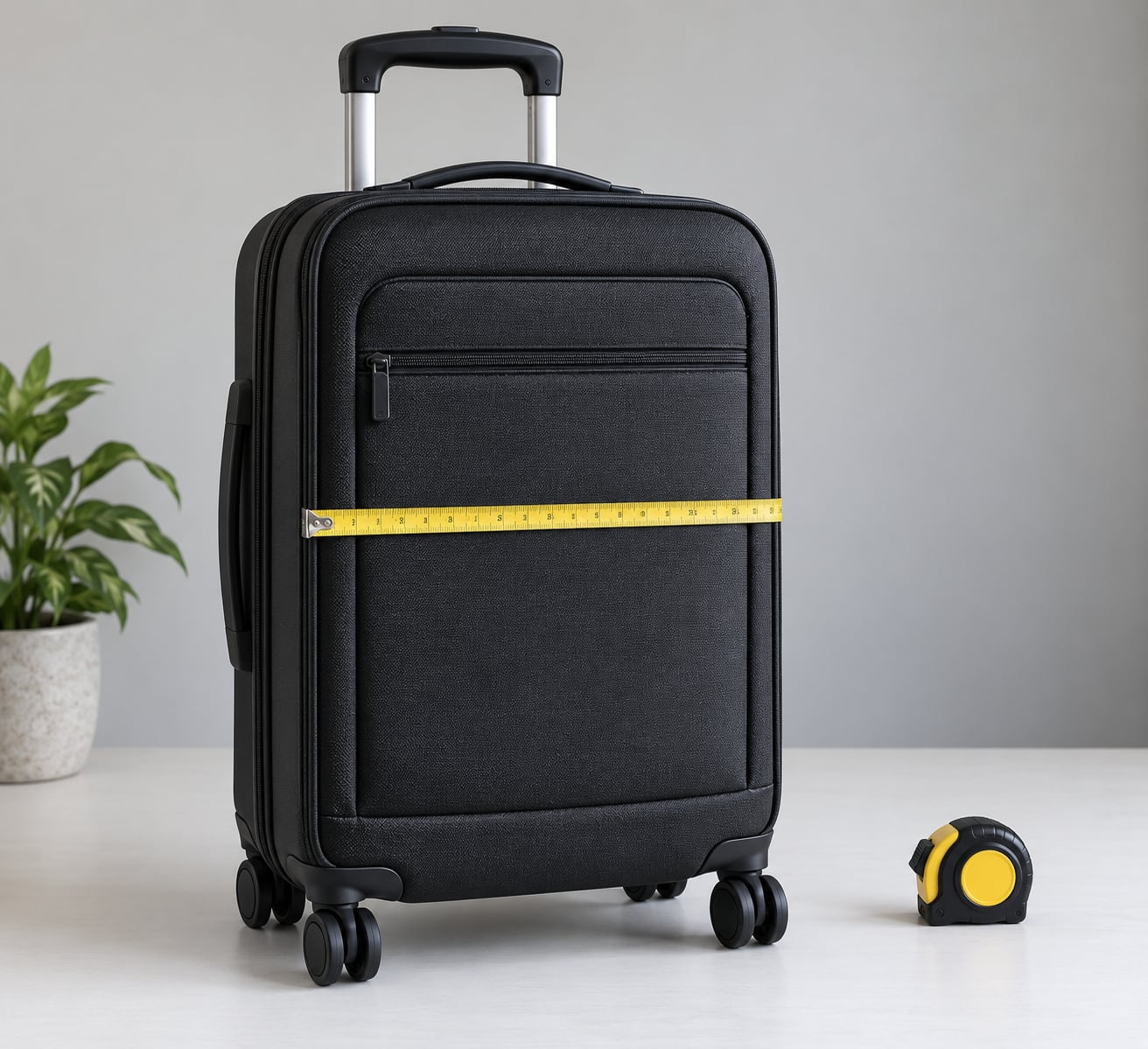
To measure a carry on bag the way a gate agent will, pack it the way you plan to fly, stand it upright, and record three numbers: height from the floor to the top of the retracted trolley handle, width at the widest side-to-side point, and length from front to back. Wheels, handles and exterior pockets all count. It takes about two minutes.
Then compare all three numbers against the allowance published by the airline actually operating your flight. That last part is where most surprises come from, because a bag sold as “20 inch” regularly measures 22 inches once the wheels are on the bottom, and a codeshare itinerary can be flown by an airline you never booked.
Airlines do not eyeball this at the gate. The standard method is a metal sizer box that the bag is dropped into, wheels and all, and it either drops in or it does not. Measuring at home the same way removes the argument you would otherwise have at 6am in a boarding line.
Table of Contents
- 1What You Need
- 2If you have no tape measure
- 3Step-by-Step: How to Measure a Carry-On Bag
- 4Measure the Bag’s Length
- 5Measure the Bag’s Width
- 6Measure the Bag’s Height
- 7Check the Airline’s Size Allowance
- 8Confirm the Bag Fits
- 9Common Mistakes
- 10Frequently Asked Questions
- 11Do airlines measure wheels when measuring luggage?
- 12Is a 22 inch carry-on the same as a bag sold as 20 inch?
- 13What happens if my carry-on is 1 or 2 inches too big?
- 14Which airline has the strictest carry-on size limit?
- 15Can I bring a carry-on and a personal item on the same flight?
- 16What size carry-on is allowed on international flights?
- 17Conclusion
What You Need
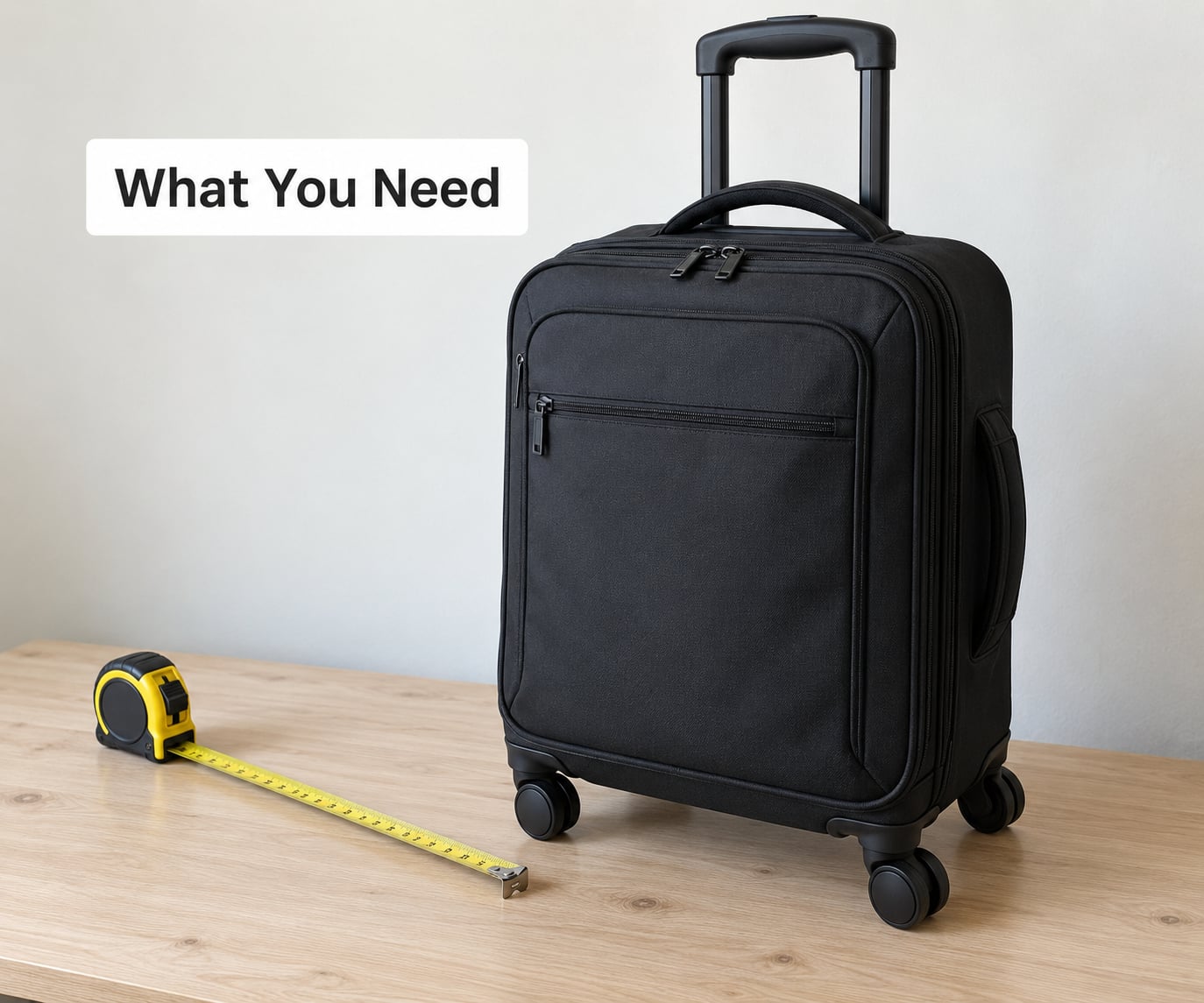
A retractable tape measure is the only tool that really matters. A 25 foot or 1 metre one costs almost nothing and gives you both inches and centimetres, which matters because airlines publish half of their limits in metric.
You also need the bag packed the way you will actually travel it. An empty softshell tells you very little, because fabric and exterior pockets grow once they are loaded.
And you need the current baggage page for the operating airline, not a screenshot of a policy you saved two years ago. Limits get revised, and the airline page is the version that gets enforced.
Optional but useful: a second person to hold the bag square, a ruler or a strip of paper for the no-tape-measure method below, and your phone camera so you can save a photo of the tape reading next to the bag.
If you have no tape measure
A piece of A4 paper works for width and length. Print or fold it to 21 cm by 29.7 cm, stand the sheet against the side of the bag, and mark where the bag ends. That gives you an instant centimetre reference without buying anything.
A length of string is better for anything curved or soft. Wrap it around the bag at the widest point, pinch the overlap, then lay the string flat against a ruler or a sheet of paper and read off the distance.
Step-by-Step: How to Measure a Carry-On Bag
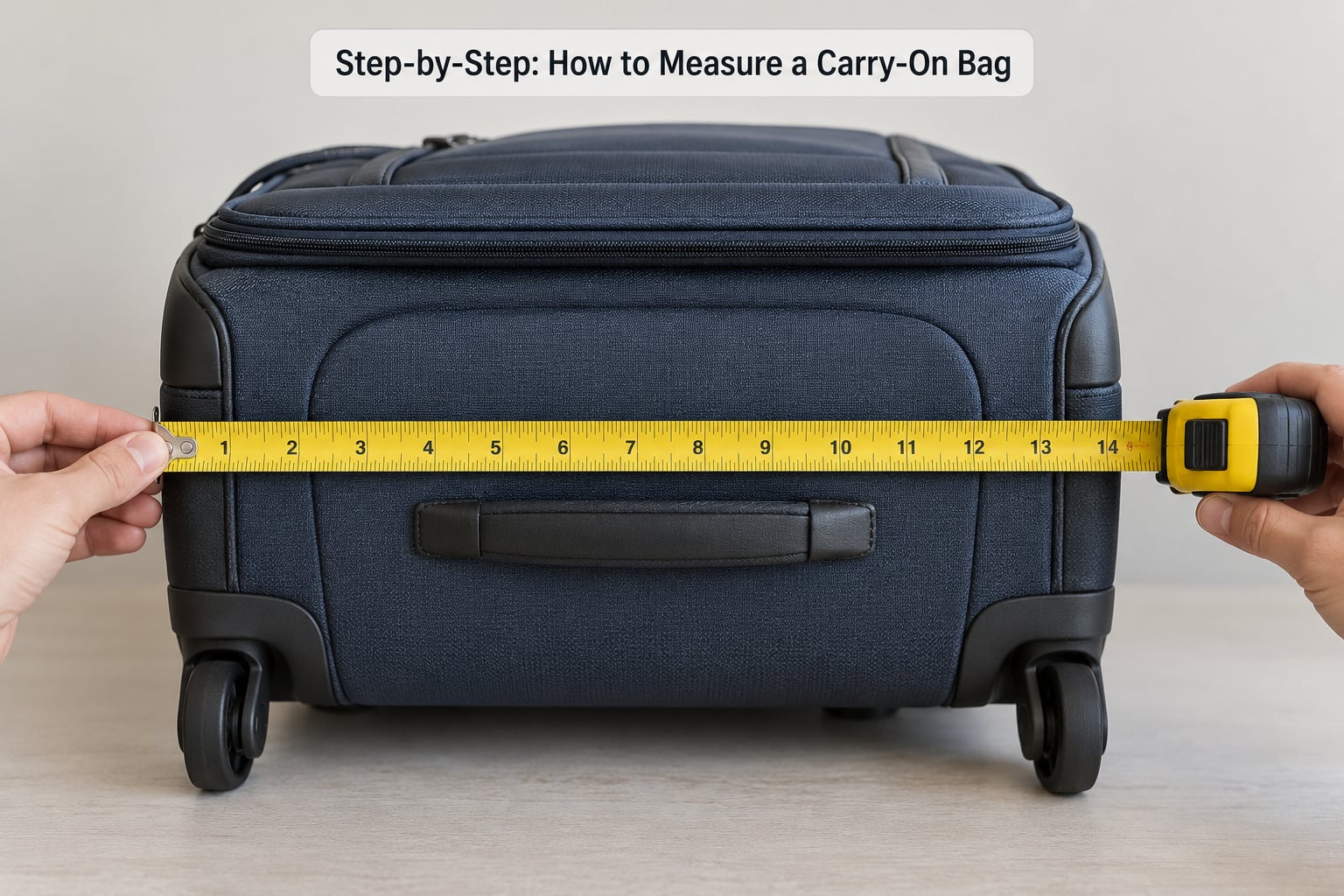
Here is the whole method in four steps, and it takes about two minutes:
- Pack the bag exactly as you will fly it, with the expansion zipper zipped shut.
- Stand it upright on a flat floor and measure height from the bottom of the wheels to the top of the handle, with the trolley handle fully retracted.
- Turn it on its side and measure width across the widest side-to-side point, including the top and side carry handles.
- Lay it on its back and measure length from the front pocket to the back panel at the fattest point.
Write the three numbers down in the same order every time: height, width, length. It stops you from transposing two figures when you compare them with an allowance later.
Measure the Bag’s Length
Length is the front-to-back measurement, and it is where soft bags fail. Set the bag on its back, measure across the fattest part of the bag rather than the empty shell, and take the reading where the front exterior pocket bulges most.
If the bag has a front pocket stuffed with a jacket or a laptop, that pocket is part of the bag. Measure it as it sits, not as it looks in the product photo.
Measure the Bag’s Width
Width is the side-to-side measurement taken at the widest point of the bag, usually across the main body near the base. Do not cheat the corners or take a reading where the case tapers, which is the most common way people get a number that is 2 cm optimistic.
Count the top and side carry handles if they protrude beyond the shell. Leave loose shoulder straps out of it, since a dangling strap is not part of the rigid footprint the sizer tests, but a permanently attached grab handle is.
Measure the Bag’s Height
Height runs from the floor to the very top of the bag, and it includes the wheels and the retracted trolley handle. Push the handle all the way down first, because a raised handle adds several centimetres and the sizer will not make an exception for you.
This is the step that explains the nominal size trap. A wheeled case typically measures around 5 cm taller than its body once the wheels are counted, so a bag advertised as 20 inches can easily come out at 22. Recessed-wheel cases measure smaller than protruding-wheel ones for exactly this reason.
Check the Airline’s Size Allowance
Find the allowance for the airline flying the leg, not the airline you bought the ticket from. On a codeshare, the operating carrier’s rules win, and published limits typically sit around 22 x 14 x 9 inches, which is 56 x 36 x 23 cm, including handles and wheels.
Several carriers also work from the linear total, which is length plus width plus height added together. The familiar 22 x 14 x 9 inch allowance equals 45 linear inches, and a 45 or 46.5 inch cap is what some international carriers check. That is where the forum confusion comes from: a bag can be comfortably inside the total and still fail on one single dimension, because the sizer tests the three dimensions separately.
| Airline | Typical carry-on allowance | Notes |
|---|---|---|
| Delta, United, American, Alaska, JetBlue | 22 x 14 x 9 in (56 x 36 x 23 cm) | The common US domestic standard |
| Southwest, Frontier | 24 x 16 x 10 in (61 x 41 x 25 cm) | A 24 inch roll-aboard fits here |
| easyJet, British Airways | 56 x 45 x 25 cm | Generous frame, but a larger bag may be charged as priority |
| Ryanair | 55 x 40 x 20 cm with priority; 40 x 30 x 20 cm free cabin bag | Strict sizer, checked right at the gate |
| Emirates | 55 x 38 x 22 cm | Weight allowance applies alongside size in economy |
These are the widely published figures, not a substitute for the airline’s own page. Check the current allowance for your specific route before you pack, and read whether the carrier sells a larger cabin bag as a paid option, which is common in Europe.
Keep the carry-on and the personal item separate too. A personal item has a much smaller limit, often around 18 x 14 x 8 in, and the two are allowances on the same ticket rather than one generous bag between you.
Confirm the Bag Fits
Now compare your three numbers against the allowance one dimension at a time. All three need to sit inside the limit, and your totals need to sit inside the linear cap if the airline uses one.
Sizers are not laser-cut to the millimetre, and gate staff have discretion on small overruns, but a bag that is 1 cm over on one side is a gamble you take every single time. Leave a couple of centimetres of margin on the depth, which is where the older narrow-body aircraft and the smaller overhead bins cause the most trouble.
If your measurements clear the limit with margin to spare, the bag is fine. If they do not, you have choices: pack lighter, check the bag instead, or buy a compliant size before the trip rather than at the gate.
Common Mistakes
Measuring the interior. Airlines check exterior dimensions, including wheels and handles. Interior lining measurements are not part of the rule and they read several centimetres smaller, which is exactly why bags get gate-checked after their owners were certain.
Forgetting the wheels and the raised handle. This is the most common error and it costs roughly 5 cm of height on a typical spinner. Push the trolley handle down before you start and measure to the bottom of the wheels, not the bottom of the shell.
Measuring the bag empty. A softshell packed for five days can be several centimetres fatter than the same bag in the shop. Front pockets bulge, compression is gone and the fabric stretches. Pack first, then measure.
Trusting the size printed on the label. Suitcase sizes are nominal categories inherited from the 1990s, not measurements. Verify anything you are buying with a tape measure in store, or ask the shop to measure it in front of you.
Using the wrong airline’s rules. Checked the wrong page, checked the wrong airline, or checked last year’s saved copy. Take the screenshot of the current allowance on your operating carrier before you leave home so you can reference it at check-in.
Measuring only one side. Cases are rarely symmetrical, and a bag with a handle plate on one side measures wider there. Take the full width at the fattest point rather than averaging.
Leaving the expansion zipper open. Most modern cases gain several centimetres when the expansion zipper is pulled. Measure it zipped shut, the way you will travel with it.
Frequently Asked Questions
Do airlines measure wheels when measuring luggage?
Yes, wheels are included in the official carry-on measurement, along with handles and exterior pockets. Airlines drop the bag into a metal sizer box with wheels down, so a case body that fits but a wheel assembly that does not will fail. On a typical spinner, the wheels and hardware add about 5 cm to the height, which is why a bag labelled 20 inches often measures closer to 22.
Is a 22 inch carry-on the same as a bag sold as 20 inch?
No. Suitcase sizes are nominal categories, not measurements. A bag sold as a 20 inch carry-on usually measures roughly 20 inches across the body, then comes out near 22 inches tall once you add the wheels and the retracted trolley handle. Measure the actual exterior dimensions yourself rather than trusting the number on the tag or the listing.
What happens if my carry-on is 1 or 2 inches too big?
Expect a gate check, and possibly an oversized or gate-check charge that is higher than the fee you would have paid online. Gate agents do sometimes wave small overruns through, but discretion varies by agent, airport and airline, so it is not a plan. If a dimension is over the limit, take the bag as checked luggage or leave something at home before you travel.
Which airline has the strictest carry-on size limit?
The low-cost European carriers are usually the strictest, because oversized cabin bags are a revenue stream rather than an inconvenience. Ryanair is the clearest example, with a small free cabin bag allowance and a larger paid one, and easyJet also sells priority cabin bags above the base allowance. If how to measure a carry on bag matters most to you, fly these airlines with a bag well under the limit.
Can I bring a carry-on and a personal item on the same flight?
On most full-service airlines, yes. You get one carry-on within the standard size allowance plus one personal item that fits under the seat, usually around 18 x 14 x 8 in, with combined weight limits in economy on many routes. Low-cost carriers often bundle both into a single paid cabin bag allowance instead, so check the specific airline before you pack two bags.
What size carry-on is allowed on international flights?
Economy limits outside the US are often more generous in centimetres but stricter in practice, especially with budget carriers. Published figures commonly fall between 55 x 40 x 20 cm and 56 x 45 x 25 cm, and some airlines pair the size limit with a weight cap around 7 to 10 kg. Long-haul carriers may also apply a smaller allowance in economy than in business, so read the fare you booked.
Conclusion
Start by measuring the complete exterior of the bag while it is packed, with the wheels on the floor, the trolley handle pushed all the way down, and the expansion zipper closed. Write down height, width and length in that order so nothing gets transposed.
Then pull up the current allowance for the airline operating your flight and compare all three numbers against it, one dimension at a time, and add them up if the carrier works in linear inches. Leave a couple of centimetres of margin, especially on depth, and you will walk through the gate with the bag still in your hand.
Airlines change their baggage rules more often than most travellers expect, so treat these figures as a starting point and verify the allowance on the airline’s own page before every trip.