
Yes, you can find the same cheap flights a travel agent books — agents work from the very same airline inventory and booking systems you can use free. The fares don’t change when you remove the agent; the work does. Fifteen minutes of comparing dates, checking the total cost and setting an alert is usually all it takes.
The rest of this guide is that routine, start to finish, including the places where you give up something real. Last updated October 2026.
Table of Contents
- 1What You Need
- 2Step-by-Step: How to Find Cheap Flights Without a Travel Agent
- 3Set Your Route and Flexible Dates
- 4Use Flexible Search Filters
- 5Compare the Total Fare
- 6Check Fare Trends and Set Alerts
- 7Book Directly When the Price Is Right
- 8Common Mistakes
- 9Frequently Asked Questions
- 10Can I find cheap flights without a travel agent and still get agent-level fares?
- 11What is the best way to compare flight prices?
- 12Should I book directly with the airline or through a booking site?
- 13How far in advance should I book a flight?
- 14Do fare alerts really help find cheaper flights?
- 15Can I save money by booking a one-way ticket or flying from a nearby airport?
- 16Conclusion
What You Need

You need less than people expect: a browser, a credit or debit card that passes online verification, and about fifteen minutes. Everything else is preparation that makes those fifteen minutes count.
- A realistic date range. Fix your deadline for travelling, not your exact dates. Everything you read about cheap flights assumes some flexibility on at least one end of the trip.
- Your non-negotiables written down. Direct flights only, no early morning departures, one checked bag, a specific seat. Write these before you search, because a filtered search that returns nothing tempts everyone to drop a rule they actually cares about.
- Alerts switched on. Price alerts on two metasearch tools and one airline, pointing at one inbox. Manual checking is the single biggest reason people miss fares.
- Documents checked early. Confirm your passport validity and whether you need a visa or transit visa. A visa requirement discovered at checkout costs far more than a fare difference.
- A note or spreadsheet tab. Every search you run, with the date, the total price and where you saw it. You will forget which of six tabs held the good number.
Step-by-Step: How to Find Cheap Flights Without a Travel Agent
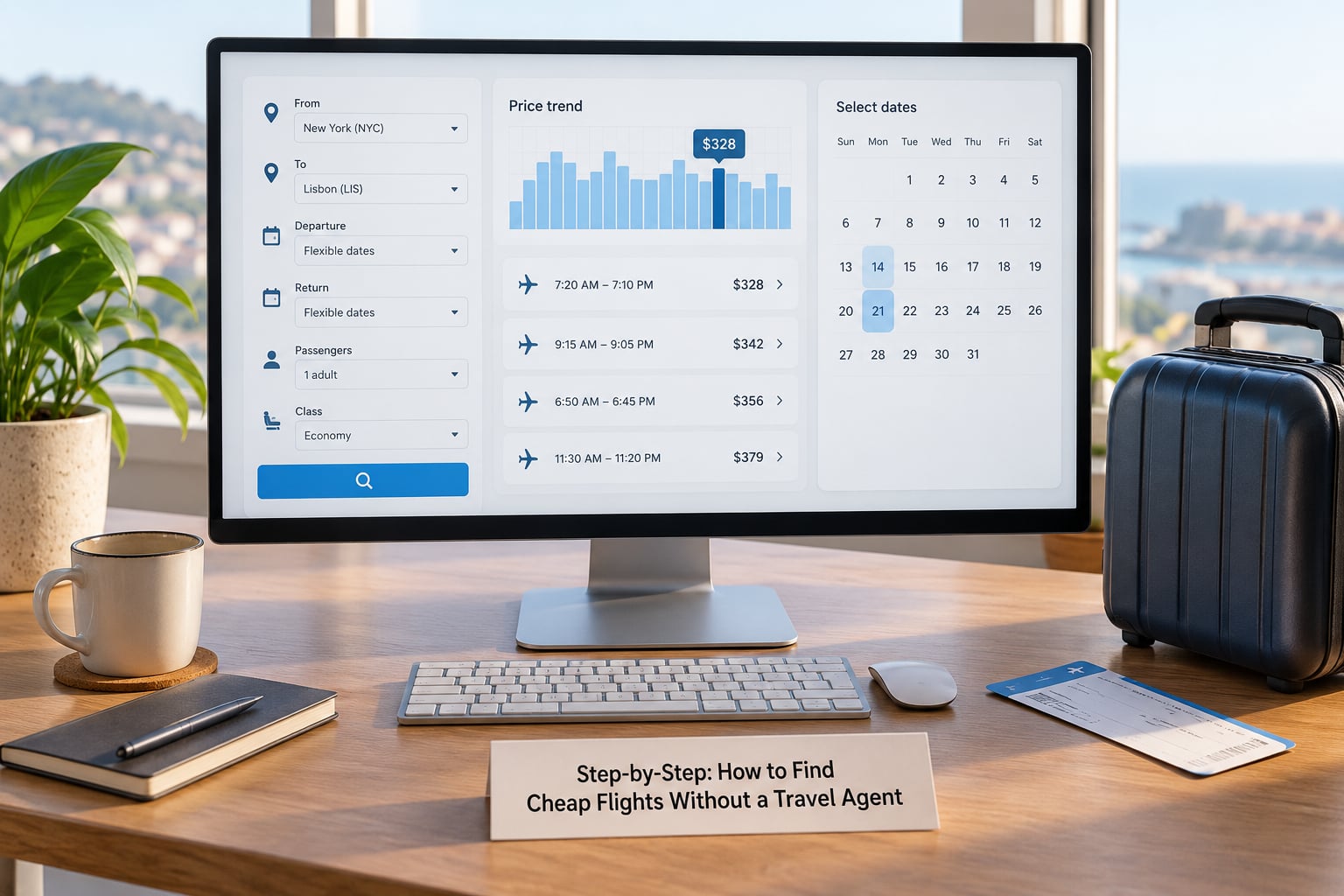
The routine is five steps: set your route and dates, use flexible filters, compare the total fare, read the price trend, then book wherever the final number is lowest. Budget about fifteen minutes for a domestic search and closer to thirty for a long-haul one with multiple connections.
Set Your Route and Flexible Dates
Start with the date grid, not the single-date form. Google Flights and Momondo both let you view an entire month or a two-to-three-month window at once, which shows you the shape of the month instead of one isolated fare.
Then widen the search in four directions:
- Nearby airports. Adding every airport within roughly an hour of your home often surfaces a lower fare. Factor in ground transport and rail before you celebrate — a cheap flight into a regional airport two hours from your destination can cost more than the fare saved.
- Midweek departures. Sunday and Friday carry the heaviest demand, so a Monday or Tuesday departure is frequently cheaper on the same route.
- Different trip lengths. Coming back two days earlier or leaving two days later often drops the fare more than shifting the whole trip.
- An open destination. If you have no fixed city, the Anywhere search on Google Flights or the map on Skyscanner shows what your budget actually buys right now. Several people planning a trip with no destination end up somewhere cheaper and better.
One caution for US readers: Southwest fares do not appear on Google Flights. If Southwest is your usual carrier, search it directly too, or use Kayak, which does carry its inventory.
Use Flexible Search Filters
The cheapest sort is a trap. On many sites it returns itineraries with 24 to 34 hours of layover, because that route technically has the lowest fare. Set a maximum connection time instead — two hours for domestic, four for international — and let the sort work with real parameters.
Other filters that genuinely change the price:
- Stops. Allowing one connection often drops a long-haul fare by a third. Zero stops is a comfort preference, not a price requirement, unless your schedule makes it one.
- Baggage. Filtering for a fare that includes a checked bag removes most low-cost carrier results at the click. This is the single most useful filter for anyone who does not travel with cabin baggage only.
- Cabin and airline. Some carriers simply do not sell on certain sites. Basic economy fares often exclude seat selection and any chance of a free change, so read the fare rules before filtering it out by name alone.
- Departure time. A red-eye or an early morning departure is cheaper on most routes and costs you a night of sleep. Decide which side of that trade you sit on before you search, not after.
Two tools rarely show identical results, and that is normal. Metasearch engines each query a slightly different set of sources, so running one broad scan on Google Flights and a second on Skyscanner or Kayak finds itineraries the other missed.
Compare the Total Fare
A fare breakdown has more lines than most people read. Here is what each one means and why it changes the answer:
- Base fare. The carrier’s own charge for the seat and service.
- Carrier surcharges and government taxes. Added by the airline and the government, and identical wherever you buy the ticket.
- Agency service or booking fee. Some online travel agencies add a per-passenger fee at checkout that was not in the headline number. Always read the final total, not the search result.
- Checked and carry-on bags. Budget carriers commonly charge per bag, each way, added at checkout. Two bags on a round trip can erase the discount entirely.
- Seat selection. Often charged separately unless you hold status or pay for a premium seat, which many carriers require for seat selection at all.
- Payment and currency fees. Paying in a currency other than the airline’s home currency adds a markup, as does some card types.
Opaque fares sit at the ugly end of this list. These hide the airline and the flight details until after you pay, which makes the total impossible to compare properly. On a phone in a taxi, an opaque fare has occasionally been the fastest way out — it is never the cheapest way to plan.
Compare like with like: same airline, same baggage, same flexibility, same total. A fare that is cheaper only because it is a different fare class is not cheaper.
Check Fare Trends and Set Alerts
Before booking, look at two views: the price calendar, which shows the cheapest days around your dates, and the price graph, which shows whether fares are rising or falling for your route. Google Flights marks typical and high prices using its own historical data, and Skyscanner and Kayak show comparable signals.
Set alerts and then stop checking. A price alert on your route tells you when it drops, which is the only reason it beats refreshing a page twenty times a day. Add alerts on two metasearch tools and one airline, because each tracks different sources.
The “book three months ahead” rule is a rough guide, not law. Cheap fares tend to appear between one and three months out for domestic trips, and earlier for international and peak-season travel, but fixed-date winter holidays can sell out well before that. When your dates are fixed, set alerts early and accept the first fare that meets your number rather than waiting for a signal that never comes.
Two extras worth knowing about: fare-drop and price-match guarantees, where a fare falls within 24 hours of booking and you can claim the difference, and mistake fares, where a ticket is published at a fraction of its real cost. Mistake fares are genuinely rare and get cancelled at the airline’s discretion. If you want them, Airfare Watchdog and similar deal services will email them to you.
Book Directly When the Price Is Right
Go direct with the airline when the total matches and your trip involves changes, a codeshare partner, or an airline you have status with. Go through an online travel agency when the price is clearly lower or the itinerary is a self-transfer arrangement no airline will issue. This table is the shortest version of that decision.
| Channel | Who issues the ticket | Extra costs | Best for |
|---|---|---|---|
| Metasearch engine | Nobody — it searches and hands you off | None | Scanning a whole month and comparing dozens of airlines at once |
| Online travel agency | The agency, on the airline’s behalf | Service fee, carrier surcharge for third-party bookings | Multi-city, open-jaw and self-transfer itineraries, packages |
| Airline direct | The airline | Occasionally a card or currency fee | Changes, cancellations, seat control, status perks, bonus miles |
Booking with the airline has real advantages beyond price. Changes and cancellations are handled by the carrier that operates the flight. Some airlines add a per-passenger surcharge when a ticket is bought through a third party, and several pay bonus frequent flyer miles for direct bookings. You still earn miles on a flight booked through an agency, unlike hotels, where the property often keeps the points.
Some airlines are simply invisible on aggregators, so a direct check is never wasted. Confirm before you pay that the booking reference appears on the airline’s own site. If it does not, stop and call the agency — you want a real airline record, not just a vendor’s number.
A self-transfer itinerary is the one case to understand before you book. Separate tickets on different airlines mean you are your own connection: if the first flight is delayed and you miss the second, the second airline owes you nothing. Many online travel agencies will build these for you, but they will not protect you from the gap.
And in the UK, EU and elsewhere, package protection rules only cover holidays sold as packages. A flight bought on its own is unprotected, which is the main thing you trade away by self-booking.
Common Mistakes
These seven errors cost independent bookers the most money, and all of them have a simple fix.
- Searching one site only. Metasearch engines query overlapping but different sources. Fix: run one broad scan on Google Flights, then one on Skyscanner or Kayak, and compare the best results.
- Trusting the cheapest sort. It hides a 30-hour layover inside a winning fare. Fix: set a maximum connection time before you sort by price.
- Comparing headline fares. Baggage and seat fees are where the discount disappears. Fix: price every option with the bags you will actually check.
- Checking daily without an alert. You cannot catch a fare by refreshing, and the constant checking changes nothing. Fix: alerts on two tools and one airline, then stop.
- Booking opaque fares. You cannot compare what you cannot see. Fix: pick a fare showing the airline, times and total before payment.
- Double booking while hesitating. Two paid tickets for one seat is a common and entirely avoidable loss. Fix: book one itinerary, or hold a fare if the tool offers a price lock.
- Booking separate tickets as a backup. A cheap backup on another airline is only a backup if the delay still leaves you a workable connection. Fix: leave at least four hours on separate tickets, or stay on one booking.
If you are flying from the US, a booking made directly with an airline at least seven days before departure can usually be cancelled within 24 hours of purchase for a full refund, provided the flight is at least seven days away. Rules differ outside the US, and the 24-hour window protects against a change of mind, not a missed flight. Elsewhere, check your own consumer-protection rules before you rely on anything.
Frequently Asked Questions
Can I find cheap flights without a travel agent and still get agent-level fares?
Usually yes, because travel agents search the same airline inventory and booking systems you can reach free. Agents sometimes hold contracted fares, group allotments or commission benefits on a few routes, but on most mainstream routes the lowest available fare is visible to anyone. You also skip any markup the agent adds. What changes is the service layer: rebooking after a disruption and complex visa or ticketing problems are what agents are paid for.
What is the best way to compare flight prices?
Compare the total landed price on the same itinerary across three channels: a metasearch engine for the broadest scan, the airline’s own site for the cleanest fare rules, and one online travel agency for multi-city or self-transfer options. Make sure bags, seats and agency fees are added to every figure before you rank them. Prices move constantly, so compare what you see today rather than a screenshot from last week.
Should I book directly with the airline or through a booking site?
Book with the airline when the total is equal or close, because changes, cancellations and seat control are simpler and you may earn bonus miles. Book through an agency when it is meaningfully cheaper or when you need a multi-city or open-jaw itinerary the airline will not build. Some carriers add a small per-passenger surcharge for third-party bookings, which can erase the agency saving on a single passenger.
How far in advance should I book a flight?
For domestic trips, cheap fares most often surface between one and three months before departure. International trips and school-holiday dates fill earlier, sometimes four to six months out. These are tendencies rather than rules, and a fixed-date holiday can be expensive at any point in the window. If your dates are locked, set a price alert early and book the first fare that meets your number.
Do fare alerts really help find cheaper flights?
They help because they watch for you, not because they find magic fares. An alert fires when a fare on your route drops, so the only action required is booking when the number suits you. Set alerts on two metasearch tools and one airline, since each tracks different sources, and pick a threshold in advance. Alerts only fire on the route you set, so reset them whenever your dates change.
Can I save money by booking a one-way ticket or flying from a nearby airport?
Both work often. Splitting a round trip into two one-way tickets can work when the outbound and return are priced separately, and a nearby airport can have a lower fare — but only after you add the cost of getting there, which can exceed the saving. Both tricks fail on the same trip where demand is strong in one direction and weak in the other, so check each direction on its own before assuming a split saves anything.
Conclusion
Open Google Flights, look at the date grid instead of a single date, then widen to nearby airports and midweek departures. Price every option with the bags you will actually check, set alerts on that route, and book with the airline when the totals are close enough that the simpler handling wins.
What you trade by skipping an agent is the work and the backup plan, not the fare. Agents earn their fee on complicated itineraries, award travel, group bookings and visa-sensitive trips. For a straightforward trip you will book twice a year, fifteen minutes of comparing is the cheaper arrangement.