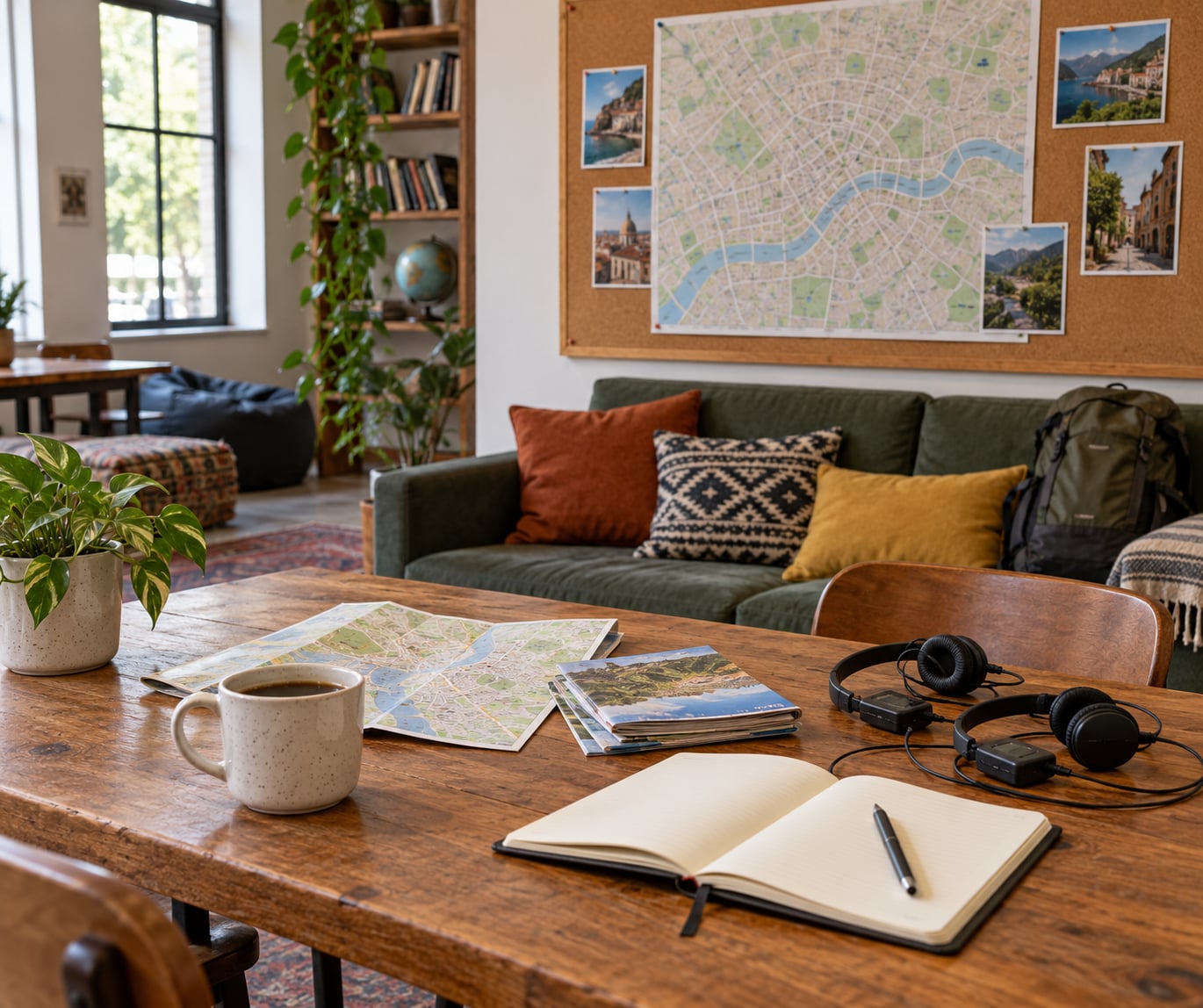
You meet people while traveling alone by putting yourself in repeated social settings: a hostel or guesthouse with a real common room, a small-group activity you are already booked on, and at least one recurring thing you show up to twice. The trick is not confidence. It is giving yourself a reason to be in the same room as someone more than once.
Most lonely trips are not lonely because of bad luck. They are lonely because the traveler booked a private room in a quiet building, ate dinner alone at a table for one, and skipped the one tour that ran four hours a day. Fix the structure and the conversations take care of themselves.
This guide takes about ten minutes to read and gives you eight steps you can set up before you fly. It works for a two-week city break, a month in one country, or a three-week hiking trail where there is no hostel at all.
Table of Contents
- 1What You Need
- 2A flexible itinerary with slack in it
- 3Accommodation chosen for its social spaces, not its price
- 4At least two structured activities booked in advance
- 5Three conversation prompts written down
- 6A way to exchange contact details without ceremony
- 7Basic solo-travel safety habits
- 8Step-by-Step
- 91. Choose a social-friendly base for your first few days
- 102. Book one structured activity for your arrival day
- 113. Learn how to meet people while traveling alone through shared spaces
- 124. Use conversation openers that work beyond your interests
- 135. Join recurring events instead of relying on chance
- 146. Add one activity that creates a reason to cooperate
- 157. Exchange contacts and make a specific low-pressure plan
- 168. Protect your boundaries while keeping the door open
- 17Common Mistakes
- 18Booking the quietest accommodation available
- 19Overexplaining that you are alone and looking for friends
- 20Forcing a conversation with someone who is not engaging
- 21Sharing too much personal detail immediately
- 22Drinking heavily on the nights you meet new people
- 23Accepting a ride from someone you just met
- 24Treating every social event as mandatory
- 25Waiting for the right moment to meet people
- 26Quick Tips for More Natural Connections
- 27Frequently Asked Questions
- 28Is it safe to meet someone I just met while traveling alone?
- 29What is the easiest way to meet people in a hostel?
- 30Should I join a solo travel tour to meet other people?
- 31How do I start a conversation with another solo traveler?
- 32How long should I stay in one place before deciding if I want to make friends?
- 33Conclusion
What You Need
Six things. None of them cost much money, and you can assemble all of them from home in a single evening.
A flexible itinerary with slack in it
Leave at least one unplanned day in your first week. If your schedule is booked down to the hour, every social invitation competes with something else, and you will always say no. A loose afternoon is what lets you accept the second coffee.
Accommodation chosen for its social spaces, not its price
You want somewhere with a common room, a shared kitchen and staff who run something in the evening. Hostels, poshtels and social guesthouses are the obvious answer, but a guesthouse with a set dinner table works just as well. A private room in a social hostel still counts, because you use the common areas either way.
At least two structured activities booked in advance
A walking tour, a cooking class, a language exchange, a market visit with a guide, a small-group day trip. Two, not one, because a single activity puts all your hopes on one group of people.
Three conversation prompts written down
Blank-page anxiety kills more first conversations than shyness does. Write three open questions on a card in your notebook, in the local language if you can, and you will never be caught with nothing to say.
A way to exchange contact details without ceremony
Most people carry a messaging app or a phone number and nothing else. Keep a QR code or a paper card handy so handing it over is a five-second act rather than a conversation you have to survive.
Basic solo-travel safety habits
Live location shared with someone at home, an emergency contact who knows where you are staying, a spare card kept somewhere separate from your main one, and a firm rule that first meetings happen in public places. None of this stops you meeting people. It is the price of doing it alone, and it is a small one.
Step-by-Step
1. Choose a social-friendly base for your first few days
Pick the first accommodation of the trip by atmosphere, not by convenience. Read recent reviews specifically for words like quiet, private, noise and remote, and skip anywhere that repeats them. Search Hostelworld for properties with high review scores in the social categories, and look at photos of the common room rather than the bedroom.
Size is the trade-off. A six-bed dorm means fewer people but a much better chance that everyone ends up at the same bar at 10pm. A thirty-bed dorm gives you a bigger pool and almost no interaction, because everyone already has their group.
Coworking spaces attached to hostels are underrated. Working alongside the same four people for three mornings produces conversations that a single evening never would.
Signal it worked: within a day of arriving, you can name three people who acknowledged you. If you cannot, you chose the wrong building.
2. Book one structured activity for your arrival day
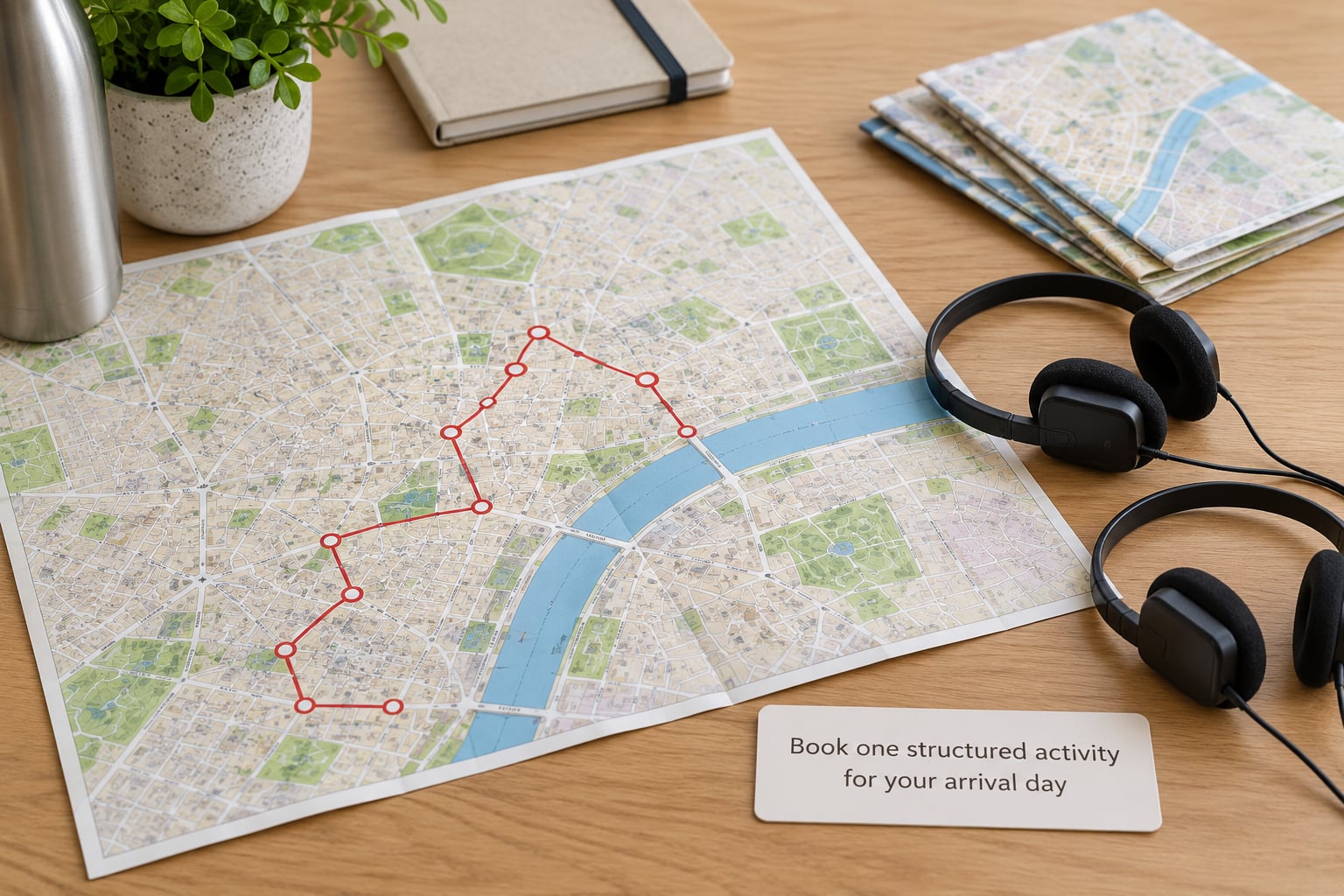
Do this before you land. Your first day in a city should not be free-floating, because free-floating days are spent alone. Book one thing that takes two to four hours and puts you in a room with a handful of strangers and a shared focus.
Walking tours return the most per hour spent, and they work in almost every city. Cooking classes, market tours with a guide, language exchanges, and small-group day excursions all work too. The important part is that you are part of a group, not an observer.
Arrive ten minutes early. People sit at the back by default, and the back is where nobody talks.
Signal it worked: you joined the group, and afterwards you exchanged at least one basic detail with someone, such as where they are staying or what they do.
3. Learn how to meet people while traveling alone through shared spaces
Shared spaces do the work for you. A communal table in a hostel kitchen, the long table at a noodle shop, counter seating at a small restaurant, a lobby bench facing the street, a coworking desk in the middle of the room. In each of these places, sitting down alone signals interest in company rather than a preference for solitude.
Counter seating is the underrated one. At a sushi counter or a busy noodle bar you are next to people by default, in a situation where a two-line exchange is completely normal. You are not interrupting anyone, because nobody has claimed the seat.
Two rules keep this pleasant. Do not take a table meant for one person when every table is full, and do not talk to someone wearing headphones or reading with a finger on a page. Approachability is not entitlement.
Signal it worked: the first exchange turns into an optional second one later that day. Not every single time. Most of the time, which is fine.
4. Use conversation openers that work beyond your interests
The worst openers are about you. Nobody wants to hear where you are from in the first ten seconds. Work from the room instead, because the room is already the thing you have in common.
- Surroundings: Ask what the person would order if they had been here twice.
- The journey: Ask how long their trip is and what is next on the itinerary.
- Recommendation: Ask which nearby place they would send a friend who had one day only.
- Small observation: Comment on something specific and let the other person correct you.
Then follow up with a real question instead of a summary of yourself. Where do you usually stay when you are here? What made you pick this trip? Have you done that day trip yet? Open questions keep a conversation moving; closed ones end it.
The move that turns a chat into a friendship is the invitation, and the best one is small and specific. Coffee tomorrow morning at a named place. Twenty minutes, one coffee, no obligation. Anything longer asks too much of a stranger.
Signal it worked: the other person volunteers information you did not ask for. People do that when they are enjoying the conversation.
5. Join recurring events instead of relying on chance
Chance produces one encounter. Repetition produces a friendship, because the second meeting removes the awkwardness the first one had to carry. That is the whole mechanic, and it is why a weekly language class beats a one-off excursion.
What repeats in most places: language exchanges, hostel-run game nights and bar hops, Meetup groups for hiking, board games, photography or language practice, fitness classes that let you sign up for a single session, volunteering projects that run several mornings a week, and regular coworking sessions or networking nights for digital nomads.
Verify the organizer before you commit. Cross-check the group on a real platform, look at how long it has existed, read who runs it, and pay attention to whether a fee is required and who receives it. Walking tours run by established operators are easier to trust than a free event found in a group chat that was created yesterday.
Set a personal limit. Two sessions of any activity is enough to know whether you want a third. Without that rule, one thing you mildly dislike eats three months.
Signal it worked: someone recognizes you by the second or third session and greets you by name.
6. Add one activity that creates a reason to cooperate
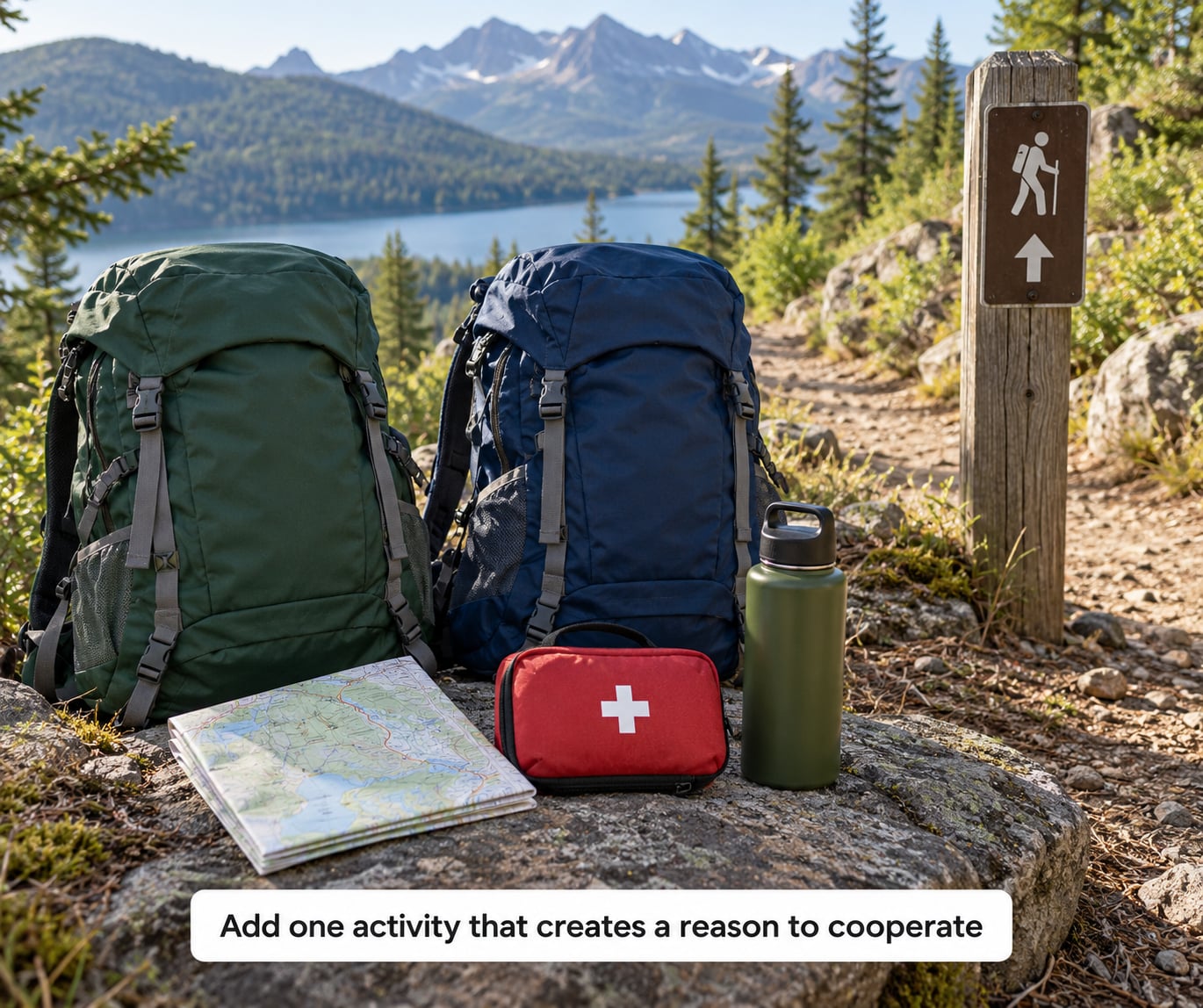
Generic nightlife is a weak tool for meeting people, and it is a bad one for shy travelers, who usually leave early and count it as a failure. Cooperation works better because you cannot be alone in it.
Good cooperative formats: a multi-day hike where you share a route and a heavy bag, team-based games, classes where you cook a dish with a partner, shared transport or a road trip you have agreed on together, community projects, and multi-day small-group trips with an operator such as Intrepid or G Adventures. On a trail or in a kitchen, you have something to say that is not small talk.
This also solves the environment problem. If you are on a long trail, on a ship, in a desert or in a rural area with no hostel, everything else in this guide changes shape, and cooperation becomes the method that still works. You are joining the other people who are actually there.
Signal it worked: you finish the activity with someone you had a comfortable conversation with during it, not only during a break.
7. Exchange contacts and make a specific low-pressure plan
Most good conversations die because nobody converts them. The moment is short and awkward and both people assume the other has forgotten, and by the next morning nobody has a reason to text.
So make the next step small, named and time-limited. I am at the bakery by the corner at eight tomorrow. If you are free, I am there and you are welcome to join me, and if not, no problem. Meeting for breakfast the following morning is the easiest version, because it needs one hour and no emotional commitment at all.
Other low-effort versions: sharing a ride to an attraction neither of you has seen, splitting the cost of a taxi to a nearby town, or walking to a district together with no fixed plan except to be out for a couple of hours.
If someone says no, let them, without sulking or asking why. A polite no from a stranger on the road is not a verdict on you, and pushing is the fastest way to turn a friendly hour into an uncomfortable memory.
Signal it worked: the other person suggests a variation or an alternative time. That means they want the plan to exist.
8. Protect your boundaries while keeping the door open
Meeting people is optional, which is the point. You can have a good week and speak to nobody outside your accommodation, and that still counts as a successful trip.
Keep accommodation details private. Your room number, which floor you are on and when you leave the door are not information you give someone you met an hour ago, even if they seem lovely. Meet in a public, well-lit place for a first outing, and never go to a secluded spot, a remote trail or an isolated address on a first meeting, however convincing the reason sounds.
Stay independent. Keep your own transport, your own money and your own booking. Someone who needs you to move with them and cannot pay their half is telling you something useful early.
Moderate alcohol. It is the single variable that changes other people’s judgment as well as yours, and it turns a fine afternoon into a situation you cannot assess clearly. Drink less, not more, on days when you have just met someone.
Share your live location with the person at home who expects a check-in, keep the phone charged, and know how to get yourself home independently at any hour. Tell one person where you are going before you go.
When something feels off, leave. An evening that felt strange an hour ago can be sorted out from a safe distance tomorrow. Trust the feeling rather than the hope that it will resolve.
Signal it worked: you made new friends without spending energy on self-protection. That is the mark of a plan that actually suited you.
Common Mistakes
Booking the quietest accommodation available
A quiet guesthouse with a lovely view and no common room is the most common reason a solo trip feels lonely. Switch to somewhere with shared spaces for the first few nights, then decide if you want more privacy later.
Overexplaining that you are alone and looking for friends
Announcing your loneliness invites pity or pressure rather than conversation. Say where you are, what you are doing today, and let the situation do the rest. People respond to presence, not to a request.
Forcing a conversation with someone who is not engaging
Two tries is the limit. A flat answer, a one-word answer and no eye contact means close the conversation and move on. Walking away quickly is normal social behaviour, not rudeness.
Sharing too much personal detail immediately
Where you are staying, how much money you carry, how long you are in the country and your home address do not belong in a first conversation with a stranger. Personal history belongs to people who have earned it.
Drinking heavily on the nights you meet new people
Heavy drinking ruins the judgement you depend on when you are alone in an unfamiliar place. Keep it to one or two drinks, eat something first, and keep enough clarity to leave when you want to.
Accepting a ride from someone you just met
Going back to their place, their vehicle or a remote location on a first meeting is a rule, not a judgement about them. Arrange your own transport every time, including the trip back.
Treating every social event as mandatory
If you go to everything, you burn out by week two and start resenting people. Pick two things a week that you would enjoy anyway, and let the rest pass.
Waiting for the right moment to meet people
There is no right moment. The people you meet while traveling alone are usually ordinary people who happened to be in the same room, and the gap between you is much smaller than it looks from the outside. Being comfortable alone first is what makes the conversations possible, and it is the whole mindset shift.
Quick Tips for More Natural Connections
- Arrive early for group activities and sit near the guide, not at the back.
- Keep three conversation prompts written on a card; you will forget them otherwise.
- Learn five local greetings and the phrase for thank you. It changes how people treat you.
- Ask a follow-up question instead of telling your own story back.
- Say yes to the first invitation, then decide about the second one.
- Go back to the same cafe, gym or library three days running. Familiarity is doing most of the work you are crediting yourself for.
- Follow up the next morning with one specific message, then leave the reply in their hands.
Frequently Asked Questions
Is it safe to meet someone I just met while traveling alone?
Most meetings are safe, and the precautions are simple. Meet in a public, well-lit place such as a busy cafe or the lobby of your accommodation, keep your own transport both ways, and tell one person at home where you are going and when you expect to be back. Never go to a secluded location or a private address on a first meeting. If a meeting ends badly, leave, block the contact, and tell your accommodation staff or a local police station, not just a friend.
What is the easiest way to meet people in a hostel?
Use the common room and the kitchen rather than your bed. Cook something simple and eat at the communal table instead of in your room, where other people are already sitting with their laptops or talking. Staff-run events such as game nights, bar hops and shared dinners work because the group is already assembled and nobody has to make the first move. A private room in a social hostel works just as well, because the common areas are open to every guest.
Should I join a solo travel tour to meet other people?
Yes, if it is a small group with an activity. Small-group walking tours, cooking classes, language courses and multi-day trips with operators such as Intrepid or G Adventures give you a shared focus for several hours, which is what turns strangers into people you recognise. A full-day coach tour with forty passengers and a free afternoon is much weaker. Check the group size before booking, and skip anything that promises matchmaking rather than travel.
How do I start a conversation with another solo traveler?
Start with what is in front of you, not with yourself. Ask what they would order, what they have already seen, or which nearby place they would recommend to someone with one free day. Ask one open question and then a follow-up rather than launching into a description of your own trip. Sit near people rather than across the room, keep your phone face down, and let the conversation end without pressure. A short, easy chat that leads to coffee is the goal, not a deep conversation.
How long should I stay in one place before deciding if I want to make friends?
Give a place a minimum of four or five days. Day one is recovery and orientation, day two is when you recognise faces, and days three to five are when real friendships start. Moving on every two days guarantees you never get past the polite stage, because connections need repeated contact in the same setting. If a place genuinely does not work for you after five days, use the time to read recent reviews for the next one and pick somewhere with better social structure.
Conclusion
Do one thing before you leave: book a social-friendly base and a single structured activity for your arrival day. That combination is the whole answer to how to meet people while traveling alone, because it puts you in a room with strangers who already have a reason to talk, and it gives you a second day to talk to them again.
Everything after that is adjustment. Stay flexible about plans, treat consent as ordinary in both directions, and keep your boundaries firm enough that you can say yes easily. A good week might mean three new names and a coffee you did not plan. That is plenty, and it is exactly how most solo travelers say they would do it again.