To plan a business trip efficiently, work backwards from the departure date: set one measurable objective, check the travel policy, get approval, book at the right lead time with the right flexibility, build an hour-by-day itinerary that respects time zones, prepare the meeting content, then close the trip with expenses and a debrief inside 48 hours. Most trips take 30 to 45 minutes of focused planning once you have done them a few times.
That last part matters. The first business trip feels like a hundred small decisions nobody gave you a process for. By the third one, you have a checklist, a booking habit and a folder you reuse. Everything below is written to get you to that point faster.
Table of Contents
- 1What You Need
- 2How to Plan a Business Trip Efficiently, Step by Step
- 31. Define the business purpose and success criteria
- 42. Check dates, destinations, and travel constraints
- 53. Set the budget and approval process
- 64. Book transportation and lodging
- 75. Build a day-by-day itinerary
- 86. Organize documents and digital tools
- 97. Confirm arrangements and share the plan
- 108. Prepare for expenses and the unexpected
- 119. Review and close the trip efficiently
- 12Common Mistakes
- 13Frequently Asked Questions
- 14How long before a business trip should I book flights?
- 15How long is a typical business trip?
- 16What documents do I need for an international business trip?
- 17What should I pack for a business trip with a laptop?
- 18Can I use ChatGPT to plan a business trip?
- 19How do I expense a business trip without problems later?
- 20Conclusion
What You Need
Nothing here needs to be bought or applied for before you start. It is a list of things you need to know or have in hand, and most of them take ten minutes to gather once you know where to look.
- The trip objective. One sentence on what has to be true when you get home. If you cannot write it, you are not ready to book anything.
- Traveller details. Full legal name as it appears on your passport, passport or ID validity dates, loyalty numbers, seat preferences, and any dietary or accessibility needs.
- Travel documents. Passport, visa or entry authorisation where required, invitation letters, proof of onward travel, and any professional credentials the destination recognises.
- The company travel policy. The Travel and Expense (T&E) rules: preferred suppliers, cabin limits, hotel rate caps by city, per diem allowance, who approves exceptions, and whether your company books for you or you self-book.
- Booking tools. The corporate booking platform or travel agency account, your expense reporting app, and a calendar that shows your team’s holidays.
- Expense requirements. The receipt threshold, the per diem rules for meals, whether mileage is reimbursed, and the deadline for filing the report.
- Contacts. The local host or client, your manager, the person who covers your work at home, and the assistance line for the travel provider.
If you work for yourself, treat the policy list as your own rules and write them down. The trips that go wrong are almost always the ones where nobody knew who was paying for what.
How to Plan a Business Trip Efficiently, Step by Step
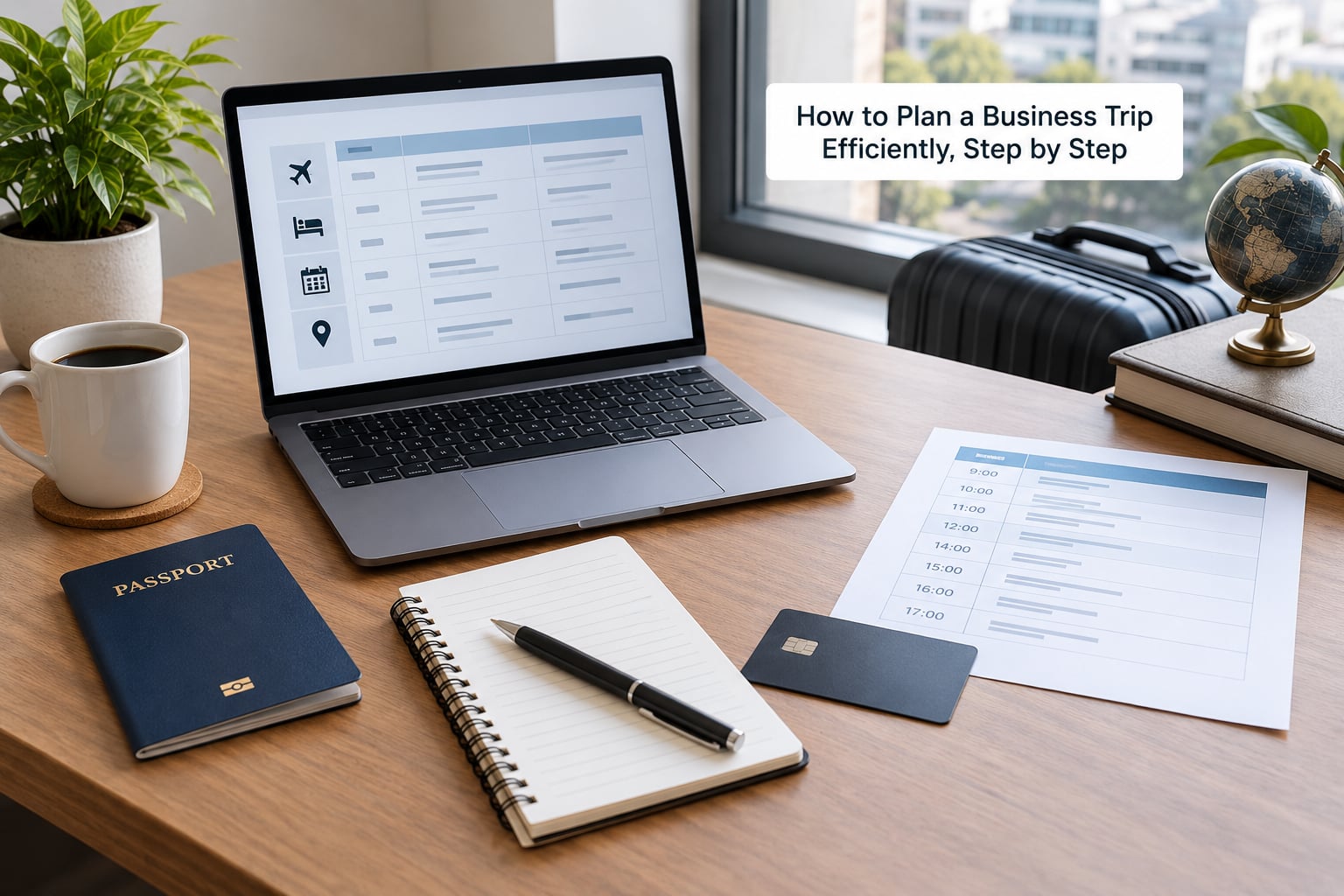
Each step below ends with a line on how to tell it worked. That check is what turns a list into a process. Do them in order; skipping the early steps is what creates the expensive problems later.
1. Define the business purpose and success criteria
Write the objective in one sentence that names a decision, a signature or a number. “Renew the contract” or “agree the pilot scope for Q1” beats “client visit” every time. Then list the meetings needed to reach that outcome and the deadline attached to it.
Use the time to decide what does not need a meeting. A status update that fits in an email rarely justifies a flight, and dropping it frees an afternoon for the conversation that actually decides something.
How long is a typical business trip? A single client meeting inside your own region is usually a one-day trip or an overnight. Domestic multi-city runs tend to run three to five days. International trips sit at four to seven days because of the travel in each direction. Derive the length from the meetings you cannot do remotely rather than picking a number and squeezing the agenda into it.
How to tell it worked: someone else could read your sentence and describe what success looks like without asking you a follow-up question.
2. Check dates, destinations, and travel constraints
Work backwards from the fixed dates. Most calendars have hard anchors, a conference that cannot move, a board meeting, a quarter close. Everything else bends around them.
Then run a reverse countdown with real lead times. For international travel, visa and entry paperwork can take weeks and occasionally months, so that sits at eight weeks out or earlier. Booking international flights usually lands between four and eight weeks ahead, and domestic flights between two and four weeks. A visa-required destination needs its application filed before the flight is ticketed. Circulating the meeting agenda happens one to two weeks ahead so attendees can prepare, and the final confirmation of hotels, ground transport and meeting rooms sits at about 48 hours.
Check time zones and working hours before you commit. A 9am meeting on the other side of the world is usually a 7pm or 11pm call for you, and it will not get better with practice. Look at local holidays and public transport strike days, and remember that ground travel adds time at both ends: an airport 45 minutes outside the city plus a train into town can eat three hours of a travel day.
How to tell it worked: you can state the earliest date you could have left and the latest date you could return without breaking anything.
3. Set the budget and approval process
Build the budget from categories, not one number. Airfare, lodging, meals, local transport, connectivity, activity or client entertainment fees, and a contingency line. Categories matter because policies usually cap them separately, and a trip that busts the hotel cap is fixable while you are still comparing options.
Separate what the company pays from what you pay. Airfare, standard hotel, and transport to and from the airport are commonly covered. Meals often run on a per diem allowance instead of itemised receipts, and extras such as a client dinner or a loyalty membership are usually out of pocket or need a separate approval. Ask rather than assume, and get the answer in writing before you spend.
Know the approval route before you book, not after. Who signs off, what the spending threshold triggers, whether the request needs a business case attached, and how long approvals usually take. Booking on your own card and claiming later is slow and often rejected.
One useful habit from frequent travellers: write the purpose and the currency on the back of each receipt as you put it in your wallet. A month later you will not remember what the taxi was for, and finance rarely guesses.
How to tell it worked: you could hand your budget and receipts to a colleague and they could file a clean expense report without asking you a single question.
4. Book transportation and lodging
Compare total journey time, not the clock time on the ticket. A cheaper flight with a three-hour layover and an hour of airport transit can leave you less useful than the pricier option you land earlier and can sleep at home.
Where flexibility exists in your dates, pay a modest premium for a changeable or refundable fare. Travellers on business travel forums repeatedly describe this as cheaper than rebooking when a client moves the meeting, and they are usually right. If dates are fixed, a restricted fare is reasonable and you simply say no when someone asks you to move it.
For hotels, location decides more than the room. Check the real transfer time from the airport and from the meeting venue at the hour you will actually travel, not the straight-line distance on a map. Frequent travellers tend to stay inside one hotel brand family and keep flights inside one airline alliance, because status credits and the small upgrades add up quietly over a year. Check your company rate before the public rate, and read the cancellation terms, not just the nightly number.
Book the ground transport while you still remember. Airport transfer, a train to the venue city, and a car or rideshare for the first client meeting. Knowing the transfer before you land removes the most common source of trip-day stress.
How to tell it worked: every confirmation number is in one place and the total door-to-door time from home to the first meeting is realistic.
5. Build a day-by-day itinerary
Put meetings, travel, meals, buffers and recovery time in the same document. A sample three-day pattern looks like this, and the shape matters more than the specific hours:
- Day 1, arrival. Morning arrival and transfer, one 60-minute meeting in the afternoon, an hour of admin to recover, dinner with the local team. No deal-making on day one.
- Day 2, the working day. 08:30 to 09:30 preparation and a review of the story since the last visit, 09:30 to 11:00 the main meeting, 11:00 to 12:00 break and notes, 13:00 to 15:00 a second session, 15:00 to 16:00 actions and next steps written down while everyone is still in the room.
- Day 3, close and go. A 30-minute follow-up call, a written recap while the details are fresh, then a transfer with enough margin to be at the airport roughly two hours before an international departure or 90 minutes for a domestic one.
Travel east to west and your body clock struggles more than going the other way, so protect the first morning after a long flight. If the offset is large, land a day early rather than scheduling something important on arrival. Keep the day of your flight free of client commitments, and leave a real buffer between a meeting’s end and the next commitment’s start, because meetings run over.
How to tell it worked: every day has at least one unscheduled hour, no back-to-back transatlantic flights with a meeting in between, and the calendar reflects local time in the destination.
6. Organize documents and digital tools
Everything needed to run the trip should work without a connection. Download boarding passes to your wallet and to a PDF on your phone, screenshot the hotel confirmation and the first day’s calendar, and put a copy of your passport’s photo page somewhere you can reach without unlocking anything complicated.
Set up connectivity before you leave. An eSIM or a roaming plan beats hunting for a SIM counter on arrival, and knowing whether your phone even supports eSIM saves an awkward airport queue. A VPN matters if you handle anything sensitive over hotel Wi-Fi. Ask your IT team what they permit rather than assuming, because policies vary and the answer changes how you work.
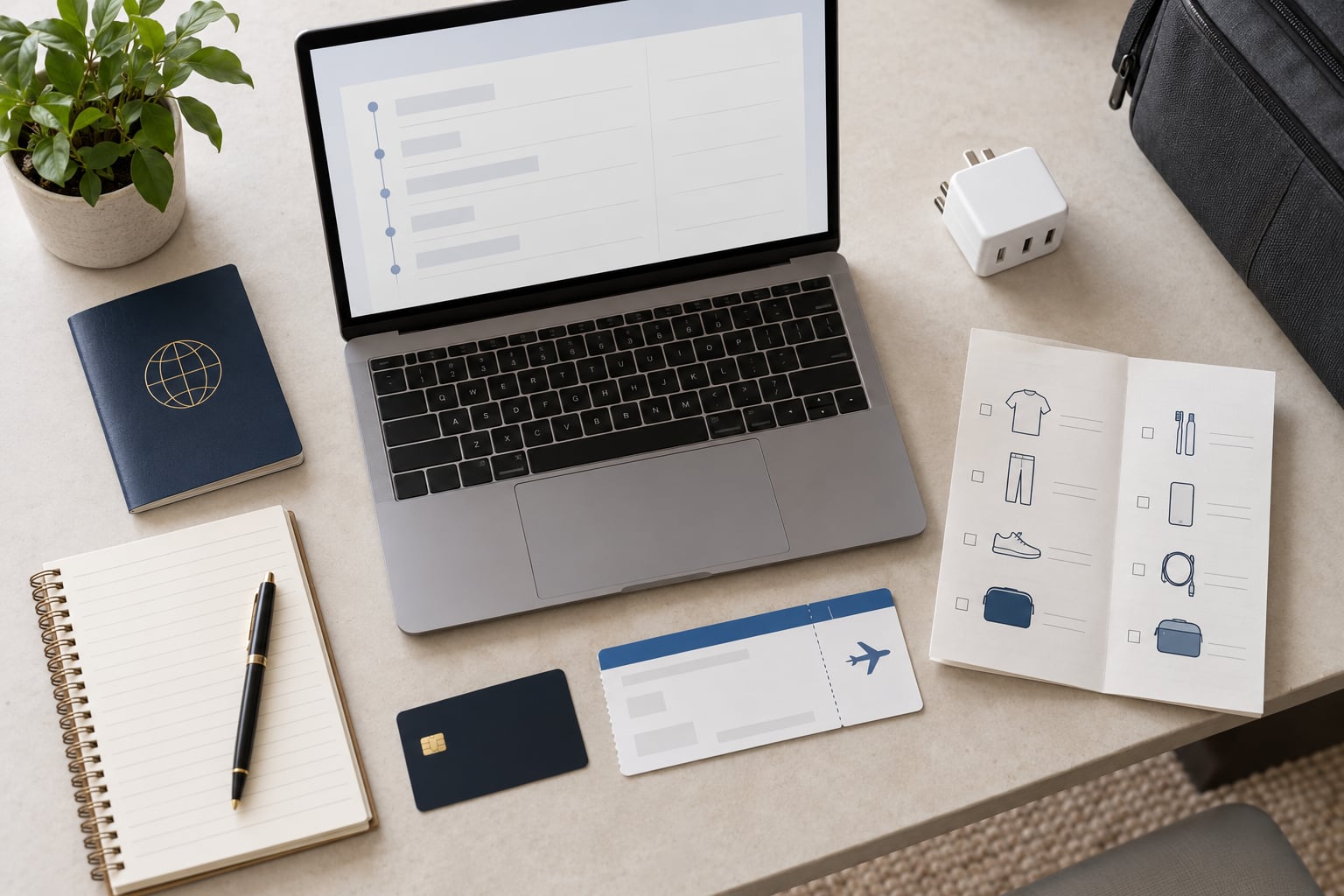
Carry the hardware that a long day actually needs: a power adapter for the destination plug type, a charger or small battery, headphones for calls on the move, and clothing that packs flat rather than creases. If a critical document matters, print one copy. Airlines do lose luggage, and a printed agenda in a carry-on has saved more than one trip.
How to tell it worked: you could go offline in an airport with no signal and still reach your boarding pass, your agenda and your hotel address.
7. Confirm arrangements and share the plan
The five things worth doing before you travel: get the approvals in writing, confirm every booking, send the agenda a week ahead, tell your manager and your team calendar, and check the local arrangements in writing with your host.
Send the agenda with the meeting title, the one outcome you want, the pre-reading, and the decisions you need them to make. People prepare when they know the ask. Ask about access requirements for the venue, the building security rules for laptops, and whether anything is being done in a language you will not read well.
Confirm hotel address, transfer options and meeting rooms with your local host a day before arrival, and ask what is genuinely expected of you socially: a dinner, a coffee, a round of golf. Getting that wrong shows up everywhere.
Leave home in good order, because this is the part first-timers forget. Hand over whatever you cover, agree who fields urgent calls, and sort keys, dependants, pets and plants before the final week. A last-minute scramble at home has ruined more departures than a missed connection.
How to tell it worked: your host has confirmed the agenda and the logistics, and nobody at work is waiting on you for something.
8. Prepare for expenses and the unexpected
Build the contingency before you need it. Save the airline rebooking number, the hotel’s direct line, your travel assistance contact and one nearby alternative hotel for each city. Keep a card available with credit headroom and a second card kept separately.
Decide the play for four situations in advance. Flight cancelled: rebook on the airline app first, notify your host, then reschedule meetings by phone rather than waiting. Lost luggage: file the report at the airport before you leave, get a written reference number, and keep essentials in your cabin bag. Laptop failure: know who your IT contact is and whether the company has a loaner arrangement locally. Visa or entry problem: have the invitation letter, passport copy and contact details of the local host or employer ready, because that is what gets you through a consulate call.
Set up receipt capture so it happens automatically. Photograph each receipt the day you get it, use the expense app as you go rather than in a pile at the end, and keep the per diem rate and the categories you can claim in a note on your phone. Files filed within a couple of days are approved faster and generate far fewer questions.
How to tell it worked: you could lose connectivity for a day mid-trip and still know every booking, every contact and every receipt.
9. Review and close the trip efficiently
The final stage is what makes the next one faster. Within 24 to 48 hours of landing back: file the expense report, write the debrief while details are fresh, and send a short follow-up to everyone you met.
The debrief is short. What was the outcome against the objective from step 1, what was agreed, who owns each action and by when, and what would you do differently on a return visit. Send the same three lines to your client or partner so the record matches.
Then update your templates. Add the meeting to your booking tracker with the actual lead time and cost, note which hotel worked and which transfer took too long, and save anything the policy team explained. A return trip planned from last trip’s data is where the efficiency actually comes from.
How to tell it worked: the report is filed, the follow-up is sent, and your next trip’s template already contains what you learned.
Common Mistakes
Booking on price alone. A fare that looks cheap in the search box can add hours of transit and a night in a hotel. Compare door-to-door total time and the transfer at each end before you decide.
Booking late because the dates felt vague. Every traveler who waits for certainty pays more and changes it later. Fix the objective, fix the deadline, then book to the lead times above and treat changes as a normal cost of business travel.
Overpacking the itinerary. Four solid meetings beat six rushed ones. Leave an unscheduled hour each day and put the most important conversation in the least tired slot of the trip, not the first available one.
Ignoring the time zone. Convert every meeting time into local time on both sides before you accept the invitation. Book flights that land early enough to sleep at a reasonable hour on your body clock, not at midnight.
Leaving confirmations to arrive at the last minute. Hotel rooms held without a guarantee, meeting rooms not confirmed and transfers never arranged are the standard causes of a trip starting badly. One 20-minute confirmation call a day before departure prevents most of it.
Losing receipts and argument material. Photograph receipts the same day, note the purpose and currency on the back of the paper ones, and file the report within the deadline. Finance cannot approve what nobody can explain.
Leaving home logistics to the last 24 hours. Keys, dependants, pets, plants and the person covering your work. Sort these a week out, not the night before.
Packing for the trip as if it were a holiday. One outfit per day plus one for the meeting that matters, everything that packs flat, one adapter, one charger, headphones. Keep the good jacket for the day it matters and wear something else to get there.
Treating AI as the source of truth. Tools can draft an agenda, summarise a policy or build a first itinerary in seconds, and they are useful for exactly that. Never rely on one for flight times, entry rules, prices or policy limits; verify those with the airline, the immigration authority and your own policy document.
Efficiency tips worth keeping: bundle several client visits into one journey rather than flying twice, stay inside one airline alliance and one hotel brand family to build status, arrive a day early for long-haul rather than recovering on a meeting day, keep printed backups of anything you cannot afford to lose, and hold the follow-up call in the calendar before you fly so the debrief does not drift.
Frequently Asked Questions
How long before a business trip should I book flights?
For international travel, start looking four to eight weeks out and book once the dates firm up. Domestic trips usually cost less between two and four weeks ahead. If a visa is required, file the application well before ticketing because processing can take weeks or months. Dates that are still uncertain are better booked on a changeable fare, since a modest premium usually beats rebooking.
How long is a typical business trip?
A single client meeting inside your region is usually a one-day trip or an overnight. Domestic multi-city visits run three to five days, and international trips tend to sit at four to seven days to absorb travel in each direction. The right length comes from the meetings you cannot do remotely plus realistic travel and recovery time, not from a target number.
What documents do I need for an international business trip?
Usually a valid passport with enough validity remaining, a visa or entry authorisation where required, an invitation letter from the host, proof of onward travel, and any professional credentials your field recognises. Also carry the host contact details and your employer’s assistance number. Keep a photo copy of the passport’s details page in cloud storage and offline on your phone.
What should I pack for a business trip with a laptop?
Laptop, charger, power adapter for the destination plug type, a small battery if the day runs long, headphones for calls in transit, and a backup cable. Clothing that packs flat beats outfits that crease, and one meeting-ready outfit is enough if you choose the day. Keep the critical documents on a printed sheet in your cabin bag in case the luggage goes missing.
Can I use ChatGPT to plan a business trip?
Yes, for drafting agendas, turning policy documents into a short summary, building a first itinerary draft and writing the expense narrative. Do not trust it with flight times, prices, visa or entry rules, or your company’s spending limits. Verify anything time-critical or financial against the airline, the immigration authority and the policy document itself before booking.
How do I expense a business trip without problems later?
File the report within your deadline, usually within a few days of returning. Photograph every receipt the day you receive it and note the purpose and currency on paper ones. Separate what the company covers from what you paid yourself, and keep the per diem rules to hand so meals are claimed correctly. Ambiguous receipts are the fastest way to get a report returned.
Conclusion
Efficient planning is nine short stages, not one big effort: objective, dates and constraints, budget and approvals, bookings, itinerary, documents, confirmations, contingency, close-out. The whole process takes under an hour once the template exists, and it protects the part of the trip that actually earns its cost, the in-person hours.
Start now with the three things that block everything else. Write the one-sentence objective, confirm the fixed dates and the approval threshold, then book the flights and hotel inside the lead times above. The rest fills in around them, and your next trip will take half as long again.