What to know before flying a dog in cargo comes down to five things: whether the airline accepts your dog on that route at all, whether the season and the aircraft allow it, the paperwork and its narrow validity windows, a crate that meets the carrier’s exact rules, and who collects the dog at the other end. Flying a dog in cargo means it travels in a pressurised, temperature-controlled hold inside an IATA-approved crate, in the care of cargo staff, instead of in the cabin with you.
I have read enough airline policies and owner threads to know where people get caught out. It is almost never the flight itself. It is a health certificate issued too early, a crate with wheels, a dog whose breed is quietly embargoed, or a receiving person who never got the collection window right.
This guide covers the whole decision, from whether cargo suits your dog at all through to the contingency plan if the flight goes sideways. Airline rules change often, so treat everything below as what to verify, not as a substitute for the operating carrier’s live animal page.
Table of Contents
- 1Should Your Dog Fly in Cargo?
- 2Is flying a dog in cargo actually safe?
- 3What to Know Before Flying a Dog in Cargo
- 4Airline, Aircraft, and Route Restrictions
- 5What to Know Before Flying a Dog in Cargo for Each Airline
- 6Health and Fitness Requirements
- 7Choosing and Preparing the Right Crate
- 8Documents, Identification, and Packing
- 9Fees, Timing, and Booking Strategies
- 10Check-In, Loading, Tracking, and Arrival
- 11What If the Flight Is Delayed, Diverted, or Canceled?
- 12Frequently Asked Questions
- 13Can any dog travel in an airline’s cargo hold?
- 14How heavy can a dog be when traveling as checked baggage or cargo?
- 15Do airlines allow dogs in the cabin instead?
- 16How early should a dog arrive at the airport?
- 17Should I feed the dog before the flight or give it water?
- 18Conclusion
Should Your Dog Fly in Cargo?
Cargo suits dogs above a cabin carrier’s weight limit, dogs on routes where the airline does not sell cabin pets, and owners who are relocating rather than holidaying. In practice that is usually a dog of roughly 10 kg or more with the carrier, or any dog on a long-haul segment sold through cargo.
It is a poor fit for an anxious or reactive dog, a very young one, an elderly one, or one with heart, breathing or spinal problems. Breed shape matters too: brachycephalic, snub-nosed breeds such as pugs, bulldogs and Boston terriers have narrowed airways, and many carriers refuse them outright or require an experienced pet shipper to handle them.
The honest comparison is with the alternatives rather than with a fantasy version of the flight:
| Option | Size limit | Paperwork burden | Best fit |
|---|---|---|---|
| In-cabin pet | Carrier must fit under the seat, usually the dog plus carrier under 8-10 kg | Health and vaccination records, sometimes a service animal form | Small, calm dogs on routes where cabin pets are sold |
| Cargo hold | Set by each carrier, commonly up to 14 kg per animal and per-crate totals | Full vet and import package with timed health certificate | Medium and large dogs, long-haul, international moves |
| Pet shipper (freight forwarder) | Same physical limits, handled for you | Same paperwork, plus coordination and customs | International moves, snub-nosed dogs, owners who cannot do airport logistics |
| Driving or ocean freight | No cabin limits | Import rules at the border, no airline rules | Relocation within a land border, or a move with weeks of lead time |
Owners on travel forums are consistent on one point: if you have a workable alternative, take it. But plenty of people with dogs in the 20 to 35 kg range have no alternative at all, and they describe cargo as far better than rehoming the dog or leaving them behind. That is a legitimate reason to move forward, provided you accept the stress the dog will likely feel.
Is flying a dog in cargo actually safe?
Commercially, yes. Live animals travel on a manifest, not as baggage, and they move in a hold that is pressurised to cabin altitude and temperature-controlled, with the loading monitored for ground crew. The hold is not a cold metal box at 30,000 feet, whatever the internet tells you, and the widely circulated claim that holds are unheated and freezing is the part that has confused people for years.
The genuine risks are narrower and more boring than the headlines suggest. The real ones are a long transit with a dog that cannot urinate or defecate, a dog that overheats because it is anxious and panting in a warm hold, an animal weakened by illness, and the documented edge cases where an animal in a crate is mishandled during a rushed loading. Those are reasons to prepare the crate and the dog carefully, not reasons to assume the process is negligent.
Two related worries come up constantly. Dogs’ ears do not pop the way human ears do, though some dogs are uneasy during pressure changes and a calm crate environment helps. And sedating a dog to prevent stress creates a bigger hazard than the stress itself, for the reasons below.
What to Know Before Flying a Dog in Cargo
Every airline publishes its own version of the same rule set, and the numbers differ enough that you must read the operating carrier’s page for your specific flight rather than generalise. Here is what to confirm before you commit money to anything.
| Item to check | What varies between airlines | Example of a published rule |
|---|---|---|
| Minimum age | Weeks required before travel | At least 8 weeks old |
| Maximum weight per animal | Per dog and per crate combined | 14 kg per animal, 2 animals per crate |
| Crate size | Maximum exterior dimensions | 150 x 90 x 90 cm maximum |
| Health certificate window | How recently it must be issued | Some carriers require issuance within 48 hours of departure, others accept a 7 to 10 day window |
| Booking lead time | How far ahead space must be reserved | At least 48 hours before departure |
| Temperature embargo | Tarmac and ramp cut-off temperatures | Live animals not accepted below 45°F or above 85°F |
| Collection window | How long the airline will hold the crate after landing | Set locally by the destination cargo terminal |
Two of these lines catch people out every time. The health certificate window is the classic: issued too early and it is rejected, so check whether your carrier wants a certificate dated within 48 hours of departure or within ten days. And the temperature embargo is checked by the airline, not by you, which means a booking you confirmed in a cool week can be refused on a hot one.
Airline, Aircraft, and Route Restrictions
Rules are set by the airline operating your flight, and the aircraft matters as much as the airline. Not every type flies live animals, and on some routes the connection is operated by a partner carrier with a stricter policy than the one you booked with.
Verify three things before you pay: the operating carrier on every segment, whether that carrier serves the route with pet cargo at all, and whether the departure and arrival airports have a live animal desk that will handle your dog. A route that works nonstop may fail completely with a change of aircraft at a hub, because the connection has its own handling agent and its own cut-off times.
What to Know Before Flying a Dog in Cargo for Each Airline
Compare carriers on the same checklist: which animal types they accept, weight and crate limits, crate construction rules, required documents, the fee basis, seasonal or geographic embargoes, check-in cut-off, tracking availability, and whether live animal handling exists at your arrival airport. Two carriers can publish identical crate rules and completely different paperwork windows, and that difference decides whether you fly on Monday or rebook for next month.
Check transit country rules as well. A dog routing through a third country may need extra permits or certificates that the origin and destination never asked for, and this is where a lot of relocations quietly go wrong. Import requirements come from the destination country’s agriculture or health authority, not from the airline, and they can include permits that take weeks to issue.
Season matters too. Heat embargoes in summer and cold cut-offs in winter remove routes from the schedule, and the destination airport’s tarmac temperature counts as well as the departure one. If your travel date sits near either threshold, build in a flexible plan or choose a different month.
Health and Fitness Requirements
Your dog needs a veterinary assessment before this trip, not just paperwork. Ask the vet specifically about fitness to fly: respiratory health, heart function, and whether the dog can manage the stress of hours in a dark hold. For an anxious dog, ask about behavioural support and pre-travel training that does not involve sedation.
Most airlines and most vets advise against sedation. It depresses the dog’s ability to regulate body temperature, impairs balance in a crate that may be moved and tilted during loading, and it removes the alert state an animal needs if something goes wrong. It is also frequently prohibited by carrier policy, which means a sedated dog can be refused at the counter.
Never give human medication to a dog unless your vet has specifically directed it. If your dog takes anything regularly, tell the vet about the trip in advance so they can advise on timing and what to put, if anything, in the crate.
Choosing and Preparing the Right Crate
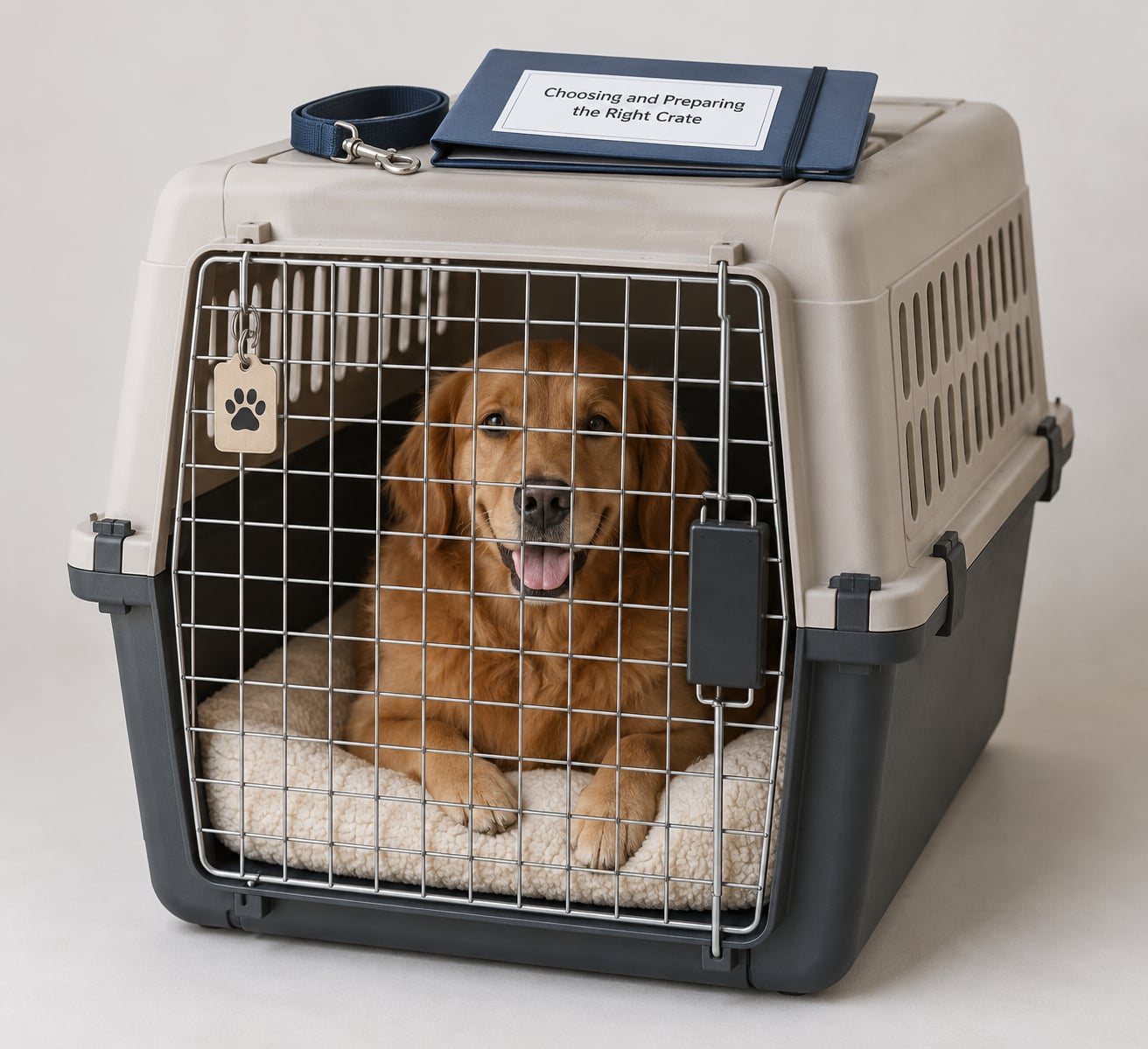
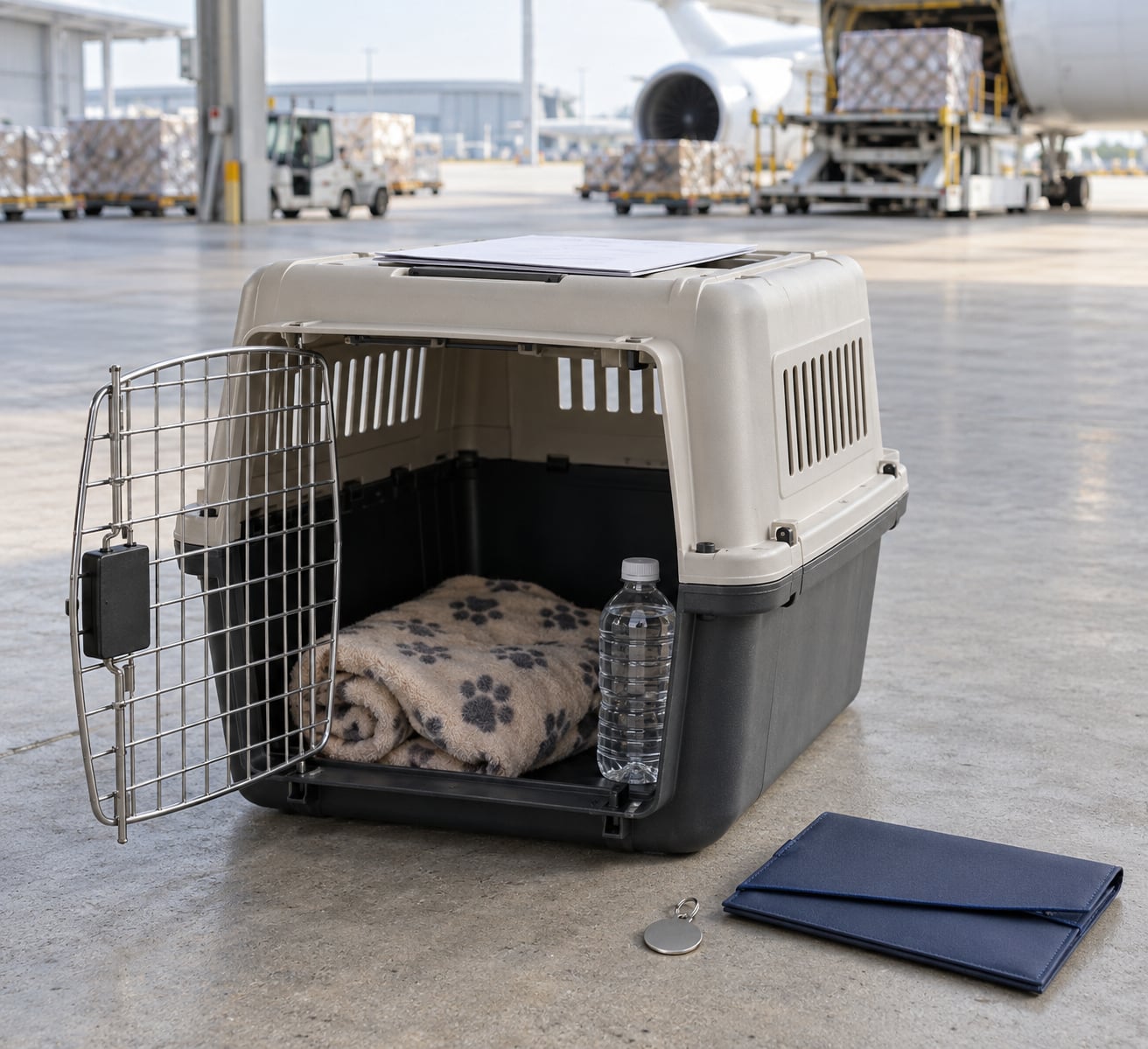
The crate is where airline rules are most concrete and where most owners get turned away. It must be an IATA-approved rigid crate that the dog can stand in, turn around in, and lie down in naturally, without touching the door or roof. If the dog has to hunch or press against the walls to fit, the crate is too small and the airline will measure it.
Construction rules are common across carriers: hard plastic sides rather than soft-sided fabric, no wheels, doors secured with cable ties rather than a lock or latch the dog could open, absorbent bedding on the base, ventilation holes left unobstructed, and strong handles on at least two sides. Your mobile number and the destination contact have to be written legibly on the outside of the crate, along with feeding instructions and the air waybill number.
Acclimate the dog to the crate before the travel day, with the door open, door closed, and then with short periods of sitting in it. Owners report this is the single biggest difference between a calm dog and a panicked one. Practise loading and unloading too: a dog that has never been lifted into a hold by strangers will find the handover far more stressful.
For water, freeze the bottle before attaching it so it does not slosh and the dog can lick it as it thaws. Add a worn blanket or a familiar item for smell, and line the base with absorbent material in case of accidents during the wait.
Documents, Identification, and Packing
Your paperwork is the thing that most often causes a refusal, and owners report that a single missing or expired document means the dog does not travel, with no exception at the counter. Build the file well ahead of time and carry two copies of everything.
Typically the package includes:
- Microchip record with the chip number matching your pet passport and import paperwork.
- Rabies vaccination certificate, valid and current for the destination’s required waiting period.
- Veterinary health certificate, issued inside the carrier’s validity window, sometimes as short as 48 hours.
- Import permit or entry documentation from the destination country’s authority, where required.
- Pet passport for EU and other destinations using that system.
- Airline cargo confirmation and air waybill details.
- Feeding and watering instructions attached to the crate, plus a top-up plan if the flight is delayed.
- Contact details for you and for the person collecting, written on the crate and on every document.
Distinguish what is mandatory from what is a sensible backup. The health certificate, vaccination record, microchip documentation and import permit are mandatory; the printed copies, the itemised crate inventory and a photo of the dog inside the crate are your safety net if something goes wrong at the far end.
Do not put human medication, sharp objects, breakable bowls or anything the dog could swallow in the crate. Put the dog in, close it, and have someone else look at the setup with fresh eyes before you leave.
Fees, Timing, and Booking Strategies
Cargo charges vary so widely by airline, route, animal weight and service level that any typical figure I gave you would mislead you. What you can do is request a written quote for your exact route, animal weight and crate dimensions, and compare it with the alternatives: cabin pet fee, pet shipper quote, or a specialist forwarder who will handle paperwork and customs.
Hidden costs add up faster than the headline charge. The crate itself is often the largest single expense, especially for a large dog. Then there are courier or shipper margins, feeding and water accessories, document fees such as import permits or veterinary certificates, and airport or handling charges at the destination.
Book the dog’s space before you finalise the rest of the itinerary. Pet space on a popular aircraft is limited, and the booking deadline is early: at least 48 hours for some carriers, longer for others and for international paperwork. Build the trip backwards from the health certificate date, not forwards from the flight date, so the certificate lands inside its validity window.
Where possible, choose a flight arriving at an airport with a known live animal process and enough daylight hours left in the day for collection. A late-night arrival at an unfamiliar terminal is a preventable problem.
Check-In, Loading, Tracking, and Arrival
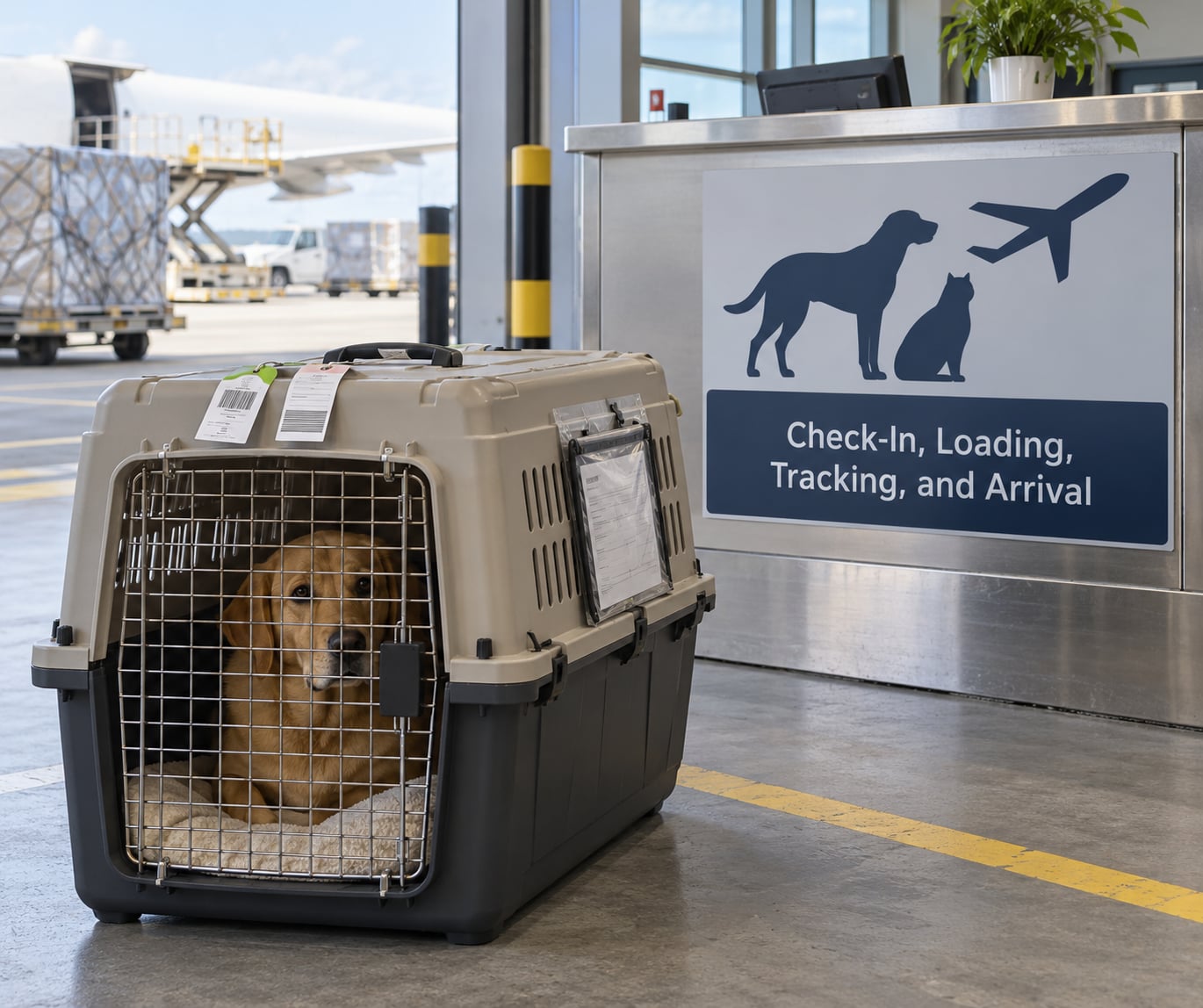
On the day, arrive early enough to clear the airline’s cargo check-in cutoff, which is earlier than passenger check-in and is set locally by the cargo terminal. Owners consistently say the wait and the uncertainty are the hardest part, not the flight.
The handler will inspect the crate and check the paperwork against your booking. They confirm the crate measurements, the fastening, your contact details on the outside, and that the dog is inside. If anything is wrong, this is where it gets fixed, and sometimes that means the dog does not fly.
Hand it over with feeding instructions attached, then step away. The crate goes into a pressurised, temperature-controlled hold on a manifest, and you can usually follow it through the airline’s cargo tracking once it is loaded. Ask for the tracking reference rather than assuming one is available on every route.
At the destination, the person you nominated collects the dog. They need photo ID matching the name on the paperwork, the air waybill or collection reference, and the collection window. They will be shown the crate before it is opened, and the dog should be allowed out somewhere quiet rather than in a public arrivals hall.
Once home, expect a quiet evening and a sore, confused animal. Owners describe decompression lasting anywhere from a day to a week, with withdrawal, poor appetite and disrupted sleep. Persistent symptoms, or anything that looks like breathing difficulty, is a vet call the same day.
What If the Flight Is Delayed, Diverted, or Canceled?
Assume something will go wrong and plan for it in advance. A rerouted cargo flight cannot follow a passenger itinerary, so the dog may end up somewhere else entirely, and there is no guarantee of a routing once it is on the manifest.
Before travelling, have these agreed in writing:
- A primary and a backup receiving person, each with photo ID and the collection reference.
- Your airline’s cargo service contact and the destination cargo terminal’s number, saved in your phone.
- A feeding plan for a long delay, since your instructions cover the scheduled flight, not a day on the ramp.
- A local vet or emergency contact at the arrival city.
- A decision rule for the dog if it arrives at a different airport and nobody can reach you in time.
Monitor the flight and cargo status yourself, and keep your phone charged and reachable. If weather closes the field or an embargo is declared at your destination, your receiving person needs standing authority to collect the dog whenever it arrives, not just on the original date.
Frequently Asked Questions
Can any dog travel in an airline’s cargo hold?
No. Most carriers set a minimum age of around 8 weeks and a per-animal weight limit that is often 14 kg, with crate size caps on top. Many airlines also refuse brachycephalic snub-nosed breeds outright, or require an experienced pet shipper for them. Older dogs and dogs with heart, breathing or mobility problems need a vet’s opinion first. Always check the operating carrier’s live animal page for your exact route.
How heavy can a dog be when traveling as checked baggage or cargo?
It depends on the airline, and the limit applies to the dog plus crate combined, not the dog alone. Many carriers cap live animals at 14 kg each with a limit on total crate weight, and set a maximum crate size around 150 x 90 x 90 cm. Exceeding either figure means the crate is refused, so measure your dog and its crate before booking, not after.
Do airlines allow dogs in the cabin instead?
Most do, within limits. A cabin pet must usually travel in an airline-approved soft carrier that fits under the seat in front of you, with the dog and carrier together typically under 8 to 10 kg depending on the carrier. Larger dogs go in the hold, either as cargo or as excess baggage. Not every route or aircraft sells cabin pets, so check before you buy your own ticket.
How early should a dog arrive at the airport?
Earlier than a passenger, because cargo check-in closes well before the flight. Many airlines require the dog to be presented at least two hours before departure, and some set cutoff times that are earlier still. Confirm the local cargo terminal’s cutoff with the airline for your specific airport and day, and remember that a delay in paperwork cannot be fixed after the cutoff passes.
Should I feed the dog before the flight or give it water?
Most owners feed a light meal early in the morning and then withhold food for several hours before departure, because a full stomach and a long hold is a bad combination. Water should always be available, attached as a bottle frozen beforehand so it does not slosh. Owners also keep the dog awake and exercised through the morning so it is ready to sleep for most of the flight.
Conclusion
Start with the operating carrier’s live animal rules for your exact route and date, before you buy anything nonrefundable. Then book the veterinary consultation, because the health certificate timing and your dog’s fitness assessment shape everything else that follows.
Have a backup route in mind, whether that is a different month, a different city or a pet shipper who can take over, and be honest about your dog’s health and stress tolerance. Flying a dog in cargo is a manageable process for a well-prepared, reasonably calm dog. It is a gamble for an anxious one, and no schedule is worth that.