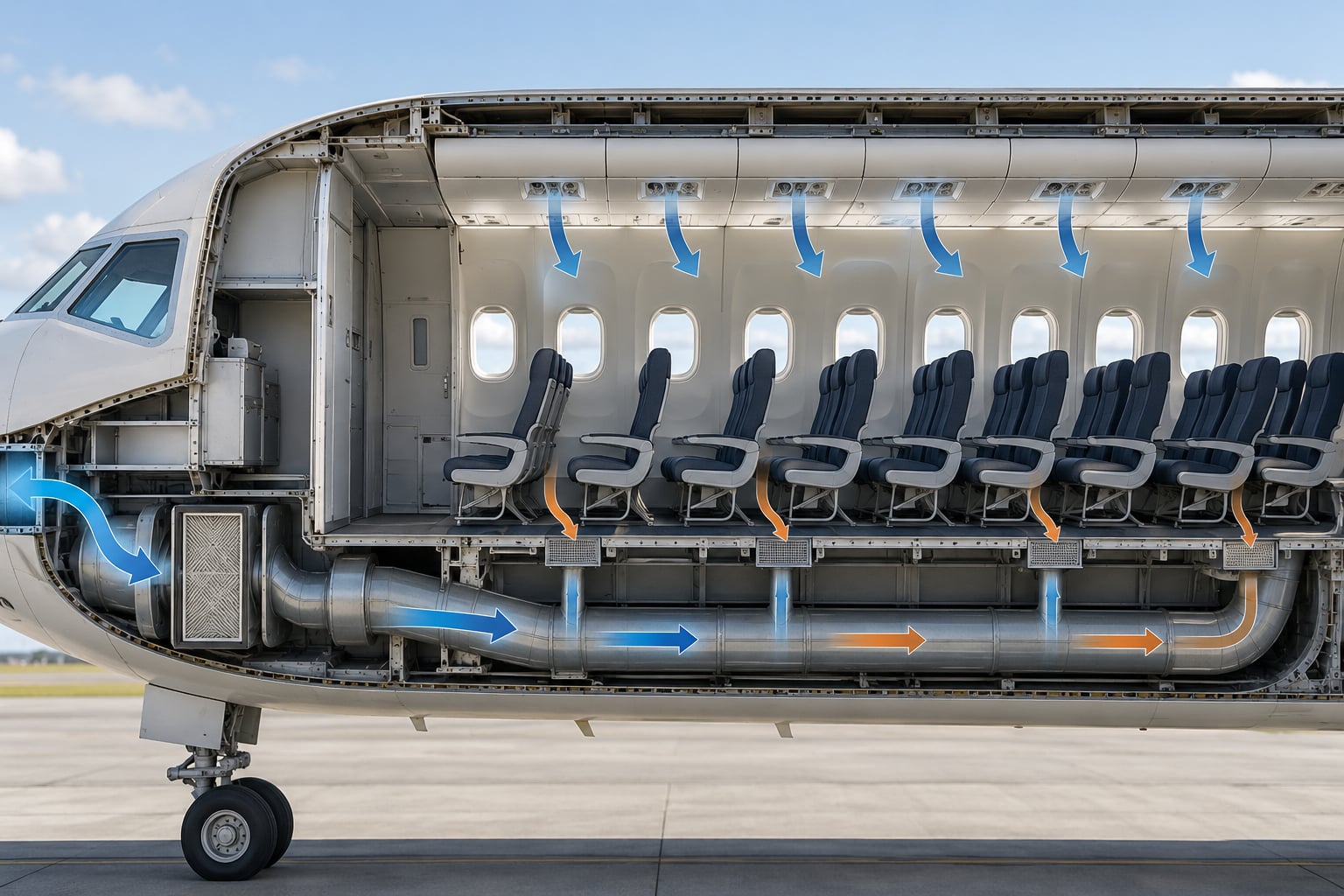
Airplane cabin air filtration works in two stages: outside air bled off the engines is mixed with cabin air that has been pulled out near the floor and pushed through HEPA filters, then delivered back through the overhead outlets. The recirculated share is filtered at roughly 99.97% efficiency for particles at or above 0.3 microns, and a cabin goes through a complete air change roughly every two to three minutes in cruise.
That is the short version. The interesting part is what sits between the engine and your seat, and what the filters deliberately do not handle. Talk to enough cabin crew on long-haul flights and you quickly learn that even frequent flyers get the recirculation half of the story wrong, usually in the direction of assuming the air is worse than it is.
This guide walks the air the whole way through the aircraft, then covers filter mechanics, fresh-air rates, maintenance, and the real limits of what filtration can do. Updated for 2026.
Table of Contents
- 1What Is an Airplane Cabin Air Filtration System?
- 2The jobs the system handles together
- 3How Does Air Move Through an Aircraft Cabin?
- 4Why the ceiling-to-floor pattern matters
- 5What Role Do HEPA Filters Play?
- 6Where the filters physically sit
- 7What the filters are certified against
- 8How Often Is Outside Air Brought Into the Cabin?
- 9The exchange rate you will actually hear quoted
- 10Does Cabin Filtration Make the Air Completely Clean?
- 11Fume events are a separate category entirely
- 12How Is the Filtration System Maintained?
- 13The routine checks
- 14Why passengers should not try to inspect anything
- 15Which Factors Can Change the Quality of Cabin Air?
- 16Design differences between aircraft
- 17Occupancy and operation
- 18Cleaning, humidity, and individual conditions
- 19Myths worth dropping
- 20Frequently Asked Questions
- 21Do airplanes use HEPA filters?
- 22Do cabin air filters really work?
- 23How often does air recirculate on a plane in flight?
- 24Are airplane air filters replaced between flights?
- 25Do private jets have HEPA filters?
- 26Do ionization cabin air filters still exist on airliners?
- 27Conclusion: Start With the Airflow, Not the Filter Label
What Is an Airplane Cabin Air Filtration System?
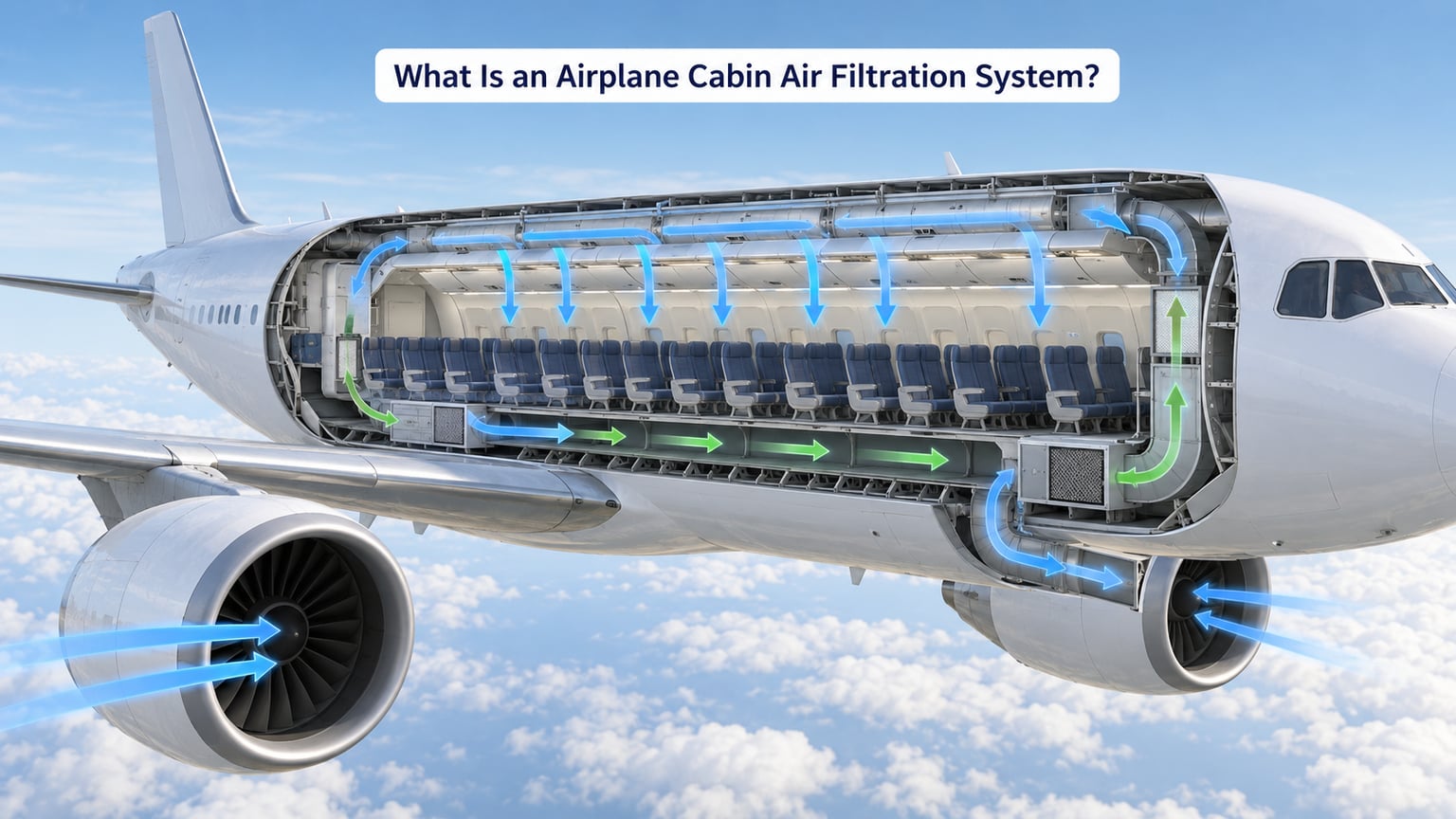
An airplane cabin air filtration system is not one box. It is the particle-handling part of a much larger environmental control system that also heats, cools, pressurises, and circulates air for the whole cabin.
The filtration element itself does a single job well: it traps airborne particles so they do not keep bouncing around the cabin. Everything else people associate with “air quality” in a plane, including temperature, humidity, smell, and how fresh the air feels, comes from other parts of the system.
The jobs the system handles together
On a pressurised airliner, the environmental control system typically has to supply breathable outside air, move that air through the occupied space, keep the cabin at a comfortable temperature, hold cabin altitude low enough that passengers can breathe comfortably, and remove particles from the recirculated portion of the airflow.
Filtration is the last item on that list, and it is the one people notice least. It also happens to be the one with the hardest performance specification behind it.
Both sides of the operation matter. The FAA states that most U.S. commercial airplanes use High Efficiency Particulate Air filters in the recirculated airflow, removing 99.97 percent of particles. Industry bodies such as IATA point out the second half of the design: on most aircraft the cabin is supplied with a blend of filtered recirculated air and fresh outside air rather than one or the other.
How Does Air Move Through an Aircraft Cabin?
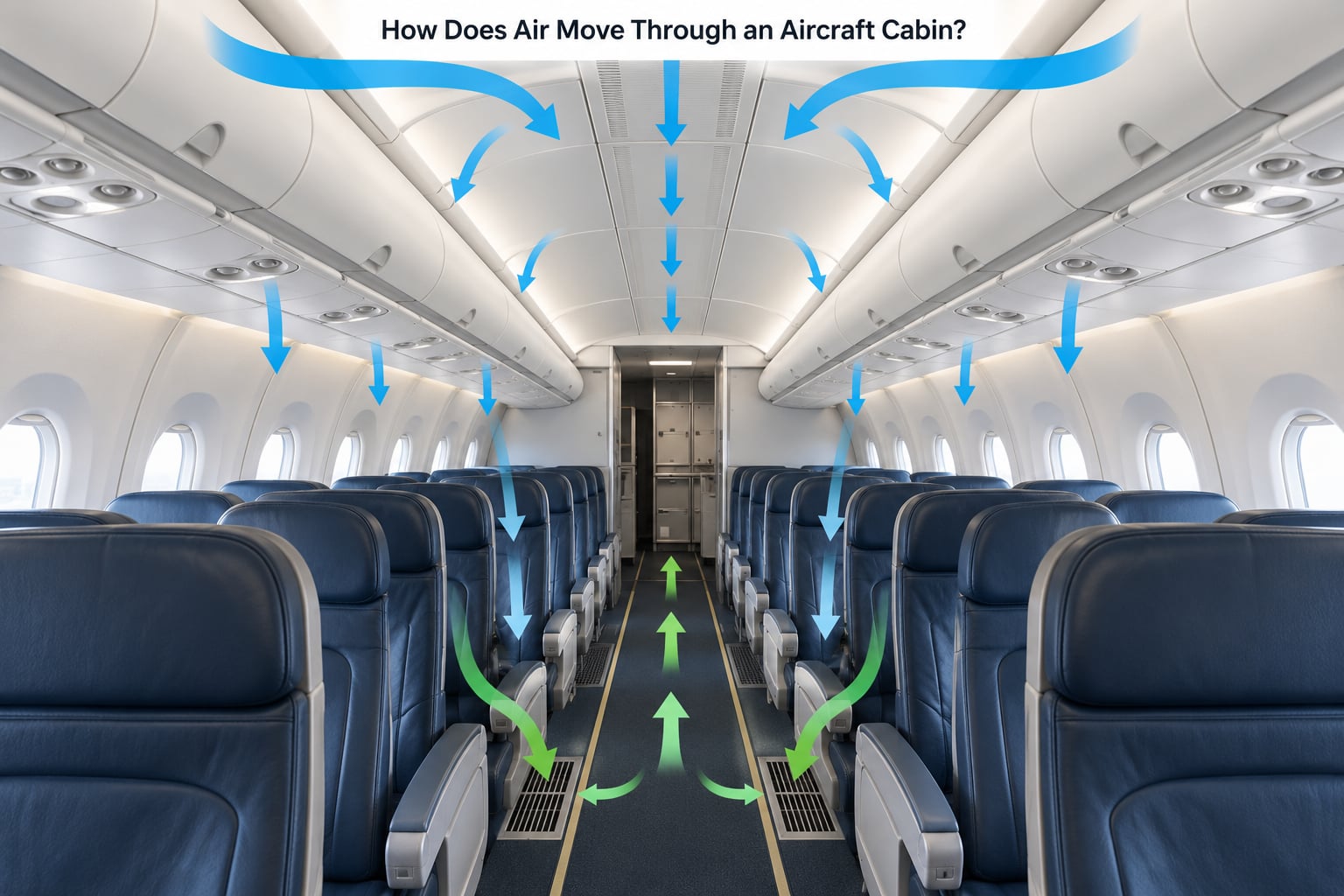
Air does not get pushed through the cabin once and thrown away. It moves in a loop, and the loop is what makes the particle numbers work.
Here is the path in order, from the engine to the seat and back again.
- Air is taken off the engine. Most airliners bleed hot, high-pressure air from the engine compressor section. That air is far too hot to enter a cabin at any useful temperature.
- The bleed air is conditioned. It passes through the air conditioning packs, which cool it down and control its humidity to a level that keeps passengers comfortable rather than soaked.
- Conditioned outside air meets recirculated cabin air. In a mixing chamber or plenum, the fresh stream is combined with a share of the cabin’s own air that has already been filtered.
- The mixed air goes out through the overhead and side outlets. Air enters the cabin high in the cabin volume and moves downward, which is the opposite of what most people expect from a room with floor vents.
- Air is drawn out near the floor. Return grilles at lower sidewall panels and under seats pull the used air back into the recirculation path, past outflow valves near the bottom of the fuselage.
- The recirculated portion passes through HEPA filters. Filters sit inside the recirculation ducting, upstream of the point where it rejoins the fresh outside air.
- The filtered air is redistributed. It rejoins the fresh air supply and the cycle repeats, giving roughly a full cabin air change every two to three minutes at cruise.
Why the ceiling-to-floor pattern matters
Air supplied at the top and extracted at the bottom produces a largely downward pattern with very little crossover between streams. Passengers in one row are not breathing the exhaled air of the row behind them in any meaningful way.
Frequent flyers often describe noticing airflow at the overhead vent, or describing the air as noticeably fresher once the packs spool up. That matches the design. The airflow most people notice is the system ramping to output, which is also why the ground period before departure feels different from cruise.
What Role Do HEPA Filters Play?
HEPA filters catch particles by interception, impaction, and diffusion. Air is forced through a mat of fibres, and particles either stick to a fibre by inertia, get trapped by inertia as the streamlines bend around a fibre, or are caught by Brownian motion for the smallest sizes.
The quoted figure is 99.97 percent removal of particles 0.3 microns and above. That number looks oddly specific because of what it represents. Zero point three microns is the most penetrating particle size, the size at which a fibrous filter is at its least efficient, so a filter rated there is also more efficient for smaller particles, which travel through fibrous media by diffusion.
That is also why 0.3 microns shows up in almost every public explanation of cabin air. It is a deliberately pessimistic test point, not a convenient round number.
Where the filters physically sit
Filter location is the part that answers the question readers on aviation maintenance forums keep asking. HEPA filters live inside the recirculation ducting, upstream of where the recirculated stream meets the outside air. Air that has been through the filter cannot reach the cabin without going through the filter again.
The housing is sealed, and the system is designed around a pressure differential across the media. Any air that bypassed the media would defeat the number, so the sealing and the airflow management matter as much as the filter paper.
What the filters are certified against
Aircraft HEPA units are tested to EN 1822 grade conventions used across European aerospace filtration, and filter manufacturers such as Pall and Donaldson publish performance data against those tests. Independent certification testing, rather than a manufacturer’s own claims, is the basis of the rating.
One detail worth knowing, because it seems contradictory: a filter with more dust loaded into it does not automatically stop working. Trapped particles accumulate on the fibres and often increase capture efficiency slightly, which is why filter condition and filter efficiency are separate maintenance concerns.
How Often Is Outside Air Brought Into the Cabin?
Aircraft use a mixture of fresh outside air and filtered recirculated cabin air, not pure recirculation and not pure fresh air. Published figures vary because the split differs by aircraft type and by design generation, and reputable sources quote different numbers for the same reason: they are describing different fleets.
National Geographic has cited roughly 40 percent of cabin air passing through the HEPA system with the remaining 60 percent piped in from outside. Other sources describe the mix closer to half and half. Both are describing real designs. The defensible statement is that a large share of the cabin’s air is recirculated, and that recirculated share is filtered.
On the outside-air side, bleed air supplied from the engines is a plentiful resource on a turbine aircraft, so the design choice is not really about scarcity. It is about humidity, temperature control, and the aircraft’s pressure and ducting limits.
The exchange rate you will actually hear quoted
The number that comes up repeatedly is a full cabin air change roughly every two to three minutes. Convert that to air changes per hour and the figure is substantial for an occupied space, though the industry standard naming for aircraft ventilation is not the same as the building-code measure used for rooms.
The practical result is what matters: the volume of air in a cabin is replaced many times over during a flight. The stale-air image that circulates in threads, that everyone keeps breathing the same air from the moment of take-off, does not match how the system is built.
Does Cabin Filtration Make the Air Completely Clean?
No. HEPA filtration is excellent at particles and does essentially nothing for several other things passengers notice. Here is the honest split, contaminant by contaminant.
- Dust, pollen, and particulate matter: very effectively removed by HEPA media.
- Aerosolised respiratory particles: captured at high efficiency along with other fine particles.
- Carbon dioxide: a gas, and not removed by particulate filtration. It is managed by the fresh-air supply rate and the number of passengers aboard.
- Humidity: set by the air conditioning packs, not by filters. Cabin humidity is deliberately kept low.
- Odours: not a particle problem at all. Activated carbon layers and cleaning address odour separately.
- Engine oil or hydraulic fluid (fume events): not removable by HEPA media. Handled as an operational hazard with its own crew procedures.
The odour question comes up constantly, usually framed as how planes deal with farts. The honest answer is that a particle filter does not remove odours at all. Smell is a gas-phase problem, and where odour control exists on an aircraft it comes from activated carbon material or from cleaning, not from the HEPA media.
Fume events are a separate category entirely
A fume event occurs when oil, hydraulic fluid, or exhaust components leak into the bleed air supply. Regulators and carriers track reported fume events as an ongoing occurrence, while confirmed incidents that actually reach the cabin are a small fraction of flights. Because the contaminant is a gas or vapour, a particle filter downstream cannot remove it.
Cabin crews have clear procedures for these situations, and they are treated as a safety issue rather than an air quality preference. If you have ever noticed a hazy or strange smell on a flight, this is the mechanism behind it, and it is not something the cabin filtration system is designed to catch.
How Is the Filtration System Maintained?
Filtration systems are maintained according to the aircraft manufacturer’s instructions, carried out by certified maintenance personnel, and recorded in the aircraft’s maintenance log.
The routine checks
Typical maintenance activity includes physical inspection of the filter element, replacement at the interval specified for the installation, checks on filter housing seals so there is no bypass leakage, and measurement of airflow and pressure differential across the media. A rising differential or falling flow is the usual signal that a filter is loading up.
Replacement intervals are set by the manufacturer and depend on the installation. They are not a fixed calendar number that applies to every aircraft.
Why passengers should not try to inspect anything
The filters, ducting, and mixing chambers are behind panels in areas passengers never access, and they are part of a certified system with defined performance. Opening anything is both unsafe and unlawful on a commercial flight.
Detailed maintenance practice also varies considerably by aircraft type and by operator, so it is worth treating general descriptions of maintenance schedules as orientation rather than as specifications for the aircraft you are about to board.
Which Factors Can Change the Quality of Cabin Air?
System performance is one factor among several. The rest explain most of the differences people notice between flights.
Design differences between aircraft
Newer airliners on major routes typically have full bleed air supply with HEPA filtration on the recirculated stream. Older aircraft, small regional jets, and many private and business jets use different architectures: fresh-air-only systems, partial recirculation with lighter filtration, or electrostatic and bipolar ionization systems.
Ionization deserves its own note. Boeing removed bipolar ionization systems from new production aircraft over disputes about byproducts, and ionization filtration has not gained broad acceptance. It is now uncommon on mainstream airliners, so a claim about “advanced ion air” on a commercial cabin is a reason to check the aircraft type.
Maintenance history matters too. A filter at end of service still traps particles efficiently, but degraded duct seals or non-standard equipment defeat the assumption that every cabin behaves identically.
Occupancy and operation
More passengers in a seat means more exhaled air and more particulate load for the same airflow. The number of air changes is high enough that this is handled far better than in an equivalent indoor room, but it is not zero.
Ground time is the other variable passengers underestimate. During boarding and taxi, packs are ramping rather than at cruise output, airflow is affected by open doors and ground power configurations, and ventilation can be running in a different mode. Short ground windows with dense boarding are a different exposure picture from a long cruise at altitude.
Cleaning, humidity, and individual conditions
Cabin humidity typically sits well below what most people find comfortable at home, which is why dryness, irritated eyes, and thirst show up in post-flight complaints more often than infection does. Odour complaints usually track cleaning cycles, galley operation, or a specific contaminant rather than filter condition.
Finally, illness in the cabin is an exposure question layered on top of a working system. Filtration lowers the concentration of airborne particles; it does not change who is sitting next to you, how long you are exposed, or what you do at the airport beforehand.
Myths worth dropping
A few persistent myths come straight out of the forum threads. You are not breathing the same air you breathed at take-off. Air does not pool by row or by section. HEPA filters do not make cabin air germ-free. And dry air is unpleasant, but it is not the reason people report feeling unwell after a long flight.
Frequently Asked Questions
Do airplanes use HEPA filters?
Yes, most commercial airliners do. The FAA notes that most U.S. commercial airplanes use HEPA filters in the recirculated airflow, removing 99.97 percent of particles 0.3 microns and larger. The filters sit inside the recirculation ducting, upstream of where recirculated air mixes with outside air. Small regional aircraft and many private jets use different arrangements, including fresh-air-only or ionization systems.
Do cabin air filters really work?
Yes for particles, no for gases. HEPA media capture dust, pollen, and aerosolised respiratory particles at very high efficiency, and efficiency rises for particles smaller than 0.3 microns. Filtration does nothing about carbon dioxide, humidity, odours, or engine oil and hydraulic fumes, which are gases or vapours. Judging the system only on the 99.97 percent figure misses most of what passengers actually notice.
How often does air recirculate on a plane in flight?
A cabin goes through a complete air change roughly every two to three minutes in cruise. Only part of that supply is recirculated cabin air; the rest is fresh air conditioned from engine bleed air. The recirculated portion passes through HEPA filters before being mixed and redistributed through the overhead outlets. Ground time is different, because the packs are still ramping to output.
Are airplane air filters replaced between flights?
Replacement follows the interval set by the aircraft manufacturer for that installation, and it is performed by certified maintenance personnel rather than between every flight. Routine work includes inspection, seal checks on the filter housing, and airflow and pressure differential measurements that show when a filter is loading up. A loaded filter still traps particles well, which is why condition and efficiency are tracked separately.
Do private jets have HEPA filters?
It varies by aircraft and by age. Some business jets use a fresh-air system with no recirculation at all, some use partial recirculation with lighter filtration, and some use electrostatic or bipolar ionization instead of HEPA media. Ionization systems have fallen out of favour and were removed from new Boeing production over byproducts concerns. Always ask about the specific aircraft rather than the category.
Do ionization cabin air filters still exist on airliners?
Rarely on mainstream airliners today. Bipolar ionization systems were fitted on some Boeing aircraft before the manufacturer removed them from new production, and regulators raised concerns about byproducts such as ozone. Most carriers rely on HEPA filtration on the recirculated stream instead. If a cabin is marketed around ionized air, that is a good prompt to ask which aircraft type you are actually booked on.
Conclusion: Start With the Airflow, Not the Filter Label
The sequence matters more than the specification sticker. Outside air is bled from the engines and conditioned, cabin air is drawn out near the floor, the recirculated share passes through HEPA media in the ducting, the two streams mix, and the combined air returns through the overhead outlets for another circuit.
Understand how cabin air filtration works on airplanes as a ventilation and filtration network rather than a single filter, and the confusing parts fall into place. The particles are handled well, the gases are not handled at all, and not every aircraft is built the same way. That is the useful first takeaway for 2026: when you want to judge a cabin, ask what the aircraft does with the air, not what a badge claims.