To sleep on a long haul flight well, you need three things: a seat that supports your neck, complete control of light and noise, and a bedtime routine that tells your body it is time to shut down. Set those up before you board and most people manage four to six hours of real rest on an overnight long-haul, even in economy. It takes about 20 minutes of preparation and a little honesty about your body’s timing.
I have watched this go wrong in every direction on long routes out of Europe and North America. The person who fell asleep with the overhead light on and woke up four hours later with a stiff neck and a dry head did not fail at sleeping. They failed at setup.
Table of Contents
- 1What You Need
- 2Step-by-Step
- 3Choose a Window or Aisle Seat
- 4Prepare Your Sleep Routine Before Boarding
- 5Block Light and Noise
- 6Get Comfortable Without Restricting Circulation
- 7Time Sleep Around the Long-Haul Flight
- 8Eat and Drink for Better Sleep
- 9Handle Wakeups and Bathroom Breaks
- 10Common Mistakes
- 11Frequently Asked Questions
- 12Which seat is best for sleeping on a plane?
- 13Are neck pillows actually good for flying?
- 14Is it okay to use an eye mask every night?
- 15Is it okay to take a sleeping pill on a long flight?
- 16When should I take melatonin before a flight?
- 17How do you sleep on a long flight with a toddler?
- 18Conclusion
What You Need
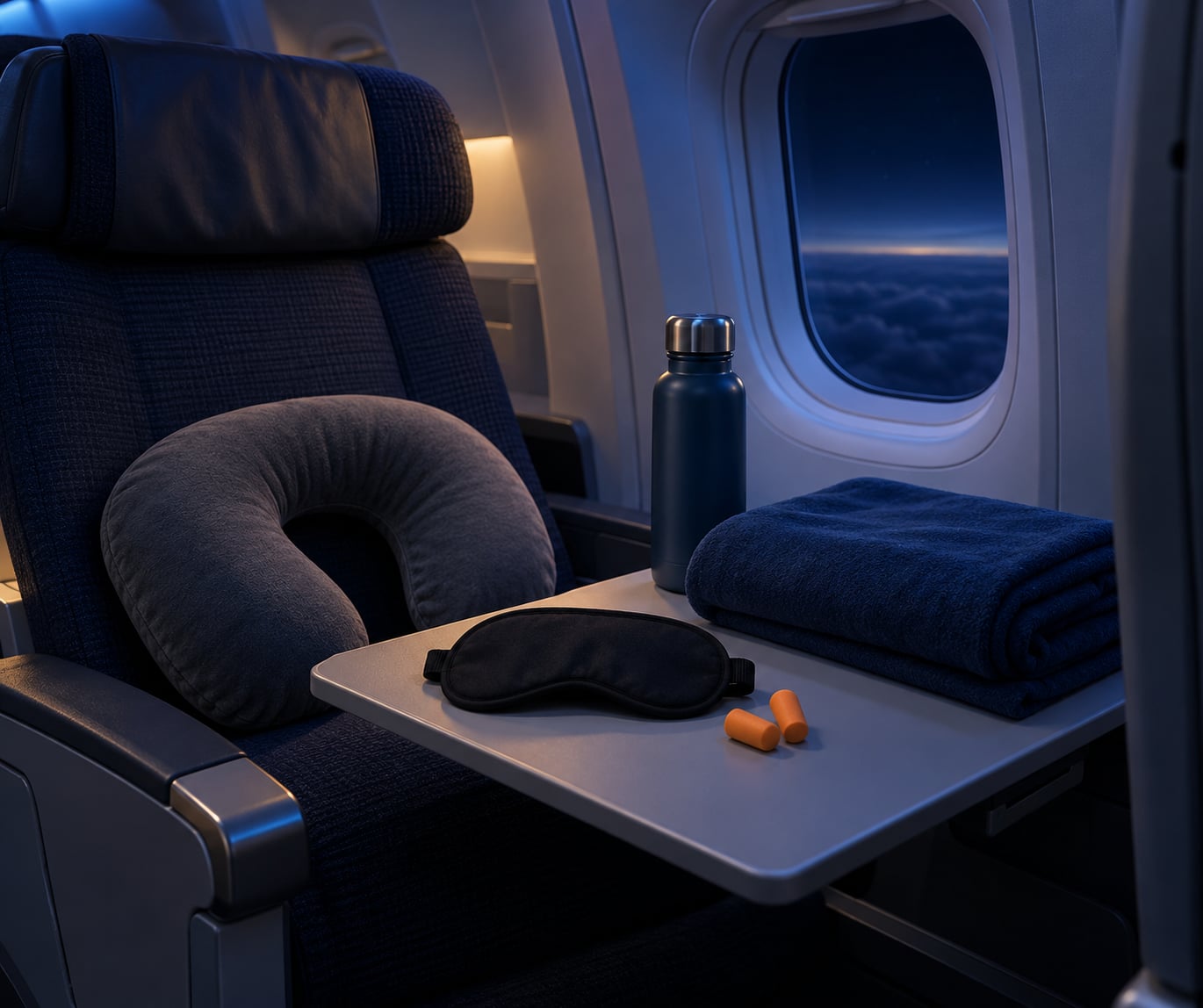
Everything fits in a single zip pouch under the seat in front of you. That rule alone decides whether you will use your gear at 2am, because anything in an overhead bin is gone by the time you want it. Getting how to sleep on a long haul flight right starts with that one habit.
- An eye mask that blocks light at the nose bridge. The cheap wraparound foam models seal better than fabric sleep masks, which leak around the nose and let cabin light straight in.
- Earplugs or noise-canceling earbuds. Filter earplugs handle engine drone; ANC earbuds handle announcements and seatmate conversation. Over-ear cans work but get uncomfortable after a few hours when combined with a pillow.
- Neck support that stops your head nodding forward. See the note below for which style to pick.
- Compression socks for the second half of the flight, plus foldable slippers if you like.
- An oversized scarf that doubles as a blanket, a neck wrap and a foot wrap. Airlines hand out thin blankets; a travel scarf is warmer and takes no cabin-bag allowance.
- Layers: a long-sleeve shirt you can roll to the elbow, plus socks. Cabin temperature swings, and cold wakes you up.
- An empty water bottle and lip balm. Cabin air is dry enough to wake a sleeper with a headache.
- Your phone, charged, with downloaded audio: a sleep podcast, white noise, or the same playlist you use at home.
On pillows: a traditional U-shaped travel pillow mostly fails on long flights, because your head still drops forward onto your chest and that is the single position that wakes you with neck pain. The styles that work are a contoured memory-foam pillow worn backward with the bulk under your chin, or a flat pillow wrapped around in a scarf. If you dislike eye masks, that scarf wrap also gives you head support and partial blackout from one item.
Step-by-Step
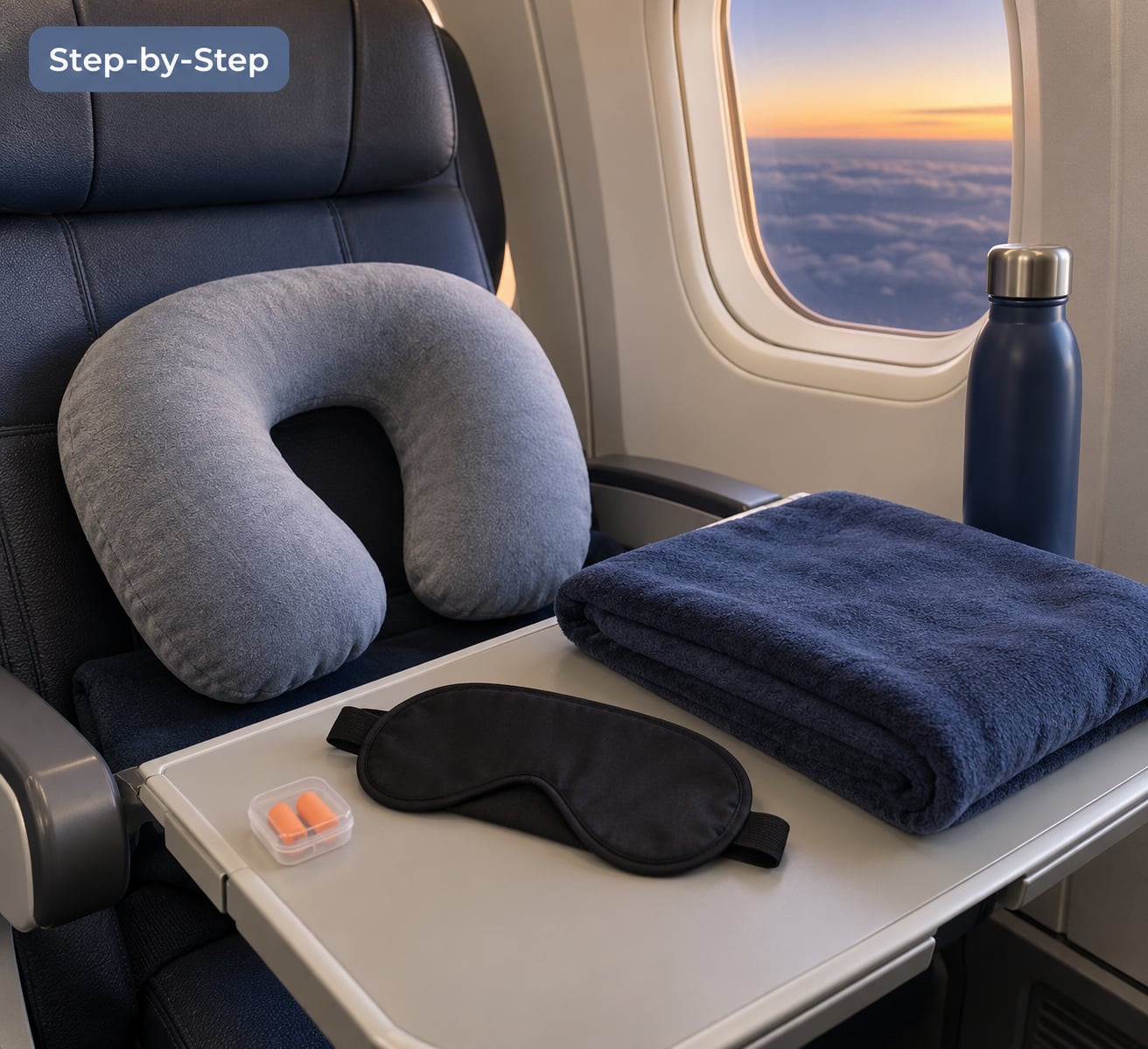
Choose a Window or Aisle Seat
A window seat is the better sleeper’s seat because the wall stops you drifting sideways and you control the row’s curtain and overhead light. The cost is that you are the one getting up for the bathroom, and the aisle seat next to you has no guarantee of quiet.
An aisle seat wins if you are a light sleeper who needs to move, if you have a long leg that needs to stretch into the gap, or if you plan to walk the cabin. A middle seat is the hardest position on any aircraft, and the advice most people give is honest: no wall, two neighbours, no escape.
Then pick the row. Stay away from the galley and the lavatories, where doors open, carts rattle and people queue. Rows directly ahead of a wing have less seat pitch. An over-wing bulkhead row has no seat in front of you, which means nothing to brace your feet against and no tray table, so it is excellent for sleeping and poor for eating.
- Window. Best for side sleepers and light sleepers. The catch is that you are the one who gets up, and the wall can be cold against your shoulder. Compensate with a scarf as a head strap and a layer for the wall side.
- Aisle. Best for tall travelers and anyone who needs to walk or stretch. The catch is neighbors crossing your line, so a foot sling on the tray table and upright dozing work better here than lying down.
- Middle. The hardest seat on any aircraft, so avoid it when you can. If you are stuck there, wear the pillow backward, wrap the scarf around your head, and let the eye mask do the work of blocking out both neighbours.
- Bulkhead with no seat ahead. Good leg room and the easiest row to sleep in, but no tray table and nothing to brace your feet against. An inflatable footrest clipped low solves the second problem, if the crew allows it.
Select the seat when you book, not at check-in. Most of these rows disappear within a day of the flight opening.
Prepare Your Sleep Routine Before Boarding
Sleep on a plane is easier if your body already thinks bedtime is close. On the day of a red-eye, shift your normal bedtime earlier by two to three hours rather than staying up extra late to force tiredness, which mostly produces a jittery kind of tired.
Caffeine is the easiest mistake to fix. Stop drinking coffee, tea and energy drinks six hours before departure. What you cannot control is the caffeine in cola, chocolate and some painkillers, so read the label.
Wash your face before you get to the gate. Skincare, a clean face and brushing your teeth are a short ritual that carries over from home, and rituals are what your brain uses as a signal. If you can manage it, change into sleep clothes at the gate rather than on the aircraft, because getting changed in a narrow lavatory is miserable.
You will know the routine is working if you feel vaguely bored rather than anxious by boarding. That low-grade dullness is the signal to stop scrolling and start the setup.
Block Light and Noise
Cabin lighting is the biggest thing keeping people awake, and the overhead light is the worst of it. Put the eye mask on before you settle rather than after you have already drifted, and check that the nose bridge seals. A mask that leaks at the nose is worse than no mask because you keep testing it.
Some travelers simply refuse eye masks. If you are one of them, a scarf wrapped over the head with a section pulled across the eyes does the same job for anyone who will look at you oddly.
For noise, run the two options in parallel: filtered earplugs for constant engine drone, and ANC earbuds for sudden sounds like a service announcement or a loud neighbor. That covers more than either alone. Over-ear ANC headphones are the most effective option but frequently start pressing on your ears against a neck pillow, so many travelers switch to earbuds partway through the night.
White noise or a familiar sleep podcast covers the middle range well and does something extra: it keeps your phone face down and out of your hands.
Get Comfortable Without Restricting Circulation
The most effective trick I know for the head-nod problem is wearing a contoured or flat travel pillow backward, so the thick support sits under your chin rather than behind your neck. That blocks the forward drop that ends most naps. Travelers with long necks or tall frames often report a standard U-shaped pillow does nothing for them, and the scarf wrap or the backward pillow is what finally works.
If you do not want to pack a pillow at all, roll up a hoodie or a sweater from your seat and use that as a head support. It is not as good and it takes half the cabin bag space, which is why many people decide a pillow counts as a bonus item rather than a second bag.
For your legs, clip an inflatable foot sling or foot hammock to the lowered tray table so your feet are supported rather than dangling. Tucked feet are what cause the restless, painful legs that end a nap. If you do not have one, rest your feet against the seat in front during the reclined phase and let them down before that stretches behind you.
Recline after take-off, once the seatbelt sign is off, rather than during it. Then change position every 60 to 90 minutes: lean forward against the tray table, sit upright, stand up in the aisle. Do not cross your legs and do not curl into a tight ball with the neck bent forward. Movement matters more than any single posture.
Time Sleep Around the Long-Haul Flight
Decide before boarding whether this is a sleep flight or a stay-awake flight, and the decision should follow your arrival time. If you land in the morning after an overnight flight, you want to be asleep for most of it. If you land in the evening after an overnight flight, sleep then stay awake until your normal bedtime, which costs you one bad evening and saves your whole first day.
Set your watch to destination time at the gate and treat that as the only clock that counts. Follow destination time for meals, water and light exposure, even while your body is still on home time.
Two concrete cases. On a 14-hour overnight flight landing at 7am local, aim for a four-hour core sleep starting about an hour after takeoff, then do not go back down in the last three hours. On a daytime long-haul where you land in the evening, treat the flight as one long nap: one sleep block of three to four hours, never more, and stay upright.
Set an alarm for your landing time as a backup. Waking up 90 minutes before landing is the difference between walking off the plane and running for the gate.
Eat and Drink for Better Sleep
Skip the heavy in-flight meal if your goal is sleep. That is hard advice when the meal is the only food for five hours, so the practical version is: eat most of it, and skip the dessert, the bread roll and anything fried. Heavy and salty food makes you thirsty, and thirst is a wake-up signal.
Drink steadily rather than in a rush. Around 200ml every couple of hours works, more if you are in a hot cabin or a long segment. Being dehydrated is the main reason people wake from an eight-hour sleep feeling worse than when they closed their eyes. Limit alcohol to nothing at all if your aim is sleep. It makes you drowsy, then it fragments the second half of the night, and it stops REM sleep entirely.
For ear pressure, yawning, swallowing and chewing gum during the descent usually does it. If pressure is a regular problem for you, ask a pharmacist about pressure-regulating earplugs before the trip rather than buying them at the gate.
Handle Wakeups and Bathroom Breaks
Every wake-up is a chance to fall back asleep in five minutes or to lose forty, and that single number is the difference between knowing how to sleep on a long haul flight and simply surviving one. Make the wake-up easy: ask a flight attendant for the minimum-interrupt service if the airline offers it, use the toilet before you settle, and keep water and the eye mask within arm’s reach rather than in the bag under the seat.
If you are in an aisle seat and your neighbor needs to get out, ask whether you can move up to the empty row behind you and stay there for an hour. It is a small request and crews usually accommodate it, and it turns a broken night into a broken hour.
When you do wake, do something dull and boring rather than something engaging. Stretch your calves, roll your shoulders, look out the window at the dark. Reading or watching a film at 3am is how two hours disappear.
And protect the arrival. On landing, get daylight early, eat a normal meal at destination time, and do not schedule anything demanding for the first few hours. Flight sleep is not the same quality as bed sleep, so it buys you recovery, not full alertness.
Common Mistakes
Wearing jeans. They are stiff, they press on the waist, and they invite restless legs. The fix is soft layers you can move in and a blanket scarf for warmth.
Sleeping in the middle seat on purpose. People do this to keep an aisle free for a partner on a cheap fare. The fix is not available after the fact, so choose an aisle or window when you book and buy a lounge pass if the noise bothers you.
Saving the eye mask for later. You need it before you settle. Same for the earplugs.
Using over-ear headphones with a thick pillow. The ear cups press and you take them off after two hours, then the noise returns. Fix: earbuds and filtered earplugs together.
Treating melatonin as a knockout pill. It shifts your clock, it does not sedate you, and it does nothing for plenty of people at any dose. Take it before travel, never for the first time in the air, and ask a pharmacist about the right amount for you.
Drinking the free wine to get sleepy. It buys you ninety minutes and costs you the rest of the night, plus dehydration.
Staying frozen in one position for five hours. Set a timer and change position, stand up, or walk to the back of the cabin.
Waking up 40 minutes before landing because you misjudged the time. Set the alarm in destination time and check it against the boarding pass.
Quick tips for the hardest overnight itineraries: pick a direct flight if you can, since a connection means two sleep cycles and two wake-ups. Book the seat early. Take the first long sleep window right after take-off while the cabin is still settling rather than waiting until 1am. And if you have a toddler, choose an aisle seat on the side away from the bassinet and near a bulkhead, because the parent who needs to move should be the one on the aisle.
Frequently Asked Questions
Which seat is best for sleeping on a plane?
A window seat gives you a wall to lean on, the least light exposure and the fewest people crossing your space. Choose an over-wing row only if the flight is short, since those have less legroom, and never sit next to the lavatories or galley. Pick an aisle seat instead if you are tall, need to stretch your legs, or know you will get up during the night. Select the seat at booking, because the best rows go within days.
Are neck pillows actually good for flying?
Only if you wear it backward. A standard U-shaped pillow sits behind your neck and still lets your head drop forward, which is the position that causes neck pain and wakes you up. A contoured or flat pillow worn backward, with the bulk under your chin, stops the drop. People who dislike pillows report rolling up a hoodie as a workable substitute, and a scarf wrap does head support and blackout in one item.
Is it okay to use an eye mask every night?
Yes, for most people. Wearing an eye mask every night is generally safe because it simply blocks light and does not change your sleep chemistry. Pick one that seals at the nose bridge, since a leaking mask makes you test it repeatedly and stay half awake. A few travelers find masks claustrophobic or uncomfortable around the eyes, and for them a scarf over the eyes works about as well.
Is it okay to take a sleeping pill on a long flight?
Talk to your doctor or pharmacist before you fly, and never take a sleeping pill for the first time in the air. Sedative sleep medicines can depress breathing, interact with alcohol and with other medicines, and some are restricted in certain destination countries, so check the rules for where you are landing. Testing any sleep medicine at home first, well before the trip, is the safest approach.
When should I take melatonin before a flight?
Melatonin works by shifting your body clock, not by sedating you, so timing matters more than dose. Many travelers take a low dose in the evening before the flight to test how their body responds, then repeat it at the same point relative to destination bedtime on the night of the flight. Ask a pharmacist for the amount that suits you, and avoid pairing it with alcohol.
How do you sleep on a long flight with a toddler?
Aisle matters more than anything else when you have a child, because you are the one who gets up. Book an aisle seat, bring a familiar blanket and lovey, and pack a sleep kit in a bag you can reach without asking a stranger. Expect the child to sleep in shorter blocks. Plan your own sleep around those windows rather than against them, and settle into the last long stretch yourself once the child is down.
Conclusion
Three things decide whether you sleep on a long haul flight, in this order. First, build the kit and put it where you can reach it from your seat: eye mask, earplugs, a pillow worn backward, layers, water. Second, book a window seat away from the lavatories, and do it the day the flight opens.
Third, decide before boarding whether you are sleeping on this flight or staying awake for it, set your watch to destination time, and start your usual bedtime routine at the gate. That is the whole method. Everything else is detail.