Learning how to travel solo for the first time comes down to four things: pick a destination you can actually manage, book the flights and the first night before you go, plan one thing per day and leave the rest open, and tell someone at home where you’ll be. That’s it. The planning is the hard part, not the traveling.
Most people who hesitate are not afraid of the destination. They’re afraid of the paperwork, the wrong train, the restaurant where every other table has two people sitting at it. Those are all solvable, and most of them have a boring answer.
I have friends who still describe the week before their first solo trip as the hardest part, and the trip itself as easy. That pattern shows up again and again in the r/solotravel threads I read while putting this together. The nerves live in the planning phase. Once you’re moving, the day gets small and specific, and small and specific is manageable.
This guide walks through the whole sequence, in the order you’ll actually do it, from choosing a city to flying home. Last updated in October 2026.
Table of Contents
- 1What You Need
- 2Valid identification and passport
- 3Travel insurance with a real assistance line
- 4One emergency contact who has your itinerary
- 5Two ways to pay, plus a cash backup
- 6Medication and a small first-aid kit
- 7Bookings that remove decisions on arrival
- 8A charged phone with the essentials downloaded
- 9How to Travel Solo for the First Time: Step-by-Step
- 101. Choose a destination that suits your comfort level
- 112. Set a budget and book the essential pieces
- 123. Build an itinerary with backup options
- 134. Prepare documents, health needs, and technology
- 145. Pack for independence: what to bring when traveling alone for the first time
- 156. Get through the airport and onto your first flight
- 167. Check in and get oriented on arrival
- 178. Manage meals, transport, and activities alone
- 189. Handle problems and know when to ask for help
- 19If you miss a connection
- 20If you lose your documents
- 21If you get sick or hurt
- 22If you’re uncomfortable with someone
- 23If you get pickpocketed or robbed
- 2410. Return home and review what worked
- 25Common Mistakes
- 26Overbooking the itinerary
- 27Keeping documents in only one place
- 28Choosing a complicated destination first
- 29Skipping the transit research
- 30Spending the emergency cushion early
- 31Not checking official entry and health guidance
- 32Frequently Asked Questions
- 33Is it safe to travel alone for the first time?
- 34Should my first solo trip be domestic or international?
- 35Where should I take my first solo trip?
- 36How do I meet people when traveling solo?
- 37How do I deal with nerves before my first solo trip?
- 38What do I do if my plans go wrong while traveling alone?
- 39Conclusion
What You Need
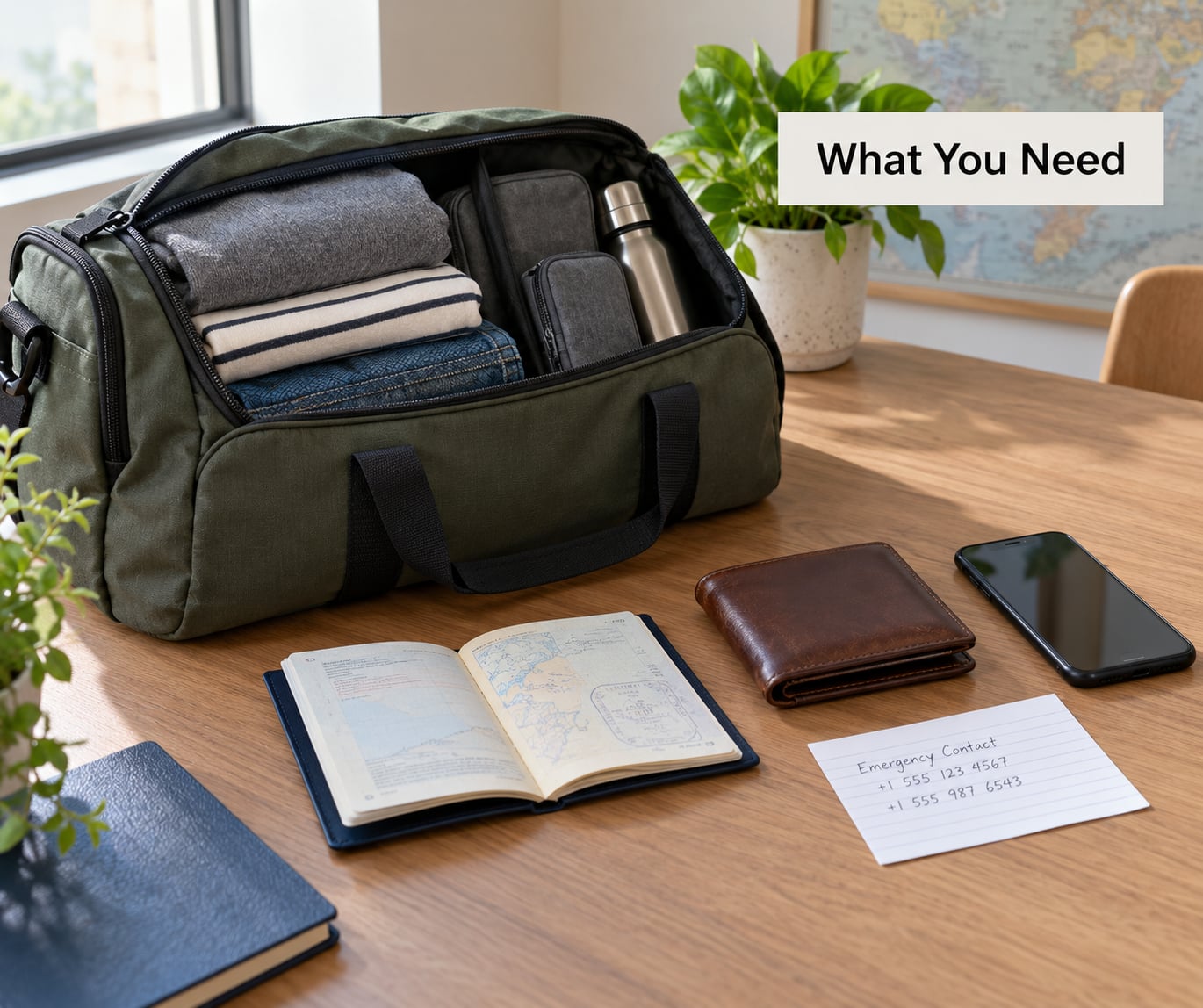
Everything below is a prerequisite, not a suggestion. Missing one of these is what turns a smooth first trip into a story about a stolen backpack.
Valid identification and passport
Your passport needs to be valid for the length of your trip plus the margin your destination requires, and many countries ask for six months’ validity remaining. Check the entry rules on the destination’s official immigration or embassy site, not a blog post written a few years ago. Domestic trips usually only need a valid driver’s license or state ID.
Travel insurance with a real assistance line
Insurance matters more alone than with a group, because there is nobody beside you to drive you, argue on your behalf, or cover a cash gap. Look for a policy with a 24/7 assistance number, emergency medical coverage, medical evacuation, and trip interruption. Read the assistance line’s hours before you buy — some are 24/7 only for the trip itself.
One emergency contact who has your itinerary
Choose a person and give them your flight numbers, accommodation address for every night, and a plan for checking in. Decide the check-in rhythm together before you leave, then actually do it. A contact who doesn’t know your schedule can’t help you.
Two ways to pay, plus a cash backup
A no-foreign-transaction-fee card is the workhorse, kept in a different place from your backup card. Withdraw cash from a bank lobby ATM rather than a standalone one on the street, and split it: most in one place, the rest in a second secure spot.
Medication and a small first-aid kit
Bring prescription medication in original packaging with a copy of the prescription, plus the doses for a few extra days. Pack what you already use for headaches, allergies, and stomach trouble so you can buy it locally if you need to.
Bookings that remove decisions on arrival
Book the flight, the first and last nights of accommodation, and the onward transport from the airport or station. Those four bookings are the difference between arriving calm and arriving lost.
A charged phone with the essentials downloaded
Before you fly, download offline maps for the whole trip, your translation app, your insurance documents, and copies of your passport. A dead battery with no downloaded map is the most common bad moment on the road. Pack a power bank and know where you will charge.
Keep one physical folder, real paper, with a photocopy of your passport, your insurance details, and your check-in contact’s number. A screen that won’t turn on should not take your entire identification with it.
How to Travel Solo for the First Time: Step-by-Step
1. Choose a destination that suits your comfort level
The first trip is not the time to test yourself. Choose a city where you can get around on foot, where a late flight won’t strand you, and where help is easy to find. Two to four days works better than two weeks, because a short trip gives you an easy exit and a long trip gives you more chances to be tired.
Screen destinations with real tools rather than vibes. The U.S. State Department travel advisories give a tiered rating by country, and the Global Peace Index ranks countries on safety and conflict levels. Both change over time, so check them the week you book and again the week you leave.
After the safety screen, look at four practical things. Is the main area walkable? Does public transit run late enough for you to get back? Will English get you through a first conversation, or does the city have a large tourism infrastructure? Is healthcare accessible if something goes wrong?
One city is usually the right call for a first trip. Multi-city itineraries mean missed-connection risk, unfamiliar transit twice, and packing a bag on a bus. Single-city removes almost all of that.
Ask yourself whether you’d want to be there with a friend. If the answer is yes, and it ranks reasonably on safety, it’s a fine solo first trip. If the appeal is entirely about a person or a group, pick somewhere else.
2. Set a budget and book the essential pieces
Build the budget in categories rather than one number: flights, lodging, local transport, food, activities, insurance, and a cushion. The cushion is not optional when you’re alone. It covers the taxi you didn’t plan, the medication you have to buy, and the flight change you might need to make yourself.
Rough ranges for a week help you sanity-check. Budget destinations often land around 50 to 80 per day for lodging, food, and local transport, mid-range cities around 100 to 180, and higher-cost cities considerably more. Flights vary so widely by origin that they usually make or break the total — check those first, then decide whether the daily number works.
Book in this order, because each booking depends on the one before it:
- Flights, once the destination is decided.
- Accommodation for the first and last nights. The last night matters more than most people expect.
- Any trains or buses needed to reach the destination and to leave it.
- One paid activity or tour, if there is one specific thing you do not want to miss.
- Travel insurance, as soon as the first payment goes through.
Leave restaurants, museums, and day trips unbooked. They are cheap to arrange later, and flexibility is what you want when you arrive tired.
3. Build an itinerary with backup options
Plan one anchor activity per day and leave the rest loose. The anchor can be a museum, a market, a class, a hike, or a landmark you genuinely want to see. It gives your day a center without turning it into a schedule you’ll resent.
For each anchor, write one backup that works in bad weather or if the place is closed. Nearby, not across town. A backup you could actually reach from where you’ll already be is a backup; one on the other side of the city is a hope.
Leave at least one day in a longer trip with nothing on it. Solo travel is where unexpected things happen, and a fully booked day turns a good surprise into a problem.
Save every booking confirmation somewhere you can reach without data. Screenshots in a folder, or a printed copy in your document folder. Confirmation numbers are the difference between fixing a problem in ten minutes and spending an hour on it.
4. Prepare documents, health needs, and technology
Confirm your entry requirements with the destination’s official source and with your airline, since carriers check documentation at boarding and can deny you entry over paperwork. Check whether you need a visa, an arrival form, or proof of onward travel, and complete anything with a deadline several days ahead.
Also check health guidance for your destination from a public health source such as the CDC, WHO, or your country’s equivalent, and talk to your doctor about vaccinations and any regular medication you take. Bring enough medication for the trip plus a few extra days, in original packaging, with a copy of the prescription.
On the tech side, the download list is short and worth doing carefully:
- Offline maps for the entire region, not just the city center.
- Translation app with the destination language downloaded.
- Digital copies of your passport, visa, and insurance certificate.
- Live location sharing set up with your check-in contact, and tested before you leave.
- A VPN if you’ll use hotel or café Wi-Fi for anything sensitive.
If you’re enrolled in the U.S. State Department’s Smart Traveler Enrollment Program, do that before departure — it takes a few minutes and gives that country list your details. If you’re not in the US, look for your own government’s travel registration service.
5. Pack for independence: what to bring when traveling alone for the first time
Pack a carry-on only for your first trip. It is faster through airports, it survives a lost checked bag, and it removes a decision. Everything you own being in one bag also means you always know where your things are.
Build the bag around a few pieces that mix. Two or three tops, two bottoms, one layer, one pair of walking shoes, one pair you can sit in for hours. Laundry facilities are everywhere, and one load halfway through a two-week trip buys you a week’s worth of outfits.
The non-negotiables, in my order of importance:
- Comfortable walking shoes that work for ten-hour days and still look fine at dinner.
- A power bank and a cable you can reach in your bag without unpacking it.
- A portable first-aid kit — pain relief, blister plasters, rehydration salts, antihistamine, and anything you regularly need.
- A small door lock or doorstop for places without one. Cheap, light, and most hosts will not object.
- A reusable water bottle and a lightweight tote or daypack that closes.
- A pen for arrival forms, a notebook for the travel journal, and headphones.
- A wallet you can separate — a small amount of cash in one, cards in another, so a lost wallet is an inconvenience rather than a catastrophe.
Skip the laptop if the trip doesn’t need one, the expensive camera, and the jewelry you’d worry about. Leave a bag of boring clothes at home or in the car if you can — nobody has ever regretted the outfit they left behind.
Keep essentials where you can reach them on the plane: passport and documents in your personal item, phone and charger in your personal item, nothing critical in the overhead bin. Ask for an aisle seat if a middle seat in a full row would make you feel boxed in on your first flight.
6. Get through the airport and onto your first flight
Arrive earlier than you think you need to, especially on a first international trip where document checks add time. Check in online if the airline allows it, get your boarding pass, and confirm your gate — gates change and the board is the only thing that will tell you.
The order of the day is simple: check in, security, gate, board, land. Most first-timer stress comes from not knowing that order. At security, put your laptop and liquids bag in a separate tray early rather than being called over.
On board, note three things before you settle: the exit row, the nearest toilet, and where your bag goes. If it’s a redeye, set an alarm and keep essentials in your personal item rather than under the seat in front of you.
If the flight gets disrupted, act in this order: turn your phone back online for real updates rather than cycling through a loop of announcements, open the airline app, and message your check-in contact that plans changed. If the delay is long enough to strand you overnight, the airline usually rebooks and covers meals and a hotel. Ask at the desk rather than online, and keep the confirmation number.
7. Check in and get oriented on arrival
Your first task after landing is not sightseeing. It’s getting to your accommodation and putting your bag down. Everything feels harder when you’re tired and holding luggage, so take that pressure off the first hour.
Before you leave the airport or station, do four things:
- Check in with your contact. A short message: landed, heading to the hotel, safe.
- Get local connectivity or confirm your offline maps work. Open the map before you get in a vehicle.
- Note the local emergency number before you need it. Pin it in your phone.
- Check the transport option from the airport or station: the official taxi rank, the app-based ride, or the public transit line. Know roughly what it costs and how long it takes.
Use the official taxi queue or a reputable app-based ride, and skip anyone soliciting in the arrivals hall. With an app-based ride, match the license plate, car model, and driver name against what the app shows you before you get in. In a car you didn’t book yourself, sit in the back, keep your bag with you, and share the trip details with someone.
At the hotel or hostel, spend five minutes on arrival rather than unpacking. Note where the exits are, whether your room has an outside door, and where the front desk is. Ask for a room away from outside doors and, if the building is old, away from the ground floor. Locals on free walking tours in tourist cities suggest a specific hotel or hostel to anyone new; that’s worth listening to.
Then do one small, easy thing nearby. A walk to find a supermarket, a coffee, a pharmacy. It gets you oriented, confirms the neighborhood is what you expected, and it’s small enough to be unstressful.
8. Manage meals, transport, and activities alone
Eating alone is the part people dread most, and it’s the part that turns out to be trivial. Sit at the bar or the counter rather than a table, which is normal and has a natural built-in audience. Bring a book, or do the thing you always do at home. Nobody is watching you, and the people who are looking are looking for their own table.
Eating early or late helps too. Off-peak restaurants are quieter, cheaper, and easier to get a seat in alone. Many cities have a lunch special that is the best value on the menu anyway.
For transport, learn the system the day you arrive. Buy a transit card or single tickets from an official machine rather than from a man outside the station. Note the last departure time for the line you’ll use, because a city that shuts down at 11pm is a different experience than one that runs all night.
Free walking tours are the single most-recommended trick in the solo travel forums. They’re cheap or free, they’re led by locals, and they end at a bar where the group mixes. Set a rule for yourself: you stay for one drink, and if it’s not a fit, you leave without it being awkward. People do it all the time.
A class, a tour, or a group activity gives you company without requiring you to carry a conversation from scratch. Cooking classes, walking tours, museum tours, and day trips are the common picks. And if you want a night alone, take it — that was part of the reason to go.
On transport safety specifically: on buses, sit near the driver on an aisle seat. On trains, choose a middle car rather than the first or last, and keep your bag where you can see it. On night buses, keep your phone charged and your valuables in your hand rather than overhead.
9. Handle problems and know when to ask for help
Something will go wrong. The goal is a short, boring sequence: stay calm, secure yourself, contact the right party, and involve authorities only when there’s real danger. Doing it in that order stops a small problem from becoming a panic.
If you miss a connection
Go to the airline, railway, or bus operator desk rather than queuing for the next person in line. Tell them what happened plainly. A missed connection is one of the most common disruptions and staff handle it many times a day. Message your contact so nobody worries while you sort it.
If you lose your documents
First, don’t panic and don’t leave the area. If you suspect theft, cancel your cards immediately. Then contact the nearest embassy or consulate of your country — they’ll tell you exactly what’s needed, and many have online reporting you can start from your phone. Your digital copies and your paper folder are why this is inconvenient rather than fatal. Don’t leave the country or lose contact with your check-in person while you deal with it.
If you get sick or hurt
For anything non-emergency, a pharmacy or a local clinic is usually the right first stop, and your insurance company’s assistance line can tell you which provider to use. If something is genuinely dangerous — chest pain, a serious fall, an allergic reaction — use the local emergency number immediately. You gave yourself a way to get home. That’s what it’s for.
If you’re uncomfortable with someone
Trust the feeling. Move to a populated place, a shop, a staffed counter, or a public transport vehicle. Enter a business and ask the staff to call you a ride. A firm no and a walk away are always available to you. If you feel you’re in immediate danger, go to the police or a hospital, both of which you should have located on arrival.
If you get pickpocketed or robbed
Report it to the local police and get a reference or report number — your insurer will ask for it. Cancel your cards remotely. Then change what failed: move the money, not your whole plan. People recover from this in hours.
Asking for help is a skill, not a weakness. Staff, drivers, and shopkeepers deal with lost travelers every day and generally find it easier to help someone who is straightforward about what they need.
10. Return home and review what worked
On the way back, check in online, confirm your gate and boarding time the night before, and re-download your offline maps in case you deleted them. Keep receipts, boarding passes, and any medical paperwork until you’re home and have filed whatever claims you need.
Then write down what actually happened, not what you planned. Which part felt hardest? Which day was the most fun? What would you book differently?
Most first-trip reviews are the same three things. Someone found the arrival more confusing than expected and settled quickly. Someone felt lonely at one specific dinner and got over it by the next. And someone was surprised they could handle it. The gap between what people fear and what happens is the whole point.
Common Mistakes
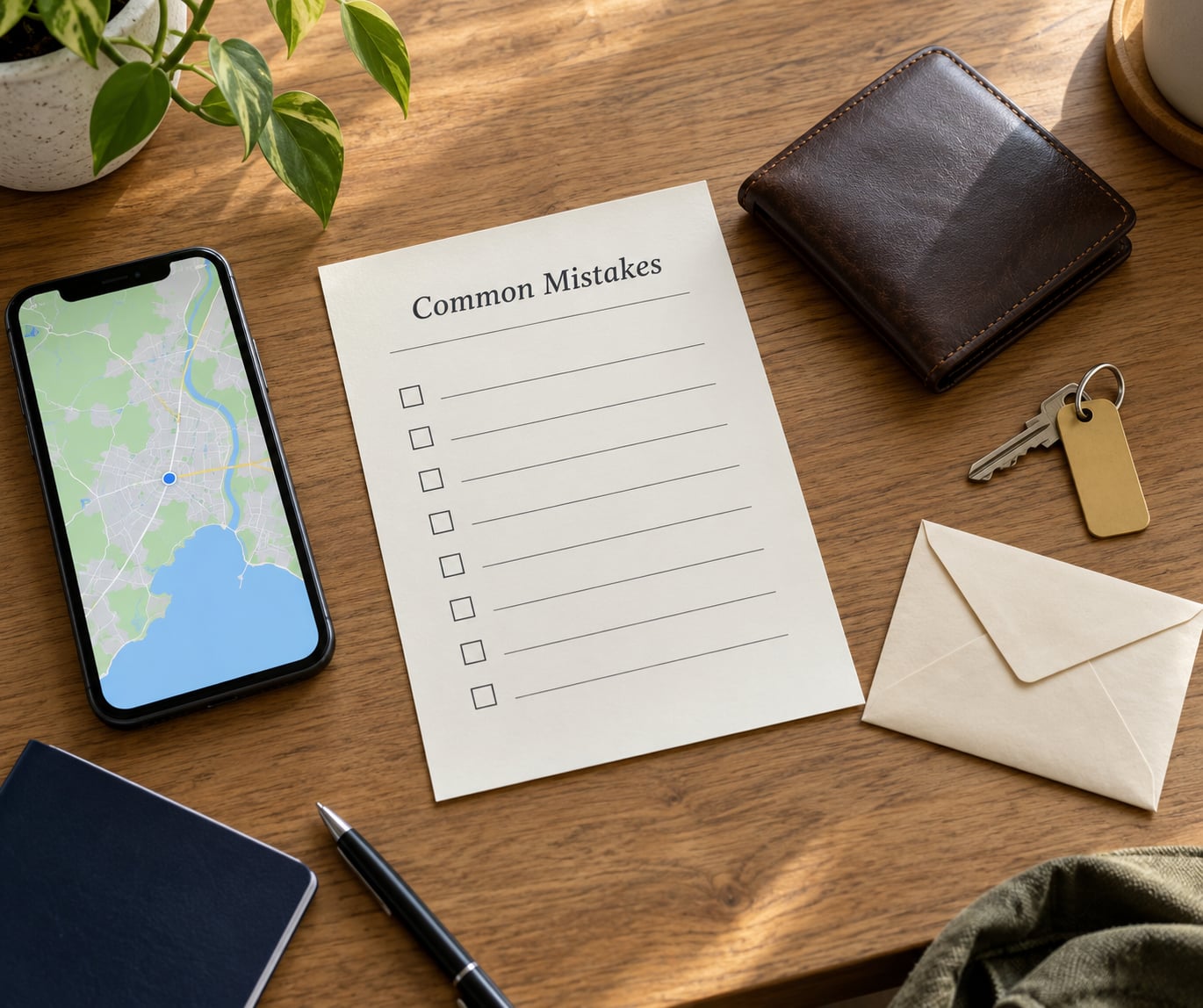
Almost every disaster story from a first solo trip traces back to one of six mistakes. All of them are fixable before you leave.
Overbooking the itinerary
The mistake: Nine booked things in three days, with nothing left for a wrong train or a bad mood.
The fix: One anchor per day, one completely free day, and a backup option per anchor that’s actually nearby.
Keeping documents in only one place
The mistake: Passport and cards in the same bag, digital copies on a phone that can die or get stolen.
The fix: A paper folder in your document pouch, digital copies in two places, and cards split so losing one doesn’t lose everything.
Choosing a complicated destination first
The mistake: A remote island, a multi-country trip, or a place with weak transit and a language you don’t speak, chosen for the photos.
The fix: Start with a walkable city with good transit and an easy arrival. Earn the complicated one — you’ll enjoy it more afterward, and you’ll handle it well.
Skipping the transit research
The mistake: Landing at 11pm and not knowing how you get from the airport to the door.
The fix: Before you book, check the official airport or station site: what the official taxi situation is, what the app-based rides work there, what the train or bus costs, and what time it stops running.
Spending the emergency cushion early
The mistake: The extra money quietly becomes dinner on day two.
The fix: Put the cushion in a separate account or envelope you physically don’t carry day to day. It’s for the taxi you didn’t plan, the prescription, the flight change.
Not checking official entry and health guidance
The mistake: Finding out about a visa, an arrival form, or a required vaccine from a forum post.
The fix: Check the destination’s official immigration site, the State Department advisory, and a public health source. Do it at booking, and again a week before you go, because requirements change.
A few things that build confidence faster than advice does. Do a solo day trip in your own city a couple of weeks before you fly, including a meal alone and a walk home in the dark. Write your itinerary document early — the act of making it settles the nerves more than most people expect. And tell people you’re nervous, because almost every first-timer is, and almost nobody remembers the person who was nervous. They remember the person who went.
Frequently Asked Questions
Is it safe to travel alone for the first time?
Yes, for the vast majority of destinations, with sensible precautions. Choose a place that ranks well on the State Department advisory and the Global Peace Index, tell someone your itinerary, split your cash, and stay aware of your surroundings. Solo travelers travel safely every day using the same basics listed here. No trip is zero-risk, but the risk is usually more ordinary than people imagine.
Should my first solo trip be domestic or international?
A domestic trip is the better first choice for most people. You keep your phone plan, your currency, your emergency healthcare, and your language, so the only new variable is being alone. A weekend solo trip teaches you almost everything an international one would, at a fraction of the risk. Go international for the second or third trip, when the logistics are already routine.
Where should I take my first solo trip?
Pick a walkable city with reliable public transit, late-night options, a solid tourism infrastructure, and a good safety ranking. A single city for three or four days beats a multi-country route for a first trip. Check the State Department advisory and the Global Peace Index, read recent reviews for the specific neighborhoods, and choose somewhere you would enjoy with a friend.
How do I meet people when traveling solo?
Free walking tours, classes, and group activities do most of the work because the social part is already built in. Sit at the bar when you eat alone and keep an open posture. Stay in a social hostel rather than a quiet hotel if meeting people matters to you. Most connections are brief, and that is completely fine. Solitude is the default, not a failure.
How do I deal with nerves before my first solo trip?
Almost all pre-trip anxiety is planning-shaped, and planning is what reduces it. Book everything that can be booked, write your itinerary out, and do a solo day trip in your own city first. On the day, focus on the next two hours rather than the whole trip. If the fear is more than nerves, talking to a doctor before departure is a genuinely sensible step, not a failure.
What do I do if my plans go wrong while traveling alone?
Use the same order every time: stay calm, secure your immediate safety, contact the airline, operator, hotel, or insurer, and involve local emergency services only if there’s real danger. A missed train is a desk conversation. A stolen bag is a police report, cancelled cards, and a different plan for the day. Having one person at home who has your itinerary turns all of it faster.
Conclusion
If you take one thing from this, make it the first step. Learning how to travel solo for the first time starts with picking a realistic destination, confirming the entry and health requirements from official sources, and building a flexible plan with one anchor per day. Send the itinerary to someone at home, pack a carry-on, and download your maps before you leave.
Everything after that is practice, and practice works better than you think. Take a domestic weekend first if you can, then a longer trip, then the one you’ve been imagining. The confidence doesn’t come from research — it comes from the first time you handle something small on your own and find out you can.