Cruise gratuities work like a per-person, per-night service charge that is either folded into your fare or posted daily to your onboard account, and it covers a pooled crew rather than one named person. Most lines give you three options: prepay it at booking, let it post automatically each night, or ask guest services to reduce or remove it before your final bill is settled.
The confusing part is not the arithmetic, which is simple, but the labels. The same charge goes by different names depending on the line and the cabin, and a second, separate service charge often gets added on top of it at bars, in specialty restaurants and at the spa. Here is what each part actually is.
Rates change frequently, so treat every figure below as a shape rather than a number and confirm the amount on your own booking document or cruise line account before you sail.
Table of Contents
- 1Are Cruise Gratuities Included in the Fare?
- 2How to check what your sailing includes
- 3How Cruise Gratuities Work
- 4How to calculate your own gratuity total
- 5Prepaid vs. Onboard Gratuities
- 6What Do Cruise Gratuities Cover?
- 7What a gratuity does not cover
- 8Can You Change or Remove a Gratuity?
- 9The practical sequence
- 10How Do Extra Tips and Personal Gratuities Work?
- 11Do Suites, Premium Cabins, and Staffed Service Charge Differ?
- 12When Are Cruise Gratuities Charged?
- 13How to Review Your Final Cruise Bill
- 14Frequently Asked Questions
- 15Are cruise gratuities mandatory?
- 16Do cruise lines charge gratuities per person or per cabin?
- 17Can I pay cruise gratuities in cash instead of charging my onboard account?
- 18Are cruise gratuities taxed?
- 19Can I remove a prepaid cruise gratuity?
- 20Do cruise gratuities go to every crew member?
- 21The Bottom Line
Are Cruise Gratuities Included in the Fare?
It depends on the line and the sailing. Some cruise lines include gratuities in the advertised fare and treat them as part of what you bought, while others advertise a low base price and add gratuities on top during the trip or at checkout.
Higher-tier lines with all-inclusive pricing, where food, drinks and shore excursions are bundled into one number, usually fold gratuities into that price. Mainstream and premium lines are more likely to charge them separately, often per person per night, and the rate frequently depends on the cabin category.
Three things shift the answer and are worth checking on your specific sailing: the cruise line, the itinerary and the cabin category. A suite on the same ship on the same sailing can carry a different nightly rate than an interior stateroom, and some lines change rates by region, with European sailings sometimes priced differently from Caribbean ones.
How to check what your sailing includes
Open your booking confirmation and look for the fare breakdown before you look at anything else. If the total shows a per-person, per-night gratuity line, it is separate. If the fare is described as all-inclusive or your rate includes meals, drinks and gratuities together, it is bundled.
Then check whether children and infants are charged the same rate as adults. Policies differ sharply by line, and that is one of the biggest surprises for families budgeting a cruise.
How Cruise Gratuities Work
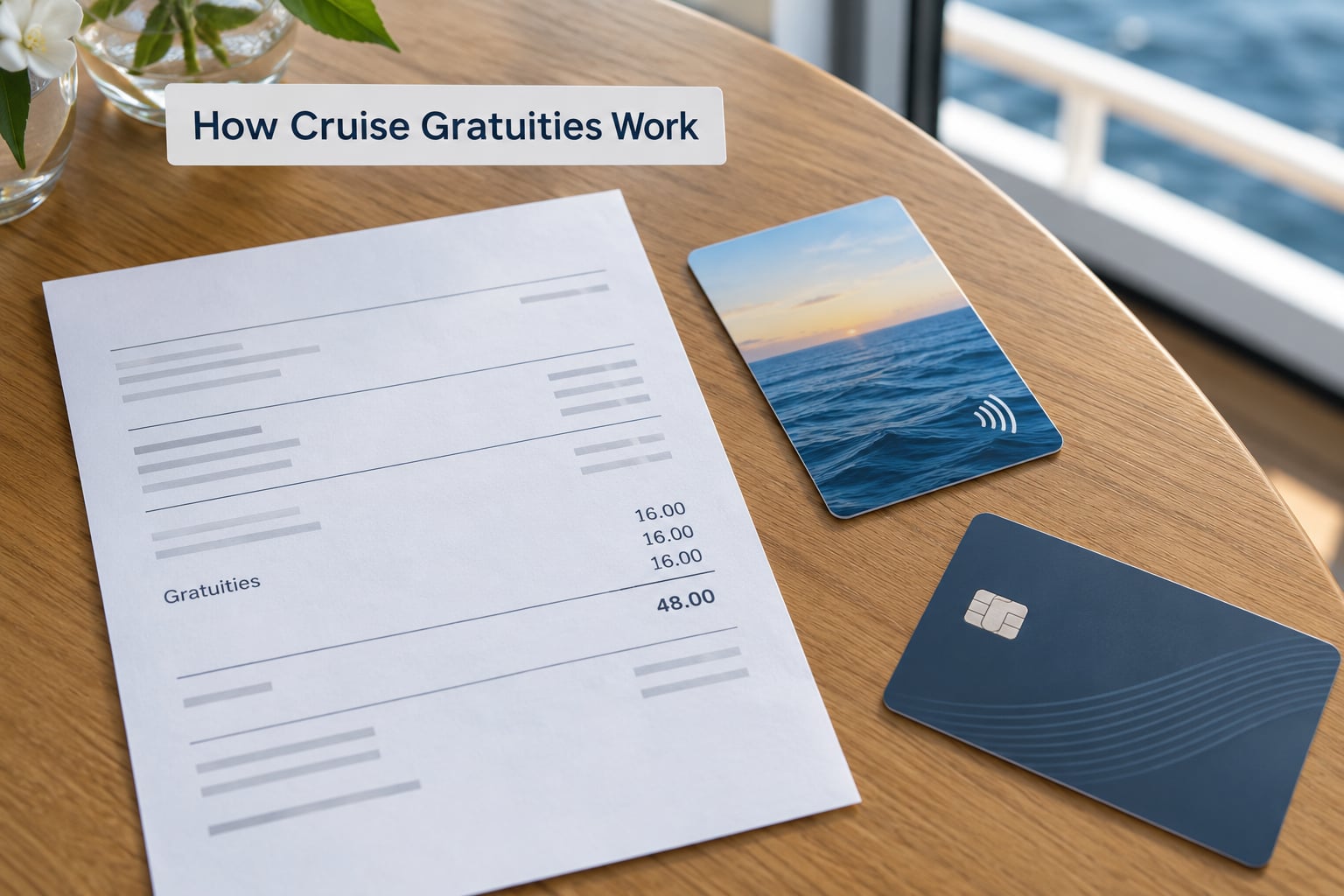
Direct answer: a cruise line sets a daily rate per guest based on cabin category, multiplies it by the number of nights and the guests who are being charged, and posts that total either at booking or night by night to your onboard account. At the end of the sailing, guest services prints a final statement, you review it, and whatever balance remains is settled on your card or from the onboard credit you set up.
So the formula is the same every time. Take the nightly rate for your cabin, multiply by the number of cruise nights, then multiply by the number of guests the line charges. A stated rate is usually per person per day rather than per cabin, and the night you board is normally not a charged night while the last night is, which is why lines talk in cruise nights rather than calendar days.
How to calculate your own gratuity total
Say your cabin carries a stated nightly rate of 18 per person, you sail seven nights, and two adults are charged. The total is 18 multiplied by 7 nights, multiplied by 2 guests, which comes to 252 for the sailing. On a seven-night trip that works out to fourteen nightly rates in total, all landing on one statement at the end.
Now add one more charged guest to the same cabin and the total rises by seven times the nightly rate, or 126. Families feel this step most sharply, which is why it is worth confirming the child and infant policy before you book rather than discovering it at the desk on embarkation day.
Prepaid vs. Onboard Gratuities
Prepaid and onboard gratuities usually cost the same total, but they differ in timing, flexibility and paperwork. Here is the practical comparison.
| Factor | Prepaid gratuity | Onboard automatic gratuity |
|---|---|---|
| When the charge appears | On your booking invoice, before you board | Night by night on your onboard account statement |
| How it is calculated | Stated nightly rate multiplied by cruise nights and charged guests | The same multiplication, posted as daily line items |
| Can you change it | Yes, usually before a published deadline or on embarkation day | Yes, at guest services, ideally early in the sailing |
| How it is paid | Charged with your deposit or final payment, or put on a payment plan | Settled from your onboard account at the end of the cruise |
| Best for | Travellers who want one settled number and no nightly line items to review | Travellers who want to adjust the amount after seeing the service |
One thing that surprises people: prepaid does not mean paid directly to crew. Even a prepaid gratuity normally settles through the cruise line, so if your plan runs through a travel agency or cruise line app, that is where a reversal or adjustment has to be requested.
If you prepay, you lose the ability to change the amount later without going through the line. If you let it post automatically, you keep that control for the whole sailing. That is really the whole decision.
What Do Cruise Gratuities Cover?
A cruise gratuity is a pooled charge, not a tip paid to a particular employee. Cruise lines describe it as compensation for service staff generally, including staff who never enter your cabin and never carry a tray. Here is what the money is normally associated with.
- Stateroom attendants, also called cabin stewards, who clean the cabin and bring room service
- Main dining room service staff, including servers, assistant servers and maître d’
- Buffet and casual dining staff, who clear tables and reset them constantly
- Bar and beverage staff working the ship, depending on the line
- Saloon and spa attendants who perform basic services
- Behind-the-scenes crew such as laundry, engineers, gallery and entertainment staff
That last group is where most of the confusion lives. Guests often assume their charge pays the person who made their bed, and it does not work that way. The charge is collected centrally and divided among eligible crew according to the line’s own policy, so no single person receives a defined slice that you can point to.
What a gratuity does not cover
Several common charges sit outside the daily rate, and this is where the final statement usually grows faster than expected.
- Beverage service charges, often a percentage added to every drink whether or not you bought a package
- Specialty dining, where a restaurant inside a premium line may add its own service charge or gratuity
- Spa and salon treatments, which commonly carry a service charge on top of the treatment price
- Shore excursions, which almost always include their own guide and driver gratuities
- Cancellations, changes and other account fees that are not gratuities at all
None of these are optional in the way a tip normally is, and they are the reason a cruise line’s advertised fare and your final bill can be far apart.
Can You Change or Remove a Gratuity?
Yes, in most cases you can reduce or remove a gratuity, and the process is not hidden. The catch is timing. The window to change a prepaid amount closes earlier than the window to change an automatic charge, and both close before your final bill is settled.
Most lines now let you adjust the nightly rate in the cruise line app or on your account page, sometimes down to zero and sometimes only within a range. Whatever the app does not allow, guest services on board can usually handle directly.
The practical sequence
- Check your booking confirmation for the deadline on changes to a prepaid gratuity.
- If you prepaid and want it reduced, contact the cruise line or travel agent before that deadline, not after you board.
- If the charge is already posting automatically, visit guest services early in the sailing rather than on the last night.
- Ask for the change in writing through the app, the website or an email so you have a record.
- Recheck the final statement before you settle it to confirm the adjustment was applied.
Procedures and deadlines vary by cruise line and by sailing, so treat this as the shape of the process rather than a promise about any particular company.
How Do Extra Tips and Personal Gratuities Work?
Extra tips are entirely discretionary and sit on top of whatever the line already charges. They go to one person rather than into the pool, which is the difference that matters to the crew member receiving it.
In practice you have a few routes. You can charge a personal gratuity to your onboard account from the app or the cabin television, you can hand cash or a prepaid card directly to the person, or you can use envelope tipping, where you leave a written note with a gift card in your cabin and name the crew member you want it to reach. All three exist on current ships, though not all three work on every line.
A simple pattern many experienced cruisers use: keep the automatic gratuity as planned, then tip the cabin attendant and your main dining team in cash once at the end of the sailing or once a night if service has stood out. Another pattern is to remove the automatic charge and tip entirely in cash, which lowers the total but also transfers the risk to you if service is uneven on some nights.
Whatever you choose, name the person when you can. A tip handed to a specific attendant is worth more to them than the same amount spread thinly across a pool of hundreds of crew.
Do Suites, Premium Cabins, and Staffed Service Charge Differ?
They often differ, and the difference shows up in three places: the rate, the label and whether it is charged at all.
Many lines publish one nightly rate for standard staterooms and a higher one for suites, mini-suites and premium tiers such as club, aqua or concierge classes. Some lines also add an automatic service charge on top of the fare for suites, on the argument that those guests receive more staff attention, and some lines only describe a gratuity as included in the fare for the highest categories.
The label is the unreliable part. A charge called a service charge, a hospitality fee or a housekeeping fee may be distributed exactly like a gratuity, handled differently, or partly retained by the company. The name on the statement tells you how the line wants to describe it, not how the money is split.
If the distribution matters to you, ask the line directly in writing before you sail and keep the answer. That is more reliable than any summary table, including this one.
When Are Cruise Gratuities Charged?
The billing sequence runs from the moment you book to the evening before you disembark, and knowing the order makes the statement much easier to read.
- At booking. If you prepay, the gratuity total appears on your deposit or final payment invoice alongside the fare.
- Before boarding. This is the window to request a change to a prepaid amount, and the deadline is set by the line.
- On embarkation day. Automatic gratuities begin posting to the onboard account, usually once per night.
- Throughout the sailing. Each night’s charge appears as its own line, alongside beverage, specialty dining and spa service charges.
- Before disembarkation. Guest services produces the final account statement, usually the evening before your last morning, and you review and settle it.
- After sailing. Any unresolved balance or later adjustment is handled by the cruise line’s billing team.
Two practical details. Your onboard account is tied to a card or to a cash deposit that is often based on expected charges plus gratuities, so an unusually large gratuity expectation can affect how much cash or credit line the ship holds for you. And the nightly posting dates on your statement should line up with the nights you were actually on board, which is exactly what you check when you read the final bill.
How to Review Your Final Cruise Bill
Read the final statement at guest services or in the app before you settle it. Ten unhurried minutes there is much easier than disputing a charge weeks later. Work through this list in order.
- Gratuity line. Find the total, divide it by the number of guests and cruise nights, and check that against the stated nightly rate for your cabin category.
- Guest count. Confirm the charge matches the people the line billed, especially if a child or infant was treated differently.
- Nights. The number of nightly postings should match your cruise nights, not your total days away from home.
- Your adjustment. If you asked guest services to reduce or remove the gratuity, verify the new figure appears rather than assuming it carried over.
- Service charges. Beverage charges, specialty dining gratuities and spa service fees are separate line items and are the usual reason a bill is higher than expected.
- Personal tips. Match any extra tips you added to the ones you actually made, so you do not pay twice for the same gesture.
If an entry looks wrong, raise it with guest services straight away while the crew who made the charge are still on board and can confirm what happened. Bring your cabin key so they can pull up your account, and ask for the correction to be noted on the statement.
If a prepaid adjustment never applied, contact the cruise line or the agency that booked it, not just the ship, since a prepaid amount is corrected where it was taken.
Frequently Asked Questions
Are cruise gratuities mandatory?
It depends on the line. Some lines fold gratuities into the fare and treat them as part of the ticket, while others charge them separately and allow guest services to reduce or remove the amount. Either way, you are not billed on top of the fare for the same charge twice. Check your sailing’s inclusion list to see which model applies.
Do cruise lines charge gratuities per person or per cabin?
Nearly always per person, per night, not per cabin. Two adults in the same stateroom are each charged the nightly rate for their cabin category. The exception is children and infants, where some lines charge a reduced rate, charge nothing for the youngest guests, or include them within a per-cabin cap. Family policies differ by line, so check before booking.
Can I pay cruise gratuities in cash instead of charging my onboard account?
You can tip crew members directly in cash, but the daily gratuity itself is normally settled through the onboard account, even when it is described as prepaid. Cash is fine for personal tips, and it is the simplest way to direct money to one attendant. Handing cash to guest services instead of the account is a different process, so ask at the desk.
Are cruise gratuities taxed?
Guests rarely see a separate tax line on gratuities, which is why they are often described as all-inclusive of tax. On the crew side, the structure varies by flag state and by where the crew member is based, and this is where the debate about gratuities as a payroll offset comes from. Ask the line how it reports and distributes the amount if that matters to you.
Can I remove a prepaid cruise gratuity?
Usually yes, but the window is short. Prepaid amounts are changed before a published deadline set by the cruise line or your travel agent, and once you are onboard the request becomes an adjustment rather than a removal. Ask early, in writing, and then verify the new figure on your final statement instead of assuming it was applied.
Do cruise gratuities go to every crew member?
They go to a pool of eligible service staff, not to every person working on board. Administrative, technical and some shore-side roles are typically excluded, and cruise lines do not publish the split. Crew who never interact with guests, such as laundry and engineers, are generally included in the pool, which surprises many first-time cruisers.
The Bottom Line
Three things to do before you sail, and they cover almost every problem people run into. Read the fare breakdown on your booking confirmation and find out whether gratuities are included or added, and at what nightly rate for your cabin category. Decide at that stage whether to prepay or let it post automatically, because the prepaid change deadline comes first. Write down the change deadline if you plan to adjust anything.
Then leave ten minutes for the final statement before you disembark. Divide the gratuity total by your guests and cruise nights, compare it to the stated rate, confirm any adjustment you requested actually appears, and check the separate service charges, which is where surprises usually hide.
Keep a copy of that statement and any written confirmation of your adjustment. It settles the question later if a charge ever reaches your bank account after the cruise has ended.