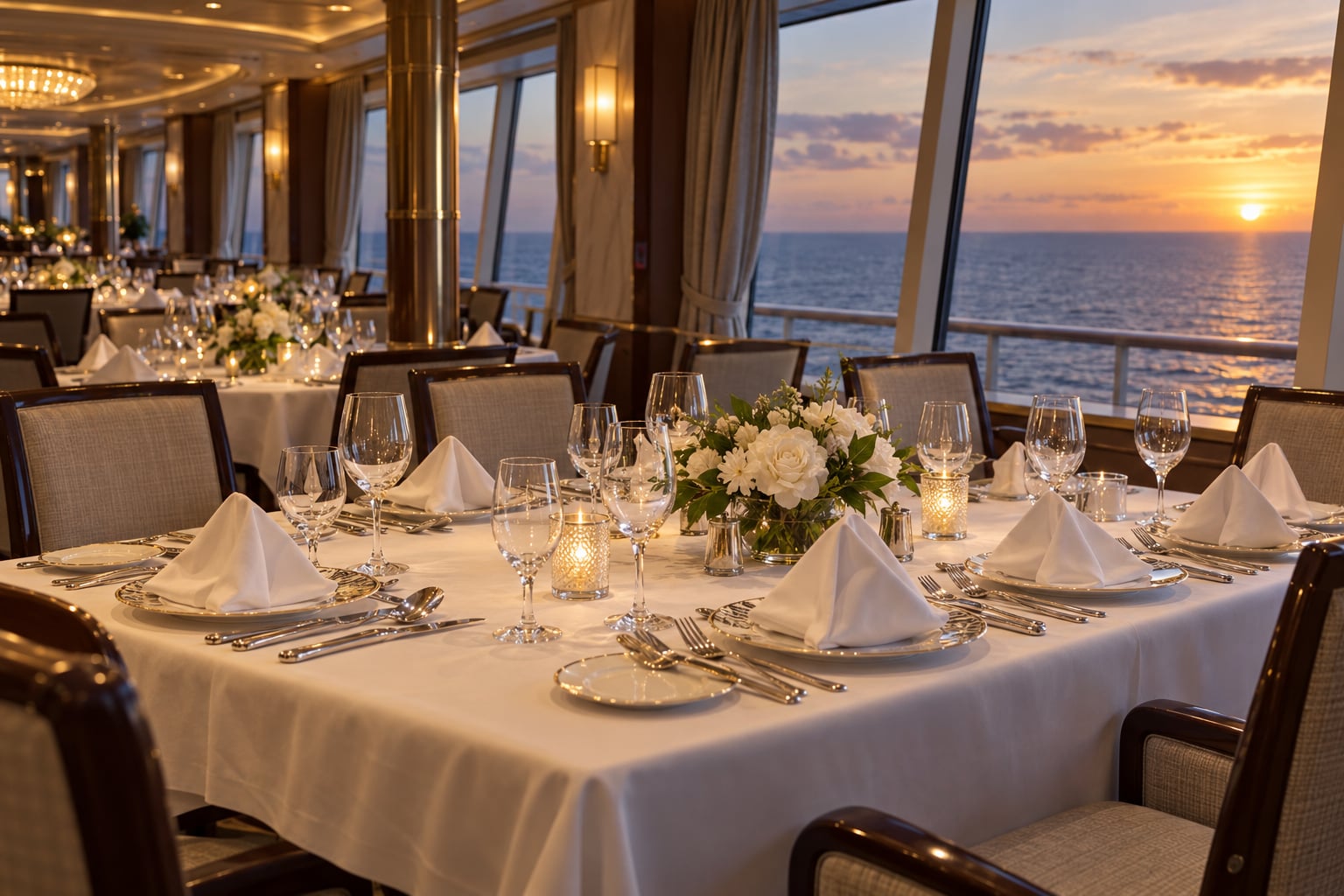
A formal night on a cruise is an evening — usually the Captain’s Gala Dinner or a special service in the main dining room — when the line asks guests to dress beyond casual for that one night. The short version of how formal nights work on cruises: they are advertised traditions, not rules anyone enforces at the door. Almost nobody has ever been turned away for wearing a polo shirt.
Most first-time cruisers pack for three black-tie evenings they never wear. Within a few hundred words you’ll know how many nights to expect, where the dress code actually applies, and how to check your own sailing’s schedule before you pay for anything.
Table of Contents
- 1What Is a Formal Night on a Cruise?
- 2How Formal Nights Work on Cruises
- 3What to Wear for Different Cruise Dress Codes
- 4Formal vs. Semiformal: What Changes?
- 5Do Formal Nights Apply to Every Cruise?
- 6How to Check Your Cruise Line’s Dress Code
- 7What If You Do Not Know What to Wear?
- 8Frequently Asked Questions
- 9Do I have to dress up for a formal night on a cruise?
- 10How many formal nights are on a 7 day cruise?
- 11How do I know which nights are formal nights on a cruise?
- 12Can I skip formal night on a cruise?
- 13What do people really wear on a formal night?
- 14What do children wear on cruise formal night?
- 15Conclusion
What Is a Formal Night on a Cruise?
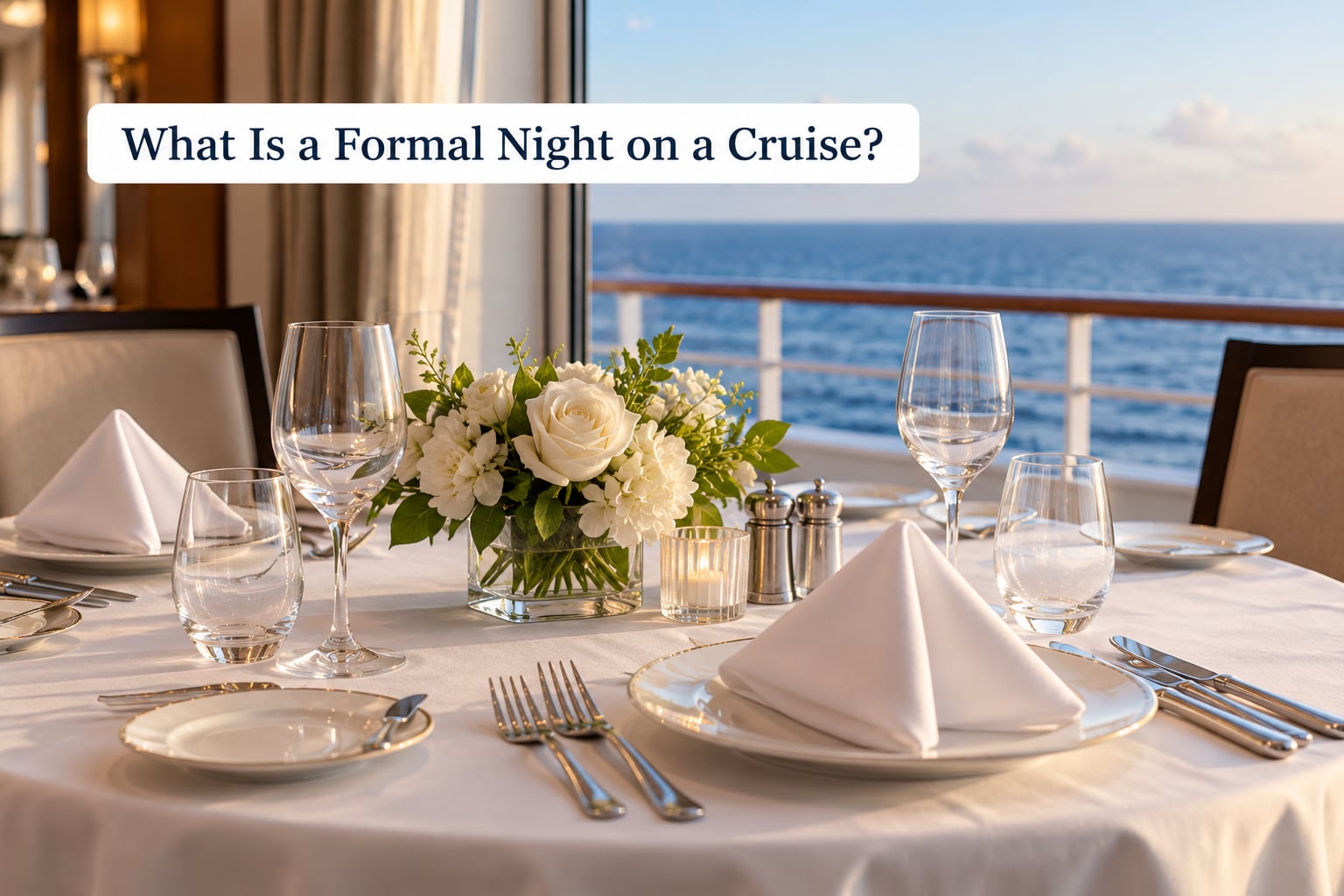
A formal night is a scheduled evening when the cruise line sets a dress code above casual, usually for the Captain’s Gala Dinner or a themed dinner service. Men are asked for a dark suit or tuxedo, women for a cocktail dress or evening gown. It is optional in practice, and it applies to certain venues on that night only.
The custom dates back to the ocean-liner era, when dining was genuinely formal and the ship’s social hierarchy was visible in what people wore. Cruise lines kept the ritual because it photographs well, gives the evening a shape, and lets guests mark an anniversary or honeymoon in a way a regular dinner doesn’t.
Two things get confused constantly. The first is dress code, which is the published rule on the daily program. The second is dress practice, which is what 300 other guests actually put on. Those are frequently not the same thing, and only the first one is the cruise line’s official position.
A semiformal night sits one step down: a suit jacket or an elegant cocktail dress is welcome, but nobody expects a tuxedo or floor-length gown. A smart casual night is looser still, usually a collared shirt with chinos for men and a simple dress or nice separates for women. Casual nights — the majority of them — mean anything that isn’t swimwear or gym wear.
How Formal Nights Work on Cruises
The code applies where the line controls the door. On a formal night that is typically the main dining room, the buffet’s upscale sections, and sometimes specialty restaurants. The pool deck, the lobby, the buffet’s casual counters and most bars carry no formal-night requirement at all.
Everything else follows from that. Buffets stay casual by design so that anyone can eat on a formal night without dressing up. Many seasoned cruisers eat at the buffet or an informal venue and skip the dining room entirely; that’s a normal choice, not a rebellion.
The evening itself has a fairly consistent shape:
- Late afternoon. Guests get ready. The pool deck quiets down around 5pm as people drift back to their cabins.
- Around 6pm. Doors open for the dining room. On gala nights there’s often a welcome drink and a chance for the captain or officers to be photographed at the door.
- 6:30 to 8pm. Dinner service, usually with assigned seating if you’re in a main dining room with a traditional seating time.
- 8pm onwards. The show moves to the theatre, or the evening continues with drinks and live music in one of the ship’s venues.
- Late. Formal night often means people stay up. The dress code is part of why the ship’s bars and dance floor stay busy after a gala dinner.
Standards differ by cruise line and by ship, sometimes within the same brand on the same itinerary. That’s why checking your own sailing beats reading a general guide.
What to Wear for Different Cruise Dress Codes
Match the outfit to the wording the line uses. Here’s what each level usually means in practice.
Formal / black tie optional. Men: dark suit, dark trousers, dress shirt, tie, dress shoes. A tuxedo is welcome but rarely required. Women: cocktail dress, jumpsuit, dressy trouser suit or floor-length gown, with dressy shoes. This is the level most lines call Formal Night or Elegant Night.
Black tie. Men: tuxedo with black bow tie, black patent-style shoes, optional cummerbund or waistcoat. Women: floor-length gown or a very refined cocktail dress. Only a minority of mainstream sailings use this, though Cunard and some Regent itineraries do.
Semi-formal. Men: suit jacket with trousers, tie optional depending on the line. Women: elegant dress, jumpsuit or nice separates. Clean loafers or dress sneakers are usually tolerated here, but check the program.
Smart casual. Men: collared shirt, chinos or dark jeans, no tie. Women: sundress, blouse with skirt or trousers, a dressier jacket. Footwear is relaxed, though trainers and flip-flops are the two things most often turned away at specialty restaurants.
Cruise casual or resort casual. Shorts, polos, sandals, cover-ups over swimwear. Cover-ups matter: most ships want a shirt or robe over swimwear outside the pool, and a towel over the shoulders is the single most common reason guests get pointed away from a dining area.
Theme night. Costume-adjacent but not formal. A white night, a Greek night or a retro night usually means themed clothing rather than suits and gowns, and most lines explicitly say it stays casual underneath.
Formal vs. Semiformal: What Changes?
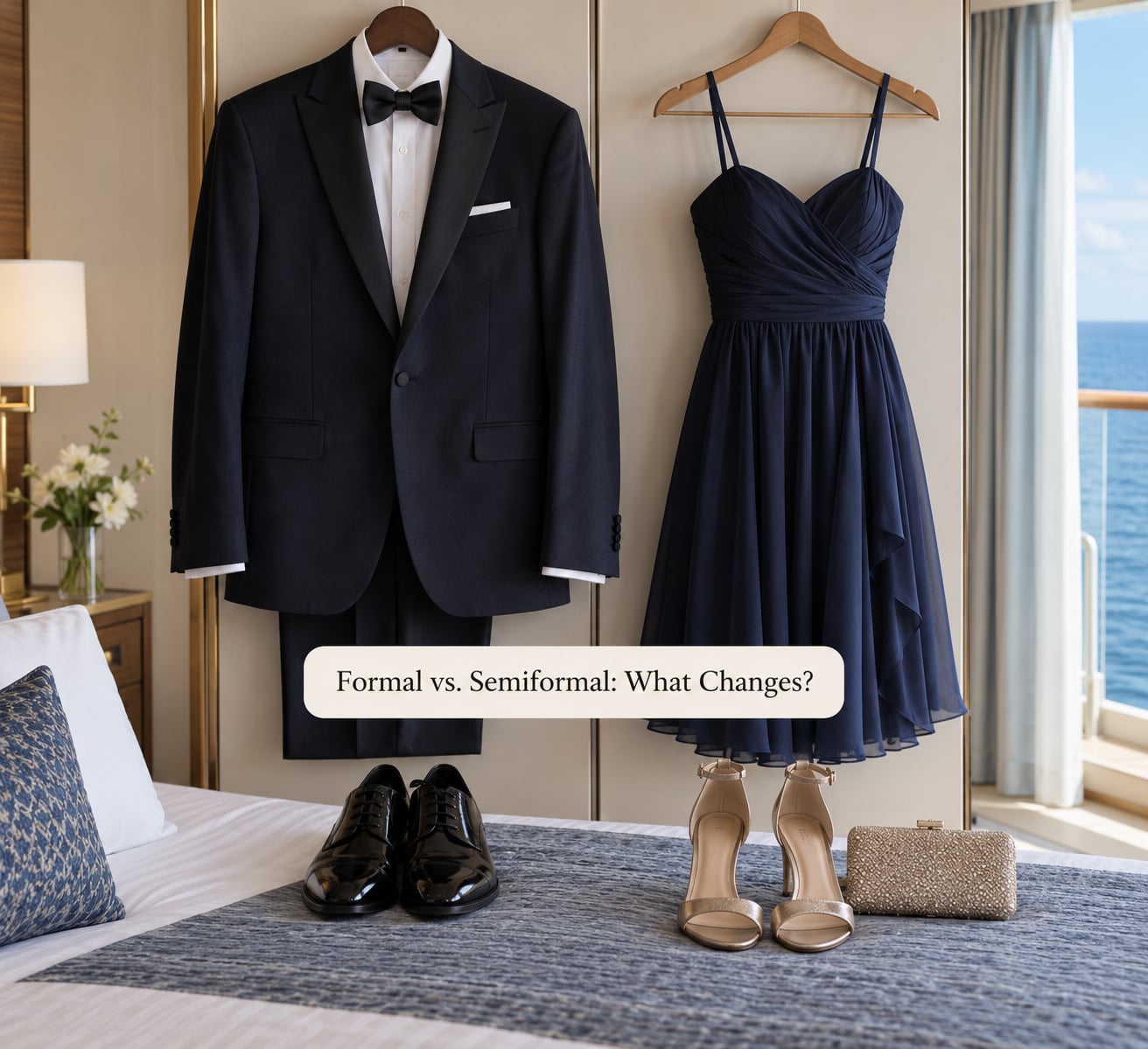
The gap between formal and semiformal is mostly about formality of the garment, not comfort. Here’s the practical difference.
| Element | Formal / black tie optional | Semi-formal |
|---|---|---|
| Men’s clothing | Dark suit or tuxedo, collared shirt, tie | Suit jacket with trousers, tie usually optional |
| Women’s clothing | Cocktail dress, jumpsuit, elegant trouser suit or evening gown | Dressy dress or coordinated separates, jacket encouraged |
| Footwear | Dress shoes, loafers or heels | Clean loafers, flats or smart casual shoes |
| Accessories | Bow tie, cufflinks, clutch or small bag, pashmina for evening air | Watch, simple jewellery, small shoulder bag |
| Where you’ll see it | Captain’s Gala Dinner, main dining room, black tie optional nights | Most “elegant night” and “dress up” labels on mainstream lines |
| Realistic expectation | A minority wear full black tie; most wear a dark suit or cocktail dress | Most guests wear one step above a smart casual outfit |
One rule of thumb from the Cruise Critic boards: if you’re wearing a dark suit or a cocktail dress, you are already better dressed than a large share of the ship. That’s the practical reality of both levels.
Do Formal Nights Apply to Every Cruise?
No. Some sailings have none, and most have fewer than older guides suggest. Lines have broadly moved toward resort casual, and several have renamed or downgraded their formal nights. Recent guidance from CLIA, the cruise industry trade body, reflects that shift toward resort casual dressing with formal nights treated as optional.
Typical patterns by line, on most mainstream itineraries:
| Cruise line | How formal nights usually appear | What “formal” tends to mean there |
|---|---|---|
| Carnival | Elegant Night, often one or two on a 7-night sailing | Dark suit or cocktail dress; tuxedo optional |
| Royal Caribbean | Formal Night on longer sailings, black tie optional on some | Dark suit or cocktail dress; tux rental offered onboard |
| Celebrity | Chic Night in place of a traditional formal night | Suit jacket or dressy cocktail dress |
| Princess | Formal Night plus occasional Black Tie Night | Dark suit or gown; black tie on designated nights |
| Norwegian Cruise Line | Freestyle cruising, so fewer mandated formal nights | Smart casual usually meets the requirement |
| P&O | Black Tie Night, typically once per cruise | Tuxedo or gown; the most traditional mainstream line |
| Disney | Formal Night, and it’s taken more seriously than most | Dark suit or gown; adults are held to it more strictly |
| MSC | Elegant Night and a captain’s gala dinner | Suit and tie or elegant dress |
| Cunard | Formal evenings on many sailings, sometimes black tie | Black tie on some nights; the strictest mainstream option |
| Regent Seven Seas | Formal nights across the itinerary | Jacket required; among the dressiest ships at sea |
By cruise length, a rough expectation for mainstream lines:
- 1 to 4 nights: usually zero. Short sailings rarely include a formal night at all.
- 5 to 6 nights: typically zero or one, often tied to a gala dinner or a longer sailing.
- 7 to 13 nights: typically one or two. This is the range most questions refer to.
- 14 nights or more: two or three is common, on lines that keep the tradition running.
Treat these as planning ranges, not promises. Ship-level policy wins every time.
How to Check Your Cruise Line’s Dress Code
The reason people panic is that lines rarely publish exact formal night dates per sailing before you sail. Here’s the routine that settles it, in order of reliability.
- Read your sailing’s daily program. This is the single most reliable source and it only appears once you’re on board. Every night lists its dress code in plain words. Check it each evening rather than assuming.
- Check the cruise line app before you travel. Most apps publish a dress code calendar or a “what to pack” guide. If it lists formal nights, you’ll see the night numbers.
- Search the cruise line’s own website for the dress code page for your line. Look for the named nights — Elegant Night, Chic Night, Formal Night — and how many the line usually runs.
- Call the cruise line or your travel agent before you sail and ask how many formal nights your specific ship and date have. Agents can usually check the published program for that sailing.
- Ask at guest services on embarkation day. The daily program is usually loaded by then, and the desk can point out which nights are which.
Don’t assume one line’s rules transfer to another. A dress code on a Regent sailing and a dress code on a short Carnival sailing are not the same conversation.
What If You Do Not Know What to Wear?
Use three inputs: the wording on the program, the venue, and the time of day. If the program says formal, you’re in the main dining room at 7pm, so dress for dinner. If it says smart casual, a collared shirt works.
If the program is vague or missing, one outfit covers most formal nights: a black outfit that passes as semi-formal with one change of accessories. Swap a tie and a belt and the same suit reads formal; swap to a dress shirt without a tie and it reads smart casual. For her, a black cocktail dress with a shawl is fine at both levels.
For kids and teens, expectations are much looser than parents assume. A collared shirt with trousers or a simple dress is plenty, and shoes matter more than the outfit. Adults are held to a stricter standard than children on most ships.
If you’re travelling with older guests or anyone who can’t manage heels or a long walk, tell the line in advance and ask about accessible seating. Blocked-chair seating in the main dining room is normally arranged through guest services or your travel agent, and it’s far easier before the sailing than on the night.
Two men’s options if a tux feels like overkill: bring a dark suit with a tie, or use the ship’s tux rental on the formal nights. Renting means one outfit for the whole cruise and no luggage weight. Bring your own if you already own one that fits.
On cost, formal nights themselves are free within your fare. What does add up is the optional extras on the same evening: a drink package, a photo package from the ship’s photographers, and specialty dining charges if you eat somewhere with a surcharge. Budget for those rather than for the outfit.
Frequently Asked Questions
Do I have to dress up for a formal night on a cruise?
In practice, no. Cruise lines publish a dress code, but enforcement is light and crew rarely turn anyone away from the main dining room. Most cruisers report that a collared shirt and a nice dress are enough to feel comfortable. The exception is the most traditional lines and ships, such as Cunard or Regent, where the requirement is genuinely enforced in the main dining room and some specialty restaurants.
How many formal nights are on a 7 day cruise?
On mainstream cruise lines, a 7-night sailing typically has one or two formal nights, sometimes none at all on shorter itineraries. Longer sailings of 14 nights or more commonly carry two or three. Exact numbers depend on the ship and date, so check your sailing’s daily program on board or ask your travel agent before you travel.
How do I know which nights are formal nights on a cruise?
The daily program, available in the cruise app and on screens around the ship, lists the dress code for every night in plain words. Before you sail, check the app or the cruise line’s website for a dress code calendar, then confirm the night numbers with your travel agent. On embarkation day, guest services can confirm the schedule for your sailing.
Can I skip formal night on a cruise?
Yes, and many experienced cruisers do. The buffet, the pool deck, most bars and any informal casual restaurant keep their normal dress code on a formal night, so you can eat whenever you like without dressing up. Only the main dining room and some specialty restaurants apply the formal requirement. Skipping it costs you nothing beyond the gala atmosphere.
What do people really wear on a formal night?
The range on any given night is wide. You’ll see tuxedos and floor-length gowns, dark suits and cocktail dresses, and a fair number of people in plain shirts and sundresses at the same table. Men who skip the tux usually wear a dark suit with a tie. Women who skip the gown usually wear a cocktail dress, a jumpsuit or an elegant trouser suit.
What do children wear on cruise formal night?
Children’s expectations are far more relaxed than parents think. A collared shirt with trousers, a simple dress, or a neat shirt and skirt is plenty. Shoes should be closed-toe and clean, and trainers are tolerated more often than not. On most lines, adults are held to the published dress code more strictly than kids are.
Conclusion
Start with your cruise line’s own sailing information rather than a generic dress code guide, because ship policy beats every rule of thumb. Once you know which nights are formal, pick the least formal outfit that meets the stated requirement and stays comfortable — for most people that’s a dark suit or a cocktail dress. Then check the daily program each evening, because the line sets the code night by night and it can change.