Cruise ship cabins are categorized in two layers. The first is the type: interior, ocean view, balcony or veranda, and suite. The second is an alphanumeric category code such as 8A, 2D or SB that pins down the deck, size, window type and how many guests the room sleeps. Every cruise line invents its own code letters, and those letters can change from one ship class to the next on the same line, so research done on one line actively misleads you on another.
The friendly name on a booking page is marketing copy. The code is what you actually buy, what prints on your cruise card, and what decides the fare. A published Carnival Adventure listing for cabin 10223 in category 8A describes a king bed that converts to two twins, a balcony, and a bathroom with a shower. That is the level of detail the code is carrying for you.
Most costly mistakes come from collapsing those two layers into one. A balcony is a type. 2D is a specific balcony, and the gap between one balcony and another can be twenty feet of deck position, a lifeboat parked in your sightline, or a bed setup that sleeps three instead of two.
Table of Contents
- 1How Cruise Ship Cabins Are Categorized at a Glance
- 2How Cruise Lines Name and Group Cabins
- 3What Do Cabin Numbers Tell You?
- 4What Are the Main Cruise Ship Cabin Categories?
- 5Interior Cabins
- 6Oceanview and Window Cabins
- 7Balcony and Veranda Cabins
- 8Suites and Other Premium Categories
- 9How Cabin Category Affects Price and Experience
- 10How to Choose the Right Cabin Category
- 11Frequently Asked Questions
- 12Is an oceanview cabin the same as a balcony cabin?
- 13Why do different cruise lines use different names for similar cabins?
- 14What does an obstructed-view oceanview cabin mean?
- 15Are interior cabins suitable for travelers who get seasick?
- 16Can cruise ship cabins be connected or adjoining?
- 17How do I find accessible cabins on a cruise ship?
- 18Conclusion
How Cruise Ship Cabins Are Categorized at a Glance
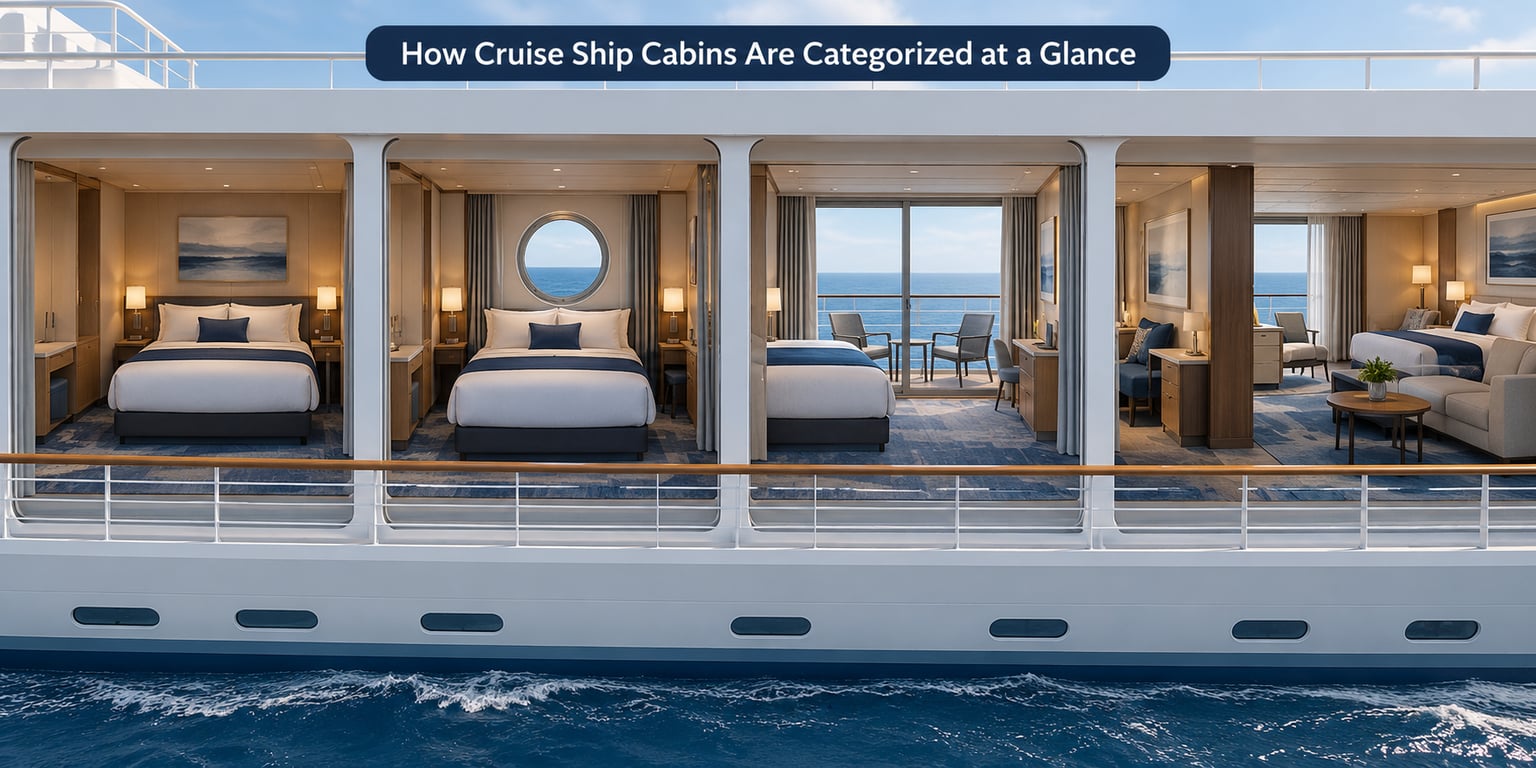
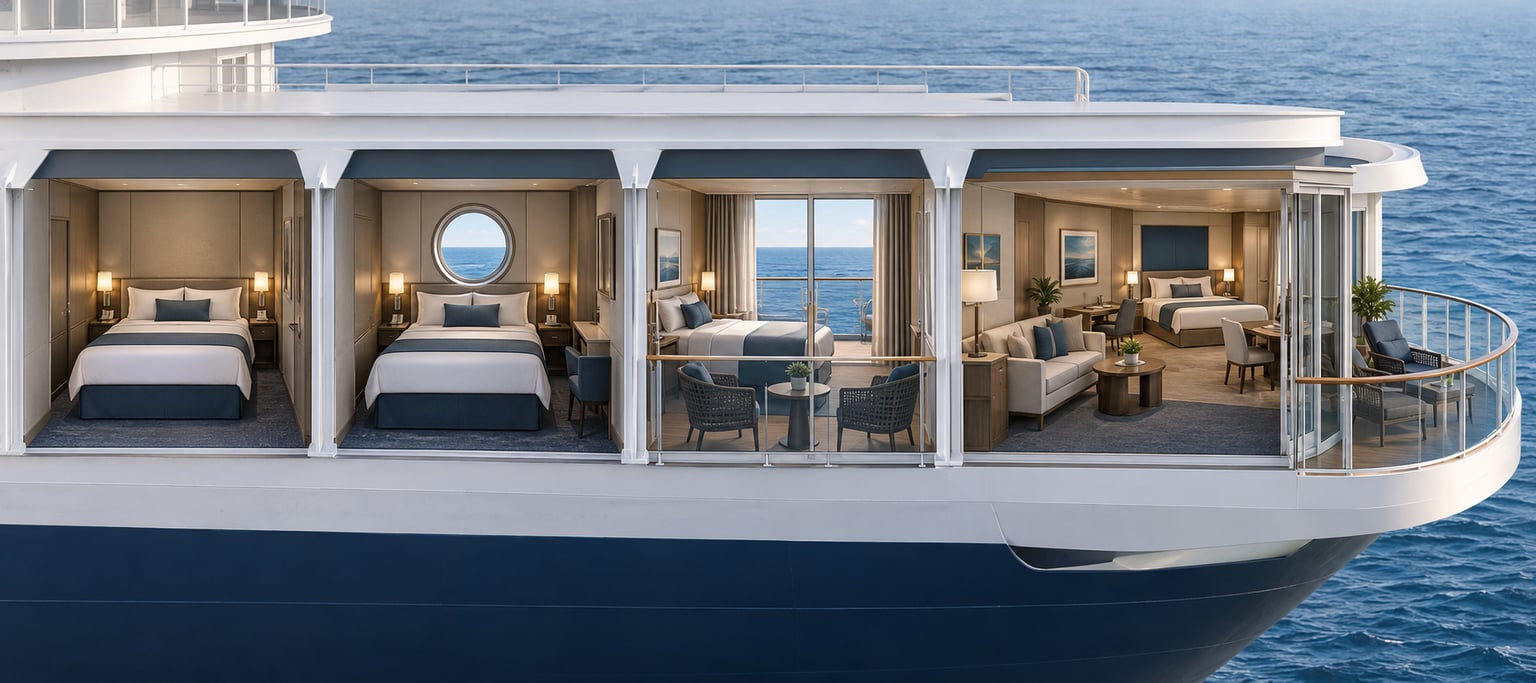
Four types cover almost every cabin sold at sea: interior, ocean view, balcony and suite. They are arranged in a deliberate ladder. The cheapest rooms sit in the middle of the vessel with no outside light at all. The most expensive sit high, wide, forward or aft, with genuine outdoor space and a living area separate from the bed.
| Cabin type | Where it sits | Light and outside access | Typical size | Sleeps | Price tier | Best for |
|---|---|---|---|---|---|---|
| Interior | Inner corridor, usually midship on lower decks | None. No window or porthole | About 150-200 sq ft on older ships, more on new large vessels | Mostly two, some sleep three or four | Lowest | Spenders who will not use the room, and anyone who wants to spend the difference ashore and onboard |
| Ocean view | Hull side, often on lower decks | Fixed picture window or porthole, usually not openable | About 160-220 sq ft | Two to three | Low to mid | Cruisers who want natural light and a sea view but will not use a balcony |
| Balcony or veranda | Widely spread, including promenades and the aft and forward ends | Sliding glass door onto a private outdoor balcony | About 180-300 sq ft of cabin, plus the balcony | Two to four depending on category | Mid to high | Most first-time cruisers, and anyone who values fresh air and a private place to sit |
| Suite | Toward the forward and aft ends and higher decks | Larger balcony, wraparound on many ships | 400 sq ft and up, some far more | Three to six | Highest | Milestone trips, families needing a second room, and anyone who wants a separate sitting area |
Square footage is a range, not a promise. Newer large vessels carry noticeably bigger cabins of every type than older, smaller tonnage, and a suite on a contemporary ship can dwarf a suite from two decades ago. Read the size line on the specific cabin listing rather than trusting the category name alone.
How Cruise Lines Name and Group Cabins
Cabin names are not standardized across the industry, and that is the single most useful thing to understand before comparing fares. A cabin called “Oceanview” on one line may be called “Outside” or “Window” on another, and the difference in size between those two products can be significant.
Terminology drifts for ordinary commercial reasons. Several lines use “veranda” where others use “balcony” for the same product. Some say “ocean view,” others “oceanview” with no space, others “outside cabin.” “Stateroom” and “cabin” mean the same room; which word appears tells you how old the line’s marketing department is, not what you get. On lines that rank heavily on balcony inventory, the balcony itself may carry its own sub-names, such as sunset balconies on the aft end or an infinite balcony that opens toward a central park deck.
Underneath the naming, the grouping is consistent almost everywhere: interior at the base, ocean view above it, balcony above that, and suites at the top, with mini-suites, suites, penthouses and one or two named top tiers along the way. Suites get their own ladder, and the perks climb with it: separate living space first, then priority boarding, then exclusive lounge or dining access, then butler service on the top tiers.
The reason categories are tiered this way is inventory. Lower category numbers are deliberately mapped to midship positions and larger cabins so the line can build a price ladder out of physical rooms. Once you understand that, a cheaper code stops feeling like a worse product and starts looking like the same room, further from the center, smaller, or with a different window.
Here is where portability breaks down. Codes are specific to a line, and often specific to a class of vessels within that line. Royal Caribbean, for example, runs a large, structured letter system that has been interpreted differently across its Icon, Oasis, Quantum, Freedom, Voyager, Radiance and Vision classes. Veteran cruisers on the Cruise Critic boards talk about letter tiers the way other people talk about hotel floors, decoding positions letter by letter for a given deck. That lexicon is real and useful, but it is not transferable.
River and expedition vessels break the pattern differently. Their hulls and itineraries mean far fewer categories in total, usually a handful of interior, window and balcony or suite options, and the differences between them tend to be about square footage rather than about window type.
| Cruise line | How its categories are structured | Codes you will meet | Watch for |
|---|---|---|---|
| Carnival Cruise Line | Numbered decks with a letter per deck, letter runs roughly A through E from one end of the deck to the other | 1A to 1E, 2A to 2D, 3A to 3D, 4A to 4E, 5A to 5C, 6A to 6B, 7A to 7D, 8A to 8D | The leading digit matches the deck, so the category tells you the deck before you look at anything else |
| Royal Caribbean International | A number tier for size and position paired with a letter for view and window type | 1D, 2D, 3D, 4D, 1A, 1E, 2F, plus I for an infinite balcony, CB for connecting, SB and SG for sunset balconies | The same letter means different things across ship classes, so confirm the code against the deck plan of the vessel you are actually sailing |
| MSC Cruises | Named tiers rather than pure codes, with cabin types attached to each name | Voyager, Opera, Fantasia, Duplicado, Bella and Dolce, plus a separate Yacht Club tier | Yacht Club is a distinct tier with its own spaces, not simply a bigger standard room |
| Holland America Line | Class-style letter codes that passengers often discuss through the lens of how the beds are configured | SA, SB and SC class cabins | Cruisers debate these mainly as quad versus triple occupancy setups, which is a different axis from view and size |
| Princess Cruises | Balcony, ocean view, interior and a broad suite range, with codes that vary by ship | Ship-specific category codes shown on the deck plan | Treat the deck plan for your sailing as the only authority; do not carry a code across from a different vessel |
What Do Cabin Numbers Tell You?
Two different things get called a “cabin code,” and confusing them causes most of the trouble. A cabin number such as 8102 is the physical room: deck 8, cabin 02. A category code such as 8A is the sales category that the line uses to price and sell a group of similar rooms. Your booking confirmation normally shows both, and only the category tells you what you bought.
Five rules cover the overwhelming majority of codes you will meet.
- Split the code into its number and its letter. Almost every code on every line follows that shape, even when the letters are spelled out.
- Read the number as size and position. On lines using the number-plus-letter scheme, a lower number generally means more square footage and a more central location toward midship, which is why it costs more.
- Read the letter as window or view type. On Royal Caribbean, for example, A is an ultra-spacious ocean view with a large balcony, C is an ocean view with a large balcony, E is an obstructed ocean view balcony, F is a studio, and I is an infinite balcony.
- Assume nothing carries between lines, or between ship classes on one line. A letter means whatever that line’s deck plan says it means, on that vessel.
- Check occupancy before you count beds. Some categories sleep two, some sleep three, some sleep four, and the letter is often the only place that information appears.
Two worked examples make the pattern concrete.
On Carnival, category 8A is an eight-category balcony on deck 8. Carnival’s ladder runs from the lower tiers, 1A through 1E, up to the upper tiers, 8A through 8D, and the letter steps across the deck from one end to the other. So an 8A and an 8B are both high deck balconies sitting near each other, differing mainly by where along the deck they fall. If a search result tells you a cabin is category 8B, the useful follow-up question is not “is that good” but “where is 8B on this deck, and what is directly outside it.”
On Royal Caribbean, the same letter and a different number tell a completely different story. The line’s own published guidance is that 1D is the more desirable, larger and more centrally located balcony, with price falling as the number climbs toward 4D and beyond. That is not a quality ranking by accident. It reflects where each tier was placed on the deck plan.
Three designations sit alongside the code itself and change what you get.
| Designation | What it means | The trade-off |
|---|---|---|
| Assigned cabin number | You bought a specific room and its number is on your documents | Higher fare, but no surprises and you can pick a deck position |
| Guarantee cabin, often X, XB or XQ | You bought a category and the line assigns the specific cabin later | Lower fare, but no control over deck, position, noise or view, and you may be moved at embarkation |
| Obstructed view | The window or balcony looks onto something solid, such as a lifeboat, a deck house, a railing or the promenade | Cheaper than the same category unobstructed, but the degree of obstruction varies widely and is not standardized |
| Accessible stateroom | A wider doorway, roll-in shower and grab bars, usually on a deck near the elevator | Fewer available, often a specific letter within a category, and they sell out early |
Obstructed view is the vaguest label in the whole system. There is no industry standard for how much obstruction is acceptable before a view becomes obstructed. A barely clipped lifeboat and a view blocked by a solid deck house have both been sold under that label. Treat it as a discount on a window, not as a window.
Guarantee cabins work the same way. You are buying inventory flexibility, not a room. Cruise lines price them lower because they can fill them last, and they assign them when other inventory is allocated. If you want a specific position, a guarantee is the wrong product no matter how good the fare looks.
What Are the Main Cruise Ship Cabin Categories?
The four broad categories below describe most cabins on most ships. Within each one, the category code decides size, position and window detail, which is why two balconies on the same deck can cost very different amounts.
Interior Cabins
Interior cabins have no window and no porthole, and they sit in the inner corridor of the ship where the structure makes an outside wall impossible. That constraint is exactly why they cost the least. Nothing about the room is cut short; the square footage is comparable to an ocean view on an older ship, and the bed, bathroom, storage and entertainment setup are usually the same.
Newer vessels have softened the experience with LED art walls that mimic a sunrise, and some ships now fit interior rooms with a virtual porthole, a screen that renders an exterior view in real time. Those additions help, and none of them equal real daylight.
Interior cabins make sense when you are out of the room for most of the day, when your itinerary is port-heavy and you will not see the cabin until you are asleep, or when the difference in fare buys you a longer or nicer trip. They are a poor choice for anyone who plans to be seasick in bed for two days.
Oceanview and Window Cabins
Ocean view cabins add one thing to an interior: an outside wall with a fixed window or porthole. The window gives you natural light and a moving view of the sea, which matters more than most first-time cruisers expect. You can stand at the glass at 6 a.m. and know it is a port day without looking at the daily programme.
Two practical details are worth checking before you book. Ocean view windows generally do not open, and on many ships they are small. On older tonnage they can be a porthole rather than a picture window, which changes the view substantially: a porthole gives you a slice of horizon, a picture window gives you a wall of sea. Obstructed ocean view is sold as a discount to the same category unobstructed, and the obstruction is often a lifeboat or a deck structure.
This is the value pick for anyone who wants light but will not spend an evening on a balcony, and for itineraries where scenery is the point, such as Alaska, Norway and the fjords.
Balcony and Veranda Cabins
A balcony cabin adds a sliding glass door and a private outdoor space, usually furnished with two chairs and a small table. “Veranda” is the same product under a different word on several lines, and both describe your own slab of outside deck with your own view. The cabin interior itself is often only modestly larger than an ocean view; what you are paying for is the door and the space behind it.
Balcony subtypes are worth decoding rather than skipping. Aft or forward-facing balconies get a wider view down the length of the ship, which is why they are often priced apart from side-facing ones. Sunset balconies sit at the stern and face the evening sun. Promenade-view balconies look onto an open deck rather than open water, and on a port-heavy Caribbean itinerary that is usually water most of the time. Infinite balconies open toward a central park area instead of the sea. Obstructed balcony means something solid sits in your sightline, and the cabins nearest the lifeboats are the usual example.
The honest trade-off is that a balcony you never use is wasted fare, and small balconies genuinely limit what you can do with them. Plenty of cruisers use a 40-square-foot balcony for coffee in the morning and nothing else.
Suites and Other Premium Categories
Suites sit at the top of the ladder and the names climb in steps: mini-suite, suite, penthouse, then named tiers such as a Royal or Ultimate suite on some lines. What separates them from a balcony is usually not the window. It is the square footage, a separate sitting area with its own sofa, sometimes two sleeping zones, and a larger balcony that may wrap around a corner.
Perks travel with the tier rather than with the room. Priority boarding, exclusive lounge or restaurant access, butler service on the highest categories and priority disembarkation at the end of the cruise all sit higher up the ladder. Which perks apply to which tier is a line decision, and it changes between ships, so read the specific listing instead of assuming a suite anywhere includes what a suite elsewhere did.
Three other categories exist outside the four main ones. Combined and connecting staterooms let families book adjoining rooms rather than squeeze four people into one. Accessible staterooms carry wider doorways, roll-in showers and grab bars. And solo travelers should know that many lines price a single occupant in a double-occupancy cabin well below the per-person fare, which makes an ocean view or balcony an affordable upgrade for someone traveling alone.
How Cabin Category Affects Price and Experience
Six things move the fare, and once you can name them you can read almost any quote.
- Size. Square footage climbs steadily up the ladder, and the jump from balcony to mini-suite is often larger than the jump from ocean view to balcony.
- Position. Midship cabins sit in the calmest part of the ship and in the most convenient location for getting anywhere. Forward cabins are quieter but windier near the bow, and aft cabins catch the engine vibration and the wake.
- View. The difference between obstructed and unobstructed is a real discount, and the difference between a side balcony and an aft or forward-facing one is usually a real premium.
- Outdoor space. A balcony you will never use is still priced as one. An ocean view at the same deck position often captures most of the enjoyment for less.
- Occupancy. The number of guests a category is built for changes its economics. A category configured for two cannot be sold to four as though it were designed for them.
- Included perks. Lounge access, specialty dining, priority boarding and butler service are bundled into the higher tiers, and those bundles are part of what you are paying for.
This is also why lower category numbers cost more. The line maps its most desirable rooms to the lowest numbers, then prices down the ladder as rooms get smaller, move toward the ends of the ship, or lose outdoor space. A cheaper code is a different room on a real deck plan, not a defective one.
Category also shapes the day itself. A cabin above the theatre or beside the pool deck gets engine vibration, foot traffic and late-night noise, and no code will tell you that. Room for that has to come from the deck plan.
How to Choose the Right Cabin Category
Start with how much time you will actually spend in the cabin. On a port-heavy Caribbean itinerary with two sea days, an interior cabin is defensible. On an Alaska or Norway sailing where half the itinerary happens inside the balcony, the cabin is the trip. That single question resolves more cabin debates than any other.
Then work through the rest in order.
- Set your budget for the room, not the trip. Decide what a window is worth to you and hold to it. Cabin category is the most elastic part of a cruise booking, which also makes it the easiest place to overspend.
- Check occupancy against your actual party. Count the people, including children, and read the sleep number on the listing. A two-person category is not a family room.
- Pick a position. Midship suits cruisers who get seasick and anyone who wants short walks to the elevators. Aft suits sunset watchers and people who want to feel the ship move. Forward suits light sleepers who will accept more wind and a narrower view.
- Decide about stairs and elevators. Older ships put some categories, including many accessible staterooms, on decks without a central elevator bank. Check before booking a mobility-limited traveler into a room at the end of a long corridor.
- Decide about guaranteed cabins. Worth it if your budget matters more than your deck. Wrong if your position, your view or your noise tolerance matters.
- Read the deck plan last, carefully. This is the step most people skip and the one that most improves a trip.
The cabins worth avoiding are identifiable on any deck plan once you know what causes noise. Cabins directly above or beside the pool deck inherit sunrise conversation, music and staff movement. Cabins near an elevator lobby inherit doors, luggage carts and early departures. Cabins adjacent to a main dining room, galley or galley storage hear service traffic at hours nobody should be awake. Cabins under a theatre or a lounge live above the aft seating bank. Cabins beside the lifeboats have a permanently obstructed view.
None of these are automatically unusable. They are just cheaper for a reason, and the reason is visible before you book if you look at the deck plan rather than at the category name.
Frequently Asked Questions
Is an oceanview cabin the same as a balcony cabin?
No. An oceanview cabin has a fixed window or porthole on the hull, and the window generally does not open. A balcony cabin has a sliding glass door leading to a private outdoor space you can sit in. Ocean view cabins are usually smaller and cheaper; balcony cabins typically run about 180-300 square feet plus the balcony itself.
Why do different cruise lines use different names for similar cabins?
Because the names are marketing, not a standard. One line calls a room an ocean view, another an outside cabin, another a window cabin, and the products behind those words can differ in size. Lines also use veranda where rivals use balcony for the same room. Category codes are equally line-specific, so a code researched on one line rarely carries to another.
What does an obstructed-view oceanview cabin mean?
It means something solid sits outside the window, such as a lifeboat, a deck house or a railing, and the line sells it below the price of the same category unobstructed. There is no industry standard for how much obstruction is acceptable, so the label can cover anything from a slightly clipped lifeboat to a view blocked almost completely. Read the deck plan for the specific cabin.
Are interior cabins suitable for travelers who get seasick?
Often yes, because most interior cabins sit midship on lower decks, which is the calmest part of a ship. That same midship position is why interior cabins are the cheapest rooms in the first place. Pick one toward the center of the ship rather than at the forward or aft ends, and you lose nothing that matters for comfort. Avoid combining an interior cabin with an end-of-ship position.
Can cruise ship cabins be connected or adjoining?
Yes, on most modern ships, but not on every category or every deck. Connecting staterooms sit side by side with a door between them, and many lines mark them with a specific code, such as CB on Royal Caribbean. The number of connecting rooms on any given ship is small, so they sell out early. Book them as two linked reservations if you are booking far in advance.
How do I find accessible cabins on a cruise ship?
Look for stateroom categories explicitly labelled accessible, which usually means a wider doorway, a roll-in shower and grab bars, and often a location close to an elevator. Check the deck plan for walking distance to that elevator bank, since some accessible rooms sit far from it on older ships. Accessible inventory is limited and sells out earlier than standard rooms.
Conclusion
Compare cabins inside one cruise line and one ship class. Cross-line fare comparisons mix different products, and cross-class code comparisons mix different meanings, which is how people end up paying more for less.
Three decisions come first. How much of your trip happens inside the cabin, which sets whether you need outside space at all. Which position on the deck you want, which sets midship, aft or forward. And whether a guarantee cabin is worth trading deck control for a lower fare. Settle those and the category code becomes a formality rather than a puzzle.
Then open the deck plan for the ship you are actually sailing and look at what sits above, below and beside your cabin. That single check catches more disappointments than any amount of category research.