Reading hotel reviews like a pro takes about ten minutes if you read them in the right order. Start with the score, then check how many reviews sit behind it, read the middling 3- and 4-star reviews before the glowing ones, filter to the last 6 to 12 months, and cross-check two or three platforms before you commit. Most people do the opposite: they open the page, read a 4.8, book, and hope for the best.
Table of Contents
- 1Key Takeaways
- 2What You Need
- 3Your exact stay details
- 4Your traveller profile
- 5Your platform list
- 6The hotel’s own claims
- 7Step-by-Step: How to Read Hotel Reviews Like a Pro
- 8Step 1: Filter for Reviews That Match Your Stay
- 9Step 2: Look for Patterns Instead of One-Star Opinions
- 10Step 3: Check the Reviewer and Review Details
- 11Step 4: Separate Facts From Personal Preferences
- 12Step 5: Compare the Hotel’s Promises With the Evidence
- 13Step 6: Make a Decision Based on Your Priorities
- 14Common Mistakes
- 15The 60-second pre-booking checklist
- 16Frequently Asked Questions
- 17Are hotel reviews reliable?
- 18Should I read the most recent hotel reviews or the highest-rated ones?
- 19What does it mean when a hotel review is verified?
- 20How can I tell if a hotel review may be sponsored or fake?
- 21Is it better to choose a hotel with a 4.2 or 4.5 star rating?
- 22How many hotel reviews should I read before booking?
Key Takeaways
- A score is an average, not a verdict. 4.8 from 12 reviews tells you almost nothing.
- Scores are not comparable across platforms. Booking.com runs 0 to 10, TripAdvisor and Google run 1 to 5.
- Read the 3- and 4-star reviews first. They name real trade-offs; 5-star reviews rarely do.
- One complaint is an anecdote. The same complaint from three unrelated guests is data.
- Check the room type. Most bad noise reviews come from rooms near the lift, not the whole hotel.
- A near-perfect score with zero criticism in a year usually means reviews are being filtered.
- Read at least three sources: the booking platform, TripAdvisor, and Google Maps.
One more thing worth stating up front, because it changes how everything else lands: guest reviews are user-generated content, and the score a platform shows you is a weighted average of individual opinions, not an inspection. Nobody walked the corridors with a clipboard.
What You Need
You need four things before a single review is worth reading, and none of them are on the review page. Without them, you are reading opinions with no filter and will draw the wrong conclusion every time.
Your exact stay details
Your booking dates, the room type you are actually booking, and how many nights. A review of a two-night weekday stay in a standard room tells you almost nothing about a week in a suite over a holiday weekend. A property can have excellent reviews for its garden rooms and consistently poor ones for the rooms above the bar, and the page will not separate them for you.
Your traveller profile
Who is going and what the trip is for. Business travel, a family holiday, a solo trip, a long stay and a weekend city break each stress the property differently. Write your two or three non-negotiables before you open any reviews: reliable Wi-Fi and a desk, connecting rooms and a pool that is actually open, a quiet room and a late check-out, a kitchenette for a month.
In my experience the reviews that help most are the ones that answer your specific question, not the ones that score highest. Ten minutes spent deciding what you cannot compromise saves an argument at the front desk later.
Your platform list
At minimum three sources: the booking platform you will use (Booking.com, Hotels.com, Expedia or Agoda), TripAdvisor, and Google Maps. Each one has a different scoring scale, a different pool of reviewers and a different resistance to gaming.
| Platform | Score scale | Who can post | How to read it |
|---|---|---|---|
| Booking.com | 0 to 10, with the score shown as a number | Guests who booked through Booking.com | Multiply by 10 and treat as a percentage. 8.5 and above is strong. |
| TripAdvisor | 1 to 5 stars | Open; anyone with an account can review a listing | Large volume, but the widest range of gaming. |
| Google Maps | 1 to 5 stars | Open; any Google user can leave one | Skewed toward local and business travel. Excellent for location and check-in. |
| Hotels.com and Expedia | 1 to 5 stars, with a 0 to 10 sub-score in some markets | Bookers, mostly | Close to Booking.com in trustworthiness. |
| Agoda | Often a 0 to 10 score rather than stars | Bookers, plus some open posting | Strong in Asia, thinner review volume elsewhere. |
That table is the first thing to internalise. A 4.2 on TripAdvisor and an 8.4 on Booking.com are close to the same hotel, not a wildly different one, and travellers on forums get this wrong constantly. Scores are only comparable within the same platform and the same property over time.
The hotel’s own claims
Open the property’s description and note what it promises: pool, gym, airport shuttle, parking, air conditioning, breakfast hours, check-in time. Every one of those promises is a claim you can test against the reviews. The description is marketing; the reviews are the record.
Step-by-Step: How to Read Hotel Reviews Like a Pro
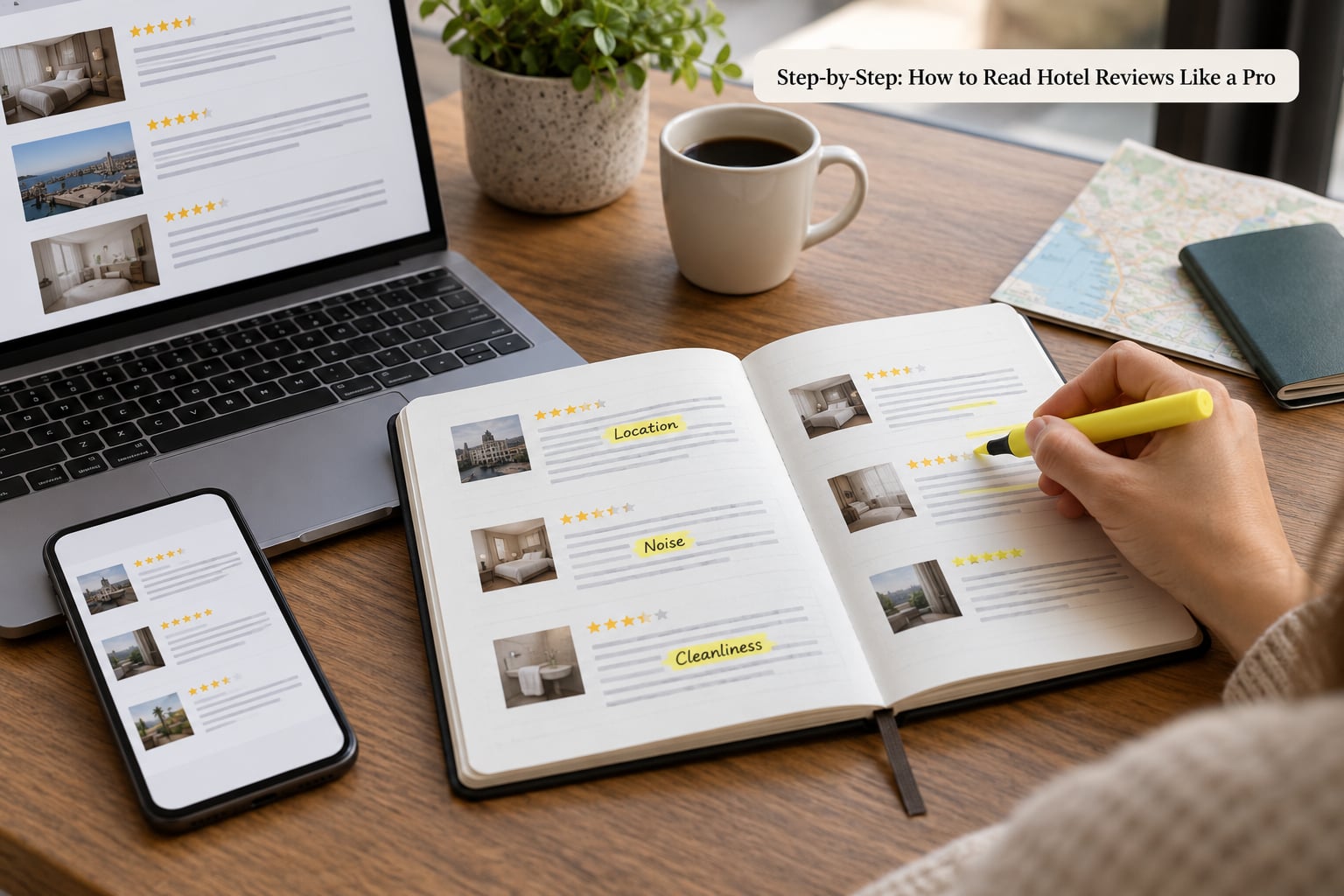
Six steps, in order. Most of the work is in steps one and two; the rest is quick once you have filtered properly.
Step 1: Filter for Reviews That Match Your Stay
Sort by most recent first, and set the room filter to the type you are booking if the platform offers one. Then read the date on each review and ignore anything older than about 12 months unless you are checking the review count. If the property says it renovated two years ago, reviews from before that work describe a hotel that no longer exists.
Look for reviews that describe your kind of stay: a solo traveller midweek, a family with a toddler at breakfast, someone working remotely from the room for a week. A reviewer whose trip looks like yours is worth ten reviewers describing someone else’s holiday.
If a hotel changed hands or rebranded, treat the score as unverified. Renovation, a new general manager and a new brand change staff, maintenance standards and sometimes half the building, and the historical average keeps its value long after the experience stopped matching it.
Step 2: Look for Patterns Instead of One-Star Opinions
Scanning for the most dramatic review is the most common mistake, and it is the easiest one to fix. What you want is repetition: the same complaint, described by three or four unrelated guests, in reviews written weeks apart. Thin walls in a specific wing. Breakfast ending at 10am during a summer season. A lift waiting time that grows after 4pm. Those are structural facts about the property.
One angry review about a leaky tap is an event. Three of them is a maintenance problem.
| Rating | What it usually means | How much attention to give it |
|---|---|---|
| 5 stars | Genuinely excellent, or someone with nothing to criticise | Low. Skim for concrete details; move on. |
| 4 stars | Very good with one small reservation | High. The reservation is the useful part. |
| 3 stars | Middling, and honest about the trade-off | Highest. Read these first and read them slowly. |
| 2 stars | Problems that the staff partly rescued | Medium. Useful if the complaint recurs. |
| 1 star | A single bad experience, or a review-bombing artefact | Low on its own. High only if repeated. |
Next, read the star distribution, not just the average. A 4.5 built on 400 five-star reviews and ten three-star reviews is a different place from a 4.5 built on 250 five-star, 150 four-star and 90 three-star. Both are fine, but the second is honest about itself, and a 9.0 on Booking.com with almost nothing in the 1 to 3 band often means reviews are being filtered before they reach the page.
Step 3: Check the Reviewer and Review Details
Credibility is mostly a matter of metadata. Look for a verified stay or “this guest stayed at the property” badge, and weight those above everything else. Then check the useful-vote total: a 3-star review that 40 people found helpful tells you other travellers wondered about the same thing.
Specificity is the strongest trust signal in review text. “The metro is an eight-minute walk, the station closes at midnight, and breakfast is 7 to 10am” can be checked. “Amazing stay, wonderful staff” cannot. Reviewers with a long history across unrelated hotels and a wide date span are usually writing from experience rather than from a free-stay invite.
Original guest photos are worth more than the hotel’s own photography, because they were taken by someone who walked in that night. Compare the two. A bathroom, a corridor or a view that looks different in guest photos tells you something the listing never will.
Step 4: Separate Facts From Personal Preferences
Split every complaint into two piles. The first is a fact about the condition of the property: cleanliness, noise level, distance to the station, Wi-Fi reliability, mattress firmness, air conditioning that works, water pressure, how long the queue at check-in is. These transfer to your stay.
The second is a preference: dark decor, mustard walls, an unhurried breakfast, a playlist in the lift, a staff member who was too chatty. If a review’s complaint starts with “I prefer” or “not my style”, it tells you about the reviewer.
The trap is that taste complaints get written in the same tone as real problems. Three reviewers who found the decor garish is a warning about the photos, not about your night. Three reviewers who said they could hear the conversation in the next room is a fact about the walls.
Step 5: Compare the Hotel’s Promises With the Evidence
Go back to the listing’s promises and test each one against the reviews. Does the gym exist and is it open, or does it appear in the photos and not in the guest photos? Is the airport shuttle real or was it discontinued? Do the review photos of the bathroom match the marketing photos? Discrepancies between official photography and guest-uploaded images are one of the most reliable signals that a property is being presented better than it is delivered.
Check how the hotel responds to criticism. A property that answers a detailed one-star review with a specific, non-defensive reply usually treats guests well when something goes wrong. One that replies with a form letter, or does not reply at all, tells you something about how a problem will be handled at check-in.
When something critical remains unclear, call the property before you book. Ask which rooms are quietest, whether the lift is central, whether breakfast is served on weekends. Front desks are generally honest about the two or three things guests complain about most, and a five-minute call can settle a question no review page answers.
Step 6: Make a Decision Based on Your Priorities
Now weigh what you found against your non-negotiables, using the score as one input rather than the verdict.
| What you see | What it means | What to do |
|---|---|---|
| Strong score, hundreds of reviews, recent criticism present and mild | A well-run property with normal trade-offs | Book it. Read the 3-star reviews for the specifics. |
| Strong score, fewer than about 50 reviews | Thin sample; the average can move a lot with one review | Check Google Maps and TripAdvisor for a second opinion. |
| High score with no criticism at all in 12 months | Reviews may be requested selectively | Look for 1 and 2-star reviews by filtering the rating down. |
| Mid score with a recurring complaint in the last year | A real, current issue | Decide whether you can work around it, or walk away. |
| Below about 7.0 on Booking.com, or below about 4.0 on TripAdvisor, repeated across platforms | Consistently below the bar | Walk away unless you have a specific reason and a mitigation. |
| Scores disagree wildly between platforms | Different reviewer pools, or one side is being managed | Trust the platform whose reviewers had to book there, then check Google. |
That last row in the walk-away line is the answer to the question people ask most often on travel forums: there is no magic number, but roughly 7 out of 10 on Booking.com, or 4 out of 5 on TripAdvisor, is where experienced travellers stop reading and start looking elsewhere. Property type matters. A simple guesthouse in a remote village will not score 9.0, and a score of 8.2 for that kind of place is a good result, not a warning.
Accept some uncertainty. You are making the decision with incomplete information, and every traveller who waited for total certainty simply booked nothing.
Common Mistakes
Judging by the star score alone. The fix is to look at the review count first, then the distribution behind the average. Score and volume together, in that order.
Treating one extreme review as representative. A single furious one-star review is usually about that person’s night. The fix is to search for that complaint in other reviews before you accept it.
Ignoring the room type. Noise complaints from rooms facing the lift do not describe the garden wing. The fix is to filter by room type and to search the review text for the specific floor or wing.
Reading old reviews. The fix is to set a 6 to 12 month window and check whether the property has been renovated, rebranded or taken over since. A brand change is the strongest invalidation signal there is.
Overlooking suspiciously positive language. Reviews that are all adjectives, with no room number, no time of day and no downside, tell you nothing. Watch for near-identical wording, a burst of reviews posted within days of each other, and reviewers with a single review in their entire history. Offer of a free stay or a discount in exchange for a review is an incentivised review in every platform’s guidelines.
Assuming a platform is honest because it looks official. Hotels collect reviews through review-management platforms and can request specific guests to leave one after a good stay. Nothing wrong with asking, but it skews the sample. Platforms where only bookers can review, such as Booking.com and Expedia, are structurally harder to game than open-posting platforms like TripAdvisor and Google Maps.
Skipping reviews entirely for a property you can call. For a small property, a boutique hotel or anything you can reach in one call, three minutes on the phone beats forty reviews.
The 60-second pre-booking checklist
- Note your review count and the star distribution, not just the average.
- Sort by most recent and check nothing you read is older than your renovation window.
- Filter to your room type.
- Read the 3-star reviews first, then the 2-star ones.
- Search the review text for your top two concerns: noise, cleanliness, Wi-Fi, queue, breakfast.
- Confirm you saw at least one complaint; if not, treat the score with suspicion.
- Open Google Maps and read the three most recent reviews there.
- Check the guest-uploaded photos against the official ones.
- Call the front desk if anything critical is still unresolved.
Frequently Asked Questions
Are hotel reviews reliable?
Partly. They are the richest unfiltered source of information about a property before you commit, but they are opinions, not inspections, and they can be filtered, incentivised or faked. They become reliable when you use them the way you would any other user-generated content: check the volume behind the score, read recent reviews only, and treat a complaint that three unrelated guests repeat as a fact about the building.
Should I read the most recent hotel reviews or the highest-rated ones?
Read the most recent ones first. A renovation, a new manager or a brand change can make reviews from two years ago describe a hotel that no longer exists, and the headline score keeps its value long after the experience stopped matching it. Once you have filtered to the last 6 to 12 months, sort by lowest rating rather than highest, because the middling reviews carry the practical detail.
What does it mean when a hotel review is verified?
A verified badge means the platform confirmed the reviewer actually stayed at that property, usually by matching it to a real booking. Verified reviews carry far more weight because the guest had something to lose and paid for the room in question. On Booking.com and Expedia, verification is structural: only guests who booked through the platform can leave a review at all.
How can I tell if a hotel review may be sponsored or fake?
Look for reviews with no specifics: no room number, no time of day, no mention of anything that happened, and no downside. Near-identical wording across several reviewers, a burst of reviews posted within days, a reviewer with exactly one review in their history, and a very high score with almost no critical reviews are all warning signs. Offers of free stays or discounts in exchange for reviews breach every major platform’s guidelines.
Is it better to choose a hotel with a 4.2 or 4.5 star rating?
Neither number matters on its own. A 4.5 built on 1,500 reviews and a normal spread of 3-star ratings is a better bet than a 4.5 built on 30 reviews. The number to rule out is roughly 4.0 or below on TripAdvisor and Google, or 7.0 and below on Booking.com, when the same complaint shows up across more than one platform and inside the last year.
How many hotel reviews should I read before booking?
Six to ten well-chosen ones beats two hundred skimmed. Filter to your room type and the last 6 to 12 months, sort by lowest rating first, and read the 3-star reviews properly. Search the text for the two things you actually care about. If a complaint appears three times, you have your answer and you can stop reading.
Start with the review count, not the score. Then filter to recent reviews, read the 3-star ones first, and search the text for the two things you would not compromise on. Everything else on the page is decoration.