To plan a first cruise, work through eight decisions in order: what kind of trip you want, how much you will actually spend, which itinerary suits you, which ship matches, which cabin you need, what the fare rules say, how you will get to the port, and what you finish arranging before sailing. Most first-cruise disappointments come from skipped steps, not from a bad ship.
That sounds obvious until you actually sit down to do it. Cruise websites are built to sell, so a beginner can spend two hours comparing ships and leave without knowing what they want. Learning how to plan a first cruise for beginners really just means working from your priorities first, then letting those priorities filter everything else. It flips the order and makes the whole process faster.
Table of Contents
- 1What You Need
- 2Step-by-Step: How to Plan a First Cruise for Beginners
- 31. Decide What Kind of Cruise Experience You Want
- 42. Set a Realistic Budget
- 53. Choose an Itinerary and Port Schedule
- 64. Pick a Ship That Matches Your Priorities
- 75. Select the Right Cabin Type and Location
- 86. Check the Total Fare and Important Policies
- 97. Book Flights and Pre-Cruise Logistics
- 108. Use a Pre-Cruise Checklist
- 11Common Mistakes
- 12Frequently Asked Questions
- 13Do I need a passport for my first cruise?
- 14How far in advance should I book a first cruise?
- 15How many nights is enough for a first cruise?
- 16Should I book shore excursions before my first cruise?
- 17Is travel insurance worth it for a cruise?
- 18Do I need a drink package on my first cruise?
- 19Conclusion
What You Need
Gather these before you look at a single sailing. It turns browsing into a short list instead of an endless scroll.
- Travel dates. Note school holidays, work commitments and any anniversary or birthday you want to mark. Sailings shift week to week in price and crowding, so your window matters more than you would expect.
- Passport or ID details. Many destinations require a passport valid for at least six months beyond your sailing date, and some require a blank page. Check the requirement for every port on your candidate itinerary, not just the one you fly into.
- A budget ceiling. Decide the maximum you would spend per person, total, before you start looking. Fares move constantly and it is too easy to talk yourself into a more expensive cabin or a longer sailing.
- A short destination list. Two or three regions you would genuinely enjoy beats fifteen you would sort of like.
- Cabin needs. How many people, any mobility limits, whether anyone gets seasick, and whether you need connecting doors for family.
- Schedule flexibility. Whether you can arrive a day early or must fly in the morning of embarkation day changes which sailings are realistic.
A roll call, the pre-cruise group the cruise line hosts online, is also worth joining early. It is free, it is full of people sailing on the same ship and date, and answers about daily life on board come from people actually doing it.
Step-by-Step: How to Plan a First Cruise for Beginners
Here is the whole process without overcomplicating it. Take the steps in order and resist the urge to jump to the ship comparison screen.
1. Decide What Kind of Cruise Experience You Want
Start with the experience, not the ship. Relaxation, culture, food, family activities, entertainment, or simply a break from winter all point toward very different sailings.
Write down your top two priorities and let them do the filtering. If rest is the goal, a ship with generous pool space, quiet evening programming and longer sea days fits better than a port-heavy schedule. If seeing places is the goal, a ship that docks in interesting places matters more than the size of the spa.
2. Set a Realistic Budget
Budget for the whole trip, not the fare. The advertised price is a starting point, and the real number is what you will spend once everything else is added.
| Usually in the fare | Often extra | Optional add-ons |
|---|---|---|
| Cabin accommodation | Taxes, port fees and government charges | Drink packages |
| Main dining room and buffet | Gratuities, if the line does not include them | Specialty dining |
| Most onboard entertainment and activities | Travel to and from the port | Spa treatments |
| Kids clubs and fitness facilities | Shore excursions | Photos, casino and shopping |
Fares vary by season, sailing, cabin location and how early you book, so compare the total you would pay rather than the headline number. Pre-cruise and post-cruise hotels, transfers and travel insurance all belong in the total too.
Gratuities deserve their own line in the budget. Some lines add an automatic daily service charge, others leave tipping to you, and many let you adjust it later. Check which applies so nothing feels like a surprise on the final bill.
3. Choose an Itinerary and Port Schedule
Compare the shape of the sailing, not just the destination names. Count the sea days, the overnight stays and the early morning start times.
Four ports in five days sounds impressive and feels like a land tour with a bed. Two sea days is what gives you time to use the ship. Overnight stays let you experience a city in the evening rather than racing back to a bus, but they also mean a later start the next morning.
Also check the departure port. A sailing that leaves from a city you can drive to can cost less once you add transport and hotel nights, and it removes an entire layer of risk.
4. Pick a Ship That Matches Your Priorities
Choose a ship that fits your priorities, not the newest or the largest one. A very large ship carries more restaurants, more activities and more people. A smaller ship carries fewer of each but tends to move through ports more easily.
Read recent reviews with a specific question in mind: is the ship noisy, is the food consistent, are the staff stretched at peak times, does it suit adults, families or both. Veteran cruisers on Reddit and CruiseCritic often make the same point, that the ship matters more than the line it belongs to.
Check accessibility while you are there. Look at elevator locations, walking distances between dining venues, and how much of the ship requires stairs. This matters more for anyone cruising with older parents, and it is the detail most people discover too late.
5. Select the Right Cabin Type and Location
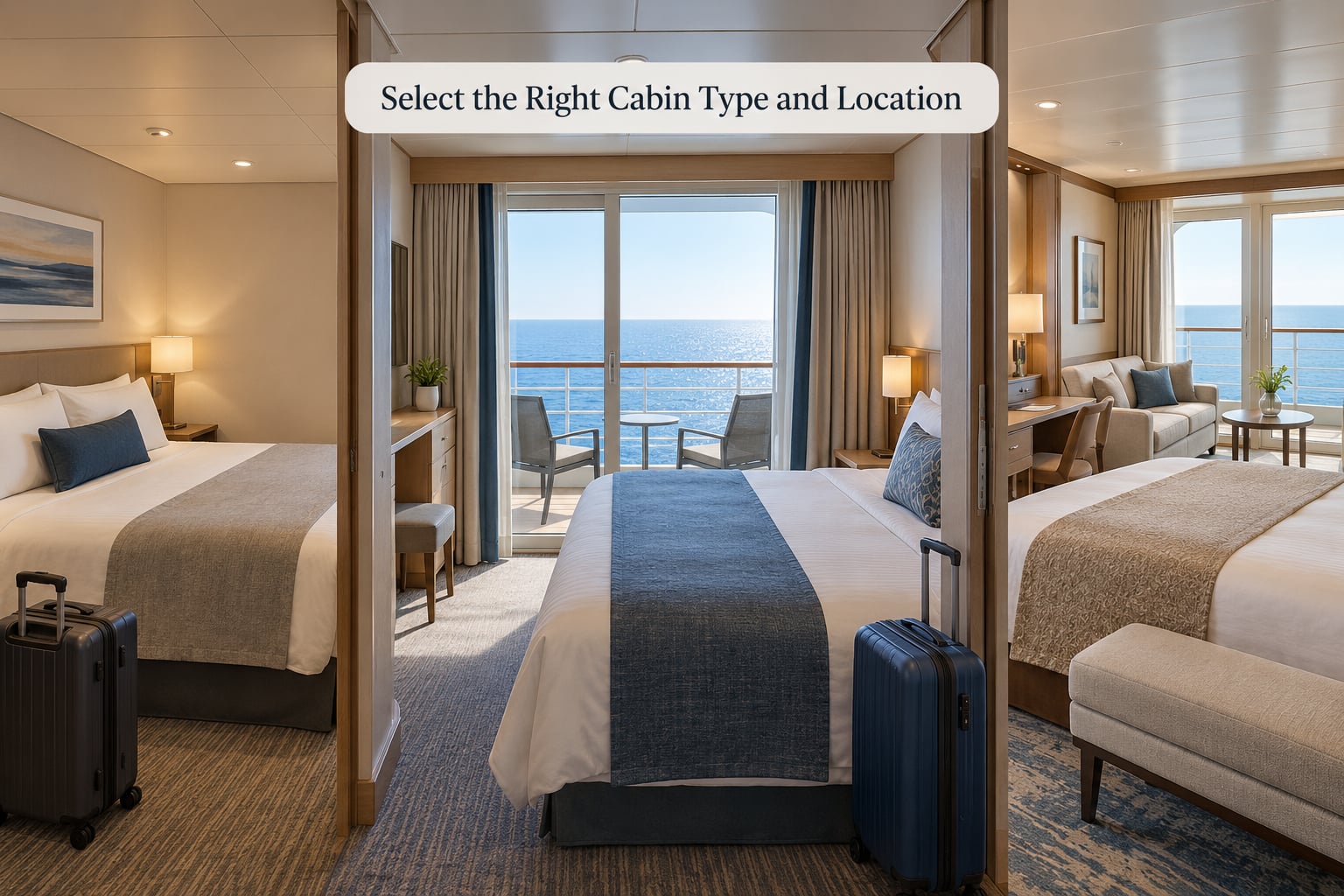
Pick the cabin that matches how you will actually use the ship. You are buying a room to sleep in, with the ship as the main attraction.
| Cabin type | Outside space | Good for | Check for |
|---|---|---|---|
| Interior | None, an artificial window or a mirrored wall | Budget, and spending your time in public areas | Whether you are comfortable without natural light |
| Oceanview | Window only | A first taste of being on a vessel at a lower cost than a balcony | Whether the window opens |
| Obstructed view | Window partly blocked by structure | People who want to save on a balcony | The wording, which usually names the obstruction |
| Balcony | Private outdoor space with chairs | Morning coffee outside, watching ports arrive, fresh air | Rail size and whether the balcony overhangs another deck |
| Suite | Larger balcony, separate sitting area, more amenities | Space, priority service, a quiet retreat | What is included beyond a bigger room |
Location matters as much as category. Midship cabins sit in the middle of the ship, so you feel less movement in rough water, which also helps with seasickness. Higher decks are closer to the noise of the pool and the buffet.
Note where the elevators and stairwells are, and avoid cabins directly above or beside them, next to a smoking or outdoor dining area, or near the engine and galley spaces on lower decks. If you are travelling as a family, connecting doors matter more than the view, and they are limited, so ask early.
6. Check the Total Fare and Important Policies
Read the fare rules before you enter any card details. They are where the practical surprises hide.
- What the fare includes. Meals, drinks, gratuities, taxes, port fees and charges, and any service charge shown as separate line items.
- Cancellation and change terms. Refund deadlines, deposit rules, name-change rules, and whether fares are refundable or non-refundable.
- Payment schedule. When the deposit is due and when the balance must be paid before sailing.
- Age and policy rules. Minimum age for sailing, cabin occupancy limits and any restrictions on who may share a cabin.
- Accessibility information. Lift access, accessible staterooms, and assistance available on board.
Screenshot the final page before you pay. Fare and policy terms change, and having the version you agreed to makes any later dispute much easier.
7. Book Flights and Pre-Cruise Logistics
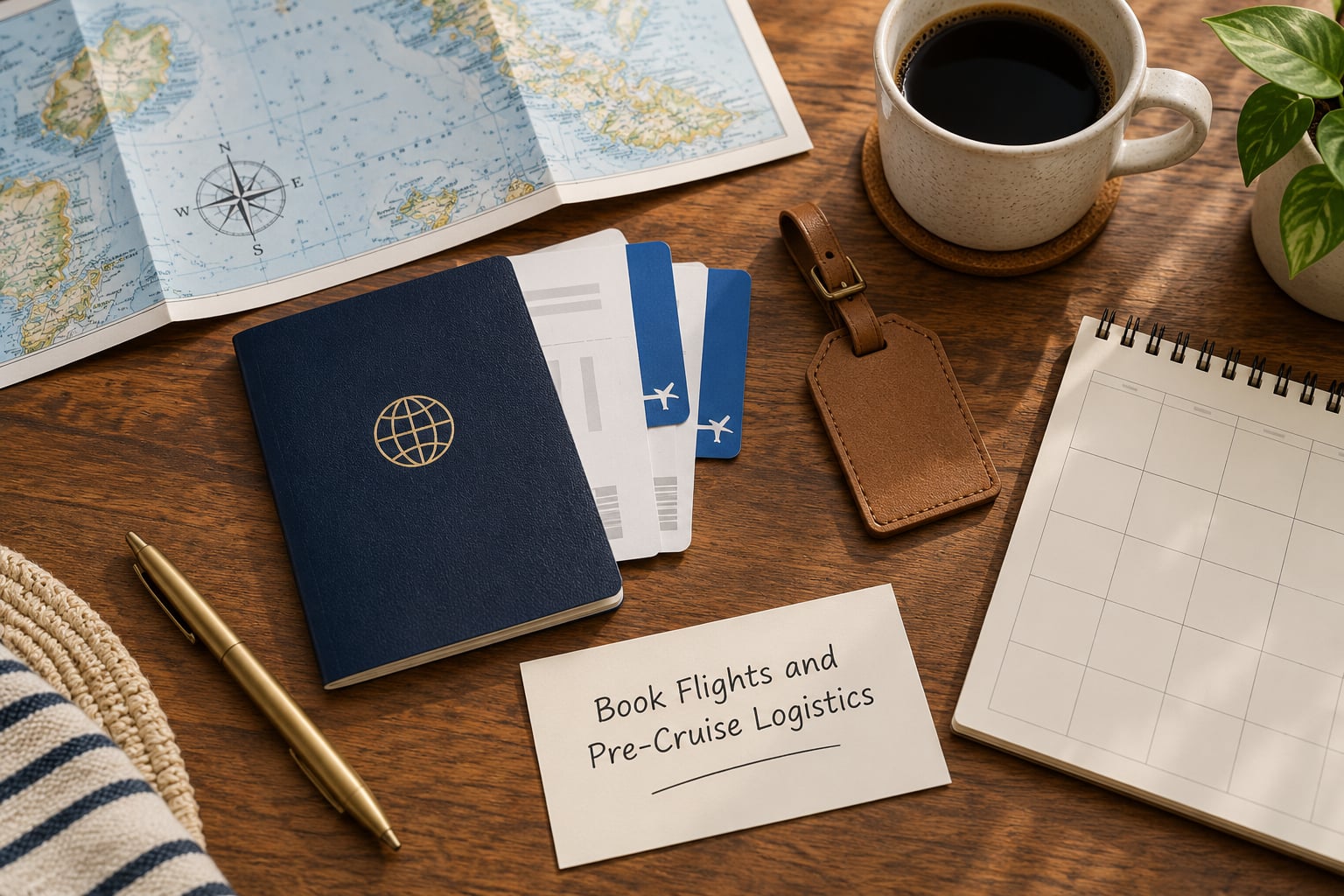
Book travel that gets you to the port with a full day of margin, not with a few hours. The ship departs on schedule, and a delayed flight does not delay it.
On embarkation day the ship is usually boarded over a long window in the afternoon, and check-in lines are longest at the end of it. Arriving earlier gets you onboard and settled before the crowd. Arriving late, on the day of a departure, is the single riskiest thing a beginner can take with a paid fare.
Staying the night before also protects you from a morning cancellation. A pre-cruise hotel near the port turns a bad travel day into a minor inconvenience, and the cost is easy to fold into the budget you set in step two.
Decide your disembarkation plan at the same time. Ships usually require you to be out of your cabin by an early hour and clear customs by a set time, so your return flight or drive should not sit just barely after that.
Finally, read the muster drill instructions before you board. The muster drill is a mandatory safety check of your cabin and lifeboat station, delivered on the ship TV and your cruise line app. Know your station on the deck plan before it happens.
8. Use a Pre-Cruise Checklist
Run through this in the week before you leave and again in the car on the way to the port.
- Passport or required ID, with enough validity beyond the sailing date
- Boarding documents downloaded offline, plus your cabin number and muster station
- Completed online check-in for every guest, including children
- Luggage tags, and a plan for what stays in a carry-on
- Medications in hand luggage, in original packaging, with copies of prescriptions
- Small bills for ports, plus a card for nearly everything else
- Phone charged, downloads synced, since ship internet is slow and priced per device
- Light clothing, comfortable non-slip shoes, swimwear, and a cardigan for cool evenings
- Seasickness remedy if you are at all prone, taken as directed beforehand
- An emergency contact who knows your cabin number and ship name
- Hotel and flight confirmations, including a pre-cruise night booked for the day before
In your first few hours onboard, find your muster station, locate your dining room and check whether the app shows your seating time, then explore the upper decks before the ship gets busy.
Common Mistakes
Nearly every first-cruise regret I hear about traces back to one of these.
- Comparing fares instead of totals. The cheapest headline price often carries the highest final bill once fees, gratuities and drinks land on your account. Fix: total up every line item before comparing two sailings.
- Choosing a port-heavy itinerary. Seven ports in seven days means you are packing and unpacking and rushing back to a bus. Fix: aim for at least two sea days, and treat them as part of the holiday.
- Forgetting the travel days. A seven-night sailing is really nine or ten days away from home. Fix: count the first and last day properly before committing to the time.
- Assuming gratuities are included. Many lines add a daily service charge automatically, and some expect extra tipping for good service. Fix: read the fare rules and the daily rate on the bill.
- Pre-buying every possible add-on. Pre-paying for drinks and specialty dining at the last moment often costs more than deciding once you can see the ship and your own habits. Fix: reserve the things you already know you will do, leave the rest until onboard.
- Booking too many shore excursions in advance. A packed excursion schedule is the top regret in cruiser forums, and an exhausted traveller enjoys none of it. Fix: plan the port days that genuinely matter and let the others stay open.
- Ignoring cabin noise and walking distance. A cabin above the buffet or far from an elevator is a bad week. Fix: read the deck position, not just the cabin category.
- Overpacking. Nobody on a cruise is looking at what you brought. Fix: one week’s worth of clothes, comfortable shoes, and nothing you would be sad to lose in a lost bag.
- Missing all-aboard time. All-aboard time is the deadline the ship gives you at each port of call, and it is the one rule with a real penalty. Fix: be back at least an hour early, and set an alarm when you go ashore.
- Not checking tender arrangements. When a ship cannot dock, it anchors offshore and ferries you in by tender, a small boat. Fix: find out in advance whether your ports dock or tender, since tender days run on tighter timing.
- Arriving on embarkation day by air. Any delay costs you the sailing. Fix: arrive the day before.
- Skipping the closed-loop check. A closed-loop cruise returns to the same port it departed from, which allows you on a home-country birth certificate and ID; an open-loop cruise ends somewhere else and normally needs a passport. Fix: confirm which type your sailing is before you pack documents.
Frequently Asked Questions
Do I need a passport for my first cruise?
Often you do, and you should assume you will. Any sailing that visits a foreign port, or that starts and ends in different countries as an open-loop cruise, requires a valid passport, usually with at least six months of validity remaining. A closed-loop cruise that returns to its home port can accept a certified birth certificate and government ID in some cases, but rules vary by line and by destination, so confirm with your cruise line and check every port on the itinerary.
How far in advance should I book a first cruise?
For most itineraries, booking a few months ahead gives you the best balance of choice and price, since popular sailings and cabin categories can sell out while last-minute fares often rise. Sailings that fill first include holiday weeks, school-break dates and popular seasonal itineraries. If your dates are fixed, book early. If they are flexible, watch fares for several weeks and use a price alert rather than guessing when a good deal appears.
How many nights is enough for a first cruise?
Five to seven nights is the sweet spot for most first-timers. It gives you one sea day to recover from travel, enough port calls to feel like you went somewhere, and enough time to learn the ship without running out of things to do. Three or four nights works as a short test run if your schedule is tight, while more than ten nights risks being longer than you want on a first trip, especially if seasickness is a possibility.
Should I book shore excursions before my first cruise?
Book ahead only the excursions you are certain about, ideally the ones that sell out or that only make sense early in the trip, such as a difficult hike or a small-group tour with limited capacity. Leave the rest until you are onboard, because you will know your pace by then and last-minute bookings are often discounted. Wherever you buy them, be back on board well before all-aboard time, especially on a tender day.
Is travel insurance worth it for a cruise?
It is worth checking, and worth buying when you are paying for a prepaid fare you could not easily replace. Read the policy for three things: medical and evacuation cover while at sea, trip cancellation and interruption cover for illness or a missed sailing, and cover for the travel days at each end. Note that a standard travel policy often excludes cruises, so look for wording that names them, and check whether you need cover for on-board medical costs.
Do I need a drink package on my first cruise?
Skip it on your first sailing. Package pricing assumes you drink heavily, and most lines also charge a service charge on top, so it only pays off if you would otherwise buy that many drinks every day. You can always add a package onboard once you know how much you actually drink. Bring a reusable bottle if the line offers water stations, and note that some packages cover only a fixed set of brands and pour sizes.
Conclusion
Start by writing down the kind of trip you want and the total you will spend, not the ship you want. Compare two or three itineraries for sea days, port pacing and departure port, then check the ship against those priorities. Read the fare rules, pick a cabin by location as well as category, and book your flights a day early with margin. Everything after that is a checklist, and it is a short one.