Late checkout means asking a hotel to let you keep your room past its posted checkout time, usually 10 a.m. to noon. It is a courtesy rather than an entitlement, so knowing how to get a late checkout at a hotel comes down to three things: you ask early, you name an exact time, and you give the desk a reason that makes sense for the housekeeping schedule.
The desk says yes whenever the room can still be sold to an arriving guest and the cleaning crew has time to reset it. Everything below is built around that reality, including what to do when the answer is no.
- The single best moment to ask for a free extension is the afternoon or evening before your departure day.
- Name the exact hour you need. A specific request gets a real answer, a vague one gets a shrug.
- Give one concrete reason with a hard end point, such as a 7 p.m. flight or a booked spa slot at noon.
- Ask what the fee is before agreeing to anything, and compare it with a day-use room or a nearby airport hotel.
- Loyalty status raises your odds but rarely guarantees an hour at every property.
- If you get a no, ask what you can still use that day, because pool, gym, lobby and luggage storage usually stay available.
Table of Contents
- 1What You Need to Ask for a Late Checkout at a Hotel
- 2The posted checkout time for that exact property
- 3Your reservation details
- 4Your loyalty standing, and its exact wording
- 5A real reason with a hard end point
- 6Something useful to offer
- 7A fallback plan
- 8A pen and a sticky note
- 9Step-by-Step
- 10Step 1: Check the Hotel’s Checkout Policy
- 11Step 2: Ask at the Right Time
- 12Step 3: Make a Specific, Polite Request
- 13Step 4: Offer Something Useful
- 14Step 5: Confirm the Final Details
- 15Common Mistakes
- 16Frequently Asked Questions
- 17Can a hotel guarantee a late checkout?
- 18How much does a late checkout usually cost?
- 19When should I ask for a late checkout?
- 20Does hotel loyalty status guarantee late checkout?
- 21What if the hotel says the room is already sold?
- 22Can I leave my luggage at the hotel after a late checkout?
What You Need to Ask for a Late Checkout at a Hotel
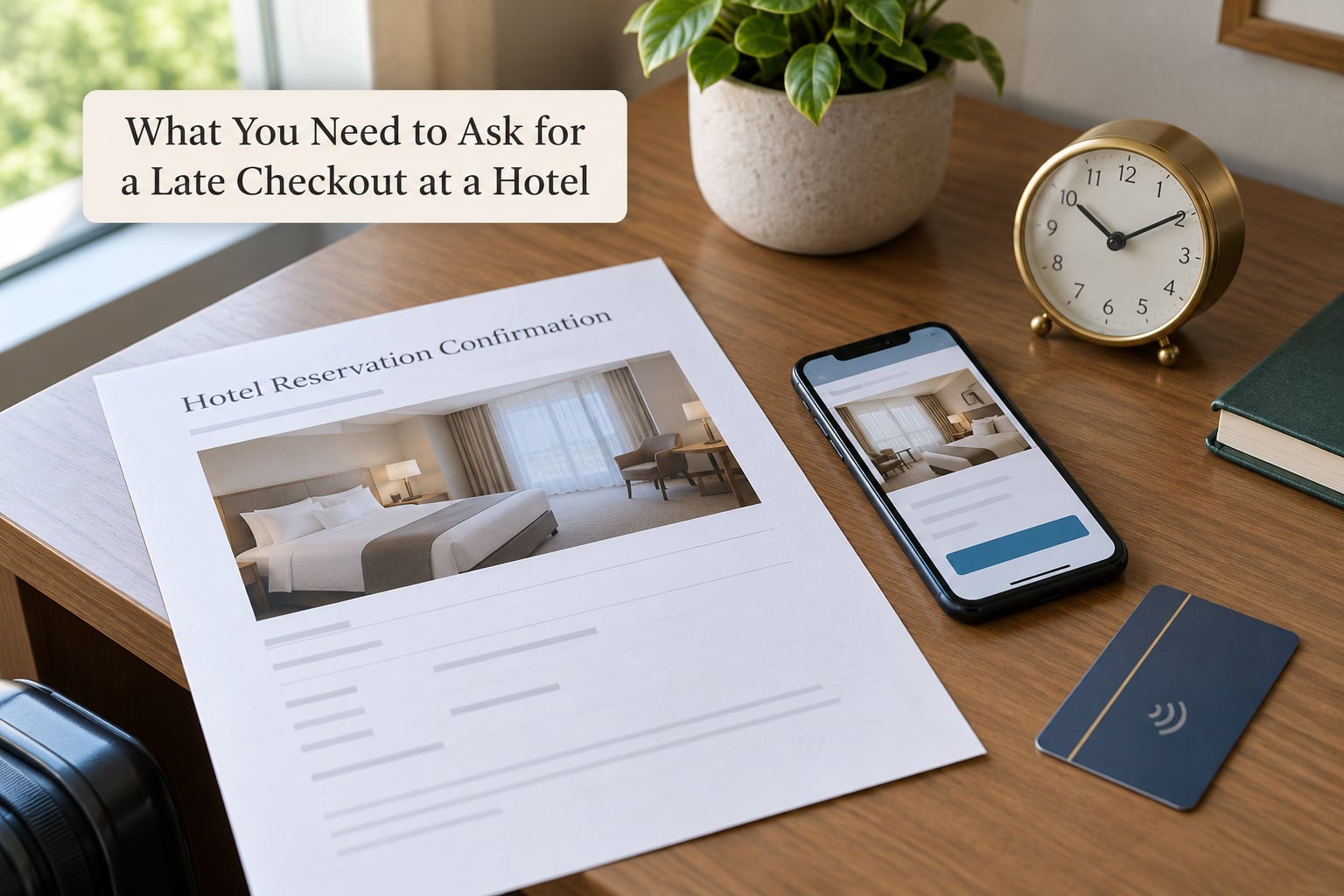
Walk into the desk with this and the conversation takes thirty seconds. Show up with nothing and you are relying on the agent’s mood.
The posted checkout time for that exact property
Your confirmation email, the hotel app or the property FAQ page will tell you whether checkout is at 10, 11 or noon. Chain defaults exist but the property sets the real number, and properties outside the US often run noon or later as standard. Never assume a chain brand’s marketing page matches the desk in front of you.
Your reservation details
Confirmation number, room type, arrival and departure dates, and one specific fact that matters more than the others: whether your checkout is back-to-back with the next arrival. A room that sold overnight for the arriving guest is already spoken for, and that single booking is the most common reason a request fails.
Your loyalty standing, and its exact wording
Write down the tier name you actually hold, because “elite member” is not a number a desk agent can act on. Then check whether the property is a resort, a convention hotel or a casino, because those categories carry carve-outs that void published benefits.
A real reason with a hard end point
“My flight is at 7 p.m., I need to be at the airport by 5” travels far better than a story about your kids. If you do have a spa slot, a remote work session or a nap scheduled, say the time out loud so the agent can picture the morning.
Something useful to offer
Decide in advance that you are willing to pay a fee or take a different product, so you can negotiate without stalling at the desk. Options usually include an hourly charge, a flat late-checkout fee, a half-day use rate or a full day-use room.
A fallback plan
Baggage storage, a booked airport hotel, a lounge day, a co-working space. Knowing what you will do if the answer is no keeps you from pushing too hard on the ask.
A pen and a sticky note
One trick costs nothing and takes two seconds: before you head out, slide a note reading “2:00 PM late checkout, thank you” onto the Do Not Disturb sign. It promises the desk nothing, but it puts your requested time in front of whoever cleans the room first, and on a quiet day that is the person who can make it happen.
Step-by-Step
Step 1: Check the Hotel’s Checkout Policy
Start where the hotel publishes its own terms, then check the loyalty program wording. Marriott Bonvoy publishes a 4 p.m. courtesy checkout for its top tiers and calls the benefit guaranteed, yet that guarantee explicitly excludes resorts, convention properties and some design brands. Hilton Honors is stingier: only its top Diamond Reserve tier carries a published 4 p.m. guarantee, with lower tiers treated case by case.
IHG One Rewards gives a 2 p.m. checkout broadly rather than tier by tier, and InterContinental Ambassador members receive 4 p.m. Hyatt attaches a published late checkout hour to its Globalist tier. Choice publishes 2 p.m. and is open about the possibility of a surcharge. Wyndham lists a late checkout benefit without publishing an hour at all. Programs change, so treat these as a starting point and confirm on the chain’s own terms page before you lean on them.
One term worth decoding: “subject to availability” simply means the desk decides that morning based on the day’s arrivals and staffing. It is not a technicality and it is not a promise. Members also report on hotel forums that each property runs different software and a different local policy, so the honest answer to “what time is late checkout” is whatever the desk at your property says on the day.
Outside the US the default is often noon or later, and chain flexibility in Europe and Latin America runs thinner than the North American program wording suggests. In Spain, Mexico or much of Central and South America you will hear the request as salida tardía or check-out tardío, and asking for it in that phrasing gets the same result as the English version.
While you have the policy open, note the 15/5 courtesy that some major programs extend: a request for a 5 p.m. arrival or a 4 p.m. checkout, handled case by case at participating properties. It is a courtesy, not a right, and it is framed as a request rather than a booking condition.
Step 2: Ask at the Right Time
Search results give conflicting advice here, with some guides saying ask the evening before and others saying ask at breakfast. Both are right for different goals, and separating them is the whole trick.
Ask the afternoon or evening before when you are hoping for a free courtesy. Staff plan room allocations for arriving guests that evening, so by the time you ask, the desk already knows who is coming in tomorrow. Make it part of the same call where you mention your late flight, before the arrival list is final.
Ask in the morning of departure, or at check-in the previous evening, when you want a paid extension or you are already at the top of the program’s benefit list. The desk has the day’s real turnover picture by then, so they can give you a real answer including the fee.
At check-in, mention your departure timing and ask what the checkout situation looks like. It is the cheapest moment to ask, the desk is quiet, and a yes at check-in can be written into your folio notes.
Outside those windows, use the hotel app or a phone call to the desk. Email rarely gets a same-day answer, which is why a text or a call to the front desk works better than a message to reservations.
Step 3: Make a Specific, Polite Request
Tone matters more than the wording. The person across the desk is absorbing the argument created by the room shortage, not causing it. Front-desk workers describe getting shouted at over a standard fee often enough that the request that lands well tends to be the one they remember.
Say the time, say the reason, say thank you. That is the whole script.
- Free courtesy, one to two hours: “Hi, I am checking out tomorrow and my flight is not until 7 p.m. Would there be any chance I could keep the room until 2 p.m. today?”
- A bigger ask, in person: “My flight got rebooked and I do not leave until 6 p.m. If there is any way I could stay until 4 or 5, I would really appreciate it. I am happy to pay whatever the fee is.”
- Status framing, ask rather than assert: “I am a Diamond member with you. Is a late checkout available today?”
- The paid version: “What would it cost to hold the room until 3 p.m.?”
- After a no: “No problem at all. Are the pool and gym still open to me this afternoon, and can I leave my bags with you?”
Match the medium to the size of the ask. A phone call works for one hour. A request for four or five hours is worth making face to face, at the desk, where the agent can see you are not being aggressive. Put the phone away and keep your voice level. If the first answer is no, do not re-argue the published fee, because that route rarely improves and it costs you goodwill at that desk for the rest of your stay.
Step 4: Offer Something Useful
Most properties charge in one of four ways. A flat fee covers a window such as up to 4 p.m. An hourly rate charges per extra hour. A half-day use gives you a few hours in the room. A full day-use room gives you the room until the evening and usually comes with a rate card of its own. Airport and casino hotels sometimes sell a paid late-departure or red-eye room rate outright, which converts the extension from a courtesy into a product you bought in advance.
A flat fee on a budget room can hurt more than it should, because properties often price the extension at a flat rate regardless of what the room cost. That is the single biggest flashpoint among guests, and it is worth remembering before you decide the fee is an insult rather than a fee. If you were only going to use the room to shower, the flat charge is poor value; if you are avoiding a second hotel night, it may be the cheapest hour of your trip.
Ask for the amount before you accept, and then compare it against three alternatives: a day-use room at the same property, a room at a nearby airport hotel for the night before your flight, and what you would spend on a lounge, a long lunch and showers anyway. The fee is often poor value on a budget room and perfectly reasonable when the alternative is a second hotel night.
Be honest about what you need, because sometimes you do not need the room at all. If the goal is a shower, a nap and a change of clothes, facilities access plus a shower room is often given free of charge once you have checked out.
Vacation rentals follow the same logic with one big difference: there is no front desk, so the host must approve the extension in writing before checkout time. Local rules commonly set checkout around 11 a.m., and staying past it without permission can trigger a cleaning fee or a full night charged against you. Ask early, in the app, framed as a question, and accept that a same-day request late in the morning is often refused.
Four things also tend to buy you a yes on their own. Booking a refundable or flexible rate, since those often bundle a later checkout. Reserving through a premium travel programme such as American Express Fine Hotels and Resorts, which publishes a 4 p.m. checkout as part of the booking. Booking a late-departure or red-eye rate where one is offered, which turns the extension into something you already paid for. And giving accurate arrival times on future bookings, which is how you build the record that gets future requests approved.
Step 5: Confirm the Final Details
Do not walk away from the desk on a handshake. Confirm the approved checkout time, the exact amount you will be charged and how it will appear on your folio, and whether your card authorization changes. Then ask about luggage storage, get the end time, and request the confirmation in writing through the app, a printed note or an email so the room attendant sees it too.
If you would rather not think about checkout at all, ask whether the property can do express checkout or send the folio digitally, and put a note on the door so the room is not serviced early.
And do not simply depart without checking out. A room you leave without a formal checkout can be logged as an unresolved stay, your card authorization can stay open, and the booking can be treated as a no-show with a fee attached, especially on prepaid or third-party rates. Two minutes at the desk removes all of that risk.
Common Mistakes
- Waiting until ten to five. By then the room is either allocated or the answer is already written. Ask the evening before for a courtesy.
- Being vague. “Can I check out late?” has no approvable version. Name the hour you need.
- Claiming your status guarantees it. A resort or convention carve-out can void the benefit, and the argument is unwinnable at the desk. Ask instead of assert.
- Forgetting to ask about the fee. Agreeing to “whatever it is” at the desk is how a flat fee ends up surprising you. Get the amount first.
- Leaving without written confirmation. The next morning a different shift may have no idea. Put the approved time in the app or in writing.
- Arguing with the desk. Accept the first answer and move on. Front-desk workers describe the fee arguments being directed at them rather than at the room shortage that creates them.
- Overstaying on a rental. In a vacation rental, staying past the checkout time without written host approval is the one mistake that reliably costs money.
Frequently Asked Questions
Can a hotel guarantee a late checkout?
Only at the property level. A published chain benefit such as a 4 p.m. courtesy is as close to a guarantee as hotels get, and even those carry carve-outs for resorts, convention hotels and some brands. Outside a published program benefit, the desk decides on the day based on the next arrival and the housekeeping schedule, and you can only get a firm answer at check-in or during the morning of departure.
How much does a late checkout usually cost?
Most properties charge one of four ways: a flat fee for a window, an hourly rate, a half-day use rate or a full day-use room rate. Airport and casino hotels also sell a paid late-departure or red-eye room rate. Ask for the amount before you agree, then weigh it against a day-use room at the same property or a nearby airport hotel, which sometimes cost the same or less.
When should I ask for a late checkout?
Ask the afternoon or evening before if you want a free courtesy, because staff plan room allocations for arriving guests that evening and already know tomorrow’s picture. Ask in the morning of departure or at check-in if you expect to pay, or if you hold a tier with a published benefit, because by then the desk can give you a real answer including any charge. Both timings work; they just answer different questions.
Does hotel loyalty status guarantee late checkout?
It improves your odds, but the word guaranteed rarely survives contact with a specific property. Some programs publish an hour for their top tiers, yet the guarantee commonly excludes resorts, convention properties and certain brands. Lower tiers usually get a request treated case by case. Members also note that each hotel runs its own local policy, so the property in front of you has the final say.
What if the hotel says the room is already sold?
Accept it quickly and pivot to what still works. Ask whether you can store your bags with the bell desk, whether the pool, gym, spa, restaurant and lobby stay open to you for the day, and whether a shower room or a half-day use is available. If you need a real bed, a nearby airport hotel for one night is often cheaper than a full day-use room.
Can I leave my luggage at the hotel after a late checkout?
In most cases yes. Bell desks hold bags before check-in, after check-out and sometimes past your flight time, and the storage itself is usually free, though a third-party booking may add a handling charge. Ask for the collection deadline, keep the claim stub or photo of the tags, and check the window if you are staying several nights. Hotels that cannot store bags often offer a secure holding fee instead.
Start tonight: find your property’s checkout hour and check the program wording for its carve-outs, then make one short call to the front desk while you still have a reason and a specific hour in mind. That single conversation solves how to get a late checkout at a hotel more often than status, points or a better rate will.
Chain policies shift with the 2026 travel season, so confirm anything you plan to rely on before you book.