Before you book a vacation rental, check four things: that the listing is genuine, that the total cost matches what you budgeted, that the house rules and cancellation policy fit your trip, and that the money goes through a protected channel. Get those right and a rental gives you more space and often a kitchen for less than a hotel of the same size. Get them wrong and you arrive to find the second bedroom is a sofa, the cleaning fee is non-refundable, and there is no one to call. Most of this work takes twenty to thirty careful minutes. Reviewed for 2026.
The short version: 12 things to check before you click Book
- Does the address exist on a map, and is the pin in the right neighborhood?
- Do the photos match the room count, the beds and the bathrooms you need?
- Do the recent reviews mention specific details, good and bad?
- Has the host replied quickly and specifically to your message?
- What is the total price with taxes, cleaning fee, pet fee and parking?
- Is the cleaning fee refundable or permanently charged?
- What is the cancellation deadline, and is any part of the payment non-refundable?
- Is there a minimum stay requirement that forces you to book extra nights?
- Are the house rules compatible with your group, including pets, kids and quiet hours?
- How do you get the keys, and at what hour on the first day?
- Are there smoke and carbon monoxide alarms, and is the address reachable by emergency services?
- Are you paying through the platform with a credit card, never by wire or gift card?
Table of Contents
- 1What You Need
- 2Step-by-Step: What to Check Before Booking a Vacation Rental
- 3Confirm the Location and Neighborhood
- 4Check the Listing Photos and Description
- 5Read Reviews and Assess the Host
- 6Verify Safety and Suitability
- 7Calculate the Full Cost
- 8Understand House Rules and Check-In
- 9Check the Cancellation and Refund Policy
- 10The Final Check Before You Pay: What to Check Before Booking a Vacation Rental
- 11Common Mistakes
- 12Frequently Asked Questions
- 13How far in advance should I book a vacation rental?
- 14Should I pay a vacation rental before confirming the booking?
- 15How can I tell if a vacation rental listing is legitimate?
- 16What should I do if the rental differs from the listing?
- 17Are vacation rental deposits usually refundable?
- 18Is it safer to book through a rental platform or directly with the host?
- 19Conclusion
What You Need
You do not need much to run this check, but you do need a few things lined up before you open a single listing. Otherwise you end up comparing half a booking.
Your dates and a flexible window. Know your firm dates and the three to five days either side. Peak weeks fill first, and off-peak flexibility is often the single biggest lever you have on both price and availability.
A second screen. Serious checking means looking at the same property on a map, a review site and sometimes the host’s own site at the same time. Splitting the tabs makes the comparison honest.
A map app you actually know. Most people underrate how much the neighborhood matters until the first night, when the bar next door empties at 1 a.m.
A credit card in the lead guest’s name. Card payments give you a chargeback route and a paper trail. Bank transfers, wire transfers, gift cards and cryptocurrency have none of that, whatever the host says.
A note where you write down the total. One note with nightly rate, cleaning fee, taxes, pet fee, parking, deposit and any resort or utility charge. Comparing two rentals by their headline rate is the most common mistake on this page, and this note is the fix.
Your travel insurance documents, if you have them. Read them before you book, not after something goes wrong, because standard policies frequently exclude peer-to-peer rentals.
Step-by-Step: What to Check Before Booking a Vacation Rental
Work through this in order. The early steps decide whether the property is worth your attention at all, and the later steps decide whether the money should move.
Confirm the Location and Neighborhood
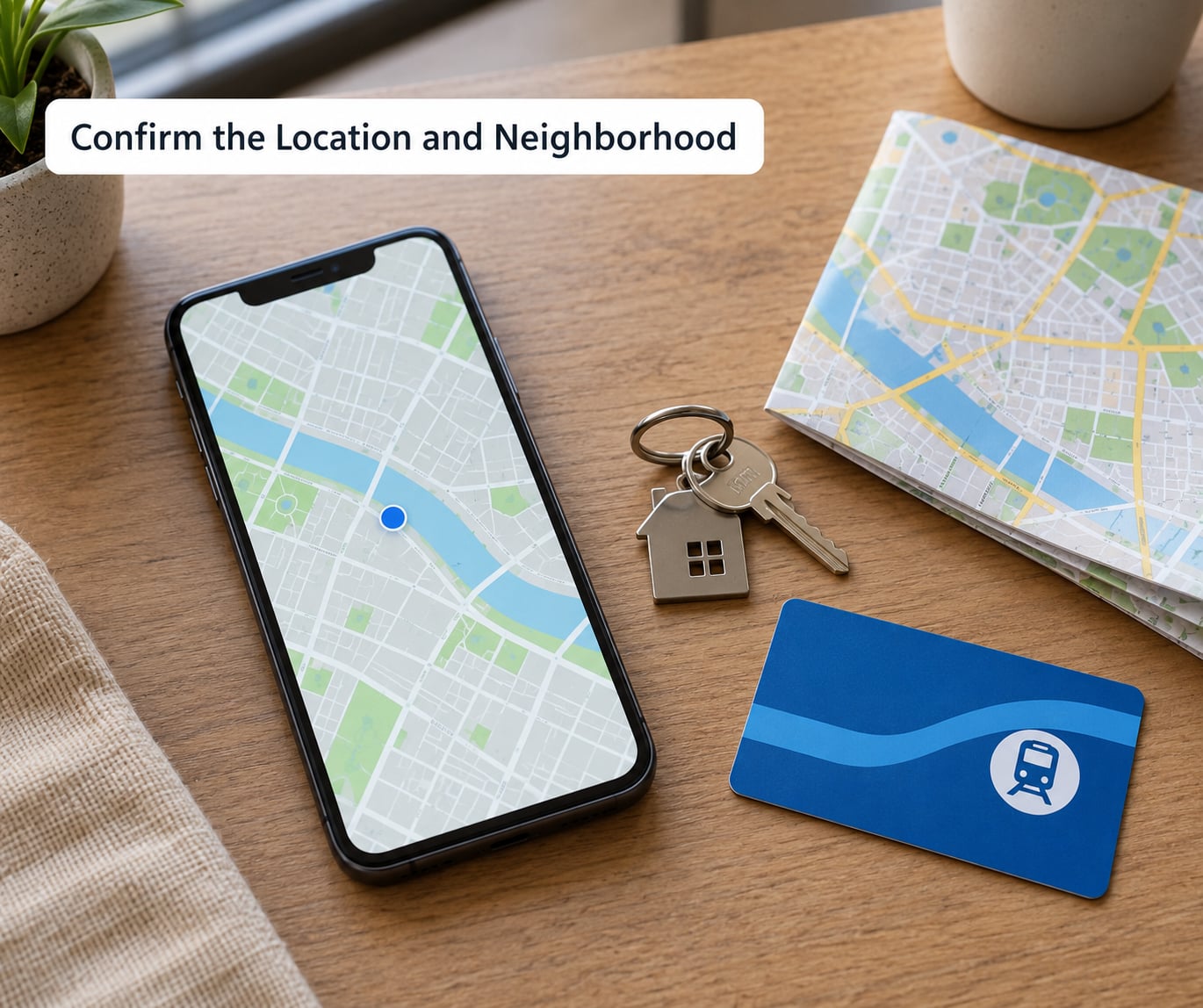
Drop the address into a map and look at the actual pin, not the neighborhood name in the headline. Vacation rental language is generous: beachfront often means a ten-minute drive plus stairs, downtown can be a district boundary away, and quiet sometimes describes a building that hosts a different kind of guest on weekends.
Then check what is genuinely around it. How long is the walk or drive to the grocery store, the beach, the station or the trailhead, and is that realistic at 9 p.m. rather than noon? Look at satellite or street view to see the parking situation, the neighboring buildings and whether the unit faces a main road.
For safety, check the crime map for the city and the block, and read what recent reviews say about noise, street lighting and parking at night. If anyone in your party is walking alone back to the rental after dark, this step matters more than the view from the balcony.
Check the Listing Photos and Description
Count rooms instead of admiring them. Most disagreements about a rental come down to someone believing a sectional sofa counts as a bedroom. Check the number of bedrooms with real doors, the number of bathrooms, and whether the sleeping spaces are a queen, a full, a bunk set or a pullout.
Look for the amenities your trip actually depends on: air conditioning or heating, a washer and dryer, a fully equipped kitchen, a proper coffee maker, parking, and outdoor space. For anything you rely on to work, remote work in particular, ask for the Wi-Fi speed in Mbps rather than accepting the word fast, because a coastal second home with a router pointed at an empty unit is a known problem.
Scroll past the marketing shots and look for the unglamorous angles: the kitchen appliances, the bathroom, the stairs, the view out of the bedroom window, and the parking space itself. Maximum occupancy is also worth checking, since it affects both your comfort and whether the booking is legal.
Read Reviews and Assess the Host
Read the most recent reviews first and the three-star ones second, because that is where the caveats live. Guests report finding small water heaters, limited seating at the dining table and thin walls in reviews that still average four stars. Recency also matters, because a property can change hands and a new owner inherits old reviews.
Then weigh the review itself. Detailed reviews that name a specific problem, a specific date and what the host did about it are worth several lines of praise with no specifics at all. A property with only vague five-star reviews and none mentioning the neighborhood, the beds or the check-in is telling you very little.
The host is a vetting criterion of their own. Send one question before you book and time the reply. Fast, specific answers about a real detail of the property are a good sign; replies that dodge the question, push you to pay immediately, or arrive only after you commit are not.
Watch for red flags while you read. Reviews that all arrive in the same week, photos lifted from another listing, a host who claims to be the owner but cannot answer basic questions about the building, or a calendar that shows dates as available which the reviews describe as booked.
Verify Safety and Suitability
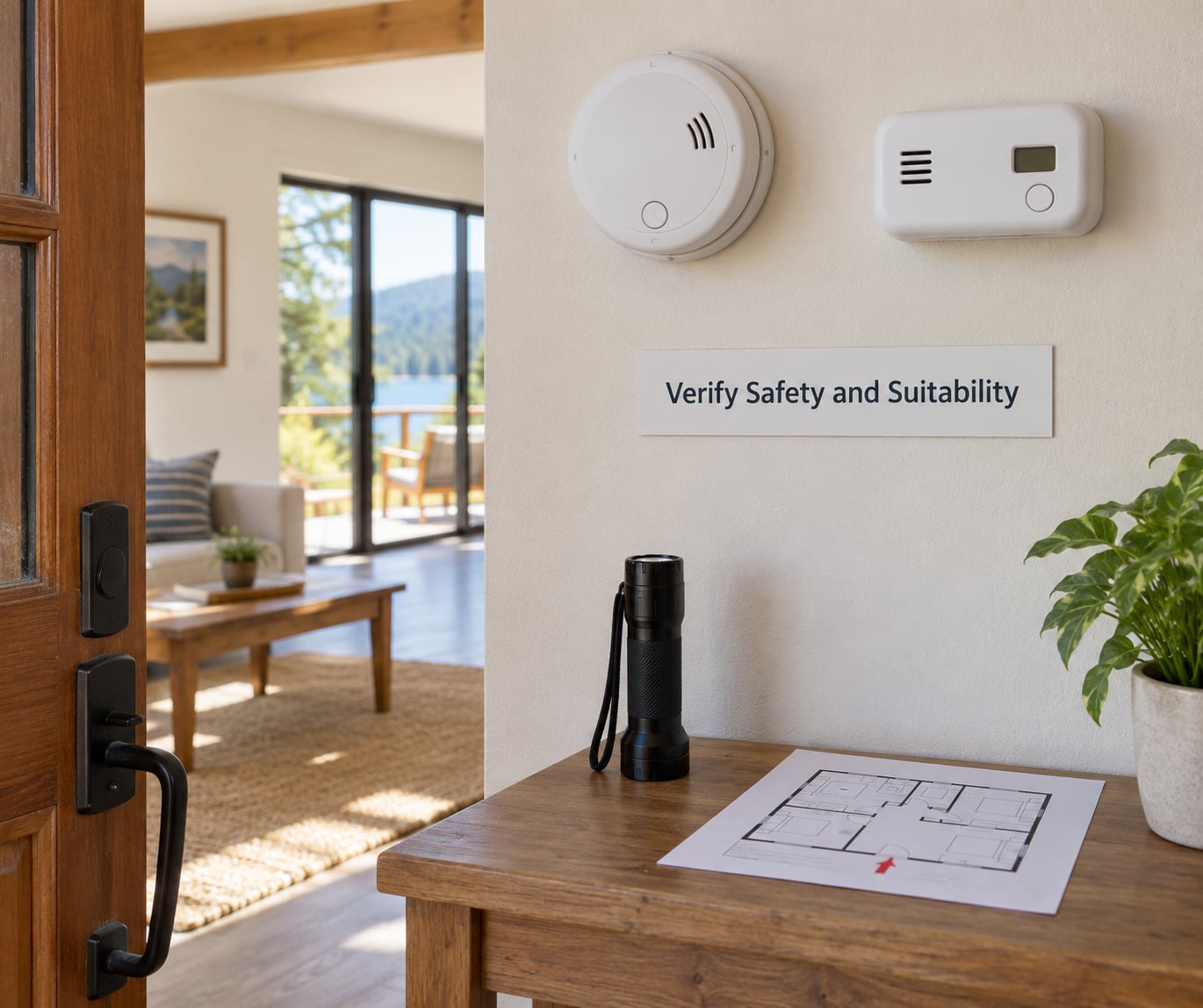
Ask directly whether the home has working smoke and carbon monoxide alarms, a fire extinguisher, a first aid kit, and locks on the exterior doors. Hosts answer this quickly and most are proud to, so a hesitation here is information. If you have children, ask about window guards, stair rails and whether the pool or hot tub is fenced and gated.
Check that the address is reachable by emergency services and ask your host to confirm the street number, since rural and converted properties sometimes have two addresses. If anyone in your group has mobility needs, the questions that matter are the number of steps from the street and from parking, whether the entry has a threshold, whether the shower has a grab bar, and whether the bedroom and bathroom are on one floor.
Two more checks that cost you nothing. Look at the local evacuation map for wildfire, hurricane or flood zones if you are heading somewhere with that history, and check the climate against the unit’s heating and cooling, because a mountain cabin without heat in an autumn week is not a good surprise. For a beach rental, pay attention to what recent reviews say about sand, humidity and ventilation.
Calculate the Full Cost
The nightly rate is the least interesting number. Enter your exact dates and your exact guest count, then read the total that appears, because many listings quote a low from rate that only reveals the real per-night price once dates are in. These are the charges worth expecting on the final number.
Nightly rate. Mandatory, and the number to treat with suspicion. Use the rate for your dates, not the from rate, and watch for weekend minimums that quietly raise the average.
Cleaning fee. Usually charged once per stay and frequently non-refundable. On a short stay this can cost more in fees than the nights themselves, so a five-night rental can be dearer than a seven-night one.
Pet fee. If applicable. Often per pet, sometimes per night, sometimes one-time, and the number of pets allowed is often lower than the number your group wants to bring.
Taxes and tourism levies. Usually a percentage of the nightly rate calculated before fees, which is why the final figure is higher than the rate plus one flat charge. This is where low advertised prices quietly stop being low.
Security deposit. Often held rather than spent and released after checkout. What matters is the release timeline in writing, not the amount, since a large deposit with no stated release date is a real cash-flow cost for a week.
Parking. Sometimes charged per night, and sometimes a street-parking restriction that appears nowhere in the photos. Confirm it with the host rather than assuming the driveway in the photo belongs to the unit.
Resort, community or amenity fees. Charged even when you use nothing. Resorts, gated communities and ski buildings add these, and they are rarely mentioned in the property description.
Utilities and optional extras. Electricity, gas, water and linen service can be added after checkout if the listing does not state them as included. Read the line items before checkout, not on the final statement.
Then compare like with like against a hotel for the same dates and the same number of guests. Booking direct with an owner or property manager can cut the platform fee, and the fee is often 10 to 20 percent of the stay, but you lose payment protection, the review history and the dispute process. Pay direct only with a property you have verified, a signed agreement and a card, never a transfer.
Understand House Rules and Check-In
House rules are not decoration. Read the quiet hours, the no-parties clause, the smoking policy, the guest profile requirements, the pet restrictions, the maximum occupancy and any rule about linen or furniture damage. Some hosts require the guest to be a certain age, or to have verification completed days before arrival, which can quietly complicate a booking made weeks ahead for a group of friends.
Then sort out arrival. What time can you check in, is it self check-in with a keypad or smart lock, and when do you get the code? Some hosts release the code only a few hours before arrival, others the morning of, and a few still hand over keys in person, which matters if your flight is delayed. Ask for the check-out time too, and for what happens to the code at that point.
This is also the moment to send the questions that settle the trip. A short message works best: confirm the number of bedrooms and bathrooms, ask whether anyone else will be in the building during your stay, ask whether the Wi-Fi has been tested recently, and ask what the Wi-Fi password delivery looks like on arrival day. Hosts who answer all four without being asked twice are telling you something.
Check the Cancellation and Refund Policy
Read the cancellation policy as a schedule, not a label. Find the exact date by which a full refund is available, the date the payment becomes non-refundable, and what the refund looks like after that point. Flexible and moderate are labels with different deadlines attached, and the deadline matters more than the adjective.
Keep the payment schedule separate from the cancellation policy. Many bookings take a partial payment at booking and the balance later, and the balance is frequently the non-refundable part, so cancelling early does not always return everything you paid.
Host exceptions are a real category, and they are written specifically so they can be used. A host may cancel for maintenance, a change of mind or a booking they think is inappropriate, sometimes with compensation and sometimes with a partial refund. Check whether the platform treats the booking as a host cancellation with guest protection, and screenshot the policy on the day you book, since these pages do change.
On insurance, read the policy before you rely on it. Standard trip cancellation and medical policies often exclude peer-to-peer and short-term rentals, and some exclude whole-destination evacuations. If the trip matters to you, look for cover that names vacation rentals explicitly, and keep the booking confirmation with the claim.
The Final Check Before You Pay: What to Check Before Booking a Vacation Rental
Recheck these in the last five minutes, with your finger on the button. Dates and number of nights match what you intended, guest count matches everyone actually coming, and the total is the number you wrote down in your note.
Confirm the address, the total price, the payment recipient and the platform. The name on the payment request should match the host or property manager on the listing. If a message asks you to pay by bank transfer, wire, gift card or crypto in order to hold the dates, that is the end of the conversation.
Save the confirmation, the policy pages and the receipt in one place, then set a reminder for 48 hours before arrival to re-confirm the check-in method, the access code timing and whether anything about the property has changed. A short message at that point catches most of the problems that would otherwise turn into a ruined first day.
Common Mistakes
These are the errors that turn a good rental into a bad week, with the fix attached to each one.
Comparing headline nightly rates. Two rentals that look equal per night can differ by hundreds once cleaning, pet and parking charges land. Fix: put the full total in your note and compare those numbers.
Accepting the from rate. The low per-night figure is often a midweek rate or an off-season rate. Fix: enter your real dates before you form any opinion of the price.
Counting sofas as bedrooms. A listing that sleeps eight in three rooms may be a two-bedroom with two pullouts. Fix: count doors, then ask the host to confirm bed sizes.
Skipping the three- and four-star reviews. That is where the small hot water heater and the thin walls are described. Fix: read the middling reviews before the glowing ones.
Trusting the calendar over the reviews. Out-of-date calendars lead to double-booking and last-minute displacement, a complaint that shows up repeatedly in host groups and support threads. Fix: if reviews mention a recent cancellation or relocation nearby, ask about it directly.
Paying outside the platform to save a fee. The saving is real and the protection is not. Fix: pay by card through the platform unless the property is already verified and the arrangement is written down.
Skipping the small print on fees. Cleaning fees that are non-refundable, amenity fees you never use and utility charges added after checkout are all common. Fix: read the fee breakdown line by line and screenshot it.
Booking for a group without asking about the neighbours. Shared amenities, shared walls and building parties are the top source of mid-stay complaints. Fix: ask who else will be in the building and what the quiet hours are enforced as.
Waiting until the last minute. Peak dates sell out, and a rushed booking is a booking you skip the checking on. Fix: do the research early, book once the total and the policy make sense, and keep your dates flexible by a few days if you can.
Frequently Asked Questions
How far in advance should I book a vacation rental?
For peak weeks, holidays and beach destinations, book as soon as your dates are firm, often four to nine months out. For shoulder season you can usually wait until three to six months without losing much. The exception is small supply: a one-bedroom in a tight market or a property with a strict minimum stay disappears earlier than a large house. Book early when you need a specific configuration, and book later when you can move your dates.
Should I pay a vacation rental before confirming the booking?
No. Confirm the listing, the dates, the total price and the payment channel first, then pay through the platform with a credit card. Paying first, or paying by wire transfer, bank transfer, gift card or crypto to hold dates, removes almost all of your ability to dispute. A host who needs payment before the booking is confirmed is telling you the booking was not confirmed.
How can I tell if a vacation rental listing is legitimate?
Look for consistency across sources. The address should exist on a map, the photos should match street view and the room count, reviews should be recent and specific rather than a block of vague praise arriving at once, and the host should answer a detailed question about the property before you commit. Treat cloned photos, flat per-night pricing that ignores dates, and any request to move the payment off-platform as serious red flags.
What should I do if the rental differs from the listing?
Photograph everything on arrival and report the difference the same day through the platform’s resolution process, with photos and the original listing text side by side. Do not wait until checkout, and do not simply leave and rebook without reporting, because that usually ends any claim. Keep your confirmation, receipts and messages, and a card payment gives you a chargeback route that a transfer does not.
Are vacation rental deposits usually refundable?
Usually yes, but not always quickly. A security deposit is held rather than spent and is normally released after you check out and any inspection is complete, which can take a few days. A cleaning fee is different: it is usually charged and kept, and many hosts mark it non-refundable even if you cancel. Check whether the deposit release timeline and the cleaning fee treatment are written down before you pay.
Is it safer to book through a rental platform or directly with the host?
The platform is safer for most people. You get card payment, a dispute process, host verification, reviews and a record of the listing and policies, at the cost of a service fee often in the range of 10 to 20 percent of the stay. Booking direct can be cheaper and sometimes more flexible, but do it only for a property you have verified, with a written agreement and a card payment, never a transfer.
Conclusion
Start with the map pin, then the room count, then the total with every fee attached, then the cancellation deadline, and only then think about paying. Those four checks take under half an hour and they catch nearly every problem that ruins a rental. Send the host one specific question, pay by card through the platform, and re-confirm the check-in two days before you arrive.