A wrinkled suit announces itself the second you walk into a meeting, and no amount of confident small talk hides it. The good news is that the fix has almost nothing to do with ironing: learn how to pack a suit without wrinkles and the creasing never happens. Fold the jacket and trousers flat instead of forcing them in, slip a plastic barrier between the fabric layers so nothing rubs, and place the folded suit where nothing heavy will sit on it.
Budget about ten minutes of prep and five minutes of packing. No special equipment is required, though a garment folder or small steamer makes life easier if you travel often. Gear improves every year, but the physics of creasing do not change, and this is still the method that works in 2026.
Table of Contents
- 1What You Need
- 2Step-by-Step
- 3Prepare the Suit Before Packing
- 4How to Pack a Suit Without Wrinkles: Choose the Right Method
- 5Fold the Jacket and Trousers Flat
- 6Layer the Pieces to Prevent Crushing and Creasing
- 7Use Tissue Paper or a Garment Folder for Delicate Fabrics
- 8Pack the Suit and Fill Empty Space
- 9Unpack and Smooth the Suit on Arrival
- 10Common Mistakes
- 11Wrinkle-Packing Tips for Different Trips
- 12Frequently Asked Questions
- 13How long should I allow for unpacking and steaming a suit on arrival?
- 14Can you roll a suit jacket to save space?
- 15Which suit fabrics crease the most when packed?
- 16Do packing boards or garment folders actually reduce wrinkles?
- 17How do I remove wrinkles from a suit without a steamer?
- 18Conclusion
What You Need
Most of the useful items here are free or already in your closet. The first one is a suit that is clean, dry and freshly pressed, because packing a garment that still holds cleaning-shop creases just preserves them somewhere new.
The second is the thin plastic bag your dry cleaner hands back with every order. That bag is the single most effective anti-wrinkle tool in this whole process. It costs nothing, it is already in the pocket of the last suit you picked up, and it creates a friction-free surface so wool slides against the lining instead of gripping and setting a crease.
Beyond that, here is what the rest of the kit looks like, and what each piece is actually for.
- A dry-cleaning plastic bag or comparable plastic cover. The friction barrier. Slide the folded suit into it before it goes in the suitcase, or line the inside of a garment folder with it.
- Tissue paper. Slip sheets between the folds of a jacket panel, between jacket and trousers, and over the top of the suit. Cheap tissue works; acid-free tissue is better if the suit is wool or silk you care about long-term.
- A breathable garment folder. A soft-sided tri-fold or flat folder that folds around the garment and holds it flat. Popular versions come in 18-inch and 20-inch sizes, so measure your jacket shoulder to shoulder before buying one.
- A hanger that fits. A wide, shoulder-shaped wooden or padded hanger. Thin wire hangers bend the shoulder of a jacket within a few days, and once that happens the suit looks wrong even when it is wrinkle-free.
- A packing board or folded cardboard insert. Optional, but it keeps a soft-sided bag from collapsing inward onto your clothes. It adds roughly a pound of weight, so frequent carry-on travelers often skip it.
- A travel steamer or wrinkle-release spray. Optional insurance for arrival day. A steamer handles deep creases; spray handles the last few stubborn lines and is easier to pack.
Which of these you actually need depends on three things. Trip length decides it, because a two-night trip rarely needs a folder and a five-city trip usually does. Fabric decides it, because linen needs more protection than a high-twist travel wool. And luggage type decides it, because a suit in a checked bag has a long wait in a hot hold and needs more barrier protection than one riding in the cabin.
Step-by-Step
Prepare the Suit Before Packing
Two minutes of preparation stops most of the problems before they start. Start by emptying every pocket: receipts, a pen, a phone, keys left in a jacket. A bulge you forgot about is a bulge that creases permanently.
Next, read the care label. Wool and cashmere blends generally tolerate steam and hanging; viscose, silk and some synthetics can spot or water-mark from steam, and linen is fine but wrinkles on sight. If the label says dry clean only, take that seriously, especially with a steamer.
Fasten the jacket the way it should hang in a closet: top button undone, lower button fastened, sleeves buttoned if they have working cuffs. This keeps the front panels from gaping open and folding unevenly. On the trousers, button the waistband, and if you have a belt, loop it through the belt loops and buckle it. Belt and tie act as soft spacers that stop the waistband and the lapel from rolling into a hard lump.
How to Pack a Suit Without Wrinkles: Choose the Right Method
There are three workable methods, and picking the wrong one is why most packed suits look terrible.
Folding flat suits almost everything structured: wool, flannel, wool-silk blends, a full-canvas jacket. It keeps the shoulder and lapel roll intact and it costs you nothing. If you only remember one method, remember this one.
Rolling suits knitwear, unstructured soft jackets, and trousers you are willing to sacrifice the pressed crease on. Rolling a structured jacket is a bad trade: the roll puts a hard crease straight through the shoulder and the lapel roll, and no amount of steam will fully undo it. Rolling is also the wrong answer for anything you plan to wear the same evening you land.
The garment folder method suits wrinkle-sensitive formalwear and multi-city trips. The folder wraps around the folded garment, so the jacket is enclosed on all sides and nothing presses a line into the lapel or shoulder. The tradeoff is volume: the folder takes more space in the bag than the loose fold, and a full-size garment bag often will not fit in an overhead bin on a regional jet.
A quick decision rule: if the garment is structured and you care how it looks tonight, fold it. If it is soft, unstructured and you are packing for three or more days, roll it. If the trip is long or the fabric is expensive, add the folder.
Fold the Jacket and Trousers Flat
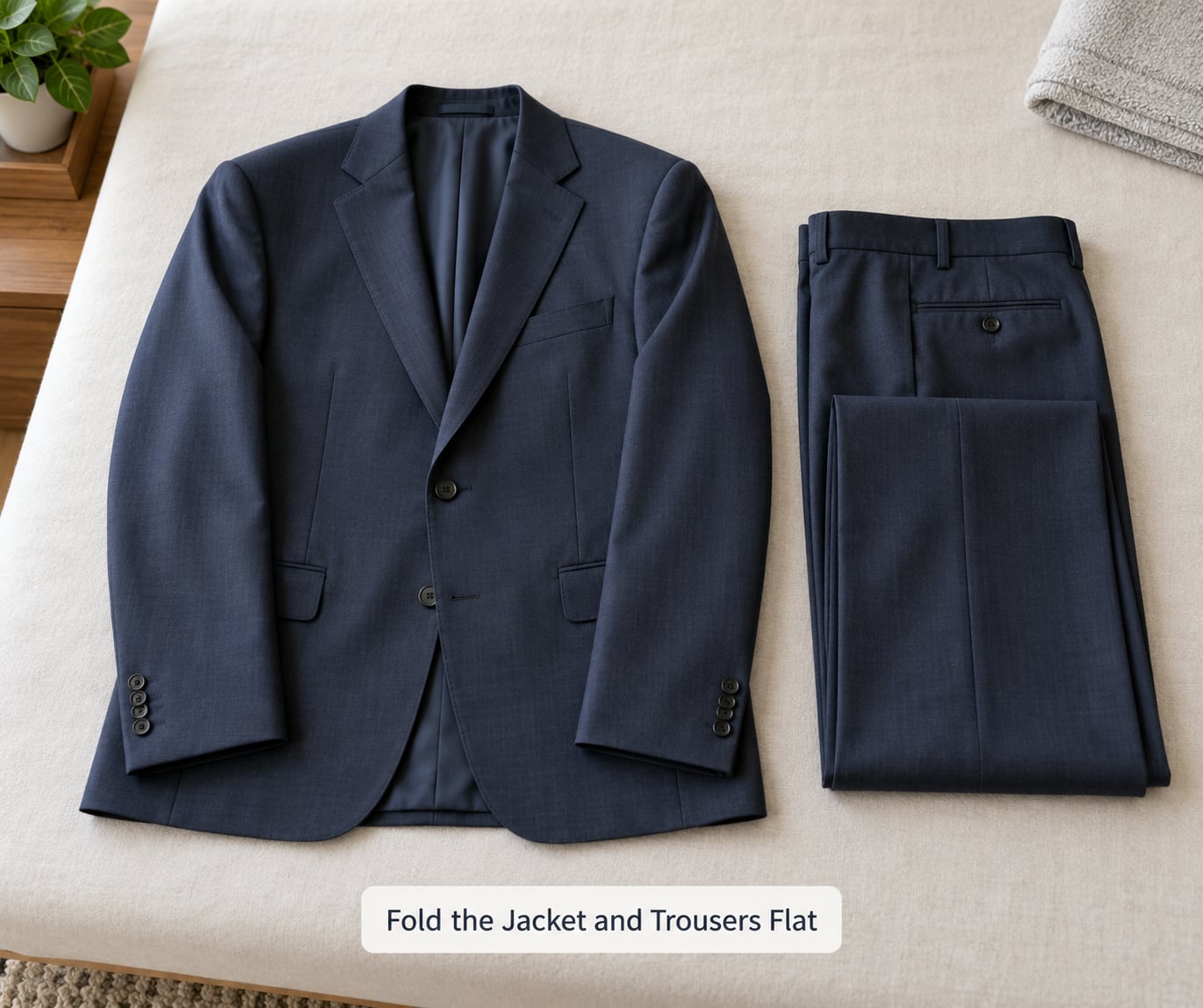
Lay the jacket face down on a flat surface with the collar toward you. Smooth the lapels flat with your hands, then lay each sleeve down along the body of the jacket, right sleeve over left, so the sleeve seams line up. The jacket should now look like a long rectangle roughly the length of the torso plus both arms.
Fold the body in half vertically, bringing one side panel over the other, and align the shoulder seams so nothing hangs out. The fold goes from the collar down to the hem, straight and flat, without gathering fabric. Smooth the whole rectangle once more with open palms; any wrinkle you iron out now is a wrinkle you do not deal with in a hotel bathroom.
Fold the trousers next, separately, so the two pieces can sit side by side rather than stacked. Fold them in half lengthwise along the inseam, then fold each leg in toward the other so they lie parallel. Press the fold with your palm, not your fingers, to keep the fabric flat. Fold the crotch area last and loosely; that is the section that bunches and creates the deep crease that shows most when you sit down.
If you want the pressed trouser crease to survive, do not fold the trousers on that line. Fold them in thirds across the leg instead, so the crease runs down the side of the folded bundle and is never bent back on itself.
Layer the Pieces to Prevent Crushing and Creasing
Wrinkles come from two directions: fabric rubbing against fabric, and pressure from weight. Layering solves both.
Slide a sheet of tissue paper between the two jacket panels before you fold the second side over the first, and another sheet over the top of the folded rectangle. Between the folded jacket and the folded trousers, lay a sheet as well. Every sheet is a slip layer, so when the case moves, the layers slide against each other instead of grinding together.
Do not force the folded suit into a compartment that is too small. A jacket crammed into a tight gap does not fold more neatly, it bunches, and bunches turn into creases that no amount of steam removes. If the folded pieces do not sit flat without pushing, unpack the case and take something else out.
Set the suit on top of everything else, or at least in the upper half of the case where nothing sits above it. Shoes, books, laptop bags and hard toiletries belong along the bottom and around the edges of the case, never on top of the formalwear.
Use Tissue Paper or a Garment Folder for Delicate Fabrics
Wool, silk, linen and anything with a delicate surface benefit from one more layer of separation. The rule is simple: the more delicate the fabric, the more slip layer between it and everything it touches.
Tissue paper goes directly between folds. Wrap a folded jacket loosely in two or three sheets, wrapping rather than binding, so you have not created a new hard edge to crease against the next layer. Tissue should be crisp and uncreased itself, so use fresh sheets rather than leftovers from a previous trip.
A breathable garment folder does the same job at a larger scale. Fold the jacket flat, lay it in the open folder, fold the trousers alongside or on top, then close the folder around everything. Pairing the folder with a compression pouch for the rest of your kit is a common setup, and it keeps the softer clothes from creeping into the formalwear’s space.
There is one case where a folder is close to essential: a trip with no laundry. A suit in a folder that you unpack and re-pack on day four comes out of the second pack noticeably flatter than the same suit loose in the case, because the folder keeps the panels in the same position each time.
Avoid the cheap non-breathable plastic covers for a whole trip. Wrapped tight and left sealed, they trap moisture, and both wool and silk can pick up a permanent smell or dull finish from a garment that never dried properly. A dry-cleaning bag is a transport barrier, not storage.
Pack the Suit and Fill Empty Space
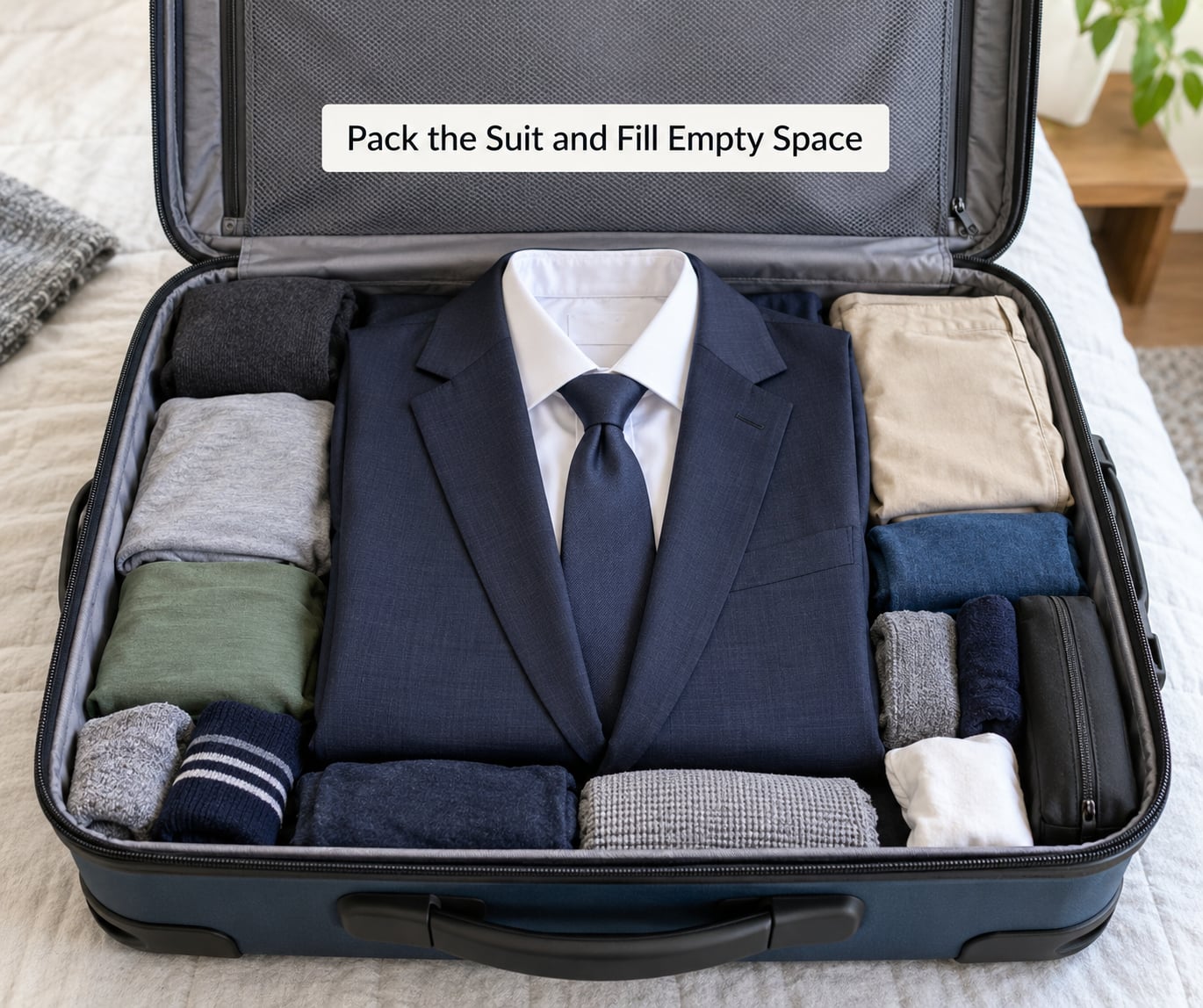
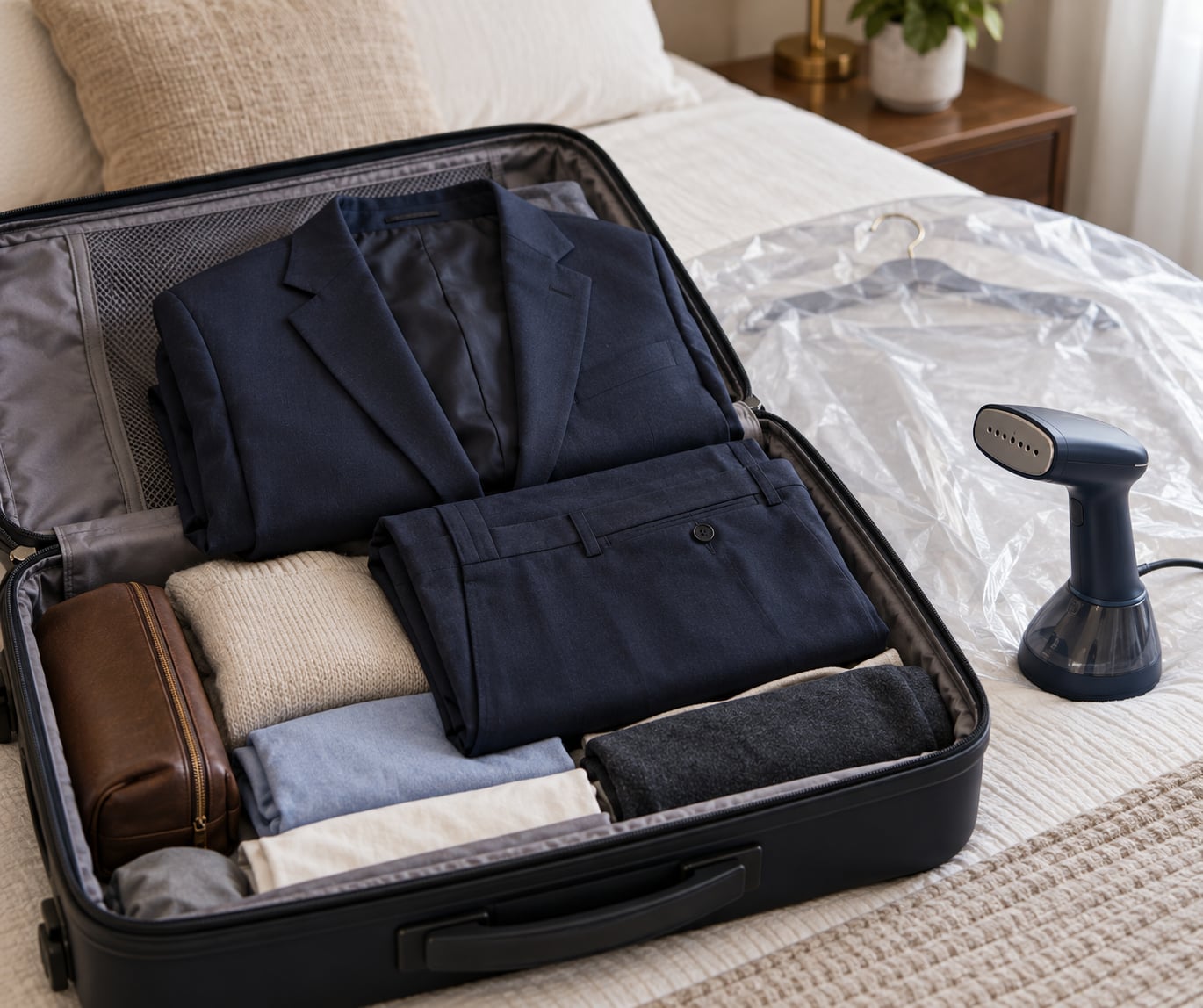
Pack in order, from the bottom up. Heaviest and least crushable first: shoes, toiletry bag, laptop, folded outerwear. Middle next: shirts, knitwear, other trousers. The suit goes in last and finishes the case, folded side up, with nothing resting on it.
Distribute the heavy items around the perimeter of the case rather than concentrated in the middle. Weight sitting in a single central block pushes down unevenly and prints a line across whatever is below it. Six pairs of shoes in a row along one wall is far kinder to a folded jacket than the same shoes stacked in the middle.
Fill every gap around the suit with soft, compressible items: rolled socks, underwear, t-shirts, a sweater. Gaps left empty let the folded suit shift and re-form creases every time the case is lifted or turned over. A snugly packed case is a stable case.
Finish by sliding the folded suit into its dry-cleaning plastic bag, or zipping it into the garment folder with a tissue sheet between the fabric and the zip. The zip and the bag seam are the two things that can press a line into wool during a long journey, and the barrier keeps them from reaching the garment.
For a whole trip, many travelers organize the rest of the case with simple volume rules. The 3-3-3 habit is three tops, three bottoms, three pairs of underwear or three accessories, doubled if you will wash. The 5-4-3-2-1 version is five tops, four bottoms, three pairs of underwear, two pairs of socks and one jacket. Neither is a law, but both stop the common failure of a case packed solid with shirts and no socks.
Unpack and Smooth the Suit on Arrival
Unpacking is the half of the process most people skip, and it is where the last few wrinkles either disappear or set. Get to the case as soon as you reach the room rather than leaving it shut in the closet while you do something else.
Take the suit out of any plastic, hang it on the wide hanger immediately, and pull the shoulders gently into shape. The garment has been folded for hours, so give it time in a hanging position before you judge it.
Then use the room. Hang the suit in the bathroom and run a hot shower for ten minutes with the door closed; steam relaxes light wrinkles in wool surprisingly well, and it is the method that works when the hotel has no iron. Stay nearby, because a wool suit left in a dripping bathroom is a wool suit that grows a water spot.
For anything the steam did not fix, work the fabric by hand. Smooth from the shoulder down toward the hem with open palms, following the weave, and press rather than rub. It takes two minutes and it works on most of what arrives.
Use a steamer last, on a low setting, held a few inches away, and only if the care label allows it. Never steam a jacket while it is on the hanger with your hand holding the collar; the weight of the wet steam plus your grip can stretch the shoulder. And keep the steamer away from glued lapels on a fused jacket, which is where heat damage shows first as a bubbling, permanently wavy edge.
Common Mistakes
Almost every badly packed suit comes down to one of these, and each has a specific correction.
- Overstuffing the case. When the zip only closes with the lid flexed hard, the contents are compressed and the compression becomes creasing. Take something out. Packing light is the single most effective anti-wrinkle move available.
- Folding along a thick seam. The shoulder seam, the sleeve head and the trouser rise are the areas most likely to leave a hard roll. Offset the fold a few centimeters from the seam so the crease lands on flat single-layer fabric.
- Packing a suit straight from the dry cleaner. Freshly returned garments still carry the press creases and a little residual moisture. Hang it in a breathable garment bag for a day, ideally overnight in a well-ventilated room, and let it relax before it goes anywhere near a suitcase.
- Burying the suit under heavy items. Shoes, laptop chargers and hard toiletry bottles print lines that will not steam out. Heavy items go at the bottom and along the walls; the suit finishes the case.
- Leaving the suit sealed in dry-cleaning plastic for a week. One trip in a plastic bag is fine. A week trapped in plastic can leave a smell, dull the surface of wool and set any crease permanently. Air it out at every hotel.
- Steaming at the wrong temperature or distance. Wool scorches and fused lapels bubble. Low heat, a few inches of distance, and move steadily so no one spot takes the full blast.
Two more that get overlooked. Packing trousers folded on the pressed crease, which guarantees the crease is gone by the second wear. And re-packing a wrinkled suit on day three without steaming it first, which adds a second generation of creases on top of the first. Steam and hang before you re-fold.
Wrinkle-Packing Tips for Different Trips
Overnight business trip. One suit, folded flat in a plastic bag, in the top third of a carry-on with a change of shirt underneath it. Skip the folder; you will be home before the fold has time to become a problem. Unpack and hang it the moment you check in.
Carry-on only, several cities. Use a soft-sided case so the suit sits in the top section and the rest fills around it. Add a garment folder for anything structured or expensive. Pack the shoes at the bottom in a hard container, and remember that a full-size garment bag will not make it into the overhead bin on a small regional aircraft.
Checked luggage. Assume the hold is hot and the bag will be handled roughly. A hard-sided case with a dedicated suit compartment and the plastic barrier inside it is the most protected option, and the one most travelers come back to for checked formalwear. Wrap the hanger area so the shoulders cannot be crushed against the shell.
Longer trips, five days or more. Most travelers pack one suit and a second pair of trousers rather than a second suit, then use hotel laundry. A second pair of trousers in a different fabric also gives you a fallback if something spills. For more than two suits, a two-garment compartment bag is worth the weight, and a folder per suit is the only setup that reliably survives a re-pack.
Last-minute departure. Skip the folder, skip the board. Fold the jacket flat, fold the trousers in thirds, put both in one plastic bag, and lay them on top of everything in the case. Five minutes of careful packing beats twenty minutes of buying gear you do not need.
Frequently Asked Questions
How long should I allow for unpacking and steaming a suit on arrival?
Ten minutes is enough for most suits. Hang it, run a hot shower with the bathroom door closed, smooth the fabric by hand, then use a steamer only on whatever the steam did not fix. Longer does not help much, because creases that need twenty minutes of steam usually need pressing instead. Unpack as soon as you reach the room rather than at the end of the evening.
Can you roll a suit jacket to save space?
You can, but only for soft, unstructured jackets that will be worn a day or two later. Rolling a structured or full-canvas jacket puts a hard crease through the shoulder and the lapel roll, and that crease does not come out with steam. For anything you plan to wear the evening you land, fold it flat and roll only the trousers if you must save space.
Which suit fabrics crease the most when packed?
Linen is the worst offender by a wide margin and will crease in almost any bag. Silk and viscose blends mark easily and can show water spots from steam. Wool and high-twist travel wools recover best, which is why frequent flyers favor them. Polyester and other performance synthetics hold a shape well but can trap heat and odor. Check the care label before using a steamer on any of them.
Do packing boards or garment folders actually reduce wrinkles?
Yes, mostly by preventing compression rather than by removing creases. A board keeps a soft-sided case from collapsing inward, and a folder keeps the jacket panels in the same position through handling and re-packing. A packing board adds roughly a pound of weight, so it earns its place on checked trips and is optional for a single overnight carry-on.
How do I remove wrinkles from a suit without a steamer?
Hang the suit in the bathroom, run a hot shower for ten minutes with the door closed, and stay nearby so nothing gets splashed. Then smooth the fabric by hand with open palms, working from the shoulders down. For stubborn lines, a light shower spray on a wide-tooth comb or a damp cotton cloth pressed against the fabric helps. Reserve a high-heat steamer for what is left over.
Conclusion
How to pack a suit without wrinkles comes down to four habits, and none of them require special gear. Fold structured garments flat with the sleeves in, protect delicate fabric with tissue or a folder, add the plastic barrier so nothing rubs, and put the suit where nothing heavy sits on top of it.
Then unpack it the moment you arrive. Hang it, steam the room, smooth it by hand, and the suit you packed in a case will look like the suit you left the closet in. If you only keep one habit from this guide, keep the plastic bag.