River cruise vs ocean cruise is really a question about what you want the holiday to be. Pick a river cruise for culture and intimacy — a small ship, a new town most mornings, meals and shore excursions usually in the fare. Pick an ocean cruise for variety at sea — big ships, pools, shows and islands no river can reach.
Neither one is more luxurious. They are different trips, and pretending otherwise is how people end up paying ocean-cruise money for a sedate week or river-cruise money for sea days they did not want.
I have watched both sides of this argument play out in cruise forums for years, and the pattern is consistent. People who loved their first river cruise almost always describe it in terms of walking into town. People who loved their first ocean cruise almost always describe what the ship offered them on a day with nowhere to go.
Table of Contents
- 1River Cruise vs Ocean Cruise at a Glance
- 2Scenery and Views: River Banks, Historic Ports and Open Sea
- 3Ship Size and Atmosphere
- 4Which cabins should you avoid on a river cruise?
- 5Destinations and Port Stops
- 6Pace, Activities, and Entertainment
- 7Duration, Costs, and Value
- 8Which Should You Choose?
- 9Frequently Asked Questions
- 10Is a river cruise more relaxing than an ocean cruise?
- 11Which type of cruise offers better scenery?
- 12Are river cruises suitable for older travelers?
- 13Which is better for families with children?
- 14Do ocean cruises have more onboard activities?
- 15Are river cruises more expensive than ocean cruises?
- 16Conclusion
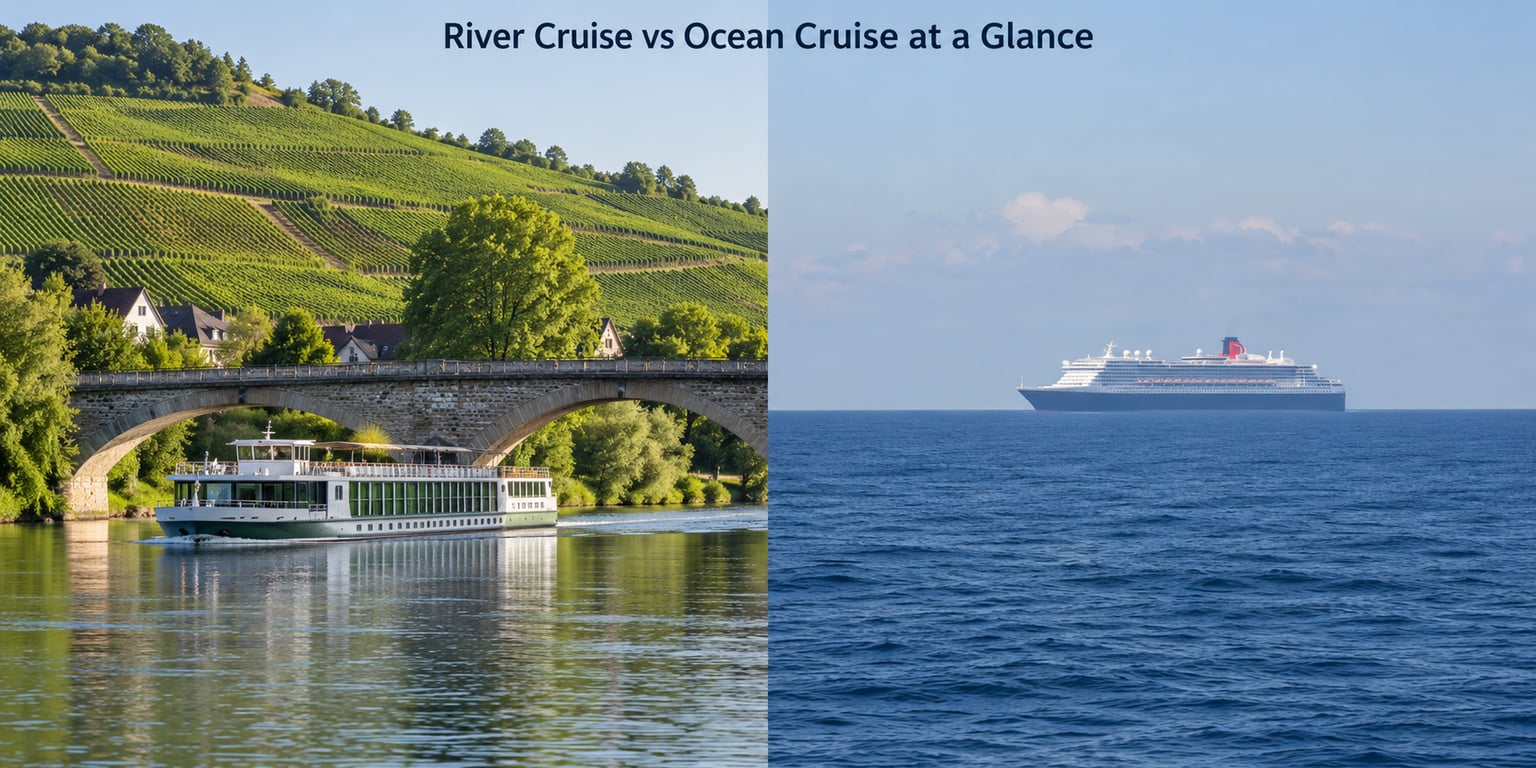
River Cruise vs Ocean Cruise at a Glance
| Factor | River cruise | Ocean cruise |
|---|---|---|
| Guests on board | Typically under 200 | 1,000 to 6,000 or more |
| Cabins | Often 80 to 100 | Hundreds to over 2,000 |
| Ship feel | Floating boutique hotel | Self-contained resort at sea |
| Typical itinerary | A new town most mornings | A mix of ports and sea days |
| Days at sea | Essentially none | Common, two or three per week |
| Getting into town | Walk off the gangway, usually minutes away | Walk, tender or coach transfer depending on port |
| Onboard entertainment | Local musicians, talks, one dining room | Showcase theatres, casinos, pools, kids clubs |
| Specialty dining | Rare, and rarely charged extra | Several venues, usually reserved or extra |
| Shore excursions | Usually bundled in the fare | Often optional and priced separately |
| Meals, drinks, gratuities | Generally in the fare | Varies by line and package |
| Motion | Calm inland water, rarely a problem | Real open-sea swell in rough weather |
| Dress code | Relaxed, no formality expected | Casual by day, occasional formal nights |
| Typical trip length | Roughly 7 to 14 nights | About 3 to 14 nights or longer |
| Per-day cost profile | Higher, with more bundled | Lower, with more billed separately |
| Best for | Culture seekers, couples, solo travellers, first-timers | Families, beach lovers, big-ship amenity fans |
Scenery and Views: River Banks, Historic Ports and Open Sea
A river cruise gives you continuous scenery. The ship moves slowly through a corridor of interest — vineyard terraces above the Rhine, castles on the Danube, painted towns along the Douro — and you can be on deck most of the day without anything feeling wasted.
Because the ship is small and usually moored overnight in the town itself, the view from your cabin window is a working street or a riverside square rather than a promenade of other ships. That closeness to the water is the whole appeal for a lot of first-time river cruisers.
An ocean cruise delivers a different kind of view: an open horizon that changes constantly with the weather, long horizon lines at sunrise, and a coastline that appears and disappears over several days. Coastal and island itineraries in the Caribbean, the Mediterranean and northern Europe give you scenery too, but you see it in chapters rather than continuously.
So which wins on scenery depends on what you want to look at. Closely observed river country, water meadows and hilltop ruins all day? River. Coastlines, sea stacks, open water and dramatic ports of call? Ocean.
One practical note. On a river ship your observation areas are usually spread across several decks, and the whole boat is walkable. On a large ocean ship the best viewing happens at the front of a forward observation lounge or up on the pool deck, and you have to find your spot.
Ship Size and Atmosphere
This is the biggest single difference, and it explains most of the others. River ships usually carry fewer than 200 guests, often across just 80 to 100 cabins. Ocean ships run from a thousand guests to well over six thousand.
The river limit is not a style choice. River ships are shallow-draft and physically constrained by river width, depth, low bridges and locks. That is why they cannot be built larger, and it is also why itineraries on some European routes can flex when water levels or lock maintenance change the schedule.
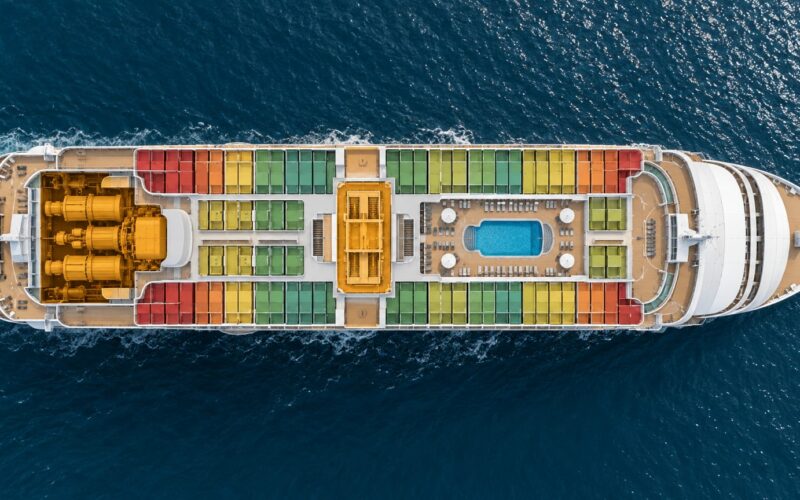
Which cabins should you avoid on a river cruise?
Ask for this question more often than most people expect. The answer is mostly about noise rather than size.
- Low decks near the engines — vibration carries upward more than most guests anticipate.
- Cabins directly beside the public lounge or dining room — music and conversation carry late into the evening on some ships.
- Cabins on the side the ship passes traffic — on busy waterways, other vessels wake you up at odd hours.
- Very forward cabins on an ocean ship — motion is strongest at the bow in a swell.
On an ocean ship the equivalent advice is to avoid the lowest deck at the very front if you get seasick, and to ask whether your cabin sits directly under a noisy venue such as the theatre, the nightclub or the engine room.
The small-ship effect that people talk about most is really about crew ratios. With fewer guests and more crew per guest, service tends to be more personal, and staff often learn your name within a day or two. On a large ship you may not recognise your server beyond week two.
Destinations and Port Stops
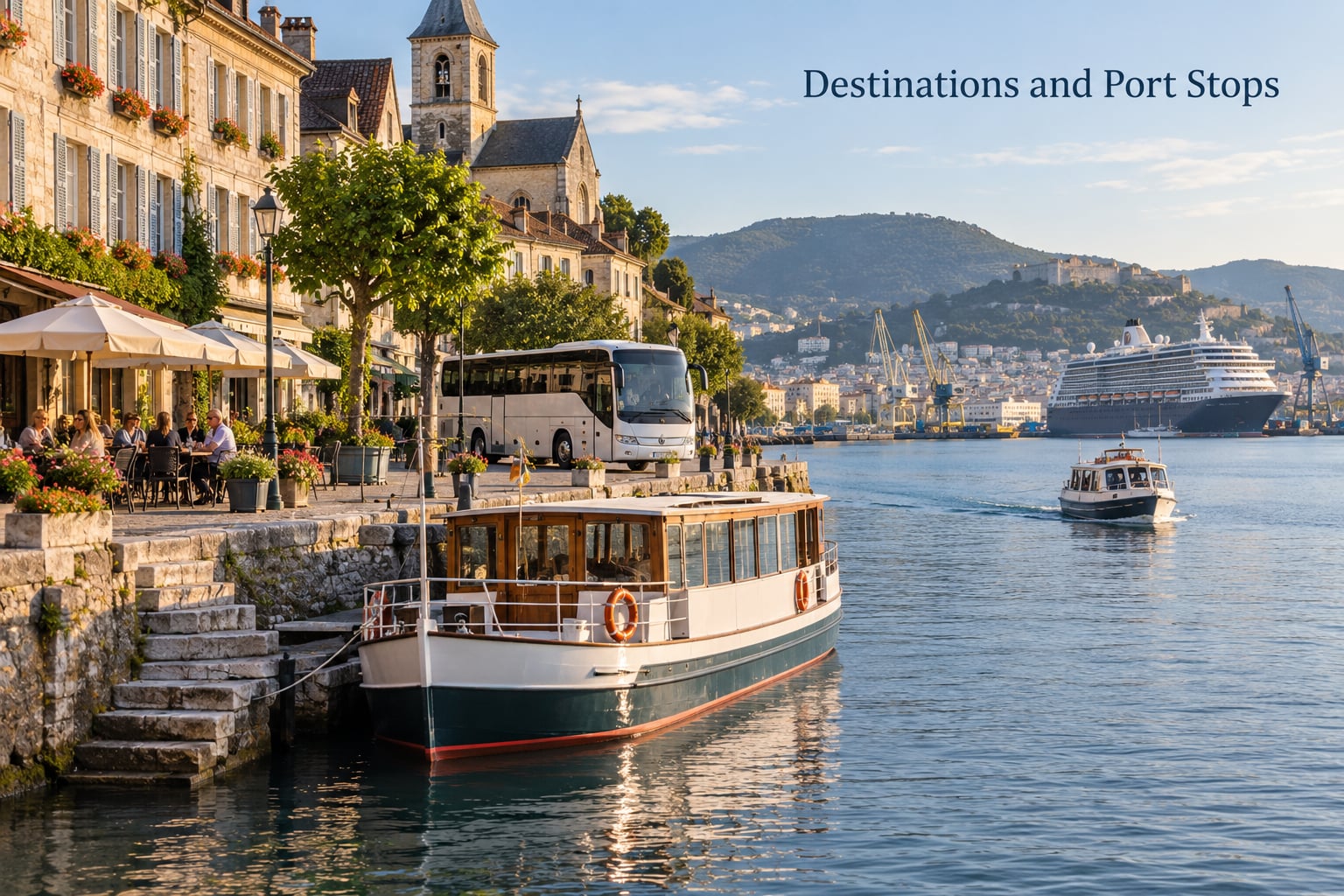
River cruise itineraries are concentrated by geography. A European river week might move through several countries in a line — Amsterdam, along the Rhine past vineyards and castles, into the Main-Danube Canal, then down the Danube toward Budapest. Other river cruising happens on the Mekong, the Nile, the Mississippi and the Chobe.
What you get is density. New architecture, new food and new history most mornings, all within a few hundred metres of where you slept. Your unpack-once instinct pays off because the thing you want to see is never far away.
Ocean itineraries cover ground a river cannot. The Caribbean, the Mediterranean, Alaska, the Norwegian fjords, expedition voyages toward polar waters — these are routes that require open water and days of transit to make sense.
The trade-off is port logistics. Large ocean ships regularly dock at industrial terminals built for freighters. Getting to the actual town centre can mean a long coach ride, and some smaller islands are only served by tender, with the ship’s crew controlling when you come and go.
River ships avoid almost all of that. Walk-off access, as cruisers call it, is the most commonly volunteered advantage in the forums, and the reason people who try a river cruise once tend to book another.
Pace, Activities, and Entertainment
A day on a river cruise has a rhythm: breakfast, a guided walk or two in the morning, lunch back on board, an afternoon of cycling, kayaking or a second outing, dinner, then something short and low-key in the evening. You are rarely bored and rarely exhausted.
Evenings are usually one musician, one host, or a local speaker giving a talk about the region you are sailing through. It is deliberately modest, and some guests love it precisely for that.
Ocean ship days are longer and offer more choice, because the ship is the destination. You might have a Broadway-style show after dinner, a drink in the martini bar, a casino, a kids club, a water slide or a spa treatment — all without leaving the vessel.
That variety is the main reason people get hooked on big ships, and it is also why some guests get disappointed. The recurring comment on cruise forums is straightforward: if you enjoy the activities and entertainment on large ocean ships, life on a river cruise can feel too sedate.
The reverse regret exists too. On ocean itineraries with two consecutive sea days, some guests simply leave the ship. One poster with a long history of mainstream ocean trips described preferring itineraries with overnight port stops, because the extra day in a place was worth more to them than another sea day.
Dining follows the same split. River ships generally run one main restaurant, an intimate alternative on premium lines, and good regional wine with dinner as part of the fare. Big ships have more choice and more upselling — the buffet is free, but the specialities and premium drinks are not.
Anyone who wants a bigger venue should weigh facilities carefully. Several mainstream river lines simply do not carry kids clubs or water slides, so a family with young children will find an ocean ship far better equipped.
Duration, Costs, and Value
European river cruises run about seven to fourteen nights. Ocean cruises are more flexible, from long weekend sailings to two or three weeks, and the price per night drops on longer trips because you are amortising the cost of getting there and back.
River cruise fares are higher per day. Five reasons explain most of the gap:
- More is bundled in. Meals, wine with dinner, gratuities, housekeeping and usually a shore excursion at every port sit in the fare rather than on a receipt.
- Tiny ships cost more to run per guest. Crew per guest is far higher, and there are only around a hundred guests to spread fuel, hotel costs and overhead across.
- Small-ship cabins sell out early. Inventory is limited and popular departures go before brochures reach most travellers.
- Fewer departures per river per season. A ship sits idle between sailings in a way a large ocean vessel does not.
- Destination access costs more. Mooring in historic city centres is expensive and regulated, and river ships cannot simply anchor anywhere offshore.
Value depends entirely on how you compare. Compare a river cruise to a mainstream ocean cruise of the same length and the river one looks expensive. Compare it to a comparable European land tour of the same region — same hotels, same restaurants, no coaches — and the picture changes, which is the argument cruise boards make over and over.
On an ocean cruise you can spend a great deal on top of the fare: premium drink packages, specialty dining, shore excursions, spa treatments and gratuities at a 20 percent or higher service charge all add up. A guest on a seven-night Mediterranean sailing can easily match or exceed the cost of a river week in the same region once extras are counted.
Both formats also leave costs outside the fare entirely: flights, pre- and post-cruise hotel nights, transfers and travel insurance. Budget for those separately regardless of format.
Which Should You Choose?
If you want one thing from this decision, decide which version of the holiday you would rather have on a day with nothing scheduled.
- Culture and history at a real pace — river. You see more, closer, with less time spent in transit.
- Shipboard amenities, pools and entertainment — ocean, without question.
- First time cruising and any hesitation about open water — river. Inland water is calm, and ships rarely roll.
- Young children — ocean. Kids clubs, splash areas and evening programmes exist mainly on big ships.
- Solo travel — river, with a caveat: small ships mean a smaller social pool, though many lines now run solo-friendly sailings.
- Islands, beaches or polar destinations — ocean. No river reaches them.
- Limited mobility — ocean, generally. River port towns mean cobbles, hills and stairs, and the river ships themselves have more internal stairs than a modern lift-equipped ocean liner.
- Getting value per day — ocean if you are disciplined about extras, river if you want everything already counted.
Two groups should probably skip a river cruise. Travellers who want entertainment every evening find small-ship programming thin. And anyone hoping to really know a place should remember that a river week gives you a taste of eight towns rather than a week in one.
Symmetrically, an ocean cruise is the wrong call if open water makes you anxious, if you would rather walk into a historic centre than ride a coach from an industrial terminal, or if two sea days in a row would sour the trip.
One option nobody discusses enough: do both. A river week through the Rhine or Danube pairs naturally with a few nights in Amsterdam or Budapest, and plenty of travellers add an ocean leg elsewhere the same year.
Frequently Asked Questions
Is a river cruise more relaxing than an ocean cruise?
Usually, yes, and mostly because of the schedule rather than the scenery. River ships reach a new town almost every morning, so there is little dead time, and the evenings are quiet by ocean standards. Ocean cruises are more relaxing only if you enjoy using the facilities, since a sea day with nothing scheduled can feel long. If relaxation means fewer decisions, a river cruise wins.
Which type of cruise offers better scenery?
It depends on the landscape you like. A river cruise gives continuous scenery from a small deck, with vineyards, castles and painted river towns visible for hours. An ocean cruise gives open water, changing horizons and dramatic coastal or island scenery, but you see it in chapters. Continuous close-range scenery favours the river; sea and coastlines favour the ocean.
Are river cruises suitable for older travelers?
Yes, but with one real caveat. Embarking is far easier on a small ship, with no long queues and no security screening, and you can walk straight into town from the gangway. The caveat is the port towns, which often involve cobbles, hills and uneven paving. Anyone with limited mobility should check each itinerary and consider an ocean ship with modern lifts and more accessible excursion vehicles.
Which is better for families with children?
Ocean, for most families. Large ships carry supervised kids clubs, splash areas, water slides and evening programmes that small river ships generally do not. River ships suit older children and teenagers who enjoy cycling, kayaking and historic towns. Some premium river lines do offer family programmes, so check what is actually aboard before ruling them in or out.
Do ocean cruises have more onboard activities?
Considerably more. Ocean ships carry multiple theatre spaces, casinos, gyms, spas, pools, specialty restaurants and organised programmes running from morning to late night. River ships offer a sun deck, lounge, small pool, bicycles and kayaks on some lines, plus local musicians and guest speakers. If activities are the point of the holiday, the ship is on an ocean cruise.
Are river cruises more expensive than ocean cruises?
Per day, usually yes, and the reason is bundling. River fares normally include meals, wine with dinner, gratuities and a shore excursion at each port. Ocean cruise fares look lower but add on premium drinks, specialty dining, excursions and automatic gratuities. On a like-for-like seven-night trip the totals are closer than most people expect, so compare what is included, not just the headline fare.
Conclusion
Decide what you want the holiday to be. If it is a steady supply of places, walkable towns and a small ship where people know your name, take the river cruise; if it is pools, shows, destinations across the sea and freedom from planning anything at all, take the ocean cruise.
Whichever you pick, compare what is included in the fare rather than the fare itself, and pick a trip length you can genuinely enjoy.