Yes, you can travel for two weeks with one bag, and the trick is not clever packing. It is packing for seven days instead of fourteen and washing once or twice while you are away. How to travel for two weeks with one bag comes down to that one decision, plus a capsule wardrobe that mixes, a three-pair shoe limit, and a laundry plan you set before you book anything. Most of the work is done in a single evening, roughly two hours including a test pack and a weigh-in.
The reason it feels impossible is that most people pack for fourteen days of variety, not fourteen days of weather. Those are different problems. Nobody needs fourteen different outfits. They need enough to get through four days without a wash, and a reliable place to wash on day five.
Here is the system, in order.
Table of Contents
- 1What You Need
- 2Carry-on only, or checked-bag-free?
- 3A bag sized to the strictest airline on your route
- 4A personal item, and a reason for it
- 5Packing tools that earn their space
- 6Laundry supplies, if you plan to wash
- 7Step-by-Step
- 81. Choose a bag you can manage
- 92. Check the route before you choose outfits
- 103. How to travel for two weeks with one bag: build the core capsule
- 11The 14-day clothing count
- 124. Pack by category and use packing tools
- 135. Plan laundry instead of packing everything
- 146. Repack and adapt at the midpoint
- 157. Complete a test pack and weigh it
- 16Common Mistakes
- 17Packing fourteen days and hoping for a miracle
- 18Clothes that do not go together
- 19Too many shoes
- 20No laundry plan
- 21Compression cubes packed solid
- 22No essentials pouch
- 23Frequently Asked Questions
- 24Can I really travel for two weeks with one carry-on bag?
- 25How many days of clothes should I pack before doing laundry?
- 26What should I do if my airline requires checked luggage?
- 27Can I bring laundry detergent and a portable washing board in my carry-on?
- 28How do I pack shoes without exceeding the airline weight limit?
- 29What if my two-week trip includes a formal event or outdoor activity?
- 30Conclusion
What You Need
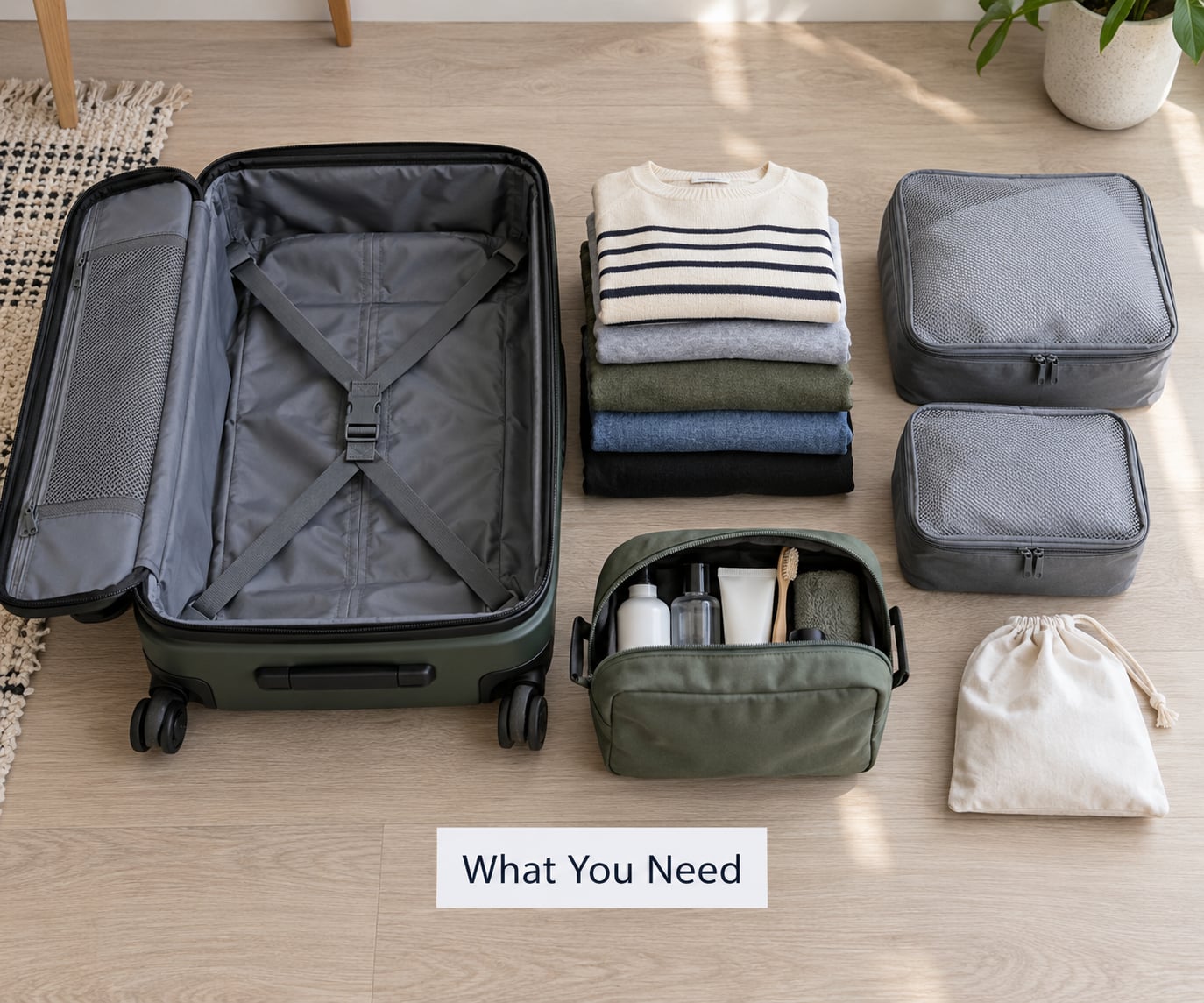
Before any clothes go in a bag, four things have to be settled. Get these wrong and the rest is decoration.
Carry-on only, or checked-bag-free?
People use “one bag” for two different trips. Carry-on only means the roller or backpack never goes into a hold, which rules out anything you cannot wash on the road and locks you to the strictest size box on the route. Checked-bag-free is looser: you still avoid the hold, but a backpacker-style trip with hostel laundry and hand-wash is genuinely easier in a 40-litre pack. Both work for fourteen days. They fail differently, and the second one needs less clothing, not more.
Whichever you are doing, the deciding factor is laundry access, not bag size. A fourteen-day trip with a washing machine on day three can be packed in a bag half the size of a fourteen-day trip with no laundry at all.
A bag sized to the strictest airline on your route
Not the strictest airline of the trip in theory. The strictest airline you are actually booked on, checked on the airline’s own site, for each leg. On a multi-city itinerary that often means two different sets of rules, and the smaller box wins. If your route includes a low-cost European carrier, assume its allowance is the one you design around; those carriers publish small maximum dimensions and enforce them with a measuring frame at the gate.
There are two different systems, and this is where most one-bag plans fall apart. Some airlines give you a size box and no weight limit, and only care whether the bag physically fits into the overhead locker. Others give you a generous box plus a weight allowance, and the sizer at the gate is a set of scales. Budget carriers are the strictest on size, and many full-service carriers outside the US are strictest on weight. Know which kind you are dealing with before you buy anything.
A personal item, and a reason for it
A small backpack or underseat bag counts as your personal item, and nearly every airline allows one on top of the carry-on. It is the piece that makes the whole system survivable: documents, electronics, medication, a change of clothes, and the toiletries you would be gutted to lose. Travellers on r/onebag treat the underseat backpack as insurance, not as a second suitcase, and that is the right framing. Keep it under the seat, never in the overhead bin, so a gate-checked roller does not take it down with it.
Packing tools that earn their space
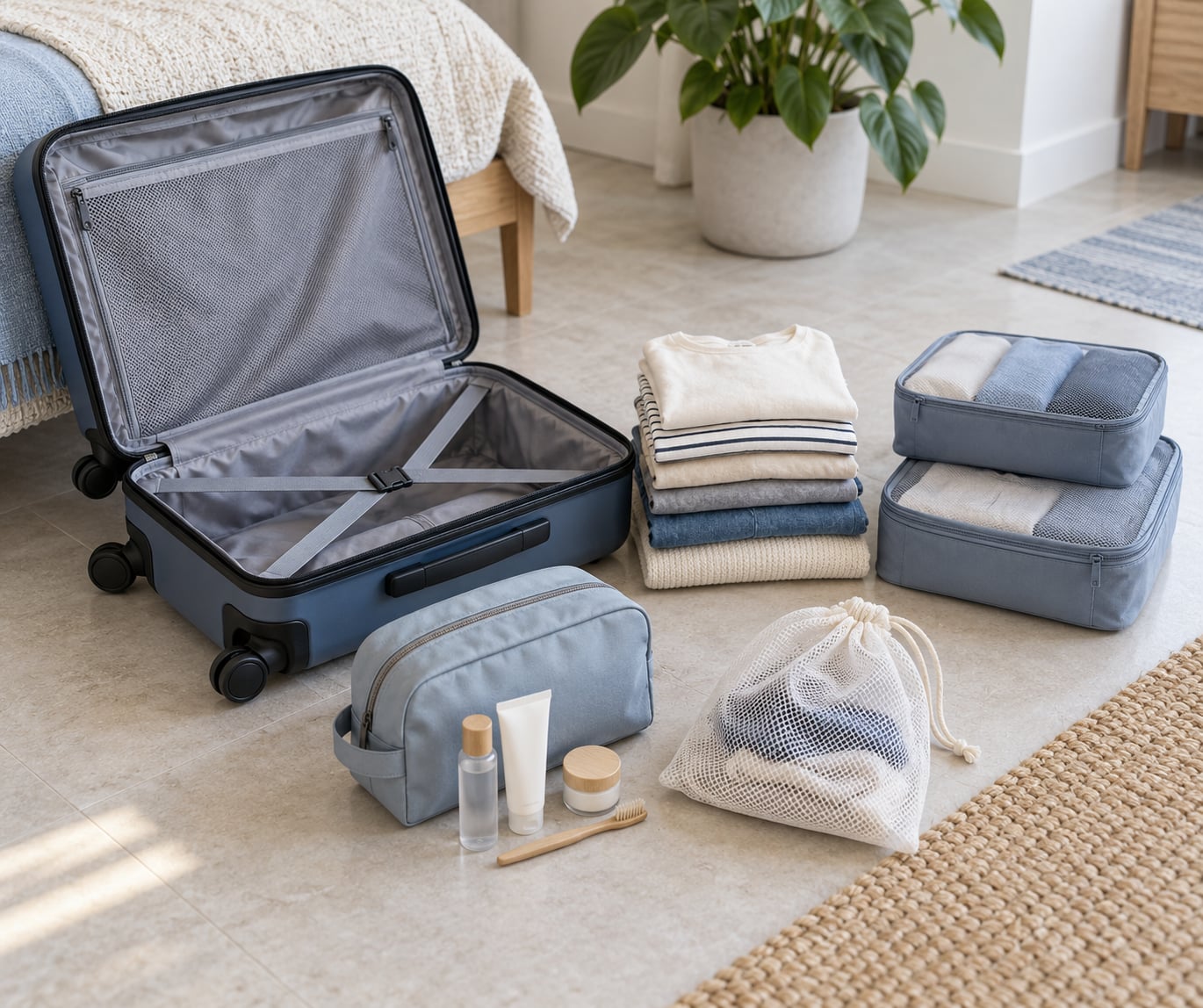
Three packing cubes, a laundry pouch, and a small laundry line or a shower-curtain-style hanging loop. Skip the vacuum bags. Experienced travellers on the Rick Steves forum consistently report that ordinary, non-compression packing cubes fit more usable clothing into the same bag, because compression sacks crush the volume but leave the contents creased and hard to find.
Laundry supplies, if you plan to wash
Two laundry detergent sheets, a mesh wash bag for socks and underwear, and a dry bag for anything that might still be damp. That is the whole kit, and it weighs almost nothing. If you refuse to hand-wash, read the no-laundry variant below before you commit to a clothing count.
Finally, the non-negotiables: passport and any required visas, travel insurance details, cards kept separate from your phone, medication in its original packaging in your hand luggage, a phone and charger, and a power bank in the cabin rather than checked. Prescription medication in the original labelled packaging is the rule most jurisdictions expect, and it is not a suggestion. Print or download anything you need for two weeks without connectivity: boarding passes, hotel addresses in the local language, insurance claims numbers and your return itinerary.
Step-by-Step
1. Choose a bag you can manage
Pick the bag after you know your route, not before. A spinner roller works well on smooth airport floors and city pavements and is miserable on cobblestones, stairs and rural trains. A backpack wins on anything with stairs or a lot of walking, and it doubles as your personal item, which effectively gives you one bag and a half. If your trip is a city break with smooth pavements and short walks, a carry-on roller is the easier object to live with for fourteen days.
Checkpoint: the bag is compliant with the smallest allowance on your route, and you have carried it loaded, up a flight of stairs, for ninety seconds without wanting to hand it to someone else.
2. Check the route before you choose outfits
Write the itinerary out day by day and mark the temperature range for each stop. This is the step people skip, and it is the one that decides whether the bag works. A two-week trip across three cities in the same climate is a completely different packing job from two weeks that start in a hot coastal city and finish in the mountains at altitude.
Then mark three things on that outline: any dress code that matters (a dinner, a business meeting, a religious site with modest-dress expectations), any activity that dirties clothes fast (hiking, cycling, cooking, a dusty train), and where you can realistically wash. That third mark is the most useful thing on the whole list.
Checkpoint: you can name the coldest and warmest parts of the trip in degrees, and you know which days are the outfit days.
A single base is the easiest version of a fourteen-day one-bag trip. One laundry day, one set of clothes suited to one climate, and a bag you can fully unpack on arrival. Multi-city is the hard version: you carry the clothing for the coldest and warmest stop simultaneously, and you need the layering system to earn its place. The difference shows up in the count, not the bag. A multi-country trip usually needs one extra layer and one extra pair of shoes, and it needs the bag chosen for the tightest airline of the lot.
3. How to travel for two weeks with one bag: build the core capsule
You are packing seven days of clothing, not fourteen. Two weeks on the road becomes seven days of outfits plus one or two washes. Everything else on this page follows from that arithmetic.
Start with a palette of two to three colours plus black or navy. Every top has to work with every bottom, and every layer has to work over every top. That single constraint does more to shrink a bag than any cube or sack ever will. Then build in layers, because layering is what lets one outfit cover a 10-degree spread in temperature instead of needing a coat per climate.
Fabrics matter more than most people expect. Merino or other wool blends can be worn three or four times without smelling, which is what makes a repeated-outfit plan survivable. Quick-dry synthetics dry overnight in a hotel room. Cotton holds water and creases, so keep it for tops and save volume.
The 14-day clothing count
| Item | Quantity | Notes |
|---|---|---|
| Tops | 5 | Two short-sleeve, two long-sleeve, one that can pass as smart |
| Bottoms | 3 | Two everyday, one travel-friendly quick-dry pair |
| Underwear | 7 | One per day plus one spare; five works if you wash on day four |
| Socks | 5 pairs | Wash with your underwear, in a mesh bag, so they stay in pairs |
| Layers | 2 | One mid-weight (merino or fleece), one packable shell or thin down |
| Sleepwear | 1 | Sleep shirt or lightweight set rather than a full outfit |
| Shoes | 2 worn or carried, plus 1 worn in transit | Walking pair, light pair, transit pair on your feet |
| Accessories | 1-2 | A scarf or a second belt changes the look of the same outfit |
The most upvoted formula on r/TravelHacks is the 4-3-2-1 rule, and it is shorter than the table above: four tops, three bottoms, two layers, one bathing suit, for one week with the second week reworn. Other travellers use 5-4-3-2-1, which adds a fifth top, a fourth bottom, a third layer, a second pair of shoes and one extra outer layer. The 3-3-3 version is the strictest: three tops, three bottoms, three layers, for about a week with laundry. The 3-5-7 rule is a different idea entirely, three colours of tops, five bottoms, seven tops in total, for a longer, dressier trip.
Pick one and adapt it to your weather. Do not average them, or you will end up packing all of them.
Some things never make the list, whatever the formula says. A full-size pillow, a blanket, a full-size towel if the accommodation provides one, a hair dryer if you can borrow one, a garment steamer, a second pair of jeans you will not wear on a walking trip, and anything sized for a trip you might take instead of this one. Two of these are the usual reason a one-bag plan quietly turns into a checked bag, so decide about them before you pack rather than at the airport.
Checkpoint: you can name at least twelve complete outfits from what is on the list, using combinations you have actually pictured, not combinations you assume will look fine.
4. Pack by category and use packing tools
Clothing, footwear, toiletries, medication, documents, electronics: six groups, and each goes in the same place every time. This matters more for a two-week trip than for a weekend, because you will be repacking mid-route and a bag that cannot be repacked in ten minutes is a bag that will not get repacked at all.
A few practical rules that hold up:
- Wear your bulkiest items in transit. Jacket, boots, the chunkiest sweater. That volume is free.
- Liquids follow the 3-1-1 rule. One clear quart-sized bag, containers of one litre or less, each of one pint or less. Shampoo and conditioner bars, a solid cleanser and a refillable bottle beat three 100 ml bottles every time.
- Medicines and glasses go in the personal item, not in the roller, so a gate check does not strand you for a day.
- Electronics stay with you. Laptops, cameras, power banks and spare lithium batteries belong in the cabin, never in a checked or gate-checked bag.
- One laundry pouch holds the detergent sheets, the mesh bag and the socks you are currently wearing, so damp things never touch clean ones.
Put dirty clothes in the mesh bag or a dry sack rather than back into the cubes. It costs you nothing and it is the difference between a bag you can find things in on day eleven and one you cannot.
Checkpoint: you can reach your medication, your chargers and one complete change of clothes without unpacking the main compartment.
5. Plan laundry instead of packing everything
This is the part that turns seven days of clothing into fourteen days of travel, and it needs a plan rather than an optimistic intention. Decide where you will wash before you leave, because a hotel room with no safe laundry option on day nine is a problem you cannot solve on day nine.
| Option | Best for | Time | The catch |
|---|---|---|---|
| Hotel sink | Tops, underwear, socks, anything quick-dry | 20-30 minutes, mostly drying | Cold water only, and lukewarm water on wool is not really lukewarm |
| Washer in your rental | Two-week stays in one place | About an hour end to end | Only available if you book that specific place for that specific reason |
| Laundromat | Full loads, two-week trips, winter | 90 minutes with drying | Per-minute pricing adds up, and not every machine has a dryer |
| Do nothing | Merino-heavy wardrobes, cold climates | Zero | You rewear everything, twice, and it takes nerve |
On the road, my order of preference is a machine, then a laundromat, then the sink. A sink wash is 30 ml of lukewarm water, a minute of agitation, a rinse, and a towel press. It handles tights, shirts and underwear. It will not rescue a load of denim, and it will not get a merino base layer dry by morning in a humid city.
Plan drying around your schedule, not around your hope. Hang things in the room overnight with a small gap between garments, drape towels over the rail, and never pack anything still damp, because damp fabric in a closed bag smells within a day. If your accommodation has no hanger, a laundry line across the bathroom solves it in ten seconds.
Underwear and socks are the practical bottleneck. Seven sets covers a full week, and washing on day four keeps you in control. The most repeated complaint on r/solotravel is socks vanishing in the wash, and a mesh bag is the entire fix.
One more variant worth knowing: if you will not hand-wash at all, add three tops, two pairs of underwear and a second pair of socks to the table above, and pick merino for anything worn next to skin. That is the no-laundry version of the same two-week plan, and it still fits.
Checkpoint: you can point to a specific laundry option within the first five days of the route.
6. Repack and adapt at the midpoint
Around day seven, stop for ten minutes and reassess. You are not optimising your wardrobe, you are checking whether the bag still matches the trip. Ask four questions: what have I actually worn, what did I not touch, did the weather match the forecast, and what is left in the itinerary.
Most of the time, a third of what you packed has not been worn, and the laundry pile has taken its place. That is a good result, not a failure. Drop the untouched items into whatever laundry you do next, then re-pack by weight rather than by cube. It also tells you something real about your next trip: you packed two pairs of shoes for a route that needed one.
If the forecast shifted hard, the fastest fix is layers you can add or strip, not a shop. If you genuinely need something you do not have, buying or renting at the destination is usually cheaper in time and stress than carrying it from home, and for a two-week trip with several bases, the shops are already on your route.
Checkpoint: the bag is still closed cleanly at day seven, and you can get to anything in the bottom without emptying it.
7. Complete a test pack and weigh it
The evening before you fly, pack the bag exactly as it will travel and then do four things. Measure it against the strictest allowance on your route, with the shoes and jacket you are actually wearing. Weigh it, and set a target most travellers hit comfortably: clothes around 4 kg, shoes 1.5 kg, toiletries and laundry kit under 1 kg, electronics and tech the rest. On a 7 kg allowance that lands just inside; on a 10 kg allowance you have room to be human about it.
Then walk to the door, pick it up, and carry it for a couple of minutes. A bag you resent at your own front door is a bag you will abandon half the bag at the airport, and that is the most common way one-bag trips fail.
Finally, run the gate-check drill. Imagine your roller is being tagged at the gate: phone, wallet, passport, medication, glasses, chargers, one change of underwear, one top, and all your toiletries are in the personal item. If that is not true yet, move it. Nobody checks those contents. It costs you five minutes and it removes the single worst moment of one-bag travel.
Checkpoint: the bag fits, weighs inside the limit, and everything you would need for the first night is reachable without unpacking.
Common Mistakes
Packing fourteen days and hoping for a miracle
This is the big one. Fourteen days of clothing is roughly double the volume of seven days, and no amount of clever folding fixes it. Cut the count in half and wash. If you have never done it before, start with one week, not two.
Clothes that do not go together
Counting outfits is not the same as having outfits. If five tops only work with two specific bottoms, you have two outfits, not five. Lay everything out on the bed and check the combinations in daylight before it goes in a bag.
Too many shoes
Three pairs is the hard ceiling and one of them is on your feet in transit. Shoes are the heaviest, least compressible thing most people pack. If a route needs a formal pair, plan one dressier option and borrow or rent the rest rather than carrying four.
No laundry plan
Packing fourteen days because you do not trust sink washing is the same mistake twice. Decide where you will wash before day one, carry the detergent sheets, and dry overnight. People report on r/traveladvice that first-timers worry about the laundry far more than the laundry ever actually costs them.
Compression cubes packed solid
They save volume on paper and create an unsearchable brick in practice. Regular packing cubes give up a little space and give back the ability to find one shirt on day ten. Fill them to about two-thirds and leave the tops accessible.
No essentials pouch
Losing a roller at the gate is survivable if your passport, medication, chargers, toiletries and one change of clothes are in the personal item. Pack it the night before and check it like a real bag, not a bag of things you grabbed at the last second.
Two smaller habits pay off as well. Separate the damp laundry into its own bag, and rewear nothing more than three or four times without a wash, which is comfortable for most fabrics and fine for merino. Accessories change the look: one scarf or a second belt makes the same outfit read as different on day nine and day twelve, which is the real answer to the repeat-outfit worry.
Two variants come up constantly, so here is the short version of each. On a work trip, the bag is the easy part; the laptop, chargers and one presentable outfit are the constraint. Keep the laptop sleeve flat against the back panel, pack one shirt that clears a dress code, and drop two tops and a pair of shoes to pay for it. With children, one bag stops being realistic and a single rolling bag per adult is a better target, with laundry every three or four days instead of every seven, because small clothes and towels multiply faster than adult ones.
Frequently Asked Questions
Can I really travel for two weeks with one carry-on bag?
Yes, if you pack for seven days instead of fourteen and wash once or twice on the road. Most two-week carry-on trips need five tops, three bottoms, seven sets of underwear, five pairs of socks, two layers, sleepwear and no more than three pairs of shoes. Merino and quick-dry fabrics let you rewear items three or four times without washing, and a sink wash or a single laundromat visit stretches the load across the full fortnight. Test-pack and weigh the bag two days before you fly.
How many days of clothes should I pack before doing laundry?
Pack seven days of clothing, then wash on day four or five. That gives you a comfortable margin and one wash before the midpoint rather than one panic wash on day twelve. Seven sets of underwear, five pairs of socks and one sleepwear set is enough for a full week. Wash underwear and socks in a mesh bag in the middle of the cycle, and use a laundromat for anything that will not dry flat in a hotel room overnight.
What should I do if my airline requires checked luggage?
Check every airline on your itinerary, not just the one you fly first. Some carriers set a maximum bag size with no weight limit, while others set a generous size limit plus a weight allowance that is checked on scales at the gate. If the tightest allowance on your route leaves no room for a compliant carry-on, change the booking rather than the bag, since one extra checked bag on a multi-city itinerary usually costs more than a second fare leg would. Keep the plan intact and buy nothing extra.
Can I bring laundry detergent and a portable washing board in my carry-on?
Yes. Two laundry detergent sheets, a mesh wash bag and a small folding washing board all travel in hand luggage with no restriction, because none of them are liquids. Avoid carrying liquid detergent, which counts against the 3-1-1 liquids allowance of one clear bag, containers under a litre and amounts under a pint. A travel rod or a length of cord across the hotel bathroom hangs a full wash overnight without a drying machine.
How do I pack shoes without exceeding the airline weight limit?
Cap it at three pairs, and wear the bulkiest on the plane. Fill shoes with socks, underwear or a soft t-shirt to save several hundred grams, and pack shoes inside a large packing cube so they do not dirty your clothes. If you only have one allowance to work with, take two: a comfortable walking pair and a light pair for hot weather or the beach, and rent formal shoes at the destination if the trip needs them.
What if my two-week trip includes a formal event or outdoor activity?
Add one elevated piece, not an entire outfit set. A dress shirt that works with your everyday bottoms, a blazer that packs flat, or a single dress handles a formal evening, and one pair of quick-dry leggings plus a second pair of training shorts handles hiking, gym days or a dusty train. Merino base layers and a packable shell cover cold or wet outdoor days, and both compress far better than the alternative of packing for a second climate.
Conclusion
How to travel for two weeks with one bag is one idea repeated: pack for seven days, wear everything, wash once, and repeat. Everything else exists to protect that idea, from the two-colour palette to the mesh laundry bag to the pack of detergent sheets.
Start tonight with the route, not the bag. Mark the temperature range for every stop, name one laundry option inside the first five days, and then build the capsule: five tops, three bottoms, two layers, seven sets of underwear, three pairs of shoes, one jacket worn in transit. Lay it on the bed, check that the combinations actually work, then pack it, weigh it, and walk to the door with it.