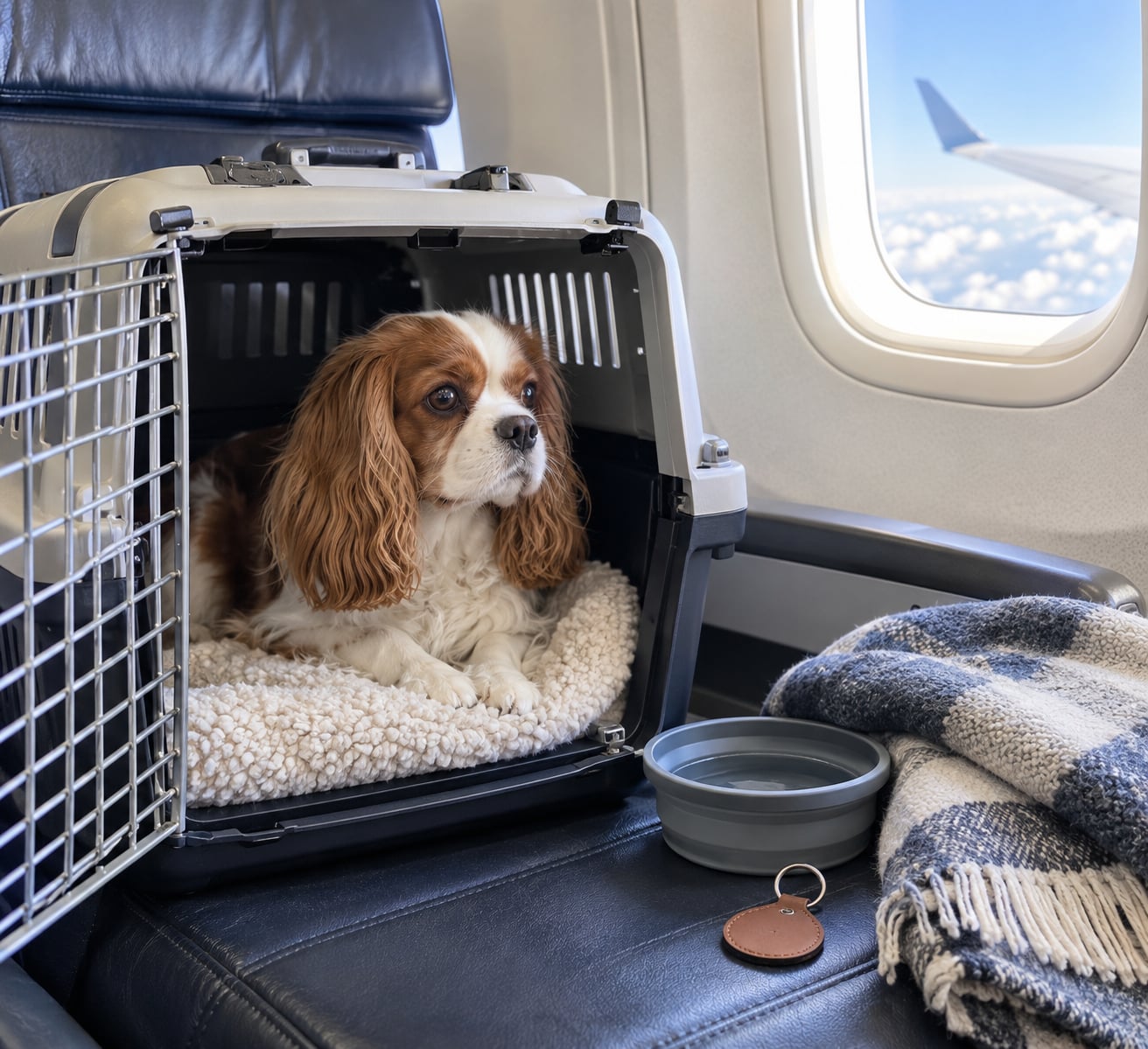
Pets travel in airplane cabins in a carrier that stays under the seat in front of you for the whole flight, booked as a separate pet space on your reservation rather than as your carry-on bag. What pets cannot fit under a seat usually travels as checked baggage, as airline cargo, or by ground transport. Rules are set airline by airline, so confirming the current policy is the first step.
That last part trips people up more than anything else. A carrier marketed as “airline approved” can still fail on a specific aircraft, because clearance depends on the seat in front of you rather than on the carrier’s label. Owners get turned away at the gate more often than at any other stage of the process.
Table of Contents
- 1How Pets Travel in Airplane Cabins: Quick Guide
- 2Which Pets Can Travel in the Cabin?
- 3Age and health matter more than size
- 4Denied boarding is a real risk
- 5What Is the Difference Between a Service Animal and an Emotional-Support Animal?
- 6What Carrier Does Your Pet Need?
- 7Test function, not arithmetic
- 8How to measure the clearance where your pet will sit
- 9Soft-sided or hard-sided?
- 10How to Prepare Your Pet for the Flight
- 11Start with a veterinary visit when one is warranted
- 12Acclimatise the pet to the carrier in small steps
- 13Pack identification and comfort items
- 14What Happens During Boarding and the Flight?
- 15How pets travel in airplane cabins: the bathroom question
- 16International arrivals can override everything
- 17What Can You Bring for Your Pet in the Cabin?
- 18How Much Does It Cost to Take a Pet in the Cabin?
- 19What Should You Do If Your Pet Is Too Stressed or Unwell?
- 20Frequently Asked Questions
- 21Can my 50 pound dog fly in cabin with me?
- 22Can pets ride in airplane cabins?
- 23Can my dog fly in the cabin if I buy them a seat?
- 24How do pets go to the bathroom on a plane?
- 25Does it cost more to fly with a service dog?
- 26Does it matter if your animal is an ESA on a plane?
- 27Conclusion
How Pets Travel in Airplane Cabins: Quick Guide
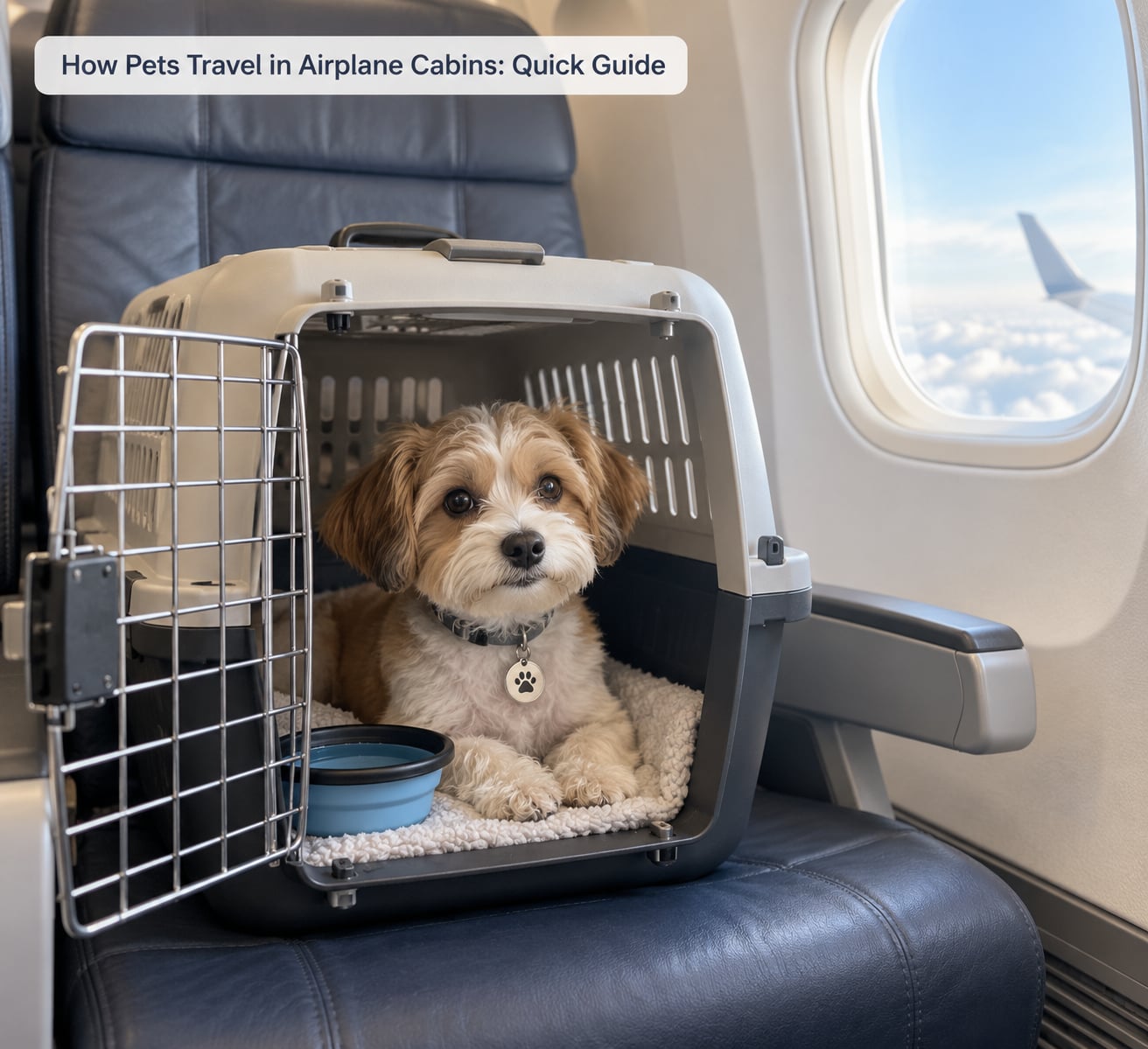
There are four ways a pet crosses the ocean or the country with you, and only one of them puts the animal under your own seat.
- In the passenger cabin. The pet stays in a carrier under the seat in front of you, for takeoff, landing and the flight in between. Space is limited and usually allocated first-come, first-served.
- As checked baggage. Often called excess or accompanied baggage. Your pet travels in a hard-sided kennel in the hold, loaded and unloaded alongside luggage. Temperament and size rules are stricter than the cabin rules.
- Through airline cargo. The airline’s dedicated program for animals that cannot travel in the cabin, handled by a department built for it rather than by baggage handlers.
- As a service animal. A trained dog assisting a passenger with a disability travels under different rules set by the U.S. Department of Transportation, and in most cases flies free without a carrier.
Before any of that, confirm that the pet qualifies, that the carrier fits, and that pet spaces are still open on your specific flight. Here is the whole picture.
| Method | Where the pet is | Carrier needed | Who qualifies | What to check |
|---|---|---|---|---|
| In-cabin pet | Under the seat in front of you, whole flight | Yes, must fit the under-seat space | Small dogs and cats that fit the carrier under the seat | Airline pet policy, pet space availability, carrier dimensions |
| Checked baggage | Pressurised hold, kennel on a baggage cart | Yes, rigid kennel per airline spec | Pets too large for the cabin, within weight and temperament limits | Kennel specification, temperature embargoes, breed restrictions |
| Airline cargo | Cargo hold, dedicated handling | Yes, IATA-spec kennel | Pets that cannot travel in the cabin or as checked baggage | Advance booking, veterinary health certificate, destination import rules |
| Service animal | At the passenger’s feet, no carrier | No | Dogs individually trained to perform tasks for a passenger with a disability | Airline reservation record, U.S. DOT service animal rules |
| Ground transport | Vehicle, no aircraft involved | Travel crate or harness | Pets within driving distance, or moved between countries overland | Rest breaks, climate control, driver hours |
One more thing shapes every answer below: pet capacity is small. Owners on pet forums report repeatedly that in-cabin pet spaces are first-come, first-served and can be full on a flight weeks before departure, even when seats are plentiful.
Which Pets Can Travel in the Cabin?
Cabin travel is built around a physical limit, so eligibility comes down to whether your pet can stand, turn around and lie down naturally inside a carrier that fits under a seat. Small dogs and cats are the usual candidates. Rabbits, small birds and small reptiles are sometimes accepted, but each airline maintains its own animal list, and some only take cats and dogs.
Weight limits are set by the airline, and most are framed as a combined figure covering the pet, the carrier and anything inside it. Because carriers weigh more than people expect, a pet that qualifies on its own scale can fall outside the limit once you add the bag. Measure the total, not the animal.
Age and health matter more than size
Airlines commonly set a minimum age, often around eight to twelve weeks, partly because vaccination and health-certificate rules require it. Older pets with heart or respiratory conditions face more risk from cabin pressure and from the stress of travel, and a veterinarian is the right person to weigh whether your pet should fly at all.
Snub-nosed breeds such as pugs, bulldogs and Boston terriers get restricted by many airlines, in the cabin and in cargo, because blocked airways make breathing difficulties more likely in flight. Brachycephalic restrictions are common enough that you should assume they apply and read the airline’s breed list.
Seasonal embargoes exist too. Several carriers refuse to transport brachycephalic breeds or very young animals during hot months, when ground and cabin temperatures are hardest to control. A quick check of the airline’s travel embargo page saves an expensive surprise.
Denied boarding is a real risk
The most common failure point is the gate agent checking the carrier against the aircraft’s actual under-seat space. If it fails there, the pet moves to cargo or goes home, and that decision is usually made after you have already paid for the flight. Measuring your carrier against the seat clearance is the single best prevention.
What Is the Difference Between a Service Animal and an Emotional-Support Animal?
A service animal is a dog individually trained to perform tasks directly related to a passenger’s disability, such as alerting a person who is deaf or guiding a person who is blind. Under U.S. Department of Transportation rules, it flies without a carrier, sits at the passenger’s feet, and is not charged as a pet. An emotional-support animal gets none of that. Airlines treat it as an ordinary pet, which in practice means a carrier, a pet space and a pet fee.
This is the most misunderstood corner of the whole subject. The protection people remember for emotional-support animals applied to airline travel before current U.S. rules took effect, and other countries handle this differently again.
| Category | Carrier | Fee | Where the animal is | Paperwork |
|---|---|---|---|---|
| Service animal | None required; harness and leash | No pet fee in the U.S. | At the passenger’s feet in the cabin | Airline reservation record, service animal forms, verbal description of trained tasks |
| Emotional-support animal | Yes, treated as a pet carrier | Pet fee applies | Under the seat in front of the passenger | Pet documentation only, if the airline asks for any |
| Pet | Yes, under-seat compliant carrier | Pet fee applies | Under the seat in front of the passenger | Health certificate, vaccination record, import permits where relevant |
Relief-area access also differs. In the United States, an airline with more than one airport location must make a pet relief area available on the property, and service animal users may use it too.
A word of caution on documentation. Airlines ask different questions and the requirements change, so this is general information rather than legal advice. Confirm with the airline’s accessibility team well ahead of travel, and if you are flying in or out of the United States, review the U.S. DOT Service Animal Air Transportation Form before you book.
What Carrier Does Your Pet Need?
The carrier is the part you control completely, and it is where most failures happen. A carrier labelled airline approved tells you nothing about whether it fits on your aircraft. You need three things: enough room to move properly, a secure closure, and ventilation.
Test function, not arithmetic
The IATA method for sizing a kennel measures the animal rather than guessing from breed averages. Measure nose to tail base for the length of the body, elbow to floor for clearance, and shoulder width across the broadest point. Twice that width gives you the internal width you need, and the internal length generally needs the body length plus half the elbow height. Add room for bedding.
Numbers get you close. The real test is function: can the pet stand up, turn around, sit upright and lie down without crouching? A carrier that fails any of those is wrong no matter what the tape measure says.
How to measure the clearance where your pet will sit
Sit in the seat, or measure at home with a tape from the front of your own seat back to the seat in front, matching the aircraft’s configuration. Seat pitch and under-seat structure both vary by aircraft, and equipment changes clearance on individual rows. Owners on pet forums report that an aisle or middle seat often gives more usable room than a window seat, which matches what the seat map is showing you when the legroom looks cramped.
Buy the carrier after the measurement. The most common avoidable mistake is a carrier that compressed well at home and filled the space completely once a towel and a water bowl were added.
Soft-sided or hard-sided?
| Type | Best for | Advantages | Trade-offs |
|---|---|---|---|
| Soft-sided | Soft carriers that compress into irregular under-seat spaces | Lighter, folds flat when checked as baggage, often more comfortable for the pet | Can be chewed through by a determined pet, and a pet that pushes hard can deform the walls |
| Hard-sided | Pets that push, scratch or chew, and checked-baggage travel | Rigid walls resist compression and chewing, easier to clean | Bulkier and heavier, so a smaller pet sometimes fits a soft carrier and not a hard one |
| Expandable | Longer flights where the pet will sleep | Gives a bigger interior for sleeping | The expanded section takes room the under-seat space does not have, so it fails in-cabin fit tests |
A few more carrier details worth checking: escape-proof clips on every zipper rather than zippers alone, mesh ventilation panels on at least two sides, a top opening that lets you reach the pet in without unclipping the whole door, and a shoulder strap that attaches to the seat. Each one exists because something goes wrong without it.
Leave the carrier out and open at home once the pet has settled into it. An unfamiliar carrier on a stressful travel day is a bad combination.
How to Prepare Your Pet for the Flight
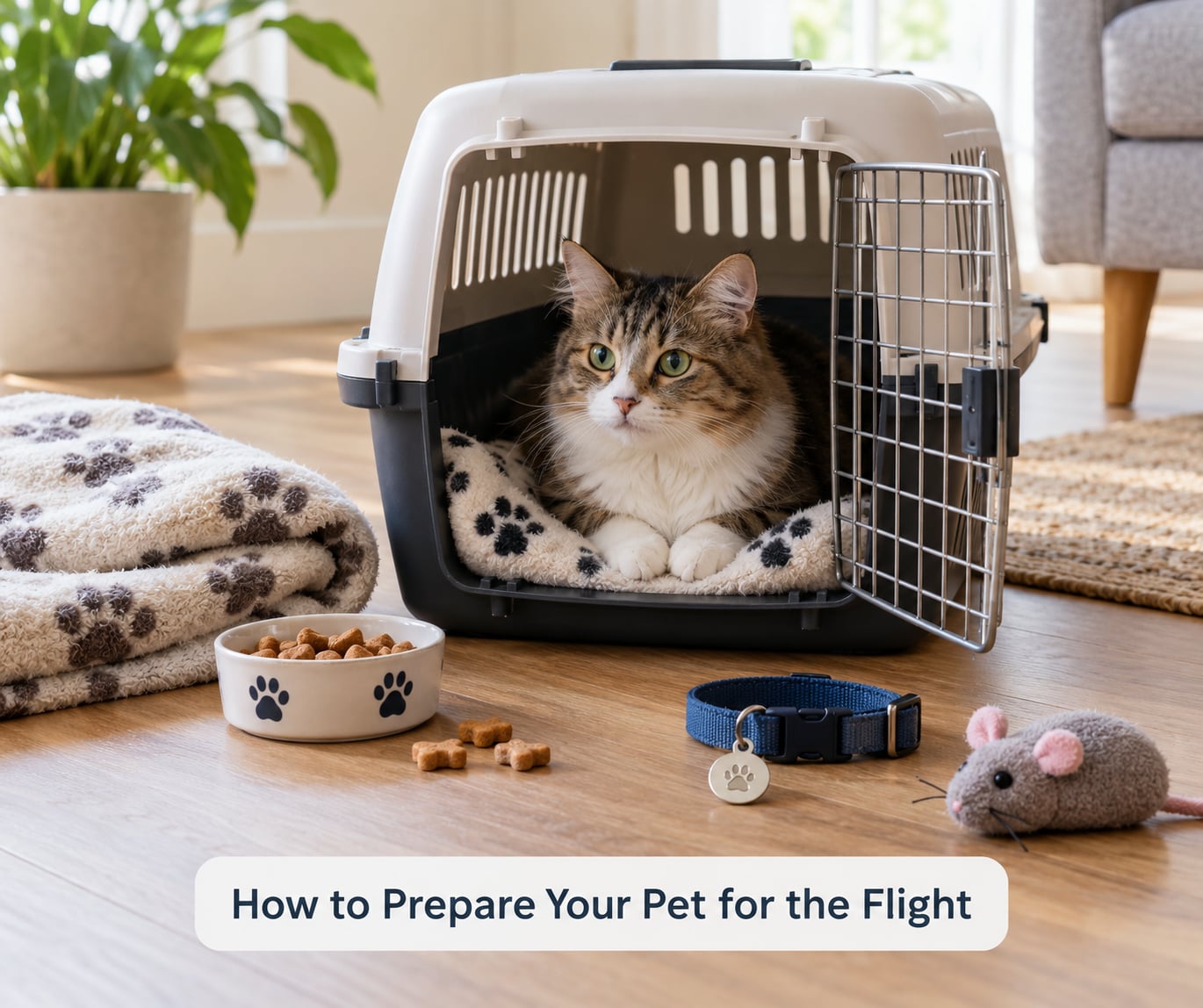
Preparation takes longer than people expect. The goal is a pet who has walked into that carrier by choice before the day of travel.
Start with a veterinary visit when one is warranted
Ask your veterinarian whether your pet is fit to fly, and get a health certificate if the airline or the destination requires one. Vaccination records and, for international trips, import permits and microchip documentation are all cheaper to arrange calmly at home than at an airport counter. Your veterinarian can also tell you whether a familiar anti-anxiety medication prescribed for travel would be appropriate for your animal.
Never give human medication. Antihistamines, ibuprofen, acetaminophen and similar products are not interchangeable with what a veterinarian prescribes, and some are dangerous for pets.
Acclimatise the pet to the carrier in small steps
Leave the carrier open in a quiet room with bedding inside and let the pet inspect it at its own pace. Once the pet settles, start closing the door for short periods while you stay in view, then build up slowly over days rather than hours. Reward calm, never force the issue.
Feed a normal meal several hours before travel rather than right before, and offer water as usual. A light stomach settles better in a small space, and asking a nervous animal to eat in a public terminal is unrealistic.
Pack identification and comfort items
A microchip is worth confirming if your pet has one, alongside a tag carrying your phone number. Keep a recent photo on your phone so you can identify the pet quickly if you are separated. Place familiar bedding in the carrier and consider a lined absorbent pad, which veterinary guidance commonly recommends for absorbing small accidents.
Work out the fallback plan as well: what you do if the pet space is full when you arrive, and who can collect the carrier if the flight is cancelled. Having a second carrier in the hold of the car is not silly. Owners who fly regularly with pets mostly keep one.
Ask the veterinarian about sedation rather than reaching for something on your own. Many vets advise against it, because a sedated animal can lose balance in an unfamiliar space and, more importantly, cannot report stress through the behaviour you would use to judge it.
What Happens During Boarding and the Flight?
Arriving early matters more here than on a normal trip. Give yourself extra time at every stage.
- Check-in with the pet. Present the pet at the ticket counter so the reservation record can be updated with the pet count. This is where airline staff confirm the carrier and ask for documents.
- Security screening. At the checkpoint your pet is usually taken out of the carrier so the carrier can pass through the X-ray machine. Practise this at home, and tell the officer you have an animal before you unclip anything.
- Relief before boarding. Airports have pet relief areas, generally landside before security and airside after it. A leash and harness plus a waste bag are the whole setup.
- Boarding. Board through the pet process the airline describes, which is often with the first or last group to give the pet a calmer aircraft.
- On board. The carrier stays under the seat in front of you for takeoff, landing and the flight. It stays closed. Crew will not open it, and you should not either.
- After landing. Take the pet out at a relief area before connecting or leaving the airport.
How pets travel in airplane cabins: the bathroom question
They do not, mid-flight, and this is the question most readers arrive with. Cabin pets have no access to public restrooms, and the carrier cannot be opened during the flight. Everything happens before and after.
Take the pet out to a relief area shortly before you board, and again immediately after landing before you do anything else. On longer itineraries, an absorbent pad inside the carrier handles the gap. If your connecting airport has a long layover, check whether that airport has a pet relief area and budget time to use it, because a mid-connection walk is far better than a full-duration wait.
What about an accident anyway? Forum reports describe dogs relieving themselves in the aisle on longer flights. Crew handle it, they clean it, and you do not need to apologise to strangers. Tell a flight attendant promptly so a wet floor does not become someone else’s problem, and clean the carrier at the next opportunity. Do not unzip the carrier to check on your pet during the flight; that is a rule violation on a paid in-cabin pet and it creates the neighbour conflict that turns a mistake into a bigger problem.
International arrivals can override everything
Domestic rules are the easy part. Arriving in the United Kingdom, Australia, New Zealand, Ireland and some other countries requires a pet to arrive in the hold and go through a quarantine or inspection facility before anyone collects it. An in-cabin booking can be valid on the outbound flight and still be impossible on the way home. Check the destination country’s agriculture or DEFRA-style import requirements before you commit to an itinerary, and remember the rule applies at the final destination, not the one you transit.
What Can You Bring for Your Pet in the Cabin?
Bring what the pet needs for a flight of the length you are flying, and nothing that cannot fit inside a closed carrier. In practice that means water in a bowl that does not spill, a normal portion of food in a sealed container, a lined absorbent pad, a familiar blanket, and the medication your veterinarian has already approved for travel.
Do not plan to open the carrier in the cabin. Anything loose inside the carrier travels unsupervised, which is how a feed bag becomes a piece of airline carpet. Feed and water arrangements should be set before boarding.
Documentation travels with you, not in the carrier: the health certificate, vaccination record, import permit, microchip paperwork and, for a service animal, the airline’s service animal forms.
The carrier itself is the one item airlines treat differently. Most treat it as your carry-on bag, so check what your fare includes and decide in advance whether losing a roller bag in the hold matters more than bringing your pet. Airlines list their allowance in their baggage rules, and pet limits are sometimes counted separately from ordinary bags, so read the policy page rather than assuming.
How Much Does It Cost to Take a Pet in the Cabin?
The total is your ticket plus a pet fee plus whatever the carrier and preparation work costs you. Here is what drives each part, because the pet fee is the smallest number of the three and the reason people get surprised by totals.
The pet fee itself is set by the airline, and it varies by carrier, route, direction of travel and booking class. International itineraries often differ from domestic ones. We cannot quote you current figures here because they change without notice, and an old number is worse than none: read the fee on the airline’s own pet travel page, then confirm it during booking rather than after.
What you give up in baggage is the part that quietly costs more. A pet carrier frequently counts as your entire carry-on allowance. Travelling light with a small dog can mean checking a roller bag anyway, which adds the standard checked-bag fee to your trip. If you would not have checked a bag otherwise, the pet turns a simple fare into a fuller one.
Preparation costs are the carrier itself, a veterinary visit, a health certificate and, for international travel, import permits, microchips and sometimes mandatory tests. That last group is where owners with tight budgets get caught, because paperwork ordered at the last minute can cost several times what it costs when arranged weeks ahead.
The value of a specific seat also enters it. Travellers who want an aisle or middle seat for under-seat clearance, or who want to avoid a middle seat between strangers, may pay for a preferred seat. Check whether pet travellers are seat-restricted on your booking, because some airlines limit which seats a pet can be placed in.
Prices quoted by airlines are typical US ranges that vary by region and change over time, so treat any figure you read as a starting point and confirm it on the airline’s own fare and baggage page for your exact route.
What Should You Do If Your Pet Is Too Stressed or Unwell?
Most in-cabin problems are stress, and stress is often visible before boarding: panting that will not settle, frantic circling, whining, refusal to eat or drink, or a pet that has not settled within the first 20 minutes. Signs that need immediate attention include difficulty breathing, collapse, repeated vomiting, pale gums, or a pet that cannot settle at all.
If the stress starts in the terminal, talk to airline staff early. They can advise on boarding priority, on whether the pet space can be adjusted, and on what happens if the animal simply cannot settle after takeoff.
If a pet is unwell before travel, do not fly it. Postpone and speak to your veterinarian, who can assess whether travel is appropriate at all and whether any prescribed anti-anxiety medication is suitable for your specific animal. That is a conversation to have days ahead, not the morning of a flight.
If something happens during the flight, tell the cabin crew. Crew carry the supplies and the procedure for an accident, and they handle the cabin while it is dealt with. Trying to fix it yourself inside a closed carrier mid-flight only makes it worse.
Frequently Asked Questions
Can my 50 pound dog fly in cabin with me?
Almost certainly not on a standard fare. Cabin pets must fit in a carrier under the seat in front of you, which suits animals in the small-dog range once the carrier is included in the total weight. A 50 pound dog cannot fit that space on a normal aircraft. Some airlines sell an extra seat for a large dog in the cabin, but the animal must still fit on the seat and stay there for the flight. Otherwise the options are checked baggage or cargo, both of which have their own weight and temperament limits.
Can pets ride in airplane cabins?
Yes, most airlines accept small dogs and cats in the passenger cabin, provided the carrier fits under the seat in front of you for the entire flight. You reserve a pet space on your reservation separately from your own ticket, the carrier stays closed through boarding, takeoff, landing and the flight, and space is usually limited and allocated first-come, first-served. Each airline sets its own combined pet-and-carrier weight limit and its own list of permitted animals, so check the policy before booking.
Can my dog fly in the cabin if I buy them a seat?
Some airlines do let you purchase a seat for a large dog, but the rules are narrow. The dog has to fit on the seat rather than the floor, remain for the whole flight, and not disturb the passenger beside you. Weight and size caps still apply, and the airline decides whether to sell the seat at all. It is not a way around the under-seat rule for any dog that could simply use a carrier. Ask the airline directly whether it offers this on your specific flight before you build a plan around it.
How do pets go to the bathroom on a plane?
They do not during the flight, because cabin pets stay closed in the carrier and have no access to public restrooms. Take your pet to a pet relief area shortly before boarding and again right after landing before you do anything else. On longer flights, an absorbent pad lined in the carrier covers the gap between those two moments. If you have a long layover, check whether that connecting airport has a relief area and leave time to use it. Expect to do the same routine at every connection.
Does it cost more to fly with a service dog?
In the United States it generally does not. A service animal flies free under U.S. Department of Transportation rules, travels without a carrier at the passenger’s feet, and is not counted as a pet or as a bag. The airline may ask for a completed service animal form and a verbal description of the tasks the dog is trained to perform. Rules outside the United States vary considerably, so check the airline and the destination country’s regulations rather than assuming the U.S. treatment follows you.
Does it matter if your animal is an ESA on a plane?
It matters a great deal, because emotional-support animals no longer receive the cabin access they once did. In the United States, airlines treat an ESA as an ordinary pet: it needs a carrier that fits under the seat, it needs a pet space on your reservation, and a pet fee applies. Only service dogs individually trained to perform disability-related tasks travel free and carrier-free. Other countries handle this differently, so confirm with the airline before booking rather than assuming your animal’s documentation carries the same rights.
Conclusion
Start by measuring, then book. Check the airline’s current in-cabin pet policy on their own site, compare your carrier against the under-seat space on that aircraft, and reserve the pet space in the same booking as your ticket rather than hoping to add it later.
If your pet is anxious, young, elderly or has a snub-nosed breed, a conversation with your veterinarian is worth more than any amount of gear, and never give human medication. Do the research once, properly, and the flight itself is mostly just a long nap for a pet who has already decided the carrier is theirs.