They solve different halves of the same problem. CLEAR+ is a private identity-verification service that shortens the front of the security line, while TSA PreCheck is a government-run program that shortens the physical screening step behind it. Most U.S. domestic flyers should buy PreCheck first and treat CLEAR+ as the upgrade worth paying for only when their home airport supports it.
That single distinction explains almost everything about the clear vs TSA PreCheck debate. The two programs are sequential stages of one checkpoint, not rivals. Because of that, the usual frame of “which is better” gives the wrong answer for a lot of travelers, so this guide breaks down what each program actually does at the checkpoint, what it costs in 2026, where each one works, and who gets the better return.
How they work together:
- CLEAR+ handles identity verification before TSA screening begins: a Clear Ambassador verifies your document with a biometric scan and escorts you to the front of a security line.
- TSA PreCheck handles physical screening after ID is confirmed: you enter the dedicated PreCheck lane and keep shoes, belt, laptop and liquids packed in your bag.
- Both together clear the whole sequence. Use CLEAR+ without PreCheck and you skip the ID line but still join the standard baggage line, which is where most of the time is spent.
Table of Contents
- 1Clear vs TSA PreCheck at a Glance
- 2How Clear and TSA PreCheck Work at the Checkpoint
- 3How to use both programs together, step by step
- 4How Much Do Clear and TSA PreCheck Cost?
- 5Ways to pay less for either program
- 6Which is better for TSA PreCheck enrollment: IDEMIA, Telos or CLEAR?
- 7Which Option Has Better Airport Coverage?
- 8Clear vs TSA PreCheck: Speed, Convenience, and Privacy
- 9Does CLEAR get you through TSA faster?
- 10Do You Need CLEAR If You Already Have TSA PreCheck?
- 11What about biometric data and privacy?
- 12Which Should You Choose?
- 13Frequently Asked Questions
- 14Do I really need CLEAR if I have TSA PreCheck?
- 15Does CLEAR get you through TSA faster?
- 16What are the downsides of using CLEAR?
- 17Does CLEAR include TSA PreCheck?
- 18Which is better for TSA PreCheck: IDEMIA, Telos, or CLEAR?
- 19How long is TSA PreCheck valid, and does it help on international trips?
- 20Conclusion
Clear vs TSA PreCheck at a Glance
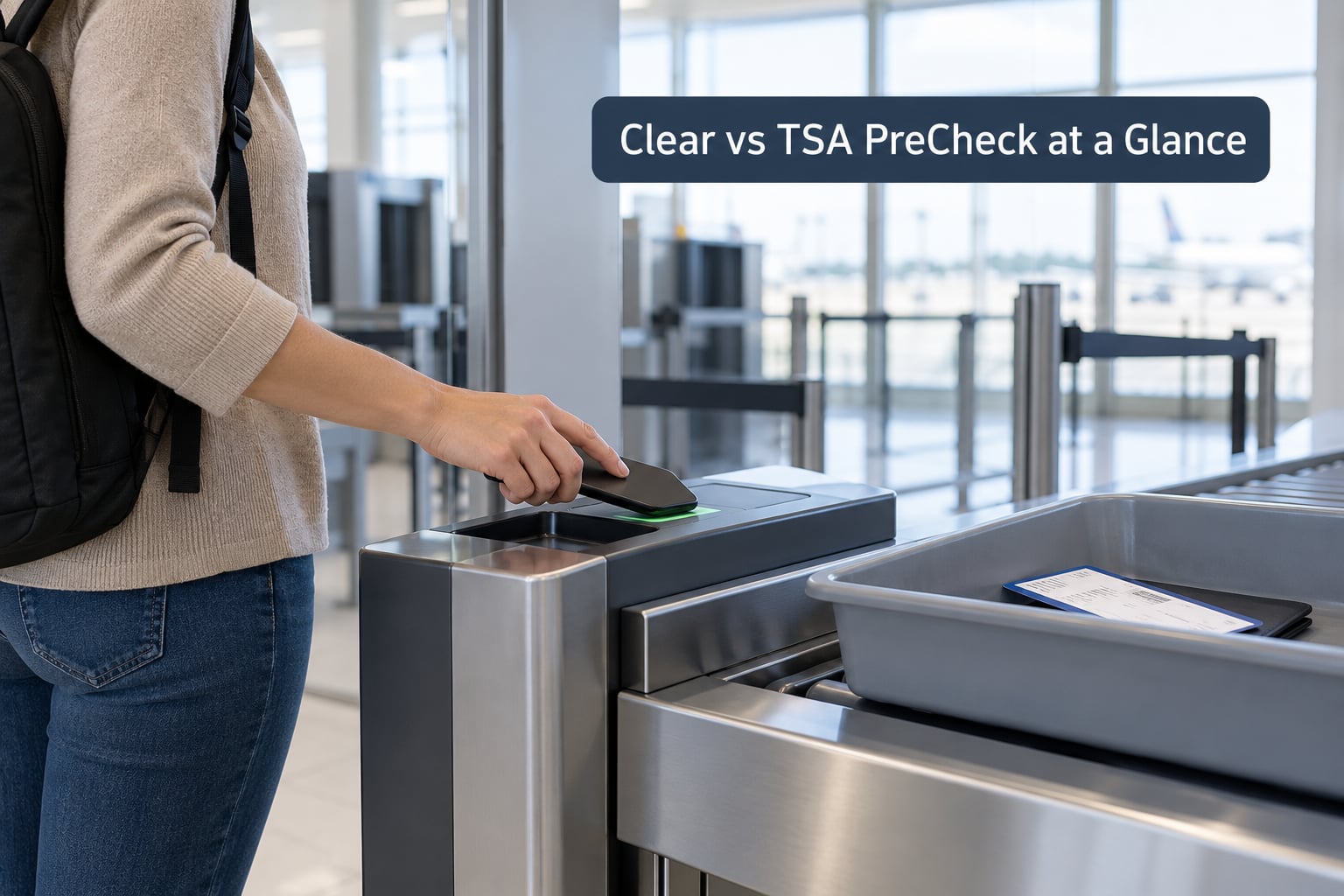
| Criterion | CLEAR+ | TSA PreCheck |
|---|---|---|
| Who runs it | Private company | U.S. Transportation Security Administration |
| Step it speeds up | Identity verification before screening | Physical screening after ID is checked |
| Typical cost | 219 USD per year, renewed annually | 85 USD for five years |
| Membership term | One year, auto-renews by default | Five years, renew before expiry |
| Airport coverage | Roughly 50 U.S. airports | More than 200 U.S. airports |
| Biometrics required | Fingerprints and iris scan at enrollment | Background check and fingerprinting once |
| Age rules | Kids under 18 ride free with an enrolled adult | Children 12 to 17 may enroll with a parent or guardian present |
| Application | Online or at an airport kiosk, about five minutes | Online form plus one in-person visit |
| Wait-time promise | None, lanes vary by hour | TSA reports roughly 99 percent of members wait under ten minutes |
| Known risk | Paid in full, benefit only at participating airports | Occasional random exclusion from the PreCheck lane |
| Best fit | Frequent flyers at a covered hub, especially with family | Anyone who flies domestically a few times a year or more |
The table is the fastest way to see the trade-off. PreCheck is cheap, long-lasting and available almost everywhere. CLEAR+ is expensive, annual and only useful at the airports where its pods sit, but it removes the ID check that PreCheck never touches.
How Clear and TSA PreCheck Work at the Checkpoint
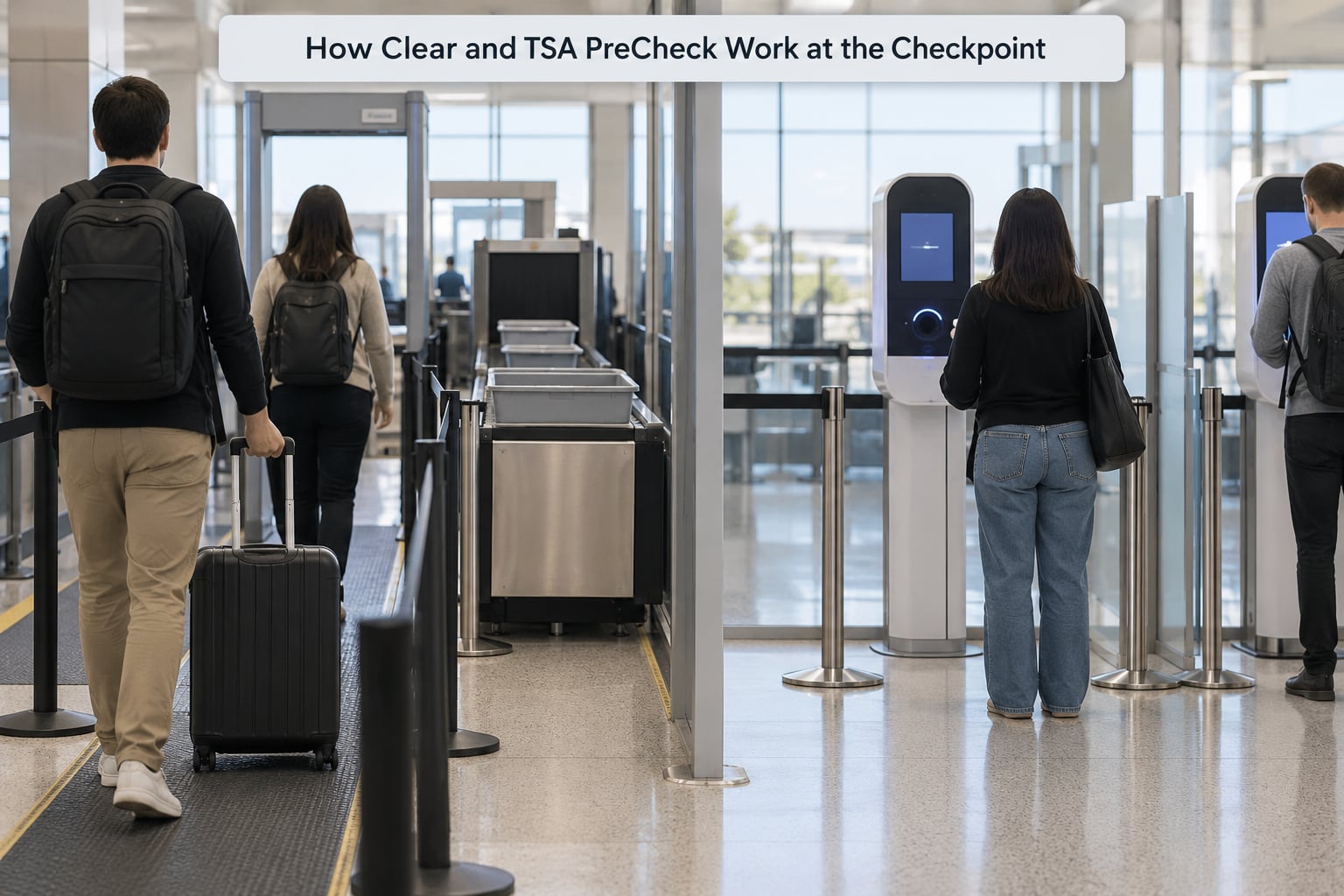
At a standard checkpoint, two things happen to you. A TSA officer confirms that the boarding pass matches your ID, then a second step screens your body and your bags. TSA PreCheck only changes the second step. CLEAR+ only changes the first.
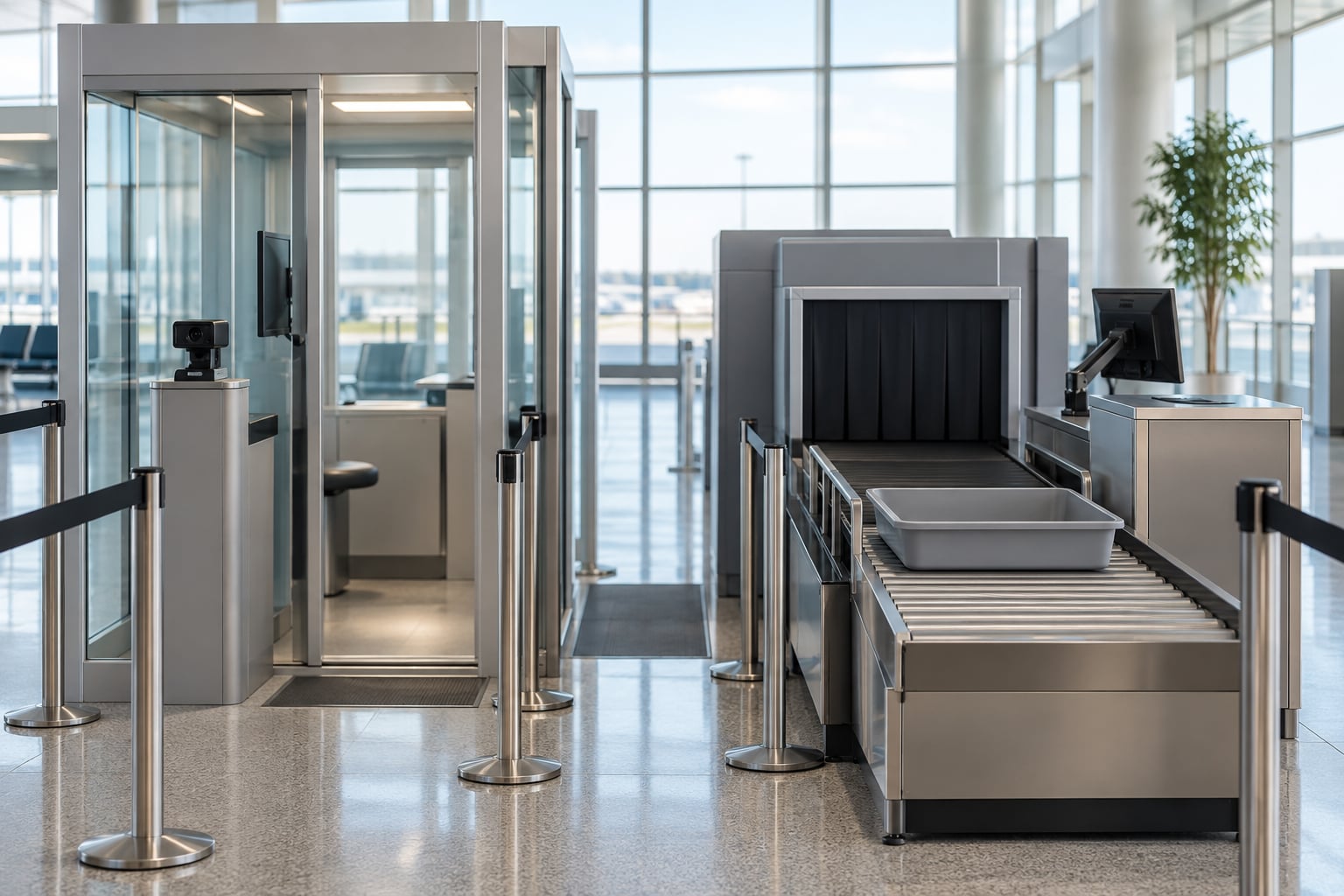
With TSA PreCheck, the TSA officer at the document podium checks your boarding pass, sees the PreCheck indicator, and points you into the dedicated lane. Inside that lane you step through a walk-through metal detector instead of stepping into a full-body scanner, and you keep your shoes, belt, laptop and liquids container in your bag. Your ID never leaves the pouch, which is a small time saver on its own.
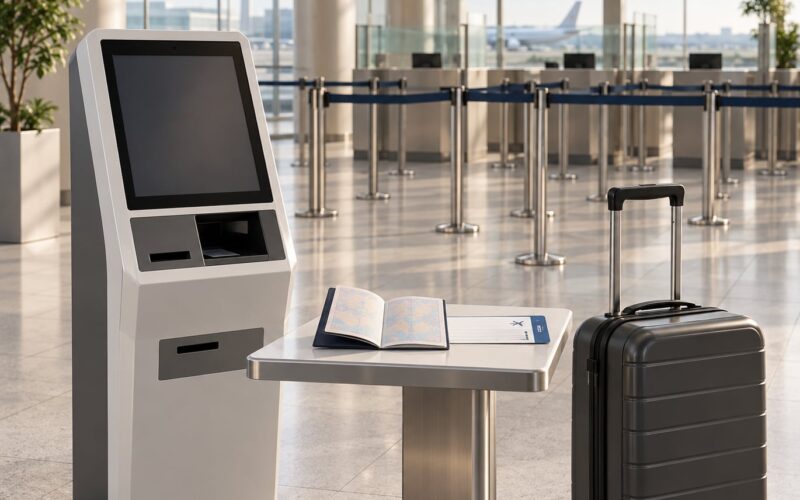
CLEAR+ sits outside the checkpoint, at or just before the document podium. A Clear Ambassador confirms your identity at a kiosk using the biometric data captured when you enrolled, then walks you to the front of a security line. That is genuinely a different queue, not the same queue with a different sign.
How to use both programs together, step by step
- Arrive at the CLEAR+ checkpoint early enough to clear identity verification before the general queue builds.
- Scan your boarding pass at the CLEAR kiosk and follow the Ambassador’s identity check.
- Have your biometrics verified, which takes a few seconds once you are recognized.
- Walk with the Ambassador to the front of the PreCheck lane.
- Clear physical screening with shoes and belt on, then head to the gate.
Whether that sequence is worth it depends entirely on how busy the CLEAR queue is at your hour of travel. One r/delta user described the starkest version of this contrast at their home airport, reporting that the PreCheck lane took about 30 minutes while CLEAR took about 5 for a family member traveling alongside someone without it. Other travelers in that same thread push back hard, saying they have never beaten the PreCheck lane using CLEAR and feel the CLEAR queue grows in proportion to membership. Both reports are real experiences, not measurements, so treat them as a range rather than a promise.
How Much Do Clear and TSA PreCheck Cost?
Here is the number that stings: CLEAR+ moved to 219 USD per year on July 1, 2026, up from 189 USD. Most of the pages still ranking for this query still quote the old figure, so verify the current price on the vendor’s site before you budget for it.
TSA PreCheck remains a five-year membership listed at 85 USD, which works out to about 17 USD per year. Enrolling through CLEAR instead of the standard provider brings the fee down to roughly 77.95 USD, and renewing online once you have a Known Traveler Number runs closer to 68.95 USD. There is also a bundle that pairs PreCheck and CLEAR+ for 219 USD in the first year, which is the cheapest route to owning both if you were going to do it anyway.
| Cost per trip | TSA PreCheck only | CLEAR+ only | Both |
|---|---|---|---|
| 4 flights a year | About 4 USD a year budgeted, about 1 USD a trip | About 55 USD a trip | About 63 USD a trip in year one |
| 8 flights a year | About 2 USD a trip | About 27 USD a trip | About 32 USD a trip in year one |
| 12 flights a year | About 1.40 USD a trip | About 18 USD a trip | About 23 USD a trip in year one |
| 20 flights a year | About 0.85 USD a trip | About 11 USD a trip | About 13 USD a trip in year one |
That table is the whole argument in miniature. PreCheck is a rounding error per trip. CLEAR+ stays expensive per trip until you are flying very often, and it only ever reaches break-even at airports where it actually operates.
Ways to pay less for either program
- Check whether a credit card in your wallet offers a statement credit for PreCheck or CLEAR+ purchases, then pay with that card.
- Delta SkyMiles and United MileagePlus elite tiers receive discounted or complimentary CLEAR+ memberships at higher status levels, so check your renewal screen before buying.
- Enroll through CLEAR rather than a third-party provider if the lower PreCheck fee matters to you.
- Look for the PreCheck and CLEAR bundle before buying them separately in the same year.
- Children under 18 ride free on a CLEAR+ membership, so families pay only for adults.
Which is better for TSA PreCheck enrollment: IDEMIA, Telos or CLEAR?
All three can enroll you in TSA PreCheck, and the differences come down to fee and convenience rather than the membership you end up with. IDEMIA and Telos run the standard provider network with enrollment centers in many cities, usually at no extra cost beyond the standard fee. CLEAR sells PreCheck as well, at the reduced fee and often with a nearby location, which is convenient if you are already signing up for CLEAR+.
| Provider | PreCheck fee | Best for |
|---|---|---|
| Standard providers such as IDEMIA and Telos | Listed standard fee | Travelers near an enrollment center, comfortable scheduling a visit |
| CLEAR | Reduced fee, roughly 77.95 USD | Travelers enrolling in both programs, or wanting one provider for both |
| Online renewal with your KTN | Lowest renewal fee | Existing members who do not need a new background check |
Whichever you pick, the membership you receive is identical, including the five-year term and the Known Traveler Number that attaches your status to reservations.
Which Option Has Better Airport Coverage?
TSA PreCheck wins on coverage without much argument. It runs at more than 200 U.S. airports, so your membership works almost anywhere you fly domestically. CLEAR+ operates at roughly 50 airports, concentrated heavily in hubs where premium travelers and long layovers overlap.
Airport coverage is also where travelers tend to misjudge the value. Someone on the r/personalfinance forum made the point that CLEAR is genuinely worthwhile if you fly out of a covered airport such as SFO often, and a poor investment if you mostly depart from somewhere without a pod. The coverage gap is why PreCheck is the safer default: you pay once and use it everywhere.
If you fly through JFK, LGA, DCA, SFO, PHX, ORD, ATL or LAX, you are more likely to encounter CLEAR at some point in the year. Confirm the participating airport list for your exact departure terminals before enrolling, since coverage expands and contracts and lanes can close early on quiet nights.
Clear vs TSA PreCheck: Speed, Convenience, and Privacy
Convenience is where the two split most clearly. PreCheck requires a short online application, a background check and one in-person appointment. CLEAR+ can be bought online or signed up for at an airport kiosk in about five minutes, which is a real advantage if you forgot to plan ahead.
Does CLEAR get you through TSA faster?
Sometimes, and the gap is largest at busy hubs during the morning bank. Forum reports range from roughly five minutes on a good day to no improvement at all when the CLEAR queue is saturated, which happens more often than CLEAR’s marketing suggests. PreCheck, by contrast, has a steadier claim: TSA reports that roughly 99 percent of PreCheck passengers wait under ten minutes.
Do You Need CLEAR If You Already Have TSA PreCheck?
Only if you fly often, leave from a covered airport and value convenience more than cost. PreCheck already handles the slower half of the process, so adding CLEAR mainly buys you a shorter ID step and an escorted walk to the front of the line. For a traveler taking four to six flights a year, that upgrade rarely earns back 219 USD.
There is one failure mode worth naming. If you buy CLEAR+ and skip PreCheck, you skip the ID podium and then walk into the standard baggage line with everyone else, which is exactly the queue you were trying to avoid. Many people who feel disappointed by CLEAR bought it without PreCheck.
One more risk belongs to PreCheck, and it is the one people forget. TSA occasionally pulls PreCheck members into the standard lane at random, so a membership does not guarantee the expedited lane on every trip. CLEAR membership has no equivalent random exclusion, though its queues are self-limiting.
What about biometric data and privacy?
CLEAR+ enrolls you with a fingerprint scan, an iris scan and a facial image held by a private company rather than a government agency. TSA PreCheck also collects fingerprints and runs a background check, but through a government process with published retention rules. Travelers uneasy about handing biometrics to a private vendor tend to land on PreCheck for that reason alone, and that is a reasonable position rather than a wrong one.
Which Should You Choose?
- Occasional flyer, four to six trips a year: TSA PreCheck only. At about 17 USD a year, nothing else comes close on value.
- Frequent domestic flyer at a covered hub: Both, and use the bundle in your first year to cut the combined cost.
- Family that flies several times a year: PreCheck for everyone, CLEAR+ for the adults, since children ride free on CLEAR membership.
- International traveler: Global Entry instead. It bundles PreCheck status and covers customs re-entry, which CLEAR does not touch.
- Delta SkyMiles or United MileagePlus elite: Check your tier’s CLEAR+ renewal offer before paying retail for it.
- Privacy-minded traveler: PreCheck, or Global Entry, and skip the private-company biometric capture.
My take after weighing all of this is that the order matters more than the choice. Buy PreCheck first, live with it for a year, and only add CLEAR+ once you know you fly enough at a covered airport to feel the difference in the line.
Frequently Asked Questions
Do I really need CLEAR if I have TSA PreCheck?
Not usually. PreCheck already removes the slowest part of screening, so CLEAR+ only shortens the ID step and walks you to the front of that lane. It tends to make sense for frequent flyers departing from one of the roughly 50 covered airports, especially families where a shorter line is worth a lot at peak hours. For four to six trips a year, the 219 USD annual fee rarely pays for itself.
Does CLEAR get you through TSA faster?
Sometimes, and the gain depends on the hour and the airport. Forum travelers report anywhere from about five minutes saved on a good day to no improvement when the CLEAR queue is crowded, since enrollment growth pushes that line longer too. TSA reports that roughly 99 percent of PreCheck passengers wait under ten minutes, which makes PreCheck the steadier bet. CLEAR is the burstier option, not the reliable one.
What are the downsides of using CLEAR?
The main downsides are cost, narrow coverage and crowded queues. Membership runs 219 USD per year, renews automatically, and does nothing at the roughly 150 U.S. airports with no CLEAR lanes. Reports also describe CLEAR lines filling up in proportion to membership, so the benefit shrinks at busy times. Using CLEAR without PreCheck is the biggest trap, because you skip the ID podium and still queue for bags.
Does CLEAR include TSA PreCheck?
No. CLEAR+ only handles identity verification before screening, and a CLEAR membership does not place you in the PreCheck lane. The two can be bought together in a bundle for 219 USD in the first year, or separately. If you only buy one, buy PreCheck: it is cheaper, lasts five years and works at more than 200 airports compared with roughly 50 for CLEAR.
Which is better for TSA PreCheck: IDEMIA, Telos, or CLEAR?
All three enroll you in the same TSA PreCheck membership, so the differences are fee and convenience. IDEMIA and Telos run the standard provider network at the listed fee with enrollment centers in many cities. CLEAR enrolls at a reduced fee of roughly 77.95 USD and is convenient if you are buying CLEAR+ anyway. Renewing online with your Known Traveler Number is the cheapest route for existing members.
How long is TSA PreCheck valid, and does it help on international trips?
TSA PreCheck runs five years from your enrollment date, and you renew before it expires. It speeds the departure checkpoint at more than 200 U.S. airports, which includes the security screening you clear before an international flight. It does not cover customs or immigration re-entry on arrival. If your trips often leave the U.S., Global Entry bundles PreCheck status and adds expedited customs, which is usually the better single purchase.
Conclusion
In the clear vs TSA PreCheck decision, PreCheck is the foundation and CLEAR+ is the add-on. PreCheck covers five years, most of the country and the part of screening that actually takes time; CLEAR+ covers a shorter list of airports for a year at a time.
Before you spend anything, check the current CLEAR+ fee, confirm that your usual departure airport has a CLEAR lane, and see whether your credit card or airline status already discounts either program. Then start with PreCheck and decide on CLEAR+ after a year of real data from your own trips.