Learning how to use public transit in a foreign city comes down to one repeatable sequence: plan the route, pick the fare that matches your trip, pay in whatever way that network accepts, then board and validate before the doors close. Every metro, tram and bus network on earth is built from the same five parts, so once you know what to look for, a system you have never seen stops being intimidating. Most of the confusion people report online is not about the network — it is about guessing at the payment step and hoping for the best.
This guide takes roughly ten minutes to read and gives you the method, not a city-by-city list that goes stale. Fares, passes and rules change often, so confirm the specifics on the official operator site before you fly.
Last updated: October 2026
Table of Contents
- 1What You Need
- 2Step-by-Step: How to Use Public Transit in a Foreign City
- 3Plan the Route Before You Leave
- 4Choose the Right Fare and Payment Method
- 5Read Signs, Announcements, and Station Maps
- 6Board and Validate the Trip
- 7Make Transfers Without Missing the Right Service
- 8Get Off at the Correct Stop and Finish the Trip
- 9What is the fastest way to learn how to use public transit in a foreign city?
- 10Common Mistakes
- 11Frequently Asked Questions
- 12Do I need a travel pass for a short trip, or are single tickets cheaper?
- 13Can I pay for transit with my phone or a contactless bank card?
- 14What happens if I forget to tap out when I get off?
- 15Can I bring a suitcase or stroller on buses and trains?
- 16How late does transit run, and what do I do after the last service?
- 17How do I get around when I do not speak the language?
- 18Conclusion
What You Need
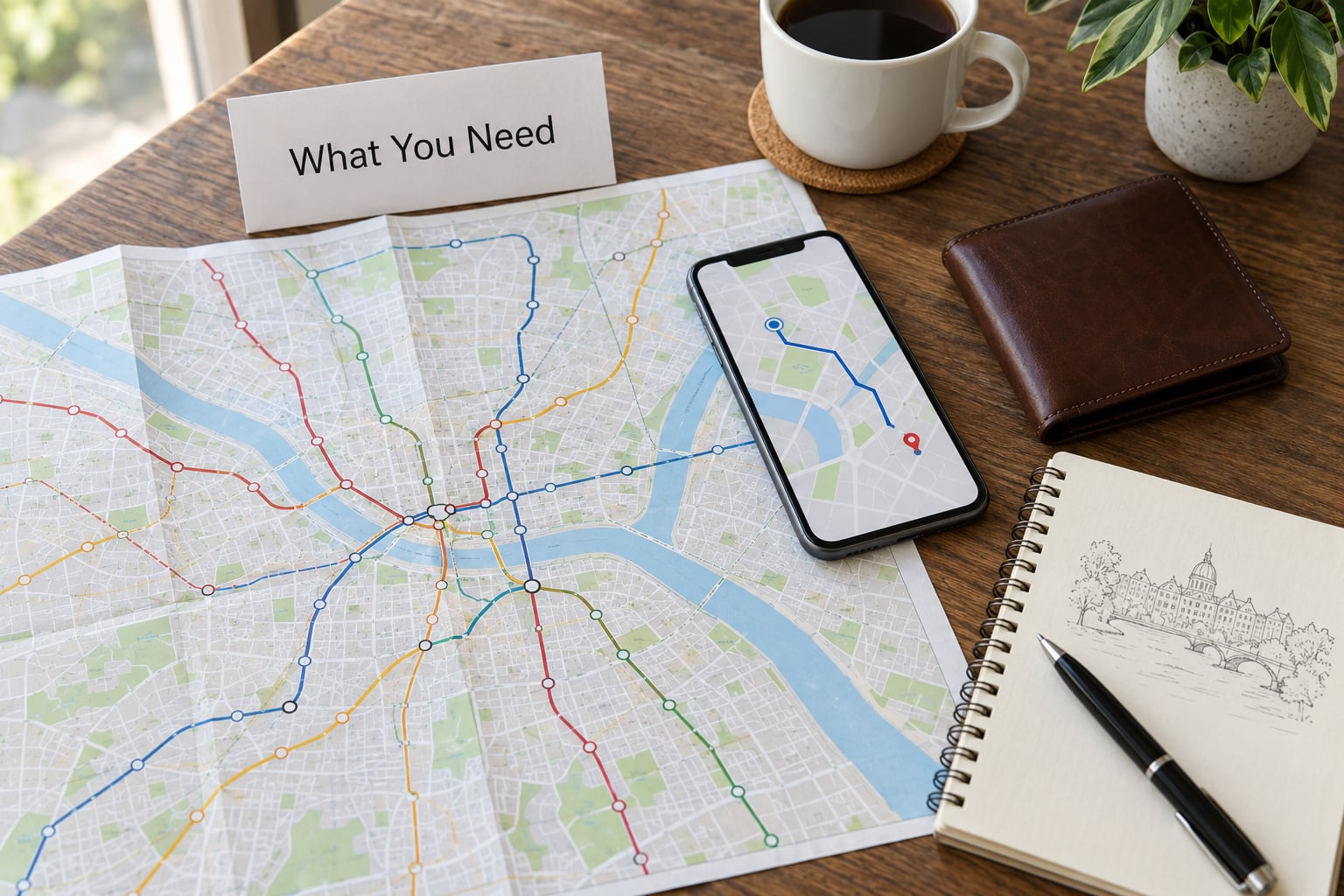
Six things, and you can set up five of them from your sofa before you leave.
- An official transit map or route planner — the operator’s own app, or the transit layer inside a general mapping app. Download the region for offline use while you have Wi-Fi.
- A payment method the network accepts — usually a contactless bank card, a phone wallet, or a small amount of local cash. Check the operator’s site for anything unusual, such as cities that do not accept foreign-issued cards.
- Your destination written in the local script — the Latin spelling on your hotel booking may not match anything on the platform board. Take a photo of the address in the local alphabet.
- Your accommodation address in the local script too, saved as a pin in your maps app. When you come out of the station underground, it is the one thing you need.
- A power bank and a short charging cable — phones die in stations more often than people expect, and a dead phone means no route, no fare and no help.
- One small note of your accommodation address on paper. Phone dies, note survives.
Two things worth deciding before departure: whether the city you are flying into runs more than one operator (many large cities do, and their cards are often not interchangeable), and what time the last service leaves from the airport.
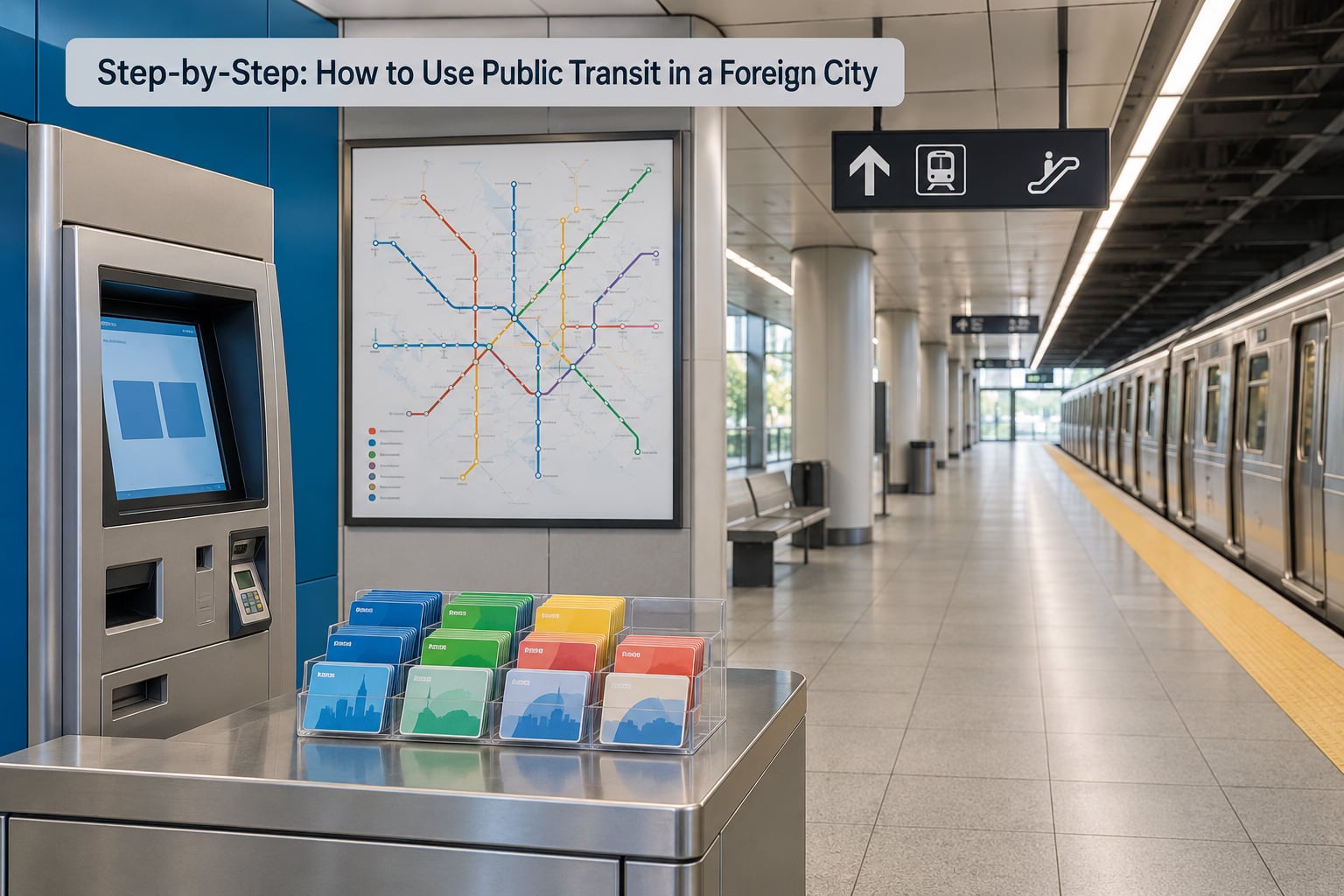
Step-by-Step: How to Use Public Transit in a Foreign City
Plan the Route Before You Leave
Compare the options the planner gives you on four things: total travel time, number of transfers, first and last service times, and how far you walk at the end. A route with one extra change often beats the fastest one when it avoids a long walk through an unfamiliar part of the city.
Note the difference between the metro, the tram, the city bus, and regional or commuter rail. Regional services are typically slower through the centre but useful for airport links and outlying sights. Save the route to your phone offline before you leave the hotel, because reception underground is often non-existent.
The clearest way to read a foreign transit map is to look at the final station rather than the compass direction. Trains are almost always labelled by where they end up, and the platform board repeats that name. Search the planner for the destination name first, then match the terminating station on the map to the sign on the platform.
Choose the Right Fare and Payment Method
Fares come in a small number of shapes everywhere. The names change, the mechanics do not.
| Ticket type | How it works | Best for | Watch out for |
|---|---|---|---|
| Single or point-to-point | One ride, often limited to a time window for unlimited changes within it | One or two trips in an unfamiliar system | The time window varies by city; check whether it starts at purchase or at first validation |
| Stored-value card | Top up an anonymous card and tap it in and out | Three rides or more, especially with transfers | Refundable deposits vary, and one card may not cover buses or another operator |
| Day or multi-day pass | Unlimited rides until it expires, often calendar-day based | Two or more days of heavy riding | Passes frequently exclude airport links, certain express services or a premium tier of line |
| Tourist card | A pass bundled with attractions or discounts | Trips where you plan to visit paid sights anyway | The transit portion alone is often dearer than a standard multi-day pass |
| Contactless bank card or phone | Tap a bank card or a wallet on the reader, no ticket needed | Short stays, cities with open-gate systems | Foreign transaction fees apply, and some systems only accept domestic cards |
A useful rule: if you expect three or more rides in a day, a day pass almost always beats singles. If you expect one, a single ticket keeps things simple. Check whether payment happens before boarding or on board — that single fact changes the whole sequence, and it differs between systems.
One caution on bank cards. The fare may be small but your bank’s foreign transaction fee can be a percentage of every tap, so a card-tapped city can cost noticeably more in fees than in fares. A local stored-value card avoids this. That trade-off is worth checking against your bank’s fee before you leave, not at the gate.
Read Signs, Announcements, and Station Maps
Almost every station has three things you will use: a route map at the concourse, a platform board at the platform, and an exit map at the arrival level. Photograph each one. They are legible in a way the language is not, and they are how you orient yourself when you surface.
Learn five words in the local script, or better, learn to read the symbols: exit, transfer or interchange, platform, tickets, and direction. These unlock the rest of the signage, because transit systems are famously consistent internally even when the street signs are not.
Most stations also announce the next stop and the terminus in a flat, repeating tone. Listen for your destination name. You do not need to understand the sentence around it — just catch the station name you saved earlier.
Board and Validate the Trip
Validation is where first-time visitors get caught, and the rule is not universal. Know which of these three your network uses before you reach the gate.
- Tap in and tap out — you touch a reader at the start and again at the end, and the fare is calculated from where you tapped out. Forgetting the second tap can mean a penalty fare, sometimes higher than a single ticket.
- Stamp on boarding — a paper ticket gets punched by a machine on the platform or on the vehicle. An unstamped ticket is an invalid ticket, and fines here are set far above the fare.
- Swipe only, no ticket — some newer systems are gate-free and read your card as you walk through. The catch is knowing which reader is a fare gate and which is an exit door.
Where you board matters. Metro platforms are level, wide and signposted, and gates do the work for you. Buses and trams are where people get it wrong: you may pay the driver in cash only, at a kiosk before you board, or with the same card you used on the train.
A few practical notes for boarding. Let people get off before you step in — it is the single most visible courtesy on any system. Walk towards the far end of the carriage and fill in from there, because the middle fills first. If boarding with a suitcase, use the wide gate and the accessible carriage rather than the narrow one at the far end.
Make Transfers Without Missing the Right Service
Follow the transfer signs inside the station rather than the signs on the platform, since platform numbers often change between levels. Give yourself five to ten minutes for a transfer, more if the station is large or you have luggage.
Watch what a service is called. A local service stops everywhere; an express or rapid service may skip your station entirely, and on some systems it costs a supplement or needs a different ticket. When in doubt, board the slow one and get off one or two stops later than you planned.
If you miss a connection, you have not ruined anything. Wait for the next service in the same direction, or walk between two nearby stations if the map shows them close — a fifteen-minute walk often beats twenty minutes of waiting.
Get Off at the Correct Stop and Finish the Trip
Check the stop display or listen for your station a few stops before you need to get out, then check again at the previous stop. On buses and trams, some systems require you to press a stop request button or signal clearly to the driver; where this is the case, the bus will otherwise drive past a raised hand. Stand up early and move towards the doors before the stop.
At the station, find the exit map before you walk. Exit numbers are usually written as a street name, a landmark, or a district rather than a compass point, so match what you see to the saved pin on your phone. Then follow street signs for the final five minutes, because the last hundred metres is where wrong turns happen.
What is the fastest way to learn how to use public transit in a foreign city?
Use the first thirty minutes deliberately. Arrive during the day, buy one ticket, take one short ride to a landmark you know, and pay attention to the machine, the gate, and the stop name. Seeing the system once in calm daylight removes most of the anxiety that shows up at midnight on the way back.
Common Mistakes
- Paying in the wrong currency or without local small notes. Ticket machines that do not give change are common on buses and common at night. Fix: carry a small stack of local notes and coins, and ask for change in an unfamiliar place before you need it.
- Boarding without validating. A forgotten stamp means an invalid ticket on stamped systems, and fines are set well above the fare. Fix: find out which of the three systems you are on, and make validation your first action on the platform.
- Heading the wrong way because you read a compass direction. Trains are labelled by their final station. Fix: identify the terminus name on the map, then find that name on the platform board.
- Assuming one pass covers everything. Airport links, express services and second operators are often excluded, and a card from one network may not work on another operator’s bus or tram. Fix: read what the pass covers before you buy, not at the gate.
- Missing the last service. Most networks thin out sharply after midnight. Fix: check the first and last times for your line in the planner while you still have data, and screenshot the return journey before you go out.
- Forgetting to tap out. On tap-in/tap-out systems the fare is only calculated when you do, and the system treats a missing tap as an incomplete journey. Fix: make the second tap a habit before you reach the exit gates.
- Not signalling on a bus or tram. In several countries the vehicle will not stop unless it clearly sees you. Fix: stand at the kerb with your hand raised, out early, and check the stop pole number.
Frequently Asked Questions
Do I need a travel pass for a short trip, or are single tickets cheaper?
Single tickets are cheaper only if you expect one or two rides. Most systems price a day pass below the cost of four or five singles, so switch to a pass on your third ride. Check whether the pass is valid for the calendar day it was issued or for 24 hours from first use, because the rule changes between cities. Airport links and express services are commonly excluded.
Can I pay for transit with my phone or a contactless bank card?
In many cities, yes. Tap a contactless card or a phone wallet on the reader at the gate, and the system charges your bank account. Two caveats: some networks only accept domestic cards, and your bank may add a foreign transaction fee to every tap, which can exceed the fare itself. Where that applies, buy a local stored-value card instead.
What happens if I forget to tap out when I get off?
On tap-in and tap-out systems, the fare is calculated from where you tapped out, so a missing second tap leaves the journey incomplete. The system may treat it as if you travelled to the furthest point on the line and charge the maximum fare, or it may add a fixed penalty on top. The same thing happens on buses and trams that use the same card. Make the exit tap a habit.
Can I bring a suitcase or stroller on buses and trains?
Almost always, but the rules differ on the smaller modes. Metro trains and commuter rail generally have luggage spaces and wide accessible doors at the ends of the platform. Trams and city buses have narrow doors, steps, and often a rule against standing in the aisle or blocking the wheelchair space. Avoid rush hour, and expect to use the accessible carriage rather than the nearest door.
How late does transit run, and what do I do after the last service?
Most urban systems run frequent trains until around midnight, then switch to night buses every 15 to 30 minutes and stop entirely for a few hours. Intercity services are much earlier. Check the first and last departure times for your specific line before leaving for the evening, and screenshot them, because the numbers in an app need a connection to load. After the last service, plan for a night bus, a booked taxi, or a walk you have checked the route for.
How do I get around when I do not speak the language?
You rarely need to speak. Show the destination name written in the local script to the driver or at the counter, and it does the work for you. Save the names of your hotel and your destination as a screenshot, learn the words for exit, transfer, platform and tickets, and keep your offline map downloaded. A translation app handles the rest, and station staff in tourist cities are used to being shown a map and a question mark.
Conclusion
Four things to do first, in order: write down your destination in the local script, check the official operator’s route planner for the journey and its first and last service times, decide your payment method and confirm the network accepts it, then build in extra time for one extra transfer or a longer walk at the end. Get one deliberate daytime ride before you need the system at night, and the rest of the trip takes care of itself.