If you only remember one thing about driving on the left, make it this: keep the side of the car you are sitting on nearest the centre line. That single rule explains almost everything else you will find confusing, from roundabouts turning clockwise to motorway lanes running the opposite way round. This guide was last checked against current guidance for 2026 and covers the parts of driving on the left that catch visitors out, from the rental counter to the parking space.
Table of Contents
- 1Which Side of the Road Do You Drive On?
- 2Where in the world traffic drives on the left
- 3What to Know About Driving on the Left Before You Set Off
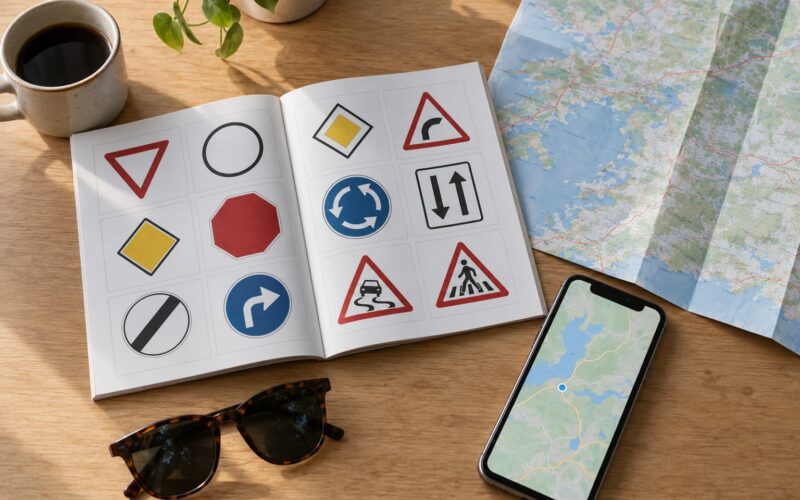
- 4Road Signs and Lane Positions When Driving on the Left
- 5Choosing and Understanding a Rental Car
- 6Your first 30 minutes, in order
- 7How to Make Turns, Enter Roads, and Use Roundabouts
- 8How Overtaking Works on the Left
- 9Parking, Fueling, and Everyday Road Tasks
- 10Safety Habits and Common Mistakes to Avoid
- 11How long does it actually take?
- 12Frequently Asked Questions
- 13Is driving on the left harder for visitors?
- 14Which countries drive on the left?
- 15How do you turn left or right when driving on the left?
- 16Which side do you overtake on when driving on the left?
- 17Can a visitor get a ticket for entering the wrong side of the road?
- 18Conclusion: What to Do First
Which Side of the Road Do You Drive On?
Driving on the left means you travel on the left-hand side of the road, you pass oncoming traffic on your right, and you approach a roundabout travelling clockwise and give way to traffic coming from your right.
It is the exact mirror of driving in the United States, Canada or most of mainland Europe. If you drive on the right at home, every habit you have about junction priority, indicator timing and mirror checks will be pointing the wrong way for your first few hours behind the wheel.
One confusion trips up more visitors than any other: the side of the road is not the same thing as the side of the steering wheel. “Left-hand drive” and “right-hand drive” describe where the wheel sits, not which way traffic flows. Across much of the Caribbean and several US territories, cars drive on the left but many of them are still left-hand-drive models with the wheel on the left. You then sit further from the kerb than you are used to, with your shoulder closer to the centre line, and your blind-spot expectations change completely.
Where the practice came from is a short history lesson. Britain standardised on the left largely because of the horse-drawn era, when passing oncoming traffic meant meeting sword arm to sword arm and riders kept to the left to avoid colliding. Countries that were British colonies kept the rule afterwards, which is why the list runs from Ireland to Fiji.
Where in the world traffic drives on the left
This table covers the main territories, grouped by region. It is a starting point only. Border crossings, island quirks and temporary diversions exist, so read the signs where you actually are driving rather than trusting a list you read online.
| Region | Places that drive on the left |
|---|---|
| British Isles and nearby | United Kingdom, Ireland, Isle of Man, Jersey, Guernsey, Malta, Cyprus |
| Caribbean and Atlantic islands | Jamaica, Barbados, Saint Lucia, Saint Vincent and the Grenadines, Antigua and Barbuda, Grenada, Dominica, Saint Kitts and Nevis, Trinidad and Tobago, The Bahamas, Turks and Caicos, British Virgin Islands, US Virgin Islands, Cayman Islands, Bermuda |
| Africa | South Africa, Kenya, Tanzania, Uganda, Zambia, Zimbabwe, Botswana, Mauritius, Seychelles, parts of Morocco and Egypt on specific routes |
| Asia and the Pacific | Japan, India, Malaysia, Singapore, Indonesia, Thailand, Brunei, East Timor, Australia, New Zealand, Fiji, Papua New Guinea |
| South America | Guyana, Suriname |
Japan and the UK are the two anchors most people recognise. Japan adds something no other major left-driving country has: many of its cars have the steering wheel on the right, along with a right-hand gear lever, which is the layout an Irish or Australian driver expects.
What to Know About Driving on the Left Before You Set Off
Before you turn the key, fix the whole system in your head in one go. Everything that follows is a variation on these few points.
- Sit near the centre line. Your position in the lane is the constant anchor, and it is more reliable than trying to remember the correct side on every bend.
- Look right first for oncoming traffic and left for pedestrians stepping off the kerb. Your first instinct on a quiet road will be to look the other way.
- Roundabouts go clockwise. Enter from the left, travel around the far side, and give way to traffic approaching from your right at the give-way line.
- Overtake on the right and return to the left lane when you are done, with the centre line on your left throughout.
- Left turns are tight, right turns are wide. A left turn uses the lane nearest the centre line, while a right turn crosses the oncoming lane.
- On multi-lane roads, the far-left lane is the travel lane and the outer lanes are for overtaking, the opposite of what the same road looks like at home.
- Check the country-specific rules before you join traffic, because priority rules, speed limits and sign shapes differ even between neighbouring left-driving countries.
- Do not drive tired. Sleep-deprived drivers make side-of-road errors more reliably than confident drivers do.
The one phrase that works better than any of these, for most people, is two words said out loud: stay left. Travellers on a St. Croix blog, on a Cape Town forum thread and on a Fodor’s Ireland discussion all arrived at the same small ritual independently. Say it when you pull away, when you come out of a junction, and after every stop.
Road Signs and Lane Positions When Driving on the Left
Signs and markings always outrank whatever your hands and shoulders want to do. If a sign, a line or another vehicle contradicts your habit, the sign is right.
- Give-way and stop lines are transverse bars across the lane rather than the triangular or inverted-triangle symbols used on the right-hand-traffic side of Europe. A row of give-way triangles or shark’s teeth is common at roundabouts and junctions in the UK and Ireland.
- A dashed line at a roundabout entry means give way. Solid white lines at the same place mean the same thing in a different country’s language, so learn both.
- Yellow edge lines in the UK and Ireland mark the edge of the road, and crossing one is an offence. Most countries that drive on the left use white lines instead, so do not carry the yellow rule to the Caribbean or to Australia.
- Lane arrows painted on the tarmac point where you must be by the next junction. Two lanes both showing left arrows, for example, mean you cannot go straight from either one.
- Yellow or white lines across the road at bus stops, crossings and box junctions have their own rules that catch out drivers who cross the centre line as a habit.
- A broken line means you may cross it when it is safe to do so, a solid line does not. In left-hand traffic, crossing to overtake happens to the right, so a solid line blocks exactly the manoeuvre you are about to attempt.
Where signs vary between countries, the priority-to-the-right rule is a useful fallback for unsigned junctions in some places, including South Africa, where first arrived tends to go first. That is not universal, though, so treat it as a default rather than a law.
Choosing and Understanding a Rental Car
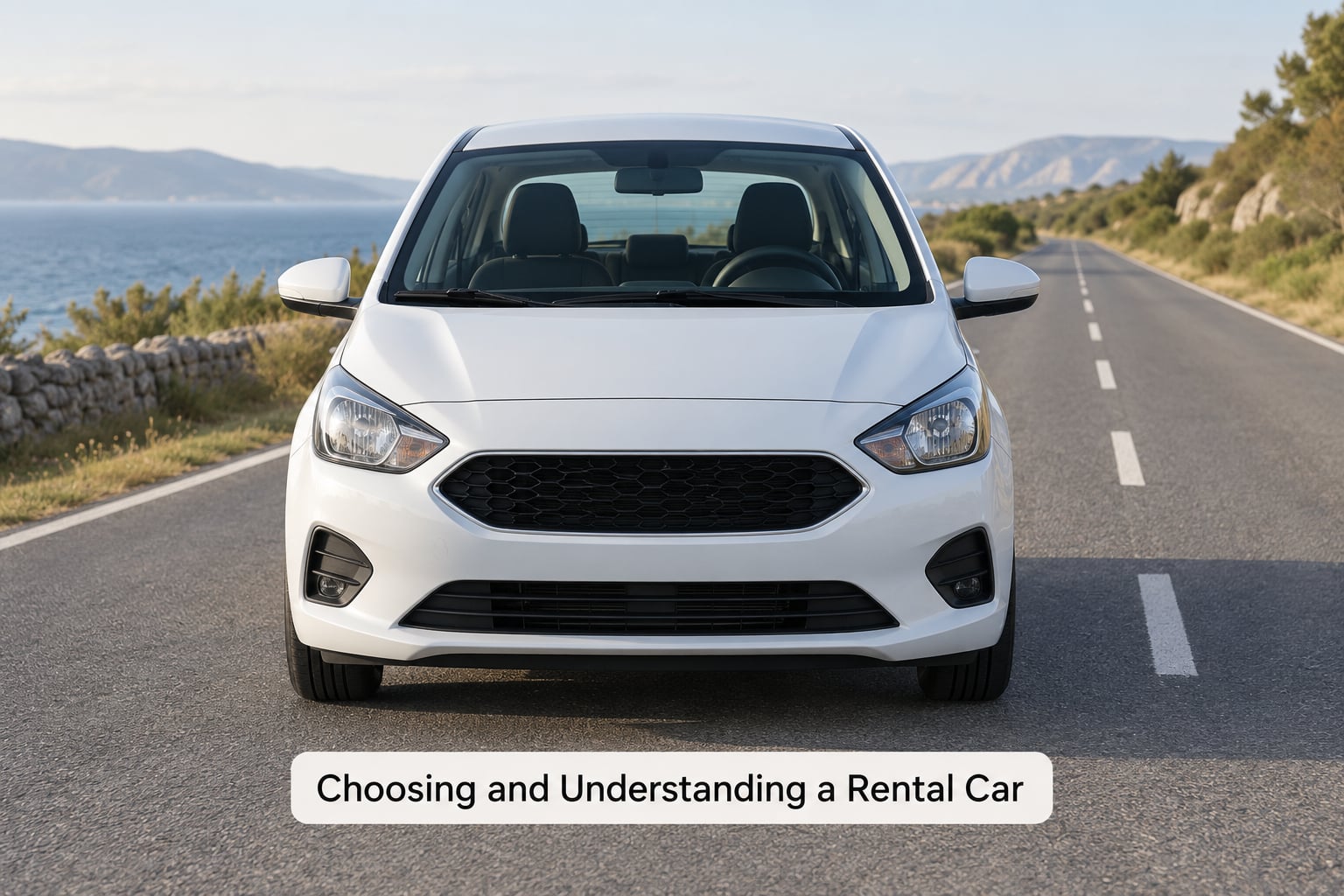
The car you pick does more for your first day than any tip you read. Two decisions matter most: automatic or manual, and whether you are sitting nearer the kerb or the centre line.
Most advice on this subject points the same way. In a Cape Town travel forum thread, several separate posters recommended an automatic unprompted, and one driver covered 7,000 km on an automatic and called it the best decision of the trip. An automatic removes the single hardest task, which is working a gear lever with your left hand while your right hand has a steering wheel held opposite to the one you are used to.
There is a genuine counter-argument. On a Fodor’s Ireland thread, one poster argued that a manual is safer for a visitor precisely because the gear lever on the left is a constant physical signal that something is different here. Drivers get into trouble, that poster argued, when they relax into autopilot.
| Automatic | Manual | |
|---|---|---|
| Best for | Visitors who do not know that car well, long days, stop-start traffic, anyone tired | Drivers confident with a stick who want the constant left-side reminder |
| Left-side risk | One less hand to coordinate during the first turns and junctions | Left hand crosses the wheel to the gear lever, near the door and away from the centre line |
| Availability | Common but often pricier and less plentiful on small islands | Usually the default and cheaper choice in many markets |
Beyond the gearbox, what to check before pulling away is simple. Confirm which side the wheel is on and whether the car is right-hand-drive or one of those left-hand-drive models in left-hand traffic. Find the indicators and wipers, which usually swap sides. Locate both wing mirrors and the rear-view mirror. Set the mirrors before moving, not while rolling.
Check what is in the boot or the boot-adjacent compartment, especially if a key fob or fuel cap has to be with the car. Know where the hazard light and the fuel filler are. Have your licence, passport, rental agreement and insurance paperwork within reach. Confirm whether the excess is reduced or waived, because that changes what happens after a minor shunt.
Then spend ten minutes doing laps of the car park you are standing in. It is quiet, it has no oncoming traffic to confuse you, and it is the one place where nobody is harmed by a wrong turn.
Your first 30 minutes, in order
- Walk to the car first and look at the steering wheel before you sit in it.
- Set your seat, head restraint and mirrors with the car stationary.
- Find the indicators and wipers and press each one while watching the front of the car.
- Switch on the lights, the hazards and the fog lights if fitted, so you know them before dark.
- Confirm the fuel type and how the filler works, including any key fob the car needs to be running.
- Drive two slow laps of the car park, practising both lock-to-lock steering directions.
- Note the gear or drive selector, and if it is a manual, find the handbrake and the gear lever before moving.
- Check the destination address and download an offline map, since signal drops on rural roads.
- Leave the car park deliberately. Say stay left before you turn out.
- Keep the first fifteen minutes on quiet streets with low traffic and no speed to worry about.
How to Make Turns, Enter Roads, and Use Roundabouts
Turning is where habit produces the clearest errors, because a left turn in left-hand traffic needs the opposite steering input to a right turn at home. Approaching a left turn, steer gently toward the centre line and take the corner tight, from the lane nearest the kerb and finishing close to the kerb on the new road.
A right turn is the mirror image and the more dangerous of the two. You need to swing wide, cross the centre line into the oncoming lane, and turn into the near side of the new road. Signal early, check your right mirror and blind spot over your right shoulder, and only move out when the road is genuinely clear. In a right-hand-traffic country, people expect to meet oncoming vehicles on your left, so hesitation here invites a near miss rather than preventing one.
At a crossroads, the danger is arriving at an unsigned junction from an unfamiliar angle and defaulting to your home country’s rule. Match your positioning to the road markings, and when they are missing, treat the arrival of other drivers as the cue.
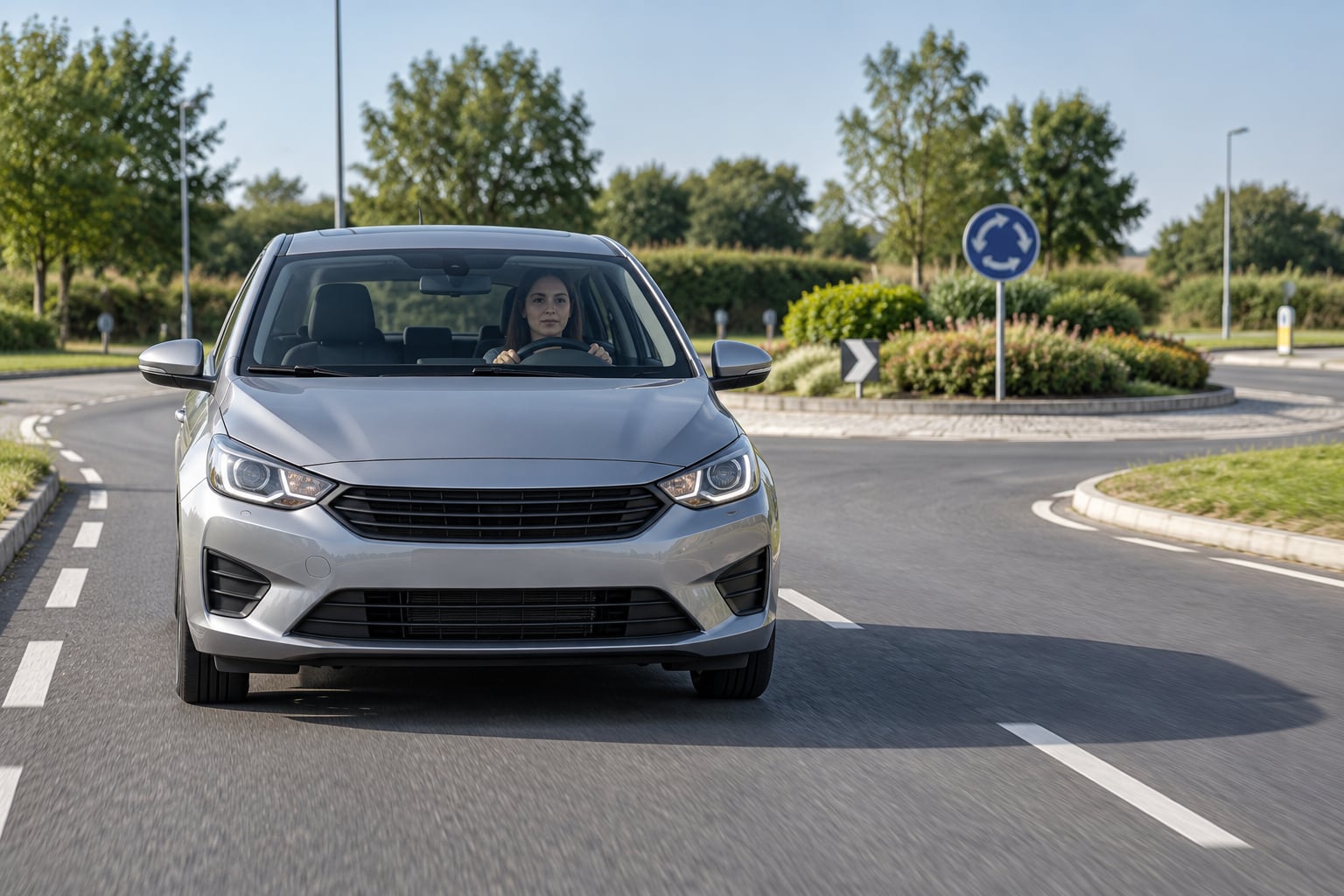
Roundabouts circulate clockwise, so the give-way traffic comes from your right. Approach, indicate left for the first exit, right for the second and third, and left again for a full circle or the exit after a U-turn. At the give-way line, check right rather than left, then take the approach lane for your exit: the left lane for exits one and three, the right lane for two and four.
Mini-roundabouts work the same way but usually have give-way markings on every arm and a small obstruction in the middle. Roundabouts are named as the single most disorienting feature by almost every forum poster on this topic. The habit that fixes it is picking your exit before you enter, then following the arrows.
| Manoeuvre | Driving on the left | Driving on the right |
|---|---|---|
| Which side you sit on | Nearest the centre line | Nearest the kerb |
| Oncoming traffic | On your right | On your left |
| Pedestrian first look | Left | Right |
| Roundabout direction | Clockwise, give way from the right | Counter-clockwise, give way from the left |
| Left turn | Tight, from the lane near the centre line | Tight, from the kerb lane |
| Right turn | Wide, crossing the oncoming lane | Wide, crossing the oncoming lane from the other side |
| Overtaking | On the right, return left | On the left, return right |
| Motorway lane order | Far left is the travel lane, outer lanes overtake | Far right is the travel lane, inner lanes overtake |
| At a stop, look for traffic | Right first, then left | Left first, then right |
How Overtaking Works on the Left
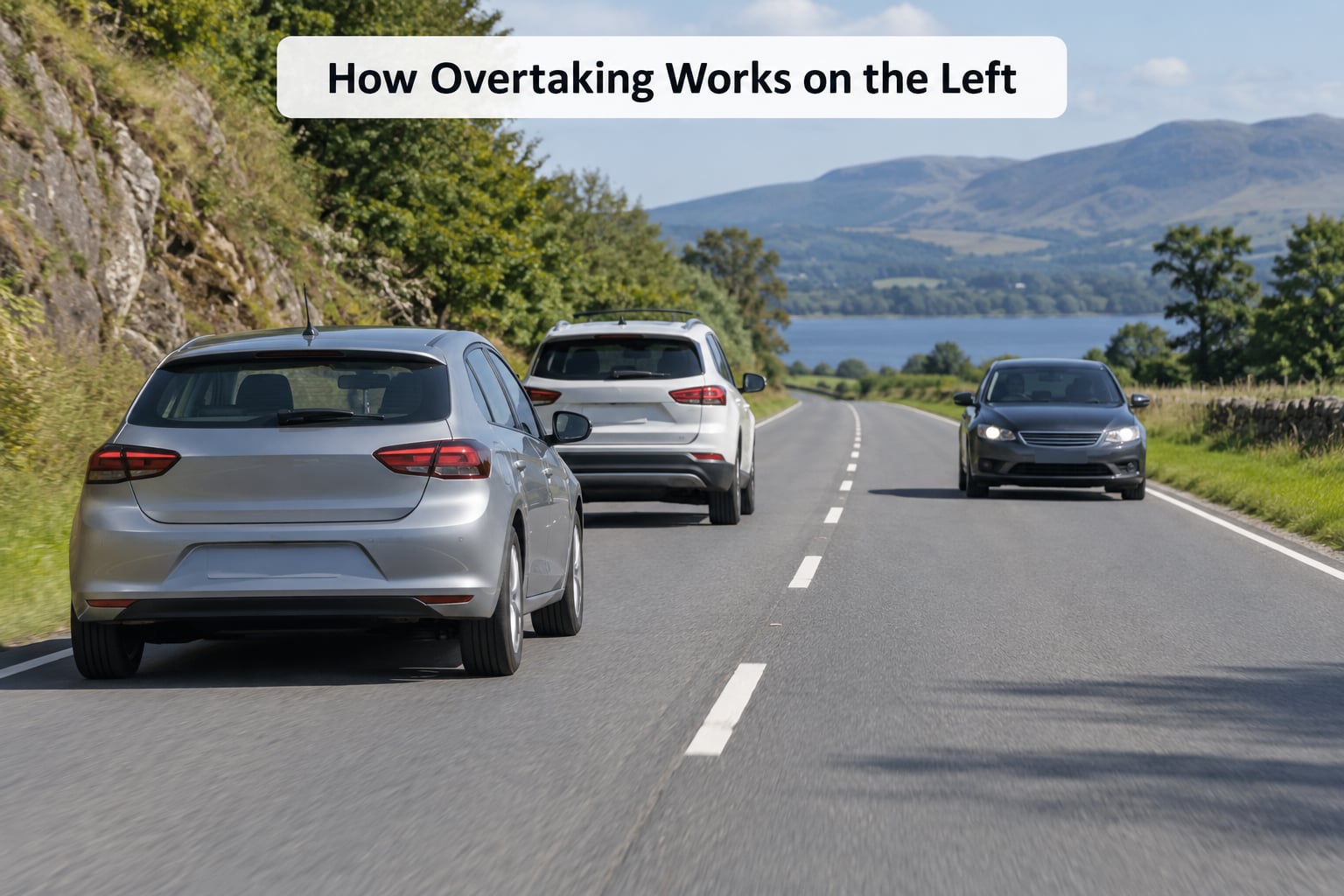
You overtake on the right in left-hand traffic, and it is the manoeuvre most likely to put you across a solid line. The centre line stays on your left for the whole move: check the left mirror and blind spot, signal right, move out, hold your speed steady rather than accelerating hard, and return left as soon as there is room.
Give way to oncoming traffic. Where the road is narrow, oncoming vehicles will move to their right, which is toward the centre of the road from your side, so leave genuine space and do not correct towards your own kerb while they pass. On single-lane roads with no markings, follow the local convention for pulling over to let faster traffic past, and use designated passing places where they exist.
Never overtake where a solid line marks the centre, inside a bend or a crest, at a junction, at a pedestrian crossing, or where the markings say the lane is too narrow. In the UK and Ireland, solid double lines or a solid line on your side mean the same thing everywhere in the world: do not cross it.
The real danger is not the motorway. It is the rural lane with a wide paved strip where oncoming traffic seems impossible, the passing place you enter nose to nose with a truck, and the road where a bend hides an overtaking tractor until the moment you commit. Slow down and stay left when visibility is short.
Parking, Fueling, and Everyday Road Tasks
Park on the left, close to the kerb, facing the direction of travel. Parking on the right puts you in the path of traffic and, in some countries, is treated as an obstruction. On streets with markings, the bays work the same way: bays on the left of the road hold you facing oncoming traffic, and bays on the right hold you facing the way you drive.
Reversing out of a bay is harder than it looks, because your view of the kerb side comes from the opposite seat position. Turn your head and look over your shoulder rather than trusting only the mirrors. Where you have to reverse into a space, take the extra second to check both sides first.
Fueling catches out left-side drivers because the pump and the filler are often on opposite sides of the car. Read which side the filler cap is on before you pull up, then loop the car around rather than shuffling across a forecourt. At an unattended pump, the keypad for your card may also sit on the driver’s door pillar rather than the driver’s window.
Drive-throughs, one-way streets, car parks and narrow town streets all mirror too. At a drive-through in a left-hand-traffic country, the lane you want is usually on your left, and the entry is often a tight loop around the building. In narrow historic town centres, a small car is genuinely easier than a large one, as island travellers note, since road width and passing places are the constraint rather than engine power.
Equipment layouts differ by country and model, so never assume the wiper stalk, indicator stalk, hazard button, fuel filler or reversing camera is where it sits at home. A Turks and Caicos trip report makes the point that unfamiliar keyless ignition and fob systems add real stress on top of the road side itself.
Safety Habits and Common Mistakes to Avoid
Most people who get into trouble on the wrong side are not total beginners. Forum posters make this point repeatedly: the real risk window opens after confidence arrives, when you stop thinking and start drifting. Each of these errors has a matching correction.
- Pulling out of a car park onto an empty road. This is the highest-risk moment in the whole trip, because there is no traffic to copy. Look both ways, then both ways again, and say the phrase out loud before you move.
- Drifting towards the centre line after a turn or an exit. Pick a fixed visual anchor, such as keeping your left hand near the lane marking, and check your position in the mirror a second after every manoeuvre.
- Signalling late. Indicate before you change lanes, not while you are already crossing the line.
- Checking mirrors on the wrong side. You are sitting closer to the centre line than usual, so the blind spot you cannot see is the one nearest the road’s middle.
- Stopping on the wrong side. If you stop somewhere unexpected, straighten the car and face forward on the correct side before pulling away.
- Restarting after a stop. Every fuel stop, lunch, toilet break or photo re-arms your home-side instinct. Treat the restart as the riskiest part of the day, not the driving in between.
- Overcorrecting a drift. If you find yourself across the centre line, ease back gradually rather than swerving, and do not brake or turn sharply unless you must.
- Following the car ahead into a mistake. Useful most of the time, useless when the car ahead is also confused. If no traffic is visible, use the markings rather than the flow.
How long does it actually take?
Forum answers range from a few days to a full year of daily driving, and both ends are honest. Most visitors drive competently, if tensely, within a day or two, and drive well after a week. What takes longer is the reflex that puts you on the correct side without thinking, and one poster who moved to Ireland reported needing a full year of daily driving before that reflex became automatic in a hazard that appeared with no warning.
Re-adapting on the way home is usually instant, which is its own small joke: travellers report bouncing straight back to their home side without thinking about it, then flying out again three months later and having to start over.
If you can, avoid collecting a car straight after an overnight flight. Sleep deprivation, jet lag and an unfamiliar side of the road are a poor combination, and the same advice applies to the first morning after a late arrival. Pick the car up, take a taxi or a transfer to the accommodation, and collect the vehicle the next day with a rested head.
A passenger helps more than people expect. Give them one job: call out stay left every time you move off, come out of a car park, leave a petrol station, or start a new leg. That single instruction catches more errors than a mirror check.
Frequently Asked Questions
Is driving on the left harder for visitors?
For the first day, yes, mainly because the errors are new rather than because the roads are harder. Your braking distance, steering and speed do not change. Most visitors drive competently within a day or two, and what takes longest is the unconscious reflex to keep left during a sudden hazard, which one Ireland-based poster said took a full year of daily driving.
Which countries drive on the left?
Around seventy territories do, including the United Kingdom, Ireland, Japan, Australia, New Zealand, India, South Africa, Kenya, Singapore and Malaysia, much of the Caribbean, Guyana and Suriname, plus Malta and Cyprus. Rules and signage differ between them, so check the country you are actually driving in rather than assuming another left-driving country matches it.
How do you turn left or right when driving on the left?
Left turns are tight: stay near the centre line, steer gently left and finish close to the kerb. Right turns are wide: signal early, check your right mirror and blind spot, and move into the oncoming lane only when it is clear. At roundabouts, circulation is clockwise and you give way to traffic arriving from your right at the give-way line.
Which side do you overtake on when driving on the left?
You overtake on the right, exactly as you would overtake on the left in a right-hand-traffic country. The centre line stays on your left for the whole manoeuvre. Check the left mirror and blind spot, signal right, match the speed of the vehicle ahead rather than accelerating, and return left as soon as there is room and no solid line prevents it.
Can a visitor get a ticket for entering the wrong side of the road?
Yes. Driving on the wrong side of the road is an offence in every country that requires you to keep left, and it is treated seriously because of the head-on collision risk. On top of a fine, insurers may refuse cover if you were driving on the wrong side, and the rental company will usually charge the damage and the loss-of-use fee. If it happens, pull over safely and do not attempt to correct on the road.
Conclusion: What to Do First
Start with three things, in this order. Check the road rules for the country you are entering, since left-hand traffic countries do not agree on signs or junction priority. Learn your rental car while it is parked, on the gear selector, the stalks, the mirrors and the fuel filler. Then drive ten slow minutes in a car park or on quiet streets before you join traffic that cannot wait for you.
Keep the driver’s side nearest the centre line, look right for oncoming traffic, overtake on the right, and say stay left every time you pull away from somewhere. That is most of what to know about driving on the left, and the rest is repetition.