
To plan a honeymoon trip, agree on the trip style, set a total budget and pick travel dates first, then book flights and accommodation and work backward through a six-month countdown of documents, reservations and packing. Most couples underestimate two things: how long passport processing takes, and how quickly adults-only suites at the best resorts fill during peak season.
That order matters because every later decision depends on the three earlier ones. A destination chosen before the budget gets decided usually becomes the destination you cannot afford, and dates picked without knowing the wedding logistics turn into a rushed departure three days after the ceremony.
Budgeting deserves a warning here. Honeymoon prices move constantly, so any figure you find in an article from six months ago is a rough shape rather than a quote. Use the categories below to plan, then get current numbers from live booking tools before you commit money.
Budget aside, what follows is the sequence that works for most couples: decide, choose, book, confirm. It takes a handful of focused evenings, and most of the work is done by the two-month mark.
Table of Contents
- 1What You Need Before Planning a Honeymoon Trip
- 2How to Plan a Honeymoon Trip Step by Step
- 3Step 1: Agree on the Honeymoon Style and Priorities
- 4Step 2: Set a Realistic Honeymoon Budget
- 5Step 3: Choose the Best Destination and Travel Time
- 6How to Plan a Honeymoon Trip Timing: Leave Now, Wait, or Delay
- 7Step 4: Book Flights and Accommodation
- 8Step 5: Reserve the Experiences That Matter Most
- 9Step 6: Handle Documents, Transfers and Packing
- 10Step 7: Confirm the Plan and Build a Backup Plan
- 11Common Honeymoon Planning Mistakes and How to Fix Them
- 12Frequently Asked Questions
- 13How far in advance should you start planning a honeymoon?
- 14What is a realistic honeymoon budget for a couple?
- 15Is a mid-range budget enough for a good honeymoon?
- 16Should we go on our honeymoon right after the wedding?
- 17What documents do we need for a honeymoon abroad?
- 18Do we need travel insurance for a honeymoon?
- 19Conclusion: Start With the First Three Decisions
What You Need Before Planning a Honeymoon Trip
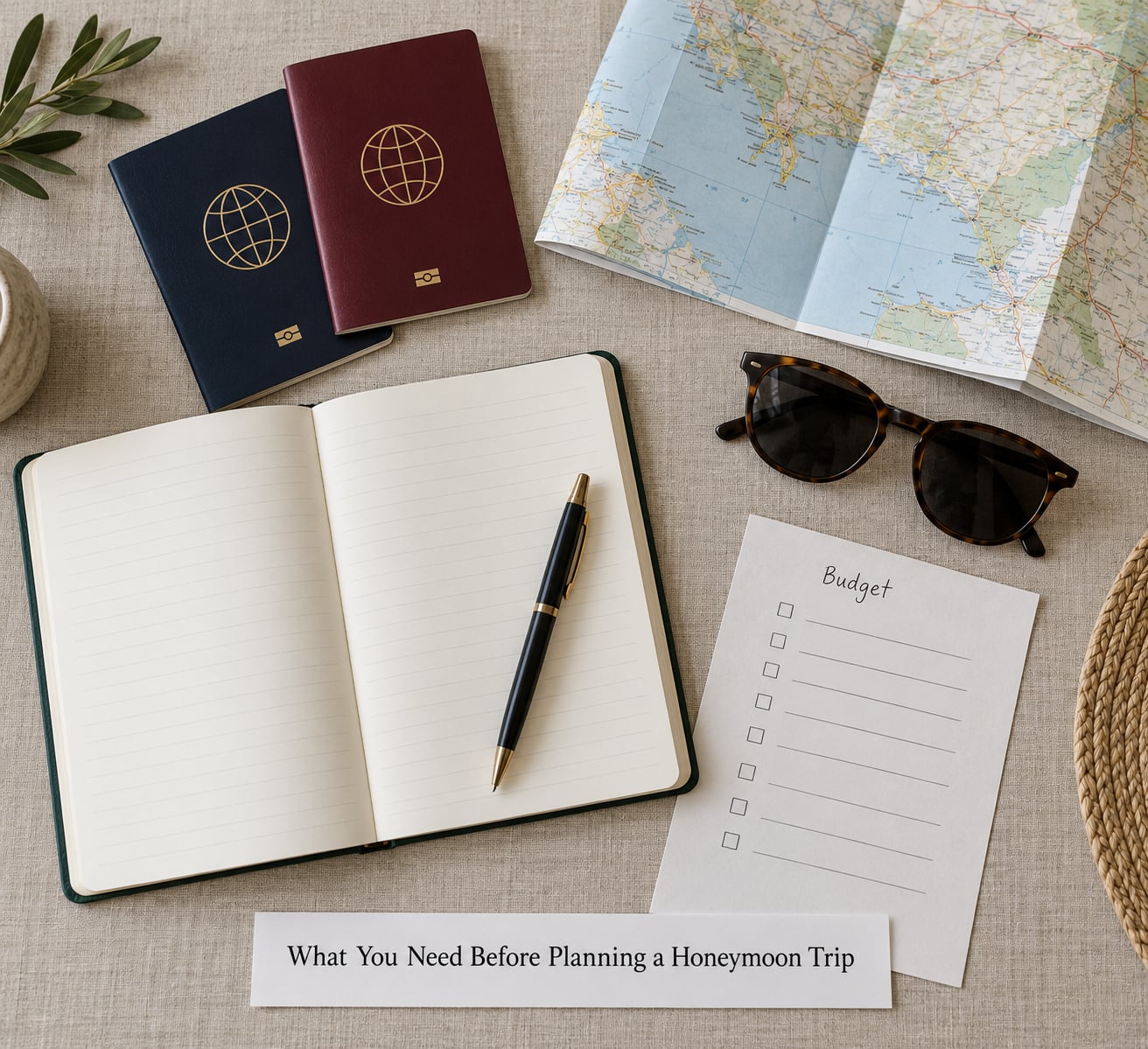
Before you compare destinations, settle these eight items. Couples who do it in this order spend an evening, not a month of arguments.
- Travel dates. Work around the wedding date, the return-to-work date, school holidays and any fixed family obligations. Be specific about the last day you can be away.
- Total budget. Decide the number one of you would actually be happy to spend, then decide who contributes what. Gifts, savings, family help and a honeymoon fund all count.
- Trip length. Six to eight days covers most honeymoon itineraries well. Two weeks works if one partner takes leave; fewer than five days usually means rushing.
- Departure city. Your home airport and any connecting hubs change both flight time and cost more than most couples expect.
- Passport and visa status. Check the expiry date now, not later. Most destinations expect six months of validity beyond your return date, and processing can take weeks.
- Must-have experiences. Two or three things you would regret missing. This is your shortlist when the budget gets tight.
- Preferred pace. Busy and structured, or slow with room to improvise. Couples disagree about this more than any other planning question.
- Flexibility each partner needs. One of you may need a firm schedule for medication or rest. Write it down so nobody assumes.
If you are still deciding whether a later moon or a minimoon suits you better, decide that here too. It changes the whole timeline, and booking against the wrong one is expensive.
How to Plan a Honeymoon Trip Step by Step
Step 1: Agree on the Honeymoon Style and Priorities
Talk about the trip in categories rather than places: relaxation, food, nature, culture, nightlife, adventure, or a mix. Most disagreements are really disagreements about pace, not destination.
Turn those preferences into three lists. Non-negotiables are the two or three experiences you would be upset to go home without. Nice-to-haves need a budget line. Everything else goes on the skip list, which is where you protect the trip from over-planning.
A useful test: if one activity were cancelled, would the trip still feel worth it? If the answer is no, that activity needs a reservation. If yes, it can wait for a free afternoon.
Step 2: Set a Realistic Honeymoon Budget
Build the budget from categories, not from a headline number. Work out what each share looks like as a percentage of the total, then fill in current figures from live booking tools.
- Flights and airport transfers: 20 to 30 percent, more in peak season or for long-haul routes.
- Accommodation: the largest line in most itineraries, usually 35 to 45 percent. Add resort and destination fees when you compare, because a lower room rate can still cost more overall.
- Food and drinks: 15 to 20 percent if you plan to eat in and out, closer to 10 percent on a full board plan.
- Activities and spa treatments: 10 to 15 percent, more if one of you wants a private tour or a couples massage.
- Insurance, fees and shopping: 5 to 10 percent.
- Contingency: 10 percent, untouched until the trip ends. Couples who skip this spend it anyway, in a worse mood.
Now ask the harder question: is the budget realistic for that destination and length? A week in one place at a mid-range resort is the easiest trip to make affordable. Two countries in eight days roughly doubles flights and transfers, and a peak-season adults-only property moves a large share of the budget.
If money needs to come from guests, set up a honeymoon fund or registry before the wedding rather than after. Funds that cover specific items, such as a dinner or a transfer, are easier to ask for than a general contribution, and they avoid the awkwardness of discussing your savings with family.
Step 3: Choose the Best Destination and Travel Time
Score each candidate against the same criteria so the comparison is honest: season and weather, flight time and connections, total cost including transfers, entry requirements, crowd levels, activities matching your non-negotiables, and how much planning each option demands.
Flight time deserves more weight than couples give it. Two long-haul legs on a short trip means more time in transit than on the beach. In-season weather that does not suit you is another reason to skip a postcard destination.
Shoulder season is the underrated choice. You usually get better room categories, thinner crowds and lower rates, and the weather risk is small if you check the history for that exact stretch of the calendar.
How to Plan a Honeymoon Trip Timing: Leave Now, Wait, or Delay
The wedding-exhaustion buffer is the part most guides skip. Couples flying out the same night usually spend the first two days recovering from the wedding, not the trip. A short wait solves it.
| Timing | Works best when | Watch out for |
|---|---|---|
| Leave within days of the wedding | Leave is limited and the destination needs a long flight window | Fatigue, leftover wedding logistics, no time to recover |
| Wait two to four weeks | You want the honeymoon feel without the post-wedding haze | Peak-season dates fill while you wait |
| Delay two to six months | Work, school or a move makes an immediate trip impossible | It slips again unless you book a date now |
Whatever timing you pick, put the departure date in a calendar with a hard booking deadline beside it. The trip that gets postponed twice is the trip that never happens.
Step 4: Book Flights and Accommodation
Flights first, then the hotel, because the hotel sets the arrival pattern. Compare practical options rather than the cheapest fare: total travel time, connection length, arrival hour and baggage rules. A red-eye that saves a day still costs you two after a wedding.
Give yourself a real airport buffer. Domestic trips usually need about two hours before departure, international trips closer to three, and peak-season lines run longer.
For the hotel, location matters more than star rating. Staying an extra night on each side of the trip often costs less than the airport transfer, the lost sightseeing day and the stress of a late arrival. Check the full cost including resort and destination fees before you compare two properties.
Confirm cancellation and change terms before you pay. Flexibility is worth real money on a trip with fixed dates, especially with a wedding in the middle of it.
Step 5: Reserve the Experiences That Matter Most
Reserve only what genuinely requires advance booking: a private tour, a dinner with a specific view, a cooking class with limited seats, a spa slot on a specific day. Everything else can be decided on the ground.
One booked anchor per person per day is a good rule. It keeps a week from turning into a schedule, and it leaves room for weather, rest and the spontaneous restaurant your hotel concierge recommends.
Tell the hotel it is a honeymoon. Many properties will arrange something small, from a plate of fruit to a room upgrade, and some perks require a marriage certificate, so keep a photocopy and a digital copy on your phone.
Step 6: Handle Documents, Transfers and Packing
Run the paperwork early. Check that the name on your passport matches the name on every booking, because a mismatch at the gate is a serious problem on an international trip. Wait to book under a new married name unless the passport already shows it.
Confirm that your passport stays valid six months beyond your return date, check visa rules for your nationality and destination, and note any vaccination or health advisory that applies. Add the insurer’s number and two emergency contacts to the shared notes.
Logistics next: airport transfer, local transport, and how you get from the airport on arrival. A long-haul flight plus a two-hour transfer plus a wedding the day before is a lot to land in tired.
Packing is easier if you pack by outfit rather than by category. Add climate layers, one dress-up outfit, whatever the destination actually requires, and the small honeymoon essentials: a change of clothes in your hand luggage, chargers, medication, sunglasses and something to open together on the trip.
Step 7: Confirm the Plan and Build a Backup Plan
Work backward from departure day and put each task on a countdown. This is the checklist most couples actually want, and the one that removes the last-minute scramble.
| When | What to finish |
|---|---|
| Six months out | Budget agreed, style and non-negotiables written down, shortlist of destinations |
| Four to five months | Destination chosen, dates fixed, flights and hotel booked, passport checked |
| Three months | Visa or entry requirements confirmed, insurance purchased, transfers arranged |
| Two months | Dining, tours and spa reservations locked in, free afternoons marked on the calendar |
| One month | Hotel perks and arrival times reconfirmed, packing list done, digital copies saved |
| One week | Flight details checked, phone plan set up, home and work handover briefed |
| Three days | Weather checked, transfer details re-read, cash and a card held in each hand luggage |
| Day before | Check-in times, passport in hand luggage, boarding passes downloaded, phones charged |
Then build a thin backup layer. Know the second choice of hotel if your booking falls through, keep one flexible night in the itinerary where the weather can move things, and carry a photo of every booking confirmation and every address in case a screen dies.
Test the practical things a week out: the payment method each of you uses, the app your airline needs, the offline copy of your documents. Nothing derails a trip faster than a card that will not work outside your home country.
Common Honeymoon Planning Mistakes and How to Fix Them
These are the failures that repeat most often, and the correction for each one.
- Booking too late. Adults-only suites, private villas and overwater bungalows in peak season are often spoken for long before the wedding. Fix: set the booking deadline at the same time you set the travel dates.
- Overscheduling. Packed itineraries turn a honeymoon into a commute. Fix: one anchor per person per day, with unscheduled afternoons kept on purpose.
- Ignoring travel time. Long connections and long layovers quietly eat two days. Fix: count door-to-door hours, not flight duration.
- Choosing a destination for looks. The place is famous but wrong for your pace, budget or weather. Fix: score candidates against your own criteria, not against a listicle.
- Not talking about money. One partner assumes the other is paying, or a gift fund is assumed before anyone asks. Fix: write down contributions and the ceiling before booking.
- Packing for the wrong conditions. Dresses for a destination that needs layers and closed shoes. Fix: check the climate for the exact dates and split outfits by day.
- Trusting reviews blindly. Reviews reflect guests with different expectations. A couple wanting quiet and three wanting nightlife can both rate the same resort well or badly. Fix: read reviews written for your travel style.
- Leaving no slack. No contingency time for a delayed flight or a rained-out day. Fix: keep one unbooked day and a cheap fallback activity in the plan.
Two smaller fixes worth repeating: check resort and destination fees before you compare properties, and reconfirm every booking by email a week out so you have a written record of names, times and cancellation terms.
Frequently Asked Questions
How far in advance should you start planning a honeymoon?
Start about six months before departure for most destinations, and earlier for peak-season adults-only resorts, long-haul routes or anywhere with visa requirements. Begin with the budget and destination shortlist, book flights and accommodation in the four-to-five-month window, and finish documents by three months out. Planning after the wedding still works, but the best room categories may already be taken.
What is a realistic honeymoon budget for a couple?
A realistic budget covers flights, accommodation, local transport, meals, activities, insurance, fees and a 10 percent contingency. As a share of the total, accommodation usually takes the largest slice at 35 to 45 percent, flights and transfers 20 to 30 percent, food 15 to 20 percent, and activities 10 to 15 percent. Get current figures from live booking tools, since rates shift with season and demand.
Is a mid-range budget enough for a good honeymoon?
Yes, for most couples, if you pick the trip carefully. A mid-range budget covers a week in one place at a good hotel with a couple of planned experiences and plenty of free time. It gets tight when you add a second country, travel in peak season, or chase a specific room category. Shorten the trip or shift the season before you stretch the money.
Should we go on our honeymoon right after the wedding?
Waiting two to four weeks is usually the sweet spot. You get the honeymoon feeling without flying out on wedding exhaustion, and you return before leave runs out. Leaving immediately suits couples with very limited leave or a destination that needs a long flight window. Delaying two to six months works too, but book the date immediately or it keeps sliding.
What documents do we need for a honeymoon abroad?
A valid passport, any required visa, proof of onward travel, and travel insurance details are the essentials. Check that the name on your passport matches every booking, and confirm six months of validity beyond your return date. Carry a digital and printed copy of confirmations, plus emergency contacts. Some resorts ask for a marriage certificate for honeymoon perks.
Do we need travel insurance for a honeymoon?
It is worth it when a large part of your budget sits in non-refundable bookings. The scenarios that pay off are a hurricane or cancelled flight, a medical evacuation from a remote destination, lost luggage right after the wedding, or a delayed return that costs you change fees. Read the exclusions for pre-existing conditions and for anything alcohol-related before you pay.
Conclusion: Start With the First Three Decisions
To plan a honeymoon trip well, three decisions do most of the work: the trip style you both want, the total budget you are both comfortable with, and the real travel dates. Set those first, choose a destination that fits them, and the rest becomes a countdown rather than a negotiation.
Do not postpone the honeymoon on purpose. If a previous date slipped, pick a new one this week and book flights before the season you want opens.