Overtourism changes travel planning in one blunt way: the easy version of booking a trip is going away. Where you used to pick a city, find a bed and show up, you now research reservation rules, visitor caps and city fees before you commit a cent. Crowds are only the visible part. The planning consequences run deeper than queues at a landmark.
The word entered ordinary English a few years ago, but plenty of travellers still use it loosely. A city that is merely popular is not automatically overtouristed. Knowing the difference changes which advice you should follow, and that distinction is where this guide starts.
Below is a stage-by-stage account of what changes: how to spot a destination under pressure, when to book each piece of the trip, how to route around the crush, what it does to your budget, and what to do when the destination is busier than the forecast promised. Rules shift constantly, so treat everything here as a planning method and verify current specifics with the destination’s official tourism site before you pay for anything.
Table of Contents
- 1How Overtourism Changes Travel Planning
- 2Why Popular Destinations Become Harder to Book
- 3Five signs a destination is tipping into overtourism
- 4Overtourism is not the same as a busy week
- 5When Should You Book in an Overtourism Destination?
- 6Where how overtourism changes travel planning bites hardest
- 7How to Avoid the Biggest Crowds
- 8Shoulder season is no longer the safe answer
- 9How to Build a More Flexible Itinerary
- 10Travellers with fixed itineraries: cruise passengers, packages and mobility constraints
- 11How Overtourism Affects Prices and Value
- 12How to Travel More Responsibly in Crowded Places
- 13How to Adjust Plans When a Destination Is Suddenly Busy
- 14Frequently Asked Questions
- 15What are the negative consequences of overtourism?
- 16How do I know if a destination is overtouristed?
- 17How can I avoid overtourism but still see the famous places?
- 18Is shoulder season still quieter than peak season?
- 19Do tourist taxes change how I should plan a trip budget?
- 20Why do some places now require reservations, and how far ahead should I book?
How Overtourism Changes Travel Planning
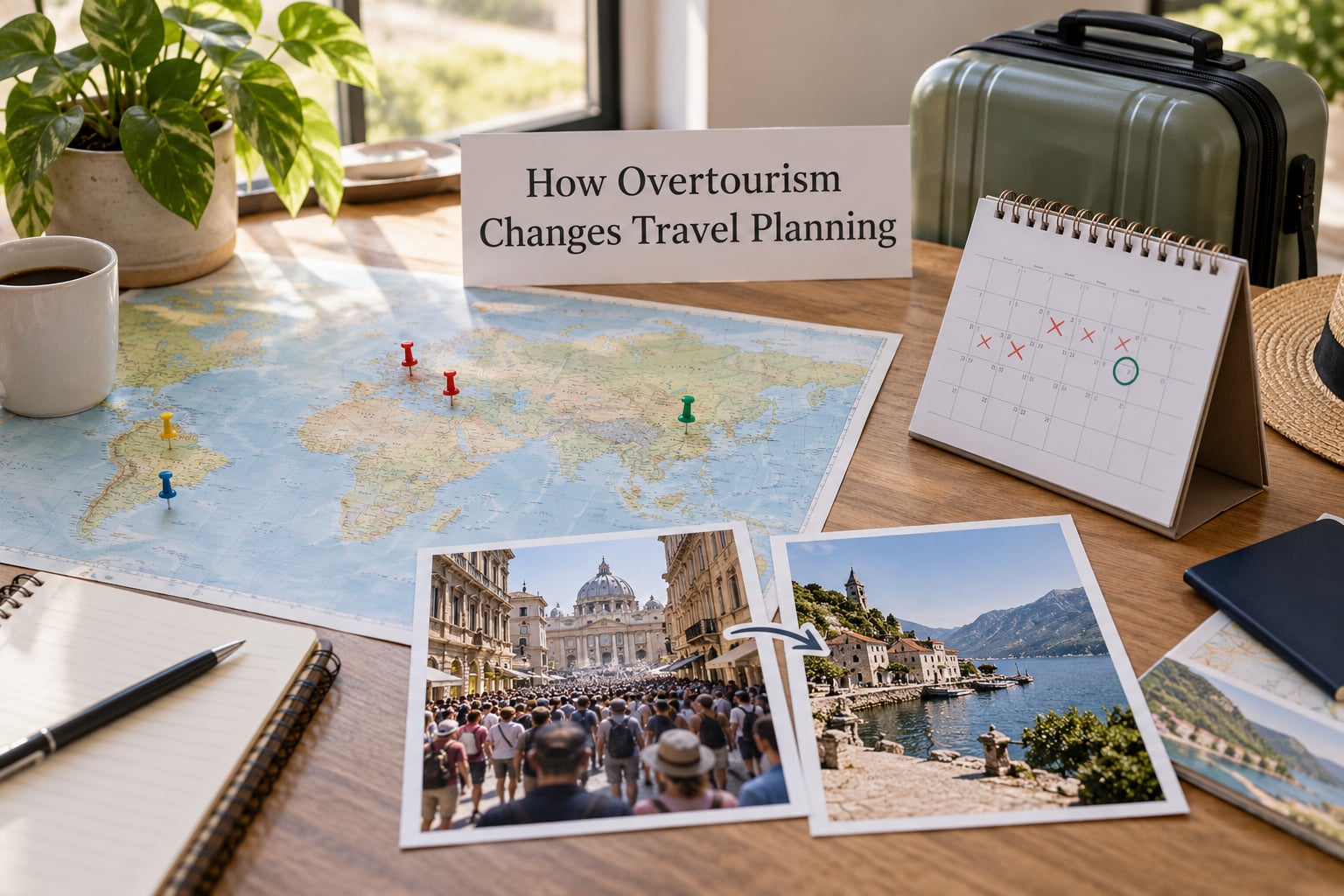
Overtourism is a situation where visitor numbers exceed what a destination, its infrastructure and its residents can reasonably absorb. Crowding is what most people notice first, but the harder symptoms are rising rents, worn infrastructure, strained public transport and residents losing the use of their own streets.
Planning shifts because authorities respond, and they respond with rules. The four that matter most for an itinerary are rationing, pricing, licensing and displacement.
- Rationing. Visitor caps, permit systems and timed entry turn a walk-up visit into a booked slot. Machu Picchu sells tickets by assigned circuit and time window, and the Inca Trail limits how many trekkers start per day.
- Pricing. Tourist taxes and visitor levies add a new line to a trip that did not exist in the old playbook. Amsterdam and Barcelona both levy a percentage-based city tax on accommodation, and the amount is usually collected at the property rather than by you.
- Licensing. Cities that tightened rules on short-term rentals have removed a large slice of holiday-let inventory from the market. Barcelona has been among the most aggressive in registering and removing listings that operate without a licence.
- Displacement. Pressure on a core pushes demand outward, onto lesser-known places. Dubrovnik and Venice have both restricted large cruise ships at their main berths, which is a demand-management tool aimed squarely at the day-visitor spike.
Compare that with how the same trip was planned a few years ago, and the shift is easy to see.
| Planning step | The older approach | What it looks like now |
|---|---|---|
| Destination choice | Pick the famous city, go when you can | Check caps, fees and access rules first, then pick |
| Timing | Try to dodge summer | Pick weekdays, then look for festival and school-holiday collisions |
| Booking lead time | Weeks ahead for flights, a month for beds | Book the constrained item first, sometimes months ahead |
| Landmark access | Turn up and queue | Reserve a timed slot in advance |
| Accommodation | Any available room or rental | Fewer legal rentals, so book legitimate supply earlier |
| On-the-ground days | Fixed day plan | One fixed anchor per day, flexible edges |
None of this makes a trip impossible. It moves research to the front of the process, which is the real headline of how overtourism changes travel planning for anyone with a fixed work calendar.
Why Popular Destinations Become Harder to Book
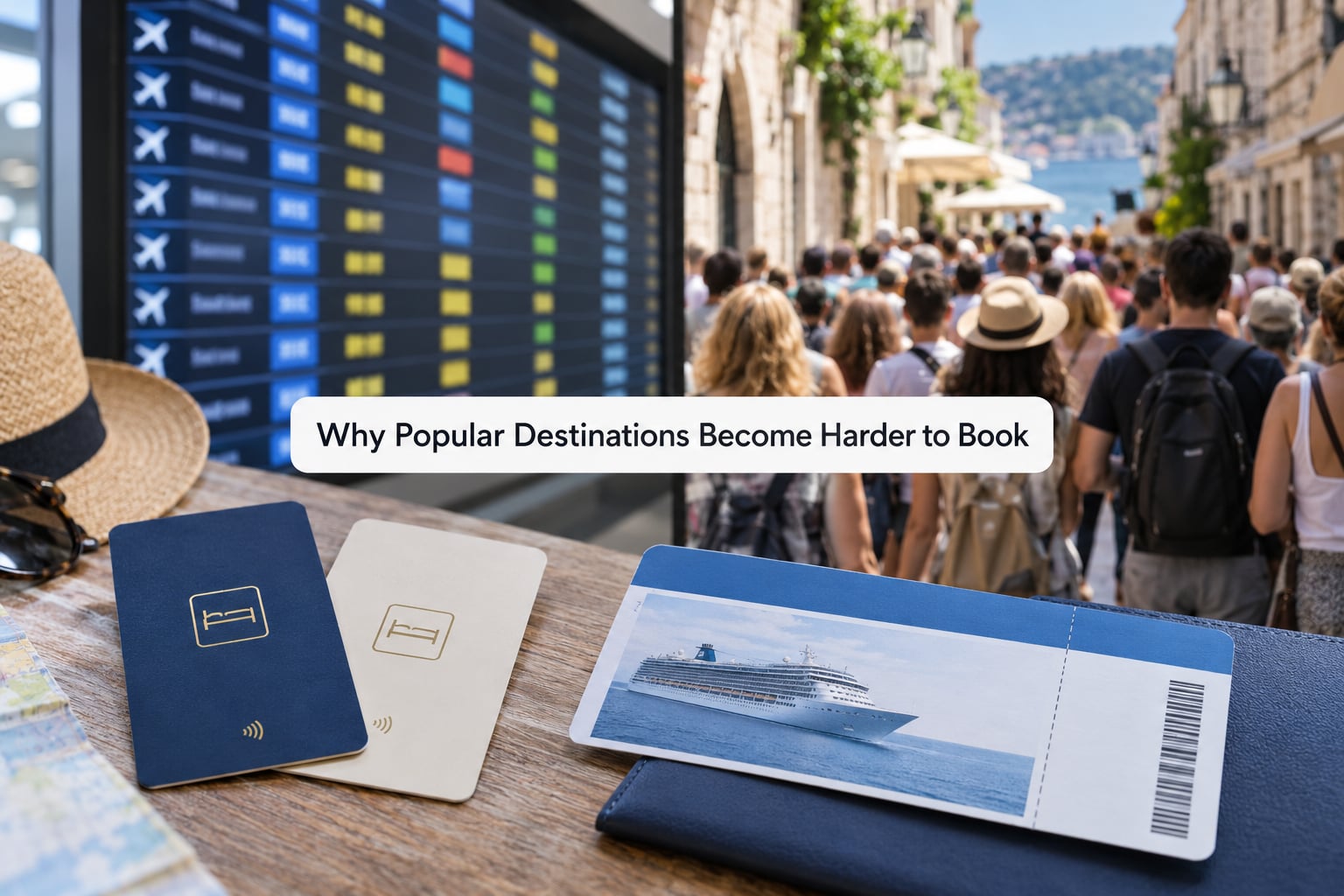
Concentrated demand hits a short list of things first: flights into one airport, rooms in one postcode, seats on one metro line, timed slots at the headline attraction, and tables in the handful of restaurants people actually want. Each of those can run out while the city as a whole still feels half-empty, and that mismatch is where planning breaks.
Cruise itineraries are the clearest case of demand arriving without warning. A ship brings thousands of people to the same dock on the same morning, and none of them chose that date. Dubrovnik’s decision to push large vessels away from its historic port and Santorini’s cap on how many cruise ships may dock per day are both attempts to turn an unmanaged crowd into a managed one.
Five signs a destination is tipping into overtourism
You can usually tell before you book, if you know what to look for. Check for these five signals, and treat any two together as a warning to plan more carefully.
- A timed-entry system with no walk-up option. If the official ticket page makes you pick an arrival window, capacity is being managed on purpose.
- Day-visitor charges or coach restrictions. Venice’s fee aimed at day-trippers on peak days and various old-town vehicle restrictions are signs that the daytime crowd is a policy problem, not just a busy market.
- New or rising city taxes. A levy added to your accommodation bill usually follows a capacity crunch.
- Rental licensing crackdowns. If a city is removing unregistered short-term rentals, the pressure on housing is severe enough to reach city law.
- Resident complaints and protest activity. Coverage of demonstrations over tourism is a signal that the destination is past comfortable capacity, and it can also mean blocked streets on your travel dates.
Overtourism is not the same as a busy week
Every destination has peak days. A packed half-term in a coastal town is ordinary seasonality, and off-season advice handles it perfectly well. Overtourism is different because it is structural: it persists across the season, it prices visitors out, and it shows up in rent levels and resident behaviour rather than only in queue length.
Forum travellers argue about this distinction constantly, and the confusion is fair. The practical test is simple. If a destination is expensive and crowded in April, August and November, the problem is not the season.
When Should You Book in an Overtourism Destination?
Book the scarcest component first, then work backwards. That single idea covers most of the uncertainty in an overtouristed destination, because everything else on the trip has more substitutes than the one thing you cannot get.
Where how overtourism changes travel planning bites hardest
Landmark access is the binding constraint. A timed-entry slot at a heavily regulated site does not appear if you arrive in town that morning, and the release schedule is often the only fact that matters. Note when tickets are released, note whether they sell out, and put the booking in your calendar the day the release opens.
Accommodation comes next in most regulated cities, particularly where rental licensing has cut supply. A city with fewer legal short-term rentals has fewer total options, and the properties that remain book out earlier than the market norm. Flights are rarely the problem in this direction, since capacity is usually fixed months ahead.
For long-distance rail and for internal flights on constrained routes, treat them like flights: a popular weekend service can be the hardest ticket in the itinerary. Trains that run alongside reserved coach routes need the same lead time. Rental cars are the exception that proves nothing useful; fleets shift seasonally and a vehicle you reserved may be a different class when you collect it.
Restaurants in the most crowded districts also behave like scarce supply once a destination is on the list. Reservable dining in a hot district fills weeks out, while a neighbourhood a short walk away may not take bookings at all.
One long-standing traveller on the Rick Steves community forum described booking a Barcelona stay before realising how heavily visited the city has become, and noted that countries oversold through advertising are now pulling that back. The planning lesson is not to skip the city, but to do the same research there that you would for a permit-limited destination.
How to Avoid the Biggest Crowds
Crowd avoidance is now a scheduling problem, not a destination problem. The most useful levers are weekday travel, time of day, and geography, in roughly that order of reliability.
- Shift the day, not the trip. Moving one day by two can halve the headcount at a busy site. It also often drops accommodation rates, which is a second win.
- Go early or late. Most headline attractions are quietest in their first hour, and the late afternoon clears before the evening crowd builds.
- Disperse geographically. Staying in a residential district near the centre rather than on the most-photographed strip spreads demand across a wider area and usually costs less.
- Check arrival days of large ships. Port schedules are public, and a cruise day can change the character of a small old town completely.
- Use the second and third choice. The next town over, the less famous trail, the local market, the neighbourhood museum.
Shoulder season is no longer the safe answer
Travel advice used to say go in the shoulder season and the crowds disappear. That worked, and then it stopped working, because shoulder-season travel got marketed to exactly the people following that advice. Forum consensus on this is close to unanimous: fewer people, but still crowded places.
The useful replacement is to treat shoulder season as a partial improvement rather than a solution. Shoulder season in a regulated destination now cuts the crowd meaningfully at major sites and barely at all in the historic core. If avoiding crowds is the point of the trip, the deciding factor is usually the specific dates rather than the general season, so check what is happening on those dates and then pick around it.
Destinations with their own festival calendar need the same treatment. Cherry blossom season in Japan and Golden Week pull enormous domestic travel, which is the point a traveller who has been visiting the country for more than a decade made on the r/JapanTravel forum, describing Tokyo and Kyoto as almost unbearable for locals during peak periods.
That same traveller raised a fair question that nobody in this industry answers cleanly: government efforts to steer visitors away from the Tokyo-Kyoto-Tokyo track have not visibly changed anyone’s itinerary. Plan your dispersion honestly rather than assuming a campaign will do it for you.
How to Build a More Flexible Itinerary
Flexibility is now a planning asset, not an indulgence. In a destination where access is rationed, a day with nothing locked in is a day you can redirect around a closed attraction, a sold-out slot or a protest route.
Split your trip into three lists before you travel. Non-negotiables get booked and protected. Good-if-possible items get researched with a rough cost in time and money. And fillers stay empty on purpose, because they are what absorbs a disruption.
Keep at most one fixed anchor per day. A reserved slot at nine in the morning leaves the rest of the day rearrangeable, and rearranging is cheaper than cancelling. In a city with a heavy evening economy, back-to-back timed slots across three attractions leave you stuck when the second one overruns.
Build one backup plan per city, not per trip. If the marquee museum is closed, what is the second thing you would rather see? Decide it while you are at home, because the alternative is standing on a pavement improvising.
Travellers with fixed itineraries: cruise passengers, packages and mobility constraints
If someone else chose your route, planning levers shrink sharply. Cruise passengers cannot substitute ports, and the ports on a big-ship itinerary are usually the ones where day-visitor pressure is highest and regulation is thinnest. All you control is the shore excursion you accept or decline, so choose smaller-group or independent options where they exist rather than joining the largest coach group in the queue.
Package holidays have a similar constraint, though a softer one. Ask what is refundable and what is not before you sign, and check whether the deposit protects you if a fee or access rule changes between booking and travel.
Mobility-limited travellers need honesty more than optimism. Dispersion advice assumes you can reach a quieter alternative, which is not true for everyone. Where mobility is a factor, prioritise a single base, a smaller city over a sprawling one, and confirmed accessible transport before you commit to a multi-city route. A traveller on the Rick Steves forum made the same economic point from the other direction, describing a move toward Eastern Bloc destinations as more cost effective and far less visited, while noting Kanazawa and Takayama in Japan as ports big ships never call at.
How Overtourism Affects Prices and Value
Overtourism affects the parts of a trip that are genuinely scarce, and it affects them unevenly. Demand concentrates on a handful of things, so those get more expensive while everything around them may get cheaper.
What scarcity reliably raises is accommodation in the most-visited districts, timed-entry reservations, some intercity transport on popular routes, and the guides and tours that sell out. Prices in a city centre under pressure are not a mystery; they are what happens when supply is fixed and demand is rationed by ability to pay.
What it does not reliably raise is everything else. Neighbourhoods outside the crush, smaller towns, off-peak dates and self-catered trips often come in below your expectation. Food, local transit and day-to-day spending frequently cost less than the headline destination suggests, because local prices track local demand, not visitor arrivals.
Compare total trip value rather than headline cost. A city where the bed is dear but the museums are uncrowded, the transport pass covers everything and the food is local may deliver a better trip than a famous city eating your budget at every gate. Levies and tourist taxes also belong in the comparison, because they recur every night rather than being a one-off entry fee.
The budget squeeze is real for travellers who saved specifically for a city, and pretending otherwise is not useful. If fees have pushed a city out of reach, that is a decision to make early rather than a shock at the booking page.
How to Travel More Responsibly in Crowded Places
Most overtourism is driven by industry incentives and growth-at-all-costs policy, not by individual visitors, so self-blame is both inaccurate and useless. What a traveller can control is demand pressure, and there is a practical list.
- Book legal accommodation. Staying in a registered hotel, hostel or licensed rental avoids adding pressure to housing stock while giving you a tax contribution through your city levy.
- Respect access limits. Timed slots, restricted beaches, closed areas and permit quotas exist for a physical reason, and breaking them puts something at risk beyond your own holiday.
- Spend locally. A neighbourhood cafe and a locally run guide keep money in the place that has to live with your visit.
- Spread by time and place. One additional visitor on a Tuesday morning in a neighbouring town does less damage than one more person in the queue at the weekend hotspot.
- Skip the redundant visit. If a famous site is already on your list and you will never return, a second half-day elsewhere spreads value instead of concentrating pressure.
- Follow local etiquette. Residents in destinations that have felt pushed out are not obliged to find every visitor charming, and behaving like a guest rather than a customer helps.
If you deliberately travel to a famous crowded city, the ethical self-check is short: stay longer and go deeper, or stay briefly and spread your money. Rushing through the landmarks to tick them off adds footfall without adding anything to the place or to your trip.
How to Adjust Plans When a Destination Is Suddenly Busy
Sometimes the destination changes after you book. A protest closes a district, a beach closes for water quality, a new rule lands between your reservation and your flight, or the resort you chose is hosting an event you did not know about.
Work through this order, and stop at the first step that solves it.
- Recheck transit first. Strikes, bridge closures and line suspensions determine what is even possible today, and everything else depends on that.
- Move the reservation, not the day. An hour earlier or later is the smallest change that often solves a sold-out slot.
- Simplify the itinerary. Cut the stop that duplicates something you have already seen, rather than compressing everything into fewer, worse days.
- Shift geography. A day in a nearby town beats a queue in a famous one, and it is usually cheaper as well.
- Wait. If the site has timed entry and you hold a late slot, go eat and come back. Crowds often thin by mid-afternoon in places whose pressure point is a single monument.
- Accept it. Some things genuinely cannot be fixed, and a bad day in a good city is not a ruined trip. Book the next day’s anchor and move on.
The hardest step is the first one, because research before booking is the only version of this that works without stress.
Frequently Asked Questions
What are the negative consequences of overtourism?
The main consequences fall on residents and local infrastructure: rents rise as short-term rentals compete for housing, residents lose access to their own streets and parks, public transport and waste systems strain, and worn heritage sites deteriorate faster. For visitors, the effects are higher prices in pressured districts, more reservation rules and a weaker sense of place once a famous site feels like a queue.
How do I know if a destination is overtouristed?
Look for five signals: timed entry with no walk-up option, day-visitor charges or coach restrictions, a new or rising city tax, rental licensing crackdowns, and resident protest activity. If two or more are present, treat the destination as regulated and plan around it. Overtourism is structural, so if a place stays busy and expensive across the whole calendar rather than only in summer, it is past ordinary peak-season pressure.
How can I avoid overtourism but still see the famous places?
Travel on weekdays, visit major attractions in the first hour after opening or in the late afternoon, and stay in a residential district near the centre instead of the most-photographed strip. Build one regional day into each city so pressure and spending spread out. Book timed entries early, and accept that the famous sites will be busy at midday and near-empty at eight in the morning.
Is shoulder season still quieter than peak season?
Less crowded, but not quiet. Shoulder-season travel was heavily promoted to exactly the people who wanted fewer crowds, so many destinations now see meaningful reductions at major sites and almost no reduction in the historic core. Forum travellers describe it as fewer people in still-crowded places. For crowd avoidance, specific dates matter more than the general season, so check what is happening on your dates.
Do tourist taxes change how I should plan a trip budget?
Yes, because they add a recurring line that older planning advice ignores. Most are collected as a percentage at the accommodation property rather than at the airport, so they scale with nights and with where you sleep rather than with how much you sightsee. A city-centre stay in a regulated destination now costs meaningfully more than a neighbourhood base, which is worth factoring into the total rather than comparing nightly rates alone.
Why do some places now require reservations, and how far ahead should I book?
Reservations are the result of capacity management. When a site reaches its physical limit, authorities ration entry with timed slots and daily permit caps rather than closing it, so a visit becomes a booked item instead of a walk-up. Book the scarcest thing first, note the release date for timed-entry tickets, and check access rules for every headline site before you book flights or accommodation.
Fee rules, caps and reservation systems change fast, so check the official tourism source for your destination before you book anything. Then book in the right order: timed entries first, legal accommodation second, transport third, and flights last. Everything else on the list is easier to adjust than those two.