If you want to learn basic travel phrases fast, the trick is to stop studying a language and start rehearsing a short list of complete sentences you will actually use. Fifteen focused minutes a day for about a week is usually enough to make 50 or 60 phrases automatic, and that is more than most travelers ever need.
I have watched people try to cram a whole language in the week before a flight and give up by day three. The ones who succeed are doing something much smaller: they pick the situations they will hit, learn full sentences for those situations, and review those sentences on a repeating schedule. Here is the whole system, without the grammar textbooks.
Table of Contents
- 1What You Need
- 2Step-by-Step
- 3Step 1: Pick three priority situations, not forty
- 4Step 2: Learn greetings and courtesy words first
- 5Step 3: Learn whole questions, never loose words
- 6Step 4: Set up spaced repetition the same day
- 7Step 5: Say every phrase out loud from day one
- 8Step 6: Test your recall without looking
- 9Step 7: Review in short bursts once you are traveling
- 10Common Mistakes
- 11Frequently Asked Questions
- 12How many basic travel phrases should a beginner learn?
- 13How long does it take to learn useful travel phrases?
- 14Can I travel comfortably without knowing the local language?
- 15Which travel phrases are most important to learn first?
- 16What is the best way to practice travel phrases while traveling?
- 17Conclusion
What You Need
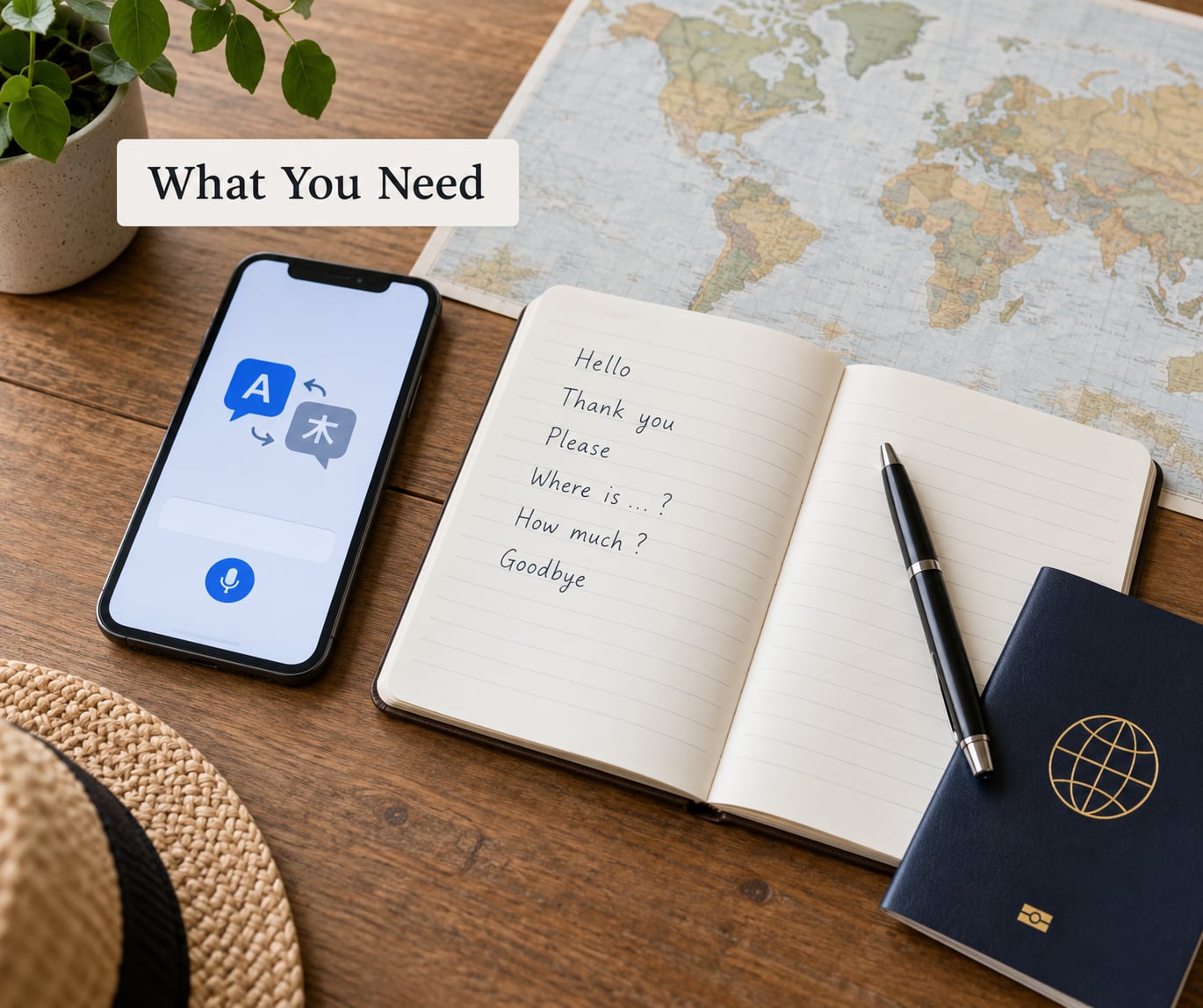
You need three things, and none of them are expensive in time or money. A phrase source with audio, somewhere to write your phrases down, and fifteen quiet minutes a day. That is the entire kit.
For the phrase source, any decent translation app with an offline language pack or a printed phrasebook works. Download the offline pack before you leave home, because the one airport where you need it is usually the one with the worst signal. A dictionary app that plays audio for each entry is better than a list-only phrasebook, since hearing the rhythm is half the battle.
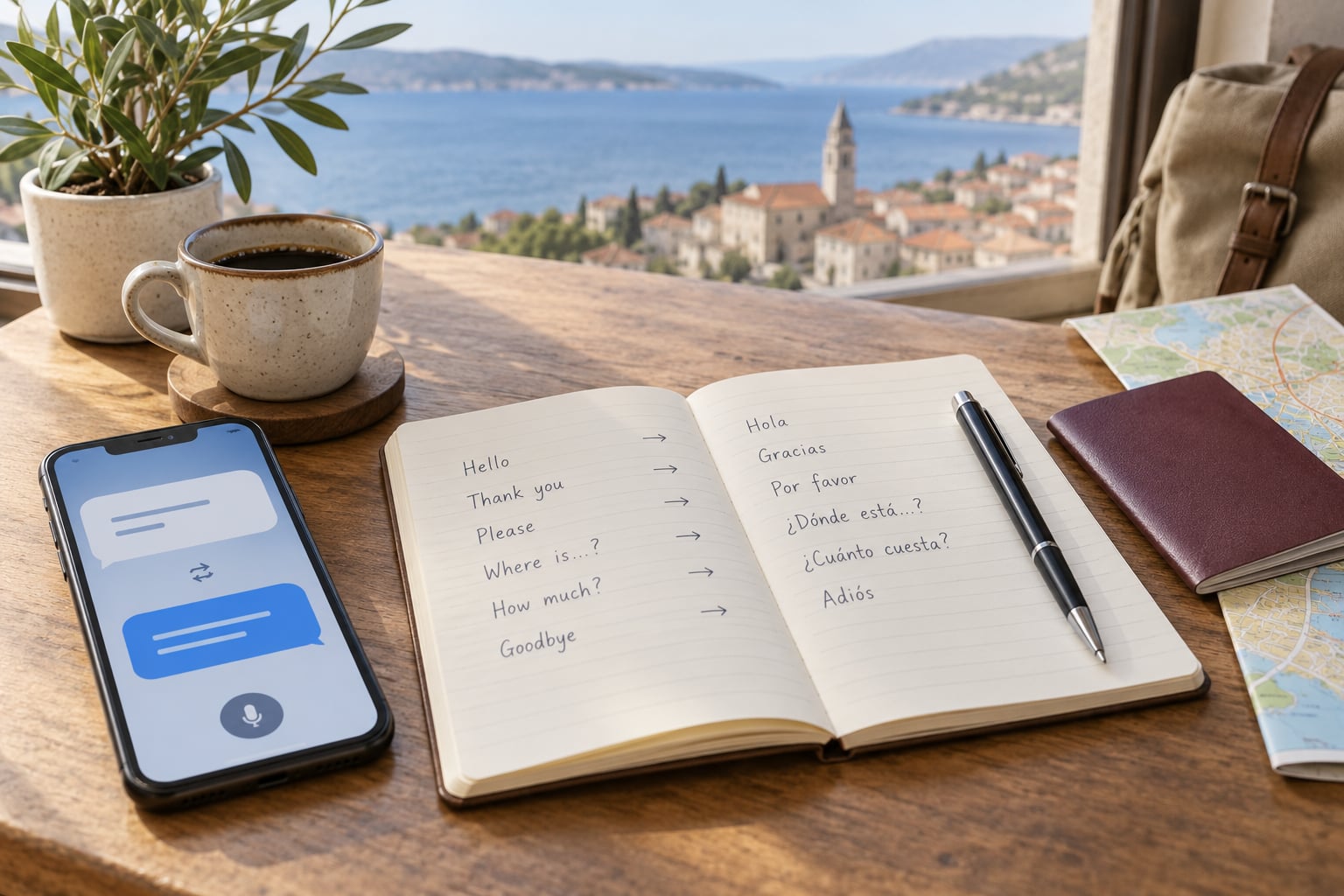
For writing, a paper notebook or a notes app on your phone. Paper has one small edge for travel: you can scribble a correction on a page and flip back to it in a queue without unlocking anything. Keep each phrase on its own line with the English meaning next to it, and add a note about where you will use it. That context note is what stops the phrase from evaporating three days later.
For pronunciation, use audio from the start. An audio-first method, whether that is a phrasebook with recordings or a spoken-lesson app, fixes the stress and the vowel sounds before bad habits set in. Writing the phrase phonetically in your own spelling helps too, the way people in language-learning forums describe, but only if you also hear it first.
Time estimate: a beginner with no prior study needs roughly 10 to 15 minutes daily for five to seven days to cover a focused list of 50 to 60 phrases. Fifteen extra minutes to write them out by hand roughly doubles what sticks. If you learn best from audio, the same phrases can ride along on your commute.
What you do not need is grammar mastery. You can go an entire trip on memorized sentences without knowing how to conjugate a verb, as long as you know who, where, how much, and what time.
Step-by-Step
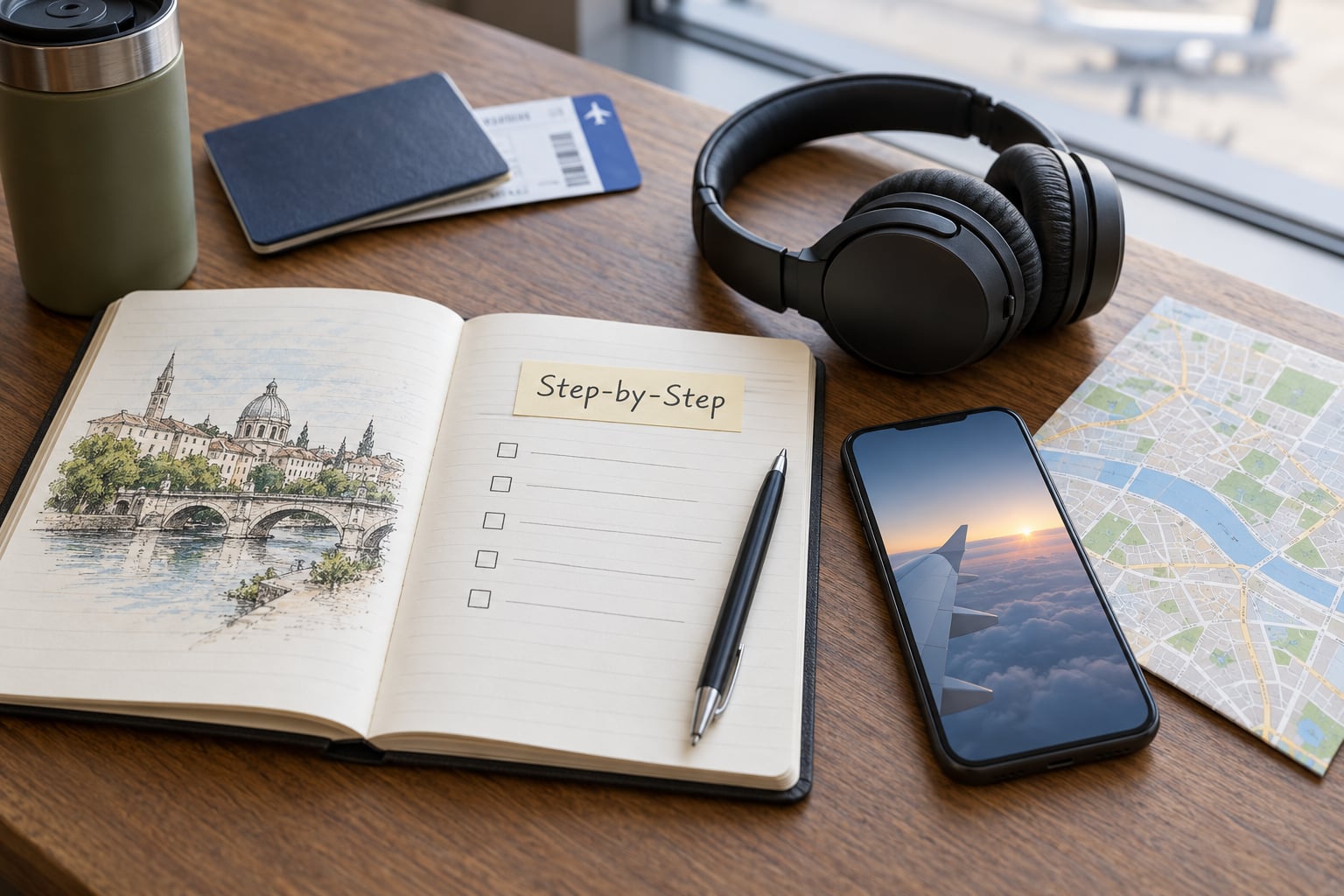
Seven steps, done in this order, take you from nothing to a usable travel kit. Each one has a clear signal that it worked, so you know when to move on.
Step 1: Pick three priority situations, not forty
Write down the three situations you are most likely to be in. For a city break that is usually directions, food, and check-in. For a beach trip it might be transport, buying sunscreen, and emergencies.
You will know it worked when you can name every situation your list covers without hesitating. Example: my Lisbon list was directions, a restaurant, and lost luggage, and that was the whole list.
Step 2: Learn greetings and courtesy words first
Start with hello, goodbye, thank you, please, excuse me, and a polite phrase such as do you speak English. These five or six words do more for how a conversation opens than anything else you will learn.
It worked when you can say the greeting to a shopkeeper and get a reply without switching to English. Courtesy words are also the fastest way to sound polite when your pronunciation is rough.
Step 3: Learn whole questions, never loose words
Isolated vocabulary is where most beginners stall, because a word only means something inside a sentence. Learn the question, not the noun. Instead of learning station, learn how do I get to the station.
It worked when you can ask a question you have never rehearsed by swapping one word. If you know how much is this and what time does it open, you can already handle a market, a museum, and a bus stop.
Step 4: Set up spaced repetition the same day
Put your phrases into a flashcard system the day you write them, and review on a widening schedule. New phrases come back the same day, then the next day, then around three days, then a week later. Free flashcard apps handle this automatically, and setting your daily review count low, maybe 20 cards, keeps you honest.
It worked when you notice yourself dreading a card, because that means it is close to the edge of your memory. That discomfort is the signal the schedule is working.
Step 5: Say every phrase out loud from day one
Reading silently feels fluent and teaches almost nothing about speech. Say each phrase aloud three times, once while imagining the situation where you will use it.
It worked when the sentence comes out faster than you can think about it. My test is whether I can say it without looking at the screen while standing up, which is roughly the state you are in at a ticket counter.
Step 6: Test your recall without looking
Cover the translation and try to produce the sentence, or hide the sentence and recall what it meant. Wrong answers are the useful part here; they tell you which cards to reschedule.
It worked when a full pass through 20 cards with no notes gives you 16 or more correct. Anything below that and the list is still too long for the time you have.
Step 7: Review in short bursts once you are traveling
Twenty minutes on a flight, a wait in an airport queue, and one session the morning you arrive is enough to keep the phrases live. Do this before the trip gets busy, because during it you will be busy.
It worked when a stranger responds to the phrase in the local language. That is the moment the phrases stop being study material and become communication.
Common Mistakes
Almost every stalled attempt comes down to method, not memory. Seven mistakes account for most of them, and each has a simple correction.
Memorizing single words. Fix: learn the full sentence that contains the word. A phrase is one item to review, not five.
Trying to learn 200 phrases at once. Fix: cap the list at 15 new phrases per session. A short list you finish is worth more than a long one you abandon.
Skipping pronunciation. Fix: play the audio before you say the phrase, every single time. Accents forgive a lot, but a mispronounced word can be the one word that gets misunderstood.
Translating literally. Fix: copy the phrase as a local would say it. Translating your English phrase word by word is how you end up asking a question that sounds confused.
Practicing silently. Fix: say everything out loud, even alone in your kitchen. Silent practice builds recognition, not speech, and recognition is not what you need at a counter.
Depending on one app. Fix: keep a paper or notes copy as a backup and download offline packs. Apps are excellent for daily review and terrible as your only plan when a phone dies or the data does not work.
Cramming the night before the flight. Fix: start seven days out, even at ten minutes a day. Ten minutes daily beats a two-hour panic session, because spaced review beats volume every time.
A few habits help more than any of the fixes. Attach each phrase to a physical place, so the one for the hotel lobby is learned while you picture a hotel lobby. Write new phrases in a different color from old ones so errors stand out on review. And say thank you out loud ten times a day, because it is the phrase you will use most and the one you will need most.
Frequently Asked Questions
How many basic travel phrases should a beginner learn?
About 50 to 60 phrases cover nearly every tourist situation, which is what language learners on Reddit and travel forums consistently report. Beginners should start smaller, at 15 per day, and split the list across three situations: greetings, transport and directions, and food or check-in. Add an emergency set of 10 as a separate group you review daily.
How long does it take to learn useful travel phrases?
For most beginners, five to seven days of 10 to 15 focused minutes a day. The first 20 phrases come together in an afternoon, and the confidence to use them usually arrives between days three and five. Longer stays can add conversational phrasing, but the practical survival set is finished long before most people expect.
Can I travel comfortably without knowing the local language?
Yes, with a translation app and some English, most tourists get through a trip. The limit shows up in places with no English at all, in smaller towns, and in situations an app cannot handle, like a pharmacy or a lost-luggage desk. Twenty phrases cover those gaps, and they also change how people treat you.
Which travel phrases are most important to learn first?
Greetings and courtesy words come first: hello, please, thank you, excuse me, and a version of do you speak English. Next come questions with a fixed shape, such as how much is this, where is the station, and what time does it open. Emergencies such as help, hospital, police, and I have an allergy should be reviewed daily.
What is the best way to practice travel phrases while traveling?
Short, repeated review sessions beat one long session. Twenty minutes on the flight, a few minutes in an airport queue, and one pass the morning you arrive is enough to keep phrases active. Say them out loud where you can, and use one deliberately each day, even something small like thank you at a café.
Conclusion
Start tonight, not the night before you fly. Write down five phrases, say each one aloud three times, and load them into a flashcard deck with a repeating review schedule. Add fifteen more the next day, in a single situation you will actually face.
Seven short sessions get you a travel kit you can use without thinking about it. Fifteen sentences, said out loud and reviewed on a spaced schedule, cover the overwhelming majority of what goes wrong and most of what goes right on a trip.
A small, practical vocabulary also makes a trip better for everyone around you. Locals notice the effort, and getting a simple question answered in their own language is a nicer experience for both sides of the counter.