Arrive at the airport 3 hours before your scheduled international departure. That single number is the right starting point for almost everyone, because international check-in involves document checks and a bag-drop deadline that domestic check-in does not. Two hours is workable for some itineraries, and three and a half to four hours is sensible from a busy hub in December. The rest of this guide is about working out which of those applies to you.
The confusion comes from the fact that “3 hours” is a comfort rule, not a physical law. It is built out of three real deadlines that most airlines publish: bag drop usually closes 45 to 60 minutes before departure, boarding typically starts 45 to 60 minutes before, and the gate closes 15 to 30 minutes before. Add the queues in front of each of those and you get the number. Once you can see the parts, you can decide where you actually need to be.
Table of Contents
- 1How Early Should You Arrive for an International Flight?
- 2Recommended Arrival Times by Airport and Situation
- 3What Determines How Long You Need at the Airport?
- 4How Airline Check-In and Bag Drop Affect Your Timing
- 5International vs. Domestic Departures
- 6How Early to Leave Home or the Hotel
- 7Special Cases That Require Extra Time
- 8Frequently Asked Questions
- 9Is 3 hours enough for an international flight?
- 10What time should I leave home for an international flight?
- 11Can I arrive at the airport only 2 hours before an international flight?
- 12How early should I arrive if I have checked luggage?
- 13What if my flight leaves from a busy or large airport?
- 14Does the airline’s boarding time tell me when to arrive at the airport?
- 15Conclusion
How Early Should You Arrive for an International Flight?
Three hours is the default answer. Two hours is defensible when the airport is quiet, you have already checked in online, you are travelling carry-on only and you know the terminal well. Four hours is worth considering for mega-hubs in peak season, a passport or visa problem, or any flight leaving before 8am.
| Situation | Arrive by | Why |
|---|---|---|
| Major hub, international, checked bag | 3.5 to 4 hours before | Long check-in and document queues, heavy security lanes |
| Major hub, international, carry-on only, checked in online | 3 hours before | Slack is enough even when security is long |
| Smaller regional airport with international service | 2.5 to 3 hours before | Shorter queues, fewer transfer checks |
| Evening or late-night departure, weekdays | 2 to 2.5 hours before | Terminals thin out after the morning bank |
| Early morning departure (before 8am) | 3 hours before, but check desk opening | Desks often open later than the 3-hour mark |
| Holiday peak, family or group with strollers | 4 hours before | Crowds plus equipment check-in |
| Known airport, PreCheck or CLEAR, carry-on only | 90 minutes to 2 hours before | Everything is already done online |
| Separate terminal security or immigration screening | Add 30 to 60 minutes | Extra checkpoint before the main terminal |
One thing worth noting about the early-morning row: arriving three hours before a 6am flight means turning up at 3am to an airport whose check-in desks may not open until 4:30am. Travellers describe this exact scene regularly on travel forums, sitting on the floor with their bags. Check your airline’s desk opening time before you commit to a 3am arrival.
Recommended Arrival Times by Airport and Situation
Airport size changes the answer more than most people expect. A single-terminal regional airport handling a couple of international departures an hour moves people through quickly. JFK Terminal 4, ORD Terminal 5, EWR and LAX do not, particularly in the 6am to 10am window when several wide-body departures overlap.
Travellers on city-specific forums like r/LAX routinely recommend 3.5 to 4 hours from that airport specifically, because of the walk between terminals and the long queues for international carriers. At smaller regionals, experienced travellers regularly target 2 hours when checked in online with no bags, and the Tripadvisor Air Travel boards split into 3-hour advocates and “overkill” dissenters along exactly that line.
Connections work differently. When you are already flying and connecting internationally, the relevant number is the minimum connection time published for that itinerary, which can be as tight as an hour at some hubs. Add the published connection time to the time you land, and aim to be at the connection point with about 45 minutes to spare.
What Determines How Long You Need at the Airport?
Eight things move the number around, and they are worth checking before you pick a time.
- Airport size and layout. Walking distance from parking or the train to the gate can add 15 to 25 minutes at large airports.
- Time of day. The morning bank between roughly 6am and 10am is the busiest stretch of the day at most hubs.
- Airline processing. Some carriers publish stricter bag-drop cut-offs than others, and low-cost airlines are usually the strictest.
- Security queue length. PreCheck or CLEAR membership shortens this noticeably; without it, a 30-minute wait is ordinary on a busy morning.
- Passport control. Departures from airports where immigration processes outbound passengers add a checkpoint that domestic travellers never see.
- Checked baggage. One bag is a five-minute counter task. Five bags, or a golf bag, is a different queue.
- Boarding group priority. Group 1 often closes while group 4 is still filing on, so your gate arrival time depends on your seat.
- Peak travel periods. Late December, Easter and the last week of August add queues that are not there in October.
How Airline Check-In and Bag Drop Affect Your Timing
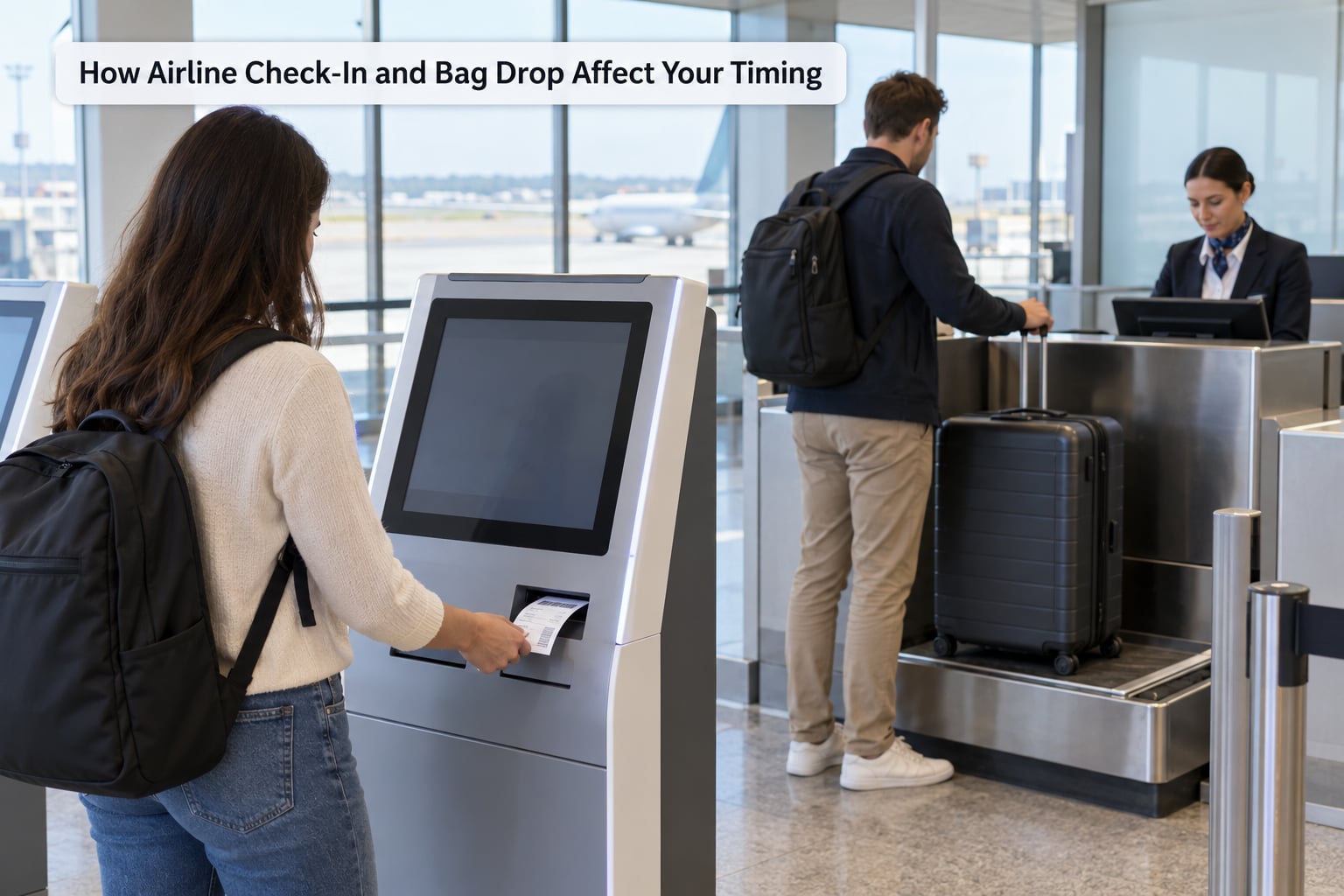
Online check-in opens 24 to 48 hours before most international departures and gives you a mobile boarding pass. That removes the counter queue, but it does not remove the deadline if you have checked baggage.
Anyone with a bag in the hold has to reach a bag-drop counter or kiosk, and that is where the first hard cut-off sits. Airlines commonly close bag drop 45 to 60 minutes before departure, and the range varies by carrier and route. The rule is simple: check the cut-off published by your airline for your specific flight, because it is the one number that ends the conversation.
There are situations where online check-in saves you nothing. A passport whose details do not match the booking, a visa question, a name spelled differently from your passport, or a destination requiring a paper arrival form will send you to a staffed desk regardless. Regular travellers in r/delta and r/unitedairlines check the bag-drop cut-off on the airline app rather than trusting a blog, which is exactly the right instinct.
If the flight is full, check-in desks can be slow even with an open queue, and bag handling delays at busy airports can stretch the drop process. Add time for those cases rather than assuming the fastest run you have ever seen is the normal one.
International vs. Domestic Departures
International departures take roughly an hour longer at the airport than domestic ones, and the extra time sits in specific places rather than being spread evenly.
First is document verification. An agent checks your passport against the booking, confirms visa and entry requirements, and asks about onward travel in some cases. That check does not exist on a domestic flight.
Second is the baggage deadline, which is typically earlier internationally because bags must be transferred to an onward carrier or loaded onto a long-haul aircraft on a tighter schedule. Third is security and immigration at the departure end, which varies widely by country and airport.
Fourth is boarding. Wide-body aircraft board more people in groups over a longer period, so the gate fills earlier and closes sooner. The result is not that 3 hours is universally correct, but that the same arrival time feels comfortable domestically and tight internationally.
How Early to Leave Home or the Hotel
Airport arrival time is only half the calculation. The rest is getting there, and this is where the 6am example becomes concrete.
Take a 6:00am international departure from an airport 45 minutes away. Your target is 3:00am at the terminal. If the drive is normally 40 minutes, leave at 2:00am to absorb traffic and the walk from parking. Add 15 minutes if the lot is a long way from the check-in hall, and 30 if you need to return a rental car. Realistically you are leaving home around 1:30am.
Other things that push the home departure earlier: airport construction and roadworks on the approach, a train or bus that runs less often overnight, holiday-week traffic, and any airport with a remote parking area served by a shuttle.
A useful rule: work backwards from the airport target rather than forwards from the check-in time. Set the airport arrival time first, then add the drive plus a 20 to 30 minute buffer for anything that goes wrong. People who plan backwards end up calm; people who plan forwards end up watching the clock at security.
Special Cases That Require Extra Time
Some travellers should ignore the three-hour default entirely.
- First international flight. Budget 3.5 to 4 hours. You will be slower at every step and may need a desk for questions.
- Early-morning departures. Check when desks open. Arriving to a locked check-in hall wastes the buffer.
- Groups and tour charters. Ten people on one reservation get processed individually. Add 30 minutes or more.
- Families with children and strollers. Strollers are checked at the gate or the counter, boarding groups for children are usually early, and you are carrying more.
- Passengers with reduced mobility. Some airports route through a longer accessible security channel. Check the airport’s own guidance.
- Unaccompanied minors. Airlines require formal handover at the gate well before boarding closes, and the parent has to stay until the aircraft departs.
- Service animals. Document checks take longer and relief areas may be outside the terminal.
- Checked sporting or oversized equipment. Golf clubs, skis and instruments often have their own earlier deadlines.
- Airports with separate screening. Some countries require passengers to clear security before entering the check-in hall, which adds 30 to 60 minutes before anything else starts.
Frequently Asked Questions
Is 3 hours enough for an international flight?
Yes, for most travellers and most airports, three hours covers check-in, bag drop, security and reaching the gate with roughly an hour of slack left. Add time from a large hub, in holiday weeks, with several checked bags, or if a document needs manual checking at the desk.
What time should I leave home for an international flight?
Work backwards from a three-hour airport target. If your flight leaves at 6am, aim to be at the terminal by 3am, then add your drive time plus 20 to 30 minutes for traffic, parking and walking. That usually means leaving home between 1:30am and 2:00am.
Can I arrive at the airport only 2 hours before an international flight?
Sometimes. Two hours is realistic if you checked in online, have carry-on only, know the airport, are not travelling at peak, and your security queue is short. It is not realistic from a mega-hub in December, with checked bags needing a counter, or on a flight leaving before 8am.
How early should I arrive if I have checked luggage?
Plan for the full three hours, and treat 45 to 60 minutes before departure as your real bag-drop deadline unless your airline publishes something else. Once that counter closes, checked bags usually cannot travel on the flight even if you are still airside with time to spare.
What if my flight leaves from a busy or large airport?
Move to 3.5 to 4 hours. Large international terminals add walking distance between parking, check-in and the gate, longer security lanes, and heavier document-check queues during the morning departure bank. City-specific traveller forums routinely recommend that range for JFK, EWR, ORD and LAX.
Does the airline’s boarding time tell me when to arrive at the airport?
No. Boarding is the last step, not the plan. It typically starts 45 to 60 minutes before departure and the gate closes 15 to 30 minutes before, which leaves no room for check-in, bag drop, security or a walk to a distant gate. Plan your arrival from the departure time instead.
Conclusion
Start with three hours before your scheduled international departure. Go earlier for mega-hubs, holiday weeks, early-morning flights, groups, checked sporting equipment and any document that needs manual checking. Go later only when you have checked in online, carry on only, know the terminal and are travelling off-peak.
Before you travel, open your airline’s app and read the bag-drop cut-off for your exact flight, along with the check-in desk opening time. That is the number that overrides everything in this guide. Then add your travel time to the airport arrival target, not just to the check-in or boarding time, and you will walk into the terminal with the buffer doing its job instead of you staring at the clock at security.