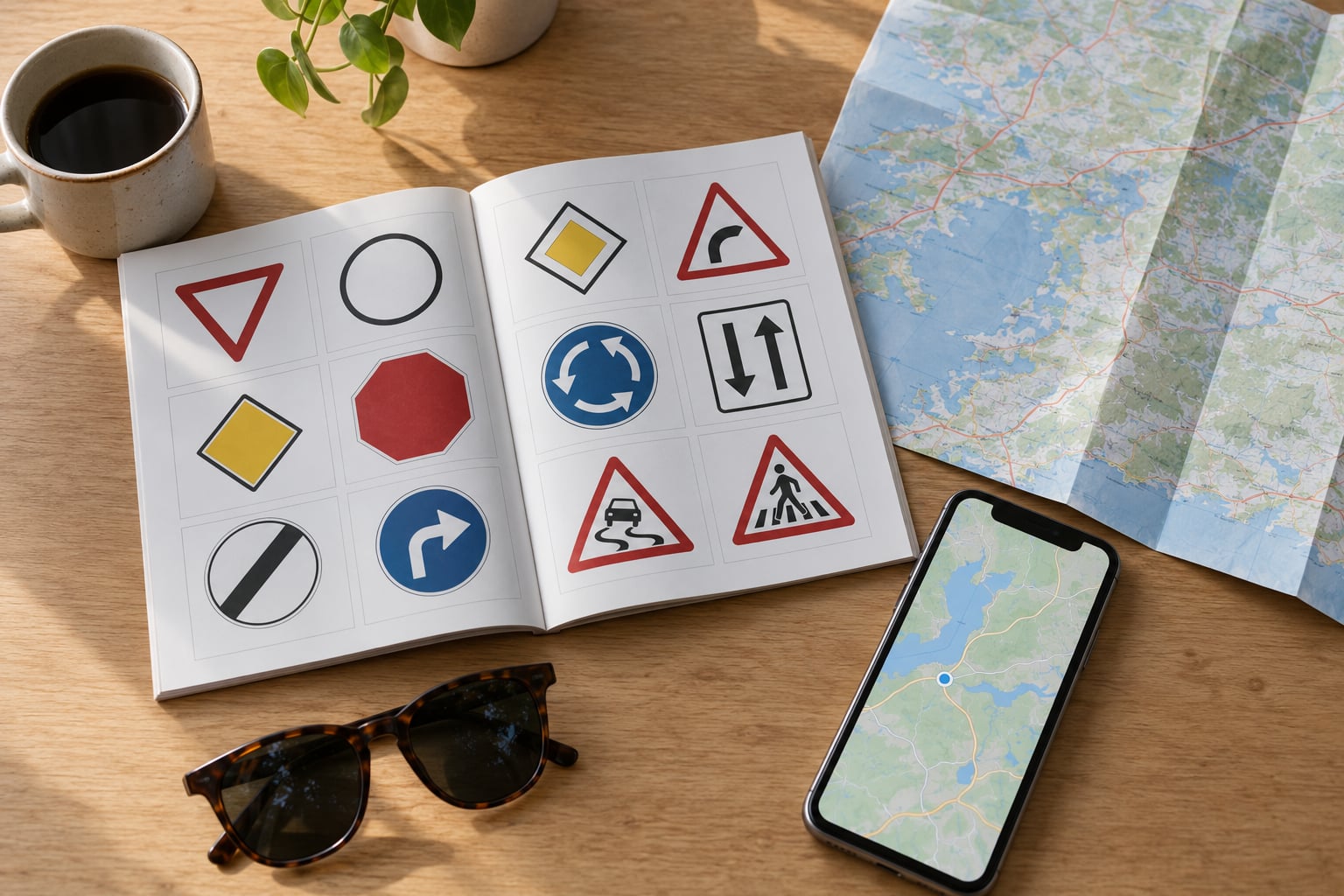
International road signs are a visual language rather than a written one: the shape and colour of a sign tell you what kind of instruction you are looking at before you read a single word, which is why most drivers can follow a road in a country whose language they do not speak. Learning how to read international road signs means fixing one order in your head — shape, then colour, then symbol, then words — and sticking to it every time. Twenty minutes of reading and one short practice routine before you collect the car is enough to remove most of the stress.
Table of Contents
- 1What You Need
- 2Step-by-Step
- 3Start With the Sign’s Shape and Colour
- 4Learn the Major International Sign Categories
- 5Read Symbols Before Words
- 6Check Supplemental Plates and Temporary Signs
- 7Account for Country-Specific Variations
- 8Build a Quick Recognition Habit
- 9Common Mistakes
- 10Frequently Asked Questions
- 11What are the meanings of international road signs?
- 12What does rappel mean on French roads?
- 13Do road signs mean the same thing in every country?
- 14What happens if I enter a low emission zone without a sticker?
- 15How do I know whether I am driving on the right or the left side of the road?
- 16Do I need an International Driving Permit to drive abroad?
- 17Conclusion
What You Need
You do not need to speak the local language. You do need a few things that make the first unfamiliar junction much less eventful, and the list is short.
- The destination’s official road code. Every national transport authority publishes one, usually as a free PDF or web page, and it is the only version of the rules that counts. Search for the country name plus “road code” or “highway code” and read the signs chapter, not the whole document.
- A phone with offline maps loaded. Download the region before you fly so navigation works with no signal. Its camera translation is useful for the word plates discussed below, but it is not a substitute for knowing the shapes.
- A translation app with an offline language pack. It is for words on supplementary plates — the small rectangles under a sign — and for the odd place-name, not for the main symbols.
- A printed or saved sign chart. One page of shapes and colours, screenshot on your phone and printed on paper. If the phone dies at a border crossing, the paper still works.
- Twenty minutes and a quiet spot. Sit somewhere calm and learn eight shapes. That is the whole preparation, and it covers the large majority of what you will meet on a road.
One more piece of paperwork deserves a sentence of its own. An International Driving Permit is a translation of your licence, not a licence, and it does nothing on its own. The countries that require one usually tie that requirement to your nationality rather than where you are driving, so check the destination’s official site before you book the rental car.
Step-by-Step
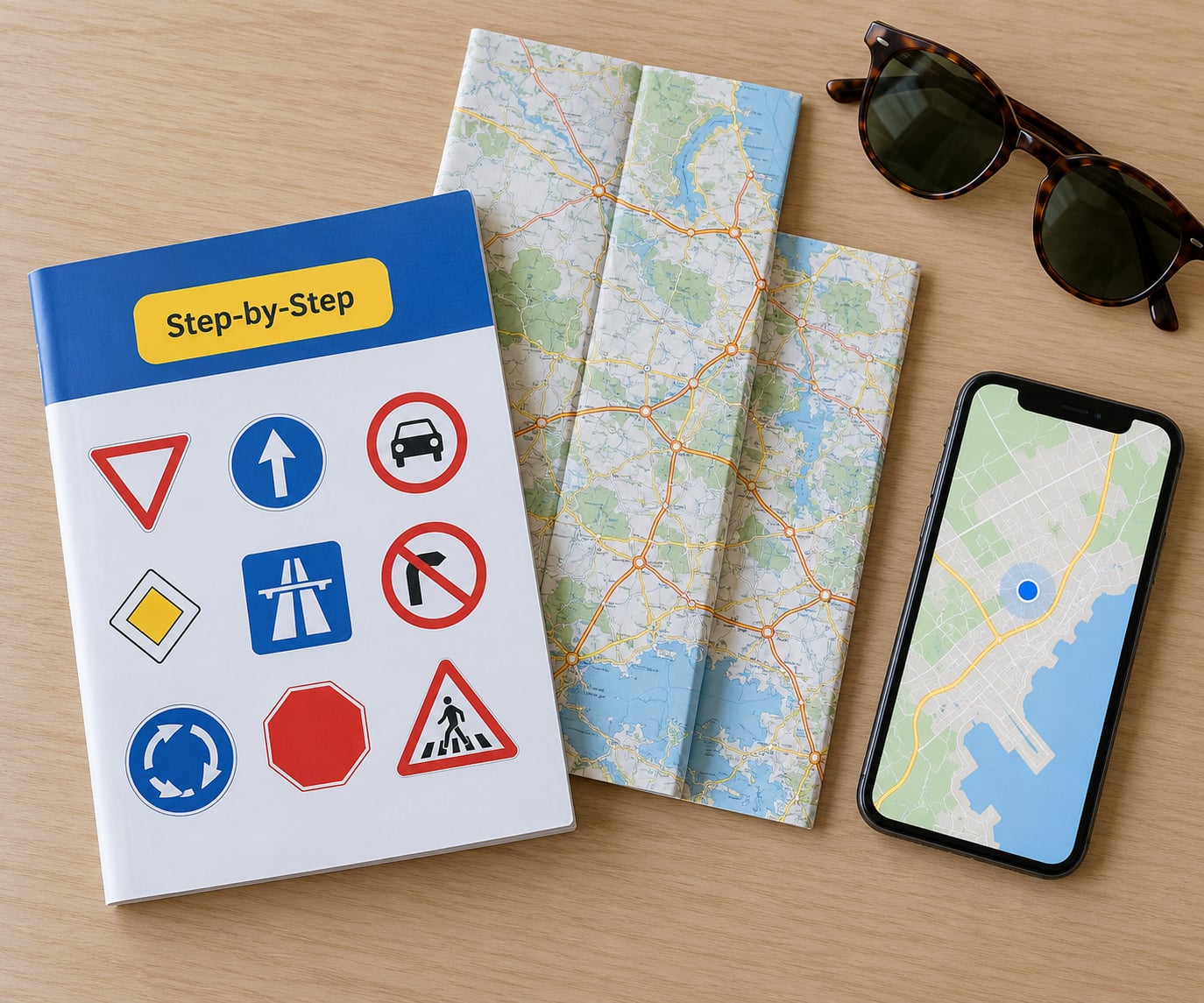
Reading a sign takes one second once the order is automatic. The six steps below build that order, and the last one is the habit that keeps you safe when a country throws something genuinely odd at you.
Start With the Sign’s Shape and Colour
Shape carries the instruction’s category, and colour narrows it down. Almost every sign in almost every country falls into one of the rows below, which is why drivers with no language still get the message right.
| Shape | Colour | What it means | Typical example |
|---|---|---|---|
| Triangle, point up | White or yellow field, red border | Warning: something is ahead | Slippery road, level crossing, roundabout ahead |
| Triangle, point down | White field with red border | Give way or yield | Junction, pedestrian crossing, mini roundabout |
| Circle with a red ring | White field, black symbol | Prohibition: this is forbidden | No entry, no overtaking, maximum speed |
| Circle, solid blue | Blue field, white symbol | Mandatory: you must do this | Keep left, ahead only, minimum speed |
| Octagon | Red field, white word or bar | Stop | Used in the Americas, Africa and much of Asia |
| Rectangle or square | Blue, green, white, black or brown | Information, direction or order | Motorway, one-way street, tourist attraction, parking |
| Diamond | Yellow field, black symbol | Warning, North American style | Same job as the red-bordered triangle |
| Diamond (square turned on its corner) | Yellow field, white border | Priority road, European style | The yellow lozenge you see on French and German minor roads |
Two things to take from that table. First, a red-bordered triangle warns while a red-ringed circle forbids — mixing those two up is the most common error I see from visitors. Second, colour alone tells you very little in isolation; the European give way sign is a red-bordered shape, and so is a warning sign, which is why the order starts with shape.
Learn the Major International Sign Categories
Five categories cover almost everything on the road. Warnings use a triangle and describe a hazard ahead rather than an instruction now. Prohibitions use a red-ringed circle and cancel something for the length of the zone, usually marked by a grey circle with black slashes at the end. Mandatory instructions use a solid blue circle and require an action: keep right, turn left ahead, minimum speed, roundabout only.
Priority signs decide who goes first, and they are the group that catches travellers out. Direction and information signs are rectangular, with colour carrying the type: blue for motorways and through routes, green for primary routes and motorway directions, white or black for local destinations, brown for tourist and cultural sites.
Two systems sit behind all of this. Most of Europe, plus Asia, Africa and the Americas to a large extent, follow the Vienna Convention on Road Signs and Signals agreed in 1968, drawn up by the United Nations Economic Commission for Europe. North America runs on the Manual on Uniform Traffic Control Devices instead, published by AASHTO, and it uses a different shape vocabulary while doing the same job. Understanding that there are two systems, not one global standard, is what stops you expecting a European sign to behave like an American one.
Read Symbols Before Words
A pictogram carries the meaning faster than a word, and on most signs it is the only content. Learn the ones you will meet in the first ten minutes of a rental: a walking figure for pedestrians, a bicycle for cycle routes, a fuel pump for a petrol station, a motorway symbol for a fast road, a red cross for a hospital, a hand holding coins for a toll point, and a ring of arrows for a roundabout.
Treat the symbol as a promise about the category, not the full rule. A fuel pump symbol tells you services are near, not that the station is open, and a toll symbol does not tell you whether you pay at a booth or by plate. Several countries also reuse the same picture with a different limit — a blue circle with a pedestrian can mean a mandatory shared path in one country and a zone in another — so check the destination’s legend rather than assuming a symbol is universal.
Check Supplemental Plates and Temporary Signs
The small rectangle bolted underneath a sign changes the sign, and it is the most commonly missed part of the whole system. Common plates give a distance in metres or kilometres, a time window with clock faces, a distance to the end of a zone, a road name, or a lane restriction when a plate sits over one lane rather than the whole carriageway.
Portable signs are the other half. Amber flashing lamps, temporary speed restrictions during roadworks, and roll-out boards for ice, flooding or a parade all carry the same shapes and colours as permanent signs, so the same reading order applies. Treat them as binding while they are there. A removed board no longer means anything, which sounds obvious and still surprises people who drive back the same road an hour later.
Account for Country-Specific Variations
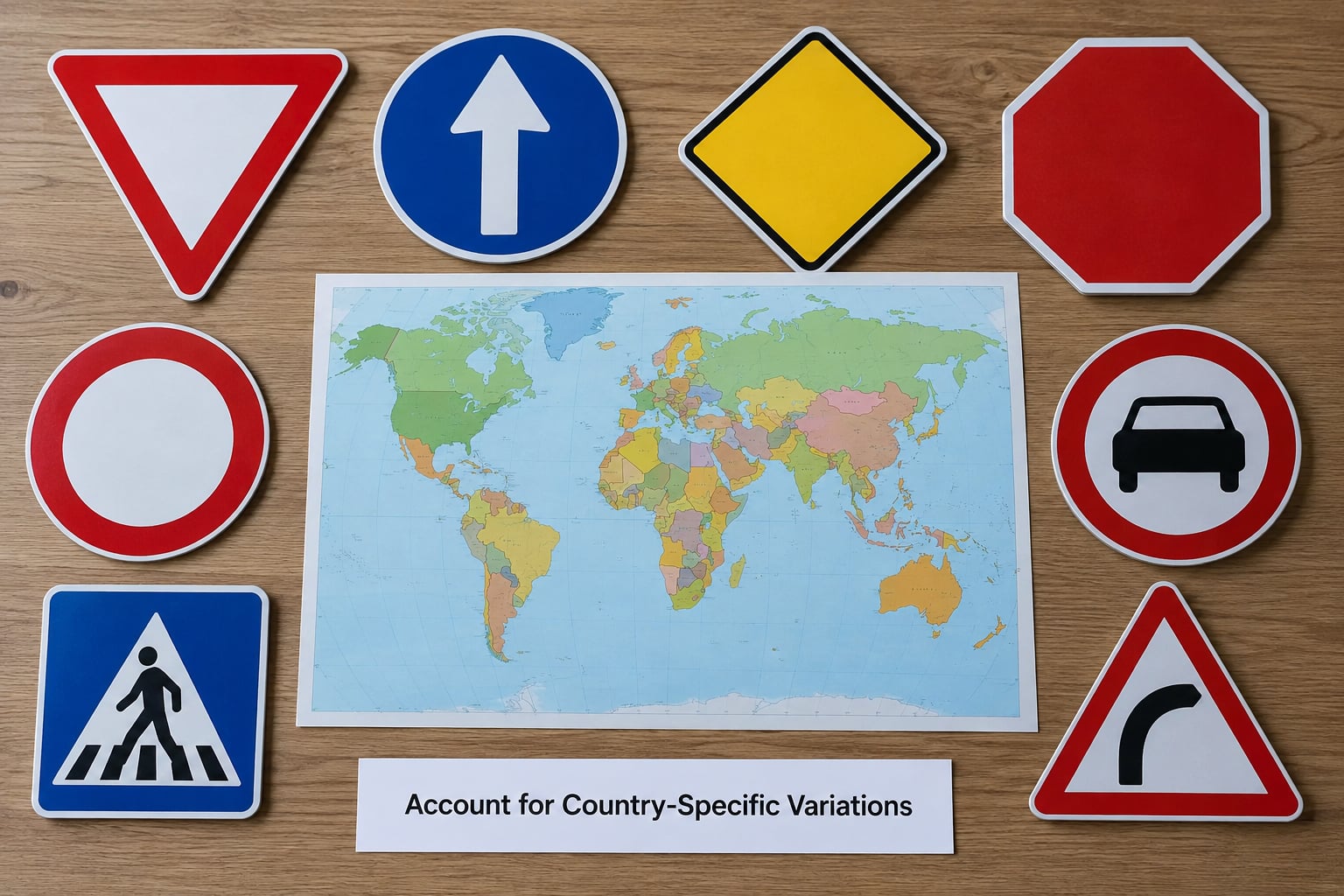
Same job, different vocabulary. Before crossing a border, know which of these four groups you are leaving, because the change is often immediate at the frontier.
| What it covers | United States and Canada | United Kingdom and Ireland | Continental Europe | Australia and New Zealand |
|---|---|---|---|---|
| Warning sign | Yellow diamond | Red-bordered triangle | Red-bordered triangle | Red-bordered triangle |
| Stop sign | Red octagon with the word | Octagon, word or bar | Octagon, word or bar | Octagon with the word |
| Give way | Point-down triangle, word YIELD | Inverted triangle, word GIVE WAY | Inverted triangle, usually unmarked | Inverted triangle, word GIVE WAY |
| Speed limit sign | White rectangle with the words SPEED LIMIT and a number, in mph | White circle with a black number, in mph | White circle with a black number, in km/h | White circle with a number, in km/h |
| Priority road | Not used; first to arrive goes | Not used; give way to traffic from the right | Yellow diamond, and priority to the right in France, Italy, Spain and Belgium | Not used |
The speed unit is the trap that produces the most expensive mistakes. A round white disc reading 50 in France is 50 km/h, while a 50 in Ohio is 50 mph. Typical posted limits worth knowing before you set off: France 50 in built-up areas, 80 on two-way rural roads and 130 on motorways, dropping to 110 in rain; Germany 50, 100 and an advisory 130 where unrestricted; Italy 50, 90 and 130; Spain 50, 90 and 120; Switzerland 50, 80 and 120; Austria 50, 100 and 130; the Netherlands 50, 80 and 100 to 130 by time and road. The UK and Ireland use 60 mph on single carriageways and 70 or 80 mph on dual carriageways and motorways. In the United States, interstate limits run mostly 65 to 80 mph, and Canada is typically 80 to 100 km/h. Local posted values always win over these national defaults.
Permit zones are the other regional difference worth memorising. Italy marks restricted historic city centres as a ZTL, a zona traffico limitato, monitored by cameras that read your plate at the entrance. France labels low-emission areas and attaches a Crit’Air windscreen sticker by emission band. Germany runs Umweltzonen where you need a green Umweltplakette on the windscreen. Spain sometimes adds a vado practitioner plate for residents only. A rental car may already carry the right sticker, so check at the counter rather than buying one you do not need.
Build a Quick Recognition Habit
Run the same five moves on every sign, at every speed, in every country. Name the shape and its category. Note the colour and what that colour narrows the category down to. Read the symbol, and ignore the language for now. Look beneath for a plate, or above for a lane arrow. Decide whether it is permanent or temporary.
When a sign genuinely will not resolve, the safe default beats a guess every time. Ease off the throttle, widen your view, and give yourself the two seconds it takes to read it. If that is not enough, signal early, pull into a safe place, and stop before working it out. Guessing at a sign is how people end up in the wrong lane, on the wrong side of a junction, or in a restricted zone they never meant to enter.
Common Mistakes
- Treating a red-bordered triangle as a prohibition. A triangle always looks ahead and warns. A prohibition is a circle with a red ring. Fix: ask shape before colour, every time.
- Trusting colour on its own. Yellow can mean warning in North America and priority road in Europe. Fix: read colour as a second clue layered on top of the shape, never as the first one.
- Skipping the plate underneath. A warning sign plus a distance plate changes the timing of the hazard, and a zone-end marker changes where the rule stops. Fix: always look below the main sign, even at speed.
- Assuming every symbol is universal. The picture is usually shared across borders, but the restrictions attached to it change. Fix: read the local legend once, in the language you cannot read, before the first long drive.
- Ignoring the units on a speed disc. 50 km/h is not 50 mph, and the difference is large. Fix: learn the posted defaults for the country and units for that country before you pick up the keys.
- Assuming priority rules carry across a border. France, Italy, Spain and Belgium apply priority to the right at unsigned junctions. Germany and the UK do not, and an American driver expecting right-of-way will eventually be wrong. Fix: treat every country border as a reset, and give way first until you have seen enough signs to know otherwise.
- Obeying a portable sign after it has gone. Temporary boards are legal only while they stand. Fix: the current sign on the road always overrides your memory of the last one.
Frequently Asked Questions
What are the meanings of international road signs?
Signs fall into a handful of categories that repeat across most of the world. Triangles warn, red-ringed circles prohibit, solid blue circles instruct, rectangles inform and direct, and an octagon means stop. Reading shape first, then colour, then the symbol, lets you get the meaning without translating anything.
What does rappel mean on French roads?
Rappel means reminder or repeat. It appears on a small plate, or as three stacked bars, next to a sign to warn that the same rule or hazard continues. Rappel 300 m under a priority sign tells you the sign applies again in 300 metres. It is a repetition, not a new rule, and it is easy to miss on a narrow French road.
Do road signs mean the same thing in every country?
Most do, and a few do not. The core categories are shared, but North America uses the MUTCD system with yellow diamond warnings and rectangular speed signs, while most of the rest of the world follows the Vienna Convention. Units, wording, priority rules and permit zones change at the border, so read the destination’s official road code once.
What happens if I enter a low emission zone without a sticker?
You can be fined, and the fine may reach you weeks later through the rental company, with an admin fee on top. Italy’s ZTL cameras read plates at the entrance, France uses Crit’Air bands, and Germany requires an Umweltplakette windscreen sticker. Check the car before you drive off, and read the zone signs on approach rather than assuming a city centre is unrestricted.
How do I know whether I am driving on the right or the left side of the road?
Look at the traffic, not at the signs. Cars already on the road tell you the rule, and one-way arrows, keep-left and keep-right blue circles, and the position of the steering wheel confirm it. The most common error for a driver crossing from a right-driving country to a left-driving one is turning into the wrong lane after a turn, so check after every junction.
Do I need an International Driving Permit to drive abroad?
It depends on your nationality, not on the country you are visiting. Many countries accept a valid home licence alone for short stays, while others require an International Driving Permit alongside it. The permit is a translation and never replaces your licence. Check the destination’s official transport authority before booking, because the requirement is legal and rentals can be refused without it.
Conclusion
Start with the destination’s own road code, not with a generic quiz, and learn eight shapes well enough to recognise them in the dark. That is how to read international road signs anywhere: everything else — colours, plates, unit conversions, permit zones — slots onto that base. Practise the order out loud on the walk back from the rental desk: shape, colour, symbol, words. Twenty minutes there removes most of the friction that drivers blame on the language.