If you want the short answer: what cruise ship cabins to avoid are staterooms positioned next to the ship’s machinery or its busiest public spaces — engine rooms low and aft, pool and buffet decks overhead, casino and nightclub floors above, elevator lobbies and stairwells in between — plus obstructed-view and connecting cabins that carry a built-in compromise. Where a cabin sits on the deck plan matters far more than the category printed on the brochure.
I learned this the expensive way, booking a starboard balcony I was proud of and then spending five nights listening to a deck-chair scraping overhead and a full dining room clearing itself at 10:30pm. A friend did the opposite and landed two decks up, midship, tucked between two passenger decks, and slept better than I did. Neither of us picked the wrong cabin category. We just read the deck plan badly.
The list below covers the ten cabin types cruisers regret most, along with who still enjoys them, because almost none of these is automatically bad. A budget booking and a mobility request can both point straight at cabins other travelers run from.
Table of Contents
- 1What Cruise Ship Cabins to Avoid at a Glance
- 21. Interior Cabins Without Windows
- 3Why interior cabins come up when people ask what cruise ship cabins to avoid
- 42. Obstructed-View Cabins
- 53. Cabins Directly Near the Engines or Machinery
- 6How to Tell Normal Vibration From a Defect
- 74. Cabins Close to Elevators, Stairs, and Public Rooms
- 85. Midship Cabins in High-Traffic Areas
- 96. Cabins with Connecting Doors
- 107. Cabins Near Family or Group Activities
- 118. Forward-Facing Cabins with Strong Motion
- 129. Aft Cabins Exposed to Wake or Wind Noise
- 1310. Cabins with Awkward Layouts or Minimal Storage
- 14Frequently Asked Questions
- 15What cruise ship cabins should I avoid if I am a light sleeper?
- 16Are interior cruise cabins always bad?
- 17Is a midship cabin quieter than a forward or aft cabin?
- 18How do I find the quietest cabin on a cruise ship?
- 19Are obstructed-view cruise cabins worth the price?
- 20How far should my cruise cabin be from the elevator?
- 21Conclusion
What Cruise Ship Cabins to Avoid at a Glance
Location beats category almost every time. The table gives you the main drawback of each cabin type, the kind of traveler who will still be happy there, and the location to book instead.
| Cabin type | Main drawback | Who may still enjoy it | Better alternative |
|---|---|---|---|
| Interior cabin with no window | No natural light, no fresh air, enclosed feel | Budget cruisers who spend most of the day ashore | Oceanview or exterior-facing balcony |
| Obstructed-view cabin | Lifeboat, steel wall or deck structure in front of the window | Anyone who cares about the balcony, not the view | A verified clear-view cabin on the same deck |
| Cabins near the engine room | Low hum and vibration, worst low and aft | Travelers who value cheap shore excursions over sleep | Midship cabin one or two decks higher |
| Cabins by elevators and stairwells | Foot traffic, elevator chimes, early announcements | Guests with limited mobility | One or two decks away from the lift lobby |
| Midship in a busy zone | Stability, but central corridor and dining noise | Motion-sensitive travelers who tolerate foot traffic | Midship on a quieter deck |
| Connecting-door cabins | Sound passes through the connecting door | Families or groups booking adjacent rooms | Non-connecting block, same deck |
| Near kids’ and teen clubs | Scheduled activity and running feet | Families travelling with children of that age | Forward or aft block away from clubs |
| Forward-facing cabins | More pitching and rolling in rough water | Travelers who want to watch the bow enter port | Midship cabin on a low deck |
| Aft cabins | Propeller wash, exhaust and wind noise on some routes | Guests who want tender access and easy dining | Aft but two decks up, or midship |
| Awkward layouts, minimal storage | Tight entry, no hanging space, odd bathroom position | Solo travelers who use the cabin for sleeping only | Larger cabin category or a wider beam |
Read the table as a starting point rather than a verdict. Ships differ so much that the same cabin number can be excellent on one hull and hopeless on another, which is why every item below ends with something you can actually check.
1. Interior Cabins Without Windows
An interior stateroom has no window, no daylight and no fresh air, and the room depends entirely on electric lighting to feel like a room rather than a corridor cupboard. Travelers who get bad motion sickness, who take a sedative to sleep, or who plan to spend hours in their cabin reading will notice the enclosure within a day. Cruisers who are ashore from breakfast to dinner often rate them as their favorite cabin of the trip.
Why interior cabins come up when people ask what cruise ship cabins to avoid
Because the issue is light and air, not money. An interior cabin is the cheapest berth on any ship, so it collects the travelers with the lowest tolerance for a room with no window: people who nap at midday, work from the cabin, or take a sleeping pill every night. If none of that describes you, the saving usually outweighs the missing glass.
Modern ships soften this considerably. Royal Caribbean’s Virtual Window panels and similar LED screens on some interior cabins look convincing on a dark sea day and obviously synthetic in bright daylight, so treat them as a partial fix, not a window. If you want light, book the oceanview one deck up and pay the difference deliberately rather than by accident.
2. Obstructed-View Cabins
An obstructed view means something solid sits between your window and the sea — a lifeboat, a steel bulkhead, a deck structure or a davit arm. Guests regularly report that an “obstructed oceanview” gave them nothing but the flank of a lifeboat, and several have said on Cruise Critic boards they would have preferred a plain inside cabin. What counts as obstructed changes by hull and sometimes by refit, so the label is not a reliable guide on its own.
The good news is that the information exists before you pay. Experienced posters on the Cruise Critic cabin selection boards note that blocked cabin numbers are usually marked on the cruise line’s own deck plan or in the brochure. Find that diagram, compare your cabin number against it, and if you are paying premium for an oceanview that turns out to face a lifeboat, ask for a different number rather than a category upgrade.
3. Cabins Directly Near the Engines or Machinery
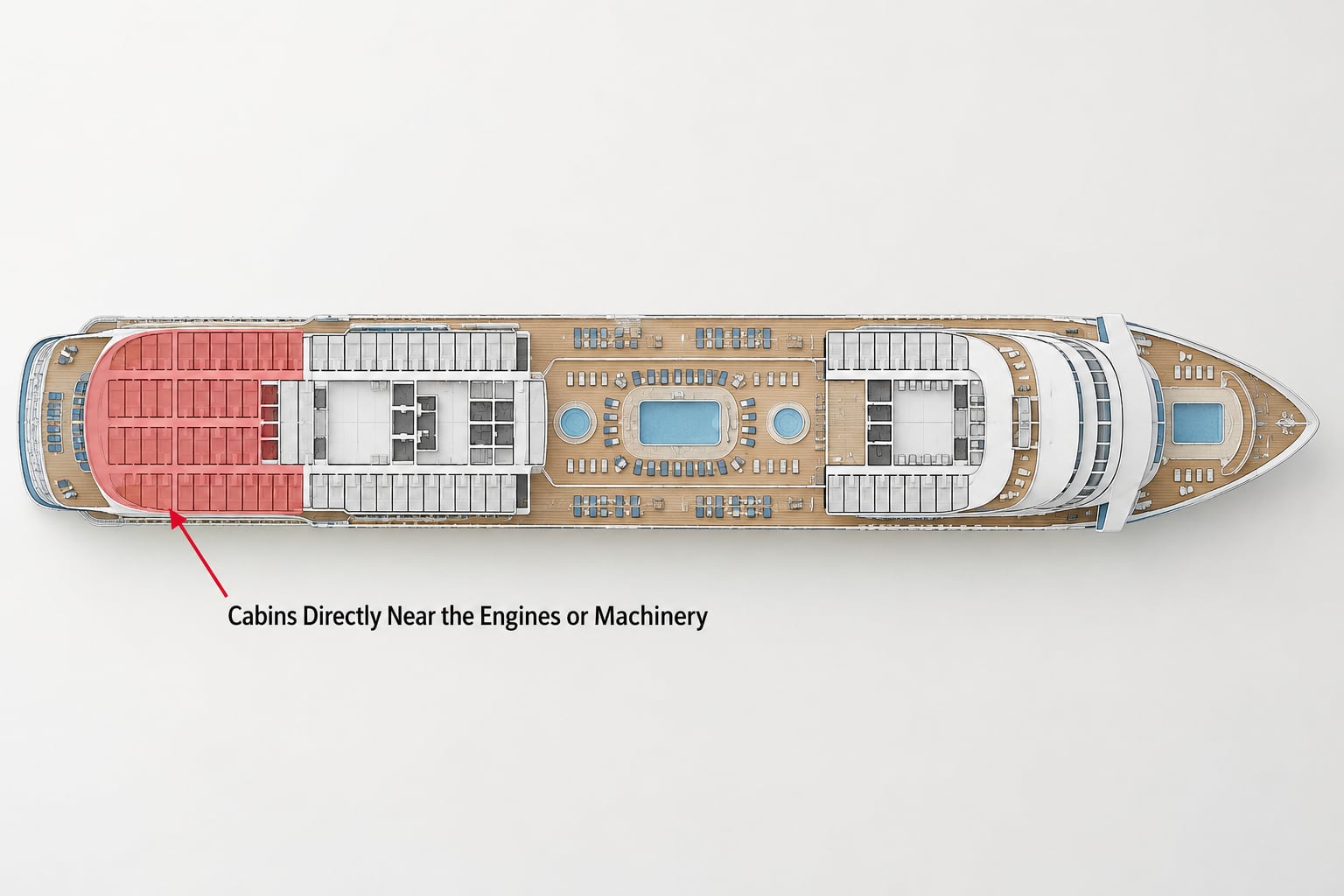
Engine noise lives low and toward the stern, so the cabins to avoid here are the lowest inside and oceanview cabins in the aft third of the ship. You may hear a steady hum, feel vibration through the bed frame, and notice it most clearly when the ship is underway at speed. Guests on Disney’s Disboards forum have long attributed persistent aft vibration to the engines, and the same complaint turns up ship after ship on Reddit’s r/DCL.
How to Tell Normal Vibration From a Defect
A faint low-frequency hum that comes and goes with the ship’s speed is normal on almost every vessel. What is not normal is a sharp rattle, a metallic knock that pulses with the engine, or vibration strong enough to rattle glasses on the desk. Report that to guest services on the first day and keep the note in your app, because it is handled far faster before the ship sails than at the end of the voyage.
The practical fix is simple. Move up one or two decks and toward midship. You lose a little of the lowest-deck charm and gain a calmer room.
4. Cabins Close to Elevators, Stairs, and Public Rooms
Cabins directly outside an elevator lobby or a stairwell inherit every footfall, elevator chime and door chime that comes with it. You also hear the daily announcements at close range, and housekeeping service starts early. Guests on Tripadvisor’s cruise forum split sharply on this one, with experienced travelers saying they deliberately book near the lifts to avoid long corridors, and light sleepers saying they would rather walk.
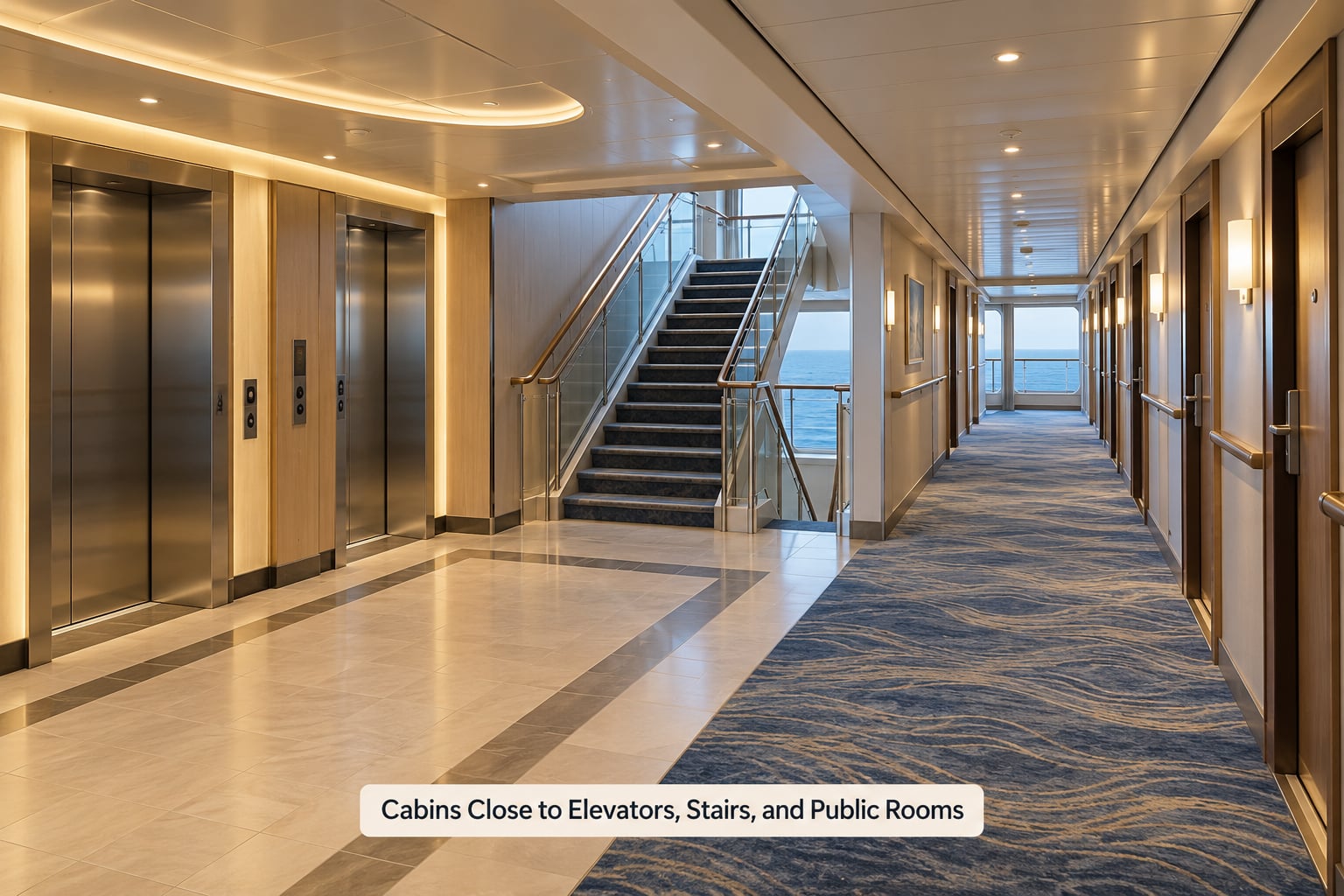
The compromise most people land on is one or two decks away from the lift rather than directly opposite it, which keeps walking short without putting a traffic hub against your door. For anyone using a wheelchair, a rollator or oxygen, a near-lift cabin is the correct choice, not the wrong one.
5. Midship Cabins in High-Traffic Areas
Midship is the most stable part of any ship and the best answer to seasickness, so it is never wrong advice on motion. The catch is that midship is also the middle of the ship, where the main corridor, the dining rooms, the theater and the service routes converge. A midship cabin on a busy deck can be quieter in terms of vibration and louder in terms of people.
Resolve the conflict by keeping midship and changing the deck. Look for a midship cabin on a deck without a venue stacked above it, and one that sits between two passenger decks rather than directly above a public space. That band of decks is where experienced cruisers consistently aim.
6. Cabins with Connecting Doors
A connecting cabin has an interior door to a neighboring stateroom, and that door is the weak point in the soundproofing between the two rooms. Voices, TV and late-night movement carry through it even when the connecting door is locked and carpeted. Families booking four rooms in a row often ask for this deliberately; solo travelers, couples and light sleepers should treat it as one of the more common regrets.
Check the deck plan for the connecting-door symbol before you pay, and ask the cruise line directly whether your specific cabin number has an active connecting door. If it does and you did not want one, request a room in a block without connecting doors — many ships offer whole non-connecting sections that are quieter for that reason alone.
7. Cabins Near Family or Group Activities
Cabins close to kids’ clubs, teen lounges, sports courts and group meeting rooms hear scheduled activity, not just random noise. Doors slamming, teenagers moving between rooms and the occasional early-morning floor show all arrive at the same hours every day. For families travelling with children of that exact age, that proximity saves a twenty-minute walk each way and is a genuine convenience.
For adults without children, couples and anyone on a honeymoon, pick a cabin in a different zone entirely rather than merely a deck away. On most ships the club areas sit in one identifiable block, so moving to the opposite third of the ship solves it faster than any amount of door-choosing.
8. Forward-Facing Cabins with Strong Motion
Forward cabins at the bow pitch into head seas, ride down heavy swells and transmit more movement than any other part of the ship, which makes them the cabins to avoid if you are prone to seasickness. Smaller and older ships exaggerate this because they have less hull length to soften the motion. They also pick up bow thruster vibration while docking, a specific complaint raised by guests in forward cabins on those vessels.
The bow does have one real advantage: you watch the ship enter every port from the front, and forward-facing rooms on large ships are often where the balconies are widest. If you want that and you are not motion-sensitive, it is a reasonable trade. If you get ill on ferries, treat forward as a skip.
9. Aft Cabins Exposed to Wake or Wind Noise
Aft cabins sit closest to the propellers and the waterline, so they pick up the low rumble of the wake, exhaust noise on some routes and stronger wind when the ship runs into weather. On itineraries with rough water or heavy wind, the aft staterooms get noticeably louder than midship. Aft placement is not automatically bad, though — it is often where tender access and dining convenience live.
Check the itinerary conditions and the deck plan together. If your sailing runs through an exposed stretch or a season known for heavy weather, move forward from the transom by a few cabins and up a deck. If your ship tenders at every port, an aft cabin may be worth more to you than quiet.
10. Cabins with Awkward Layouts or Minimal Storage
Some cabins are technically well located and still hard to live in: the door swings into the bed, the bathroom door opens onto the wardrobe, or the entry angle forces you sideways past the desk. Inside cabins on lower decks are the usual offenders, where designers fit a bathroom into space that has to be subtracted from the room. Minimal hanging space means unpacking into drawers and living out of a suitcase.
Look at the floor plan rather than the photo when the cruise line publishes one, and compare the square footage against the category. If a layout is awkward, a step up in category fixes it far more reliably than a change of deck.
Frequently Asked Questions
What cruise ship cabins should I avoid if I am a light sleeper?
Light sleepers should aim away from elevator lobbies and stairwells, cabins under the pool deck, buffet, casino or nightclub, cabins flanking crew stairs and service doors, and any room with an active connecting door. Choose one or two decks away from a lift, in a block flanked by two passenger decks, and confirm on the deck plan that no public venue sits directly above or below your cabin number.
Are interior cruise cabins always bad?
No. Inside cabins suit travelers who spend most of the day ashore and return mainly to sleep, and they are the least expensive way to take a cruise. They become a mistake for anyone who gets motion discomfort, takes a sedative at night, or plans long hours in the cabin. If natural light matters to you, an interior cabin without a virtual window is worth stepping up from.
Is a midship cabin quieter than a forward or aft cabin?
Usually yes. Midship sits furthest from the engines, the bow thruster and the propeller wash, so it usually carries the least machinery noise and vibration, and it also moves least in rough water. The exception is a midship cabin on a deck where the main dining room, theater or service corridors sit above or beside it, where foot traffic can beat hull noise.
How do I find the quietest cabin on a cruise ship?
Pull up the deck plan for your exact ship and sailing, then mark four things: the elevator and stair cores, the galley and buffet, the casino and nightclub, and the tender dock. Pick a band of decks with no venue stacked above or below, then choose a cabin one or two decks from a lift rather than beside it, and ask in writing for that cabin number before you finalize the booking.
Are obstructed-view cruise cabins worth the price?
They are worth it only if you want a balcony and care little about what you see from it. Obstructed cabins still give you outside seating and fresh air, so many guests are happy. Blocked cabin numbers are usually marked on the cruise line deck plan or brochure, so check before paying and ask for a clear-view cabin in the same category if yours is blocked.
How far should my cruise cabin be from the elevator?
For most guests, one deck away is the sweet spot. Far enough to avoid the lobby noise and early announcements, close enough that the walk to breakfast stays short on a large ship. Guests using a wheelchair, a rollator or oxygen should skip that rule entirely and book as close to a lift as the line allows, since easy access matters more than silence.
Conclusion
The worst cabin is not a type, it is a mismatch: engine noise for someone who needs silence, an obstructed balcony for someone who bought it for the view, a forward cabin for someone who gets seasick. Before you pay, sort out what cruise ship cabins to avoid means for your own sailing. Open the deck plan for that ship, find your cabin number, and check what sits above, below and beside it. Then ask for that number by name.