Cruise dining times are assigned when you book, not on the day you board. You pick a dining style and an early or late seating, the cruise line holds that slot, and the confirmed time prints on your guest card at embarkation. Table numbers are a separate thing, handled onboard by the maître d’.
Most people who get unhappy about dinner seating are not unhappy about the food. They booked late, never picked a preference, or assumed a request had gone through, and ended up with the last seating of the night. This guide walks through where how cruise dining times are assigned actually breaks down, line by line, and what to do when the confirmed time does not work.
One more thing worth saying up front. Cruise lines do not use identical words for this. You will see assigned, set, traditional, first seating, main seating, flexible, open, anytime and My Time. Those all describe one of two systems, and mixing up the two is the source of most confusion on cruise forums.
Table of Contents
- 1How Cruise Dining Times Are Assigned
- 2The four-step assignment flow
- 3What the seating labels actually mean
- 4What Happens During Cruise Booking?
- 5Why a preferred time shows as unavailable
- 6Where the confirmation shows up
- 7Does Your Cabin Number Affect Your Dining Time?
- 8Why Can You Be Assigned a Different Time Than Your Choice?
- 9Typical early and late main dining room times by cruise line
- 10Can You Change Your Cruise Dining Time After Booking?
- 11Where to make the request, line by line
- 12What If You Need a Specific Dining Time?
- 13How Dining Assignments Work Once You’re Onboard
- 14Fixing a seating time after boarding
- 15Frequently Asked Questions
- 16Are cruise dining times assigned by cabin number?
- 17When will my cruise dining time be confirmed?
- 18Can my family or travel group request the same dining time?
- 19Can I change my assigned dining time once I am on the cruise?
- 20How do dietary restrictions affect cruise dining assignments?
- 21What should I do if I need an early or late dining time?
- 22Conclusion
How Cruise Dining Times Are Assigned
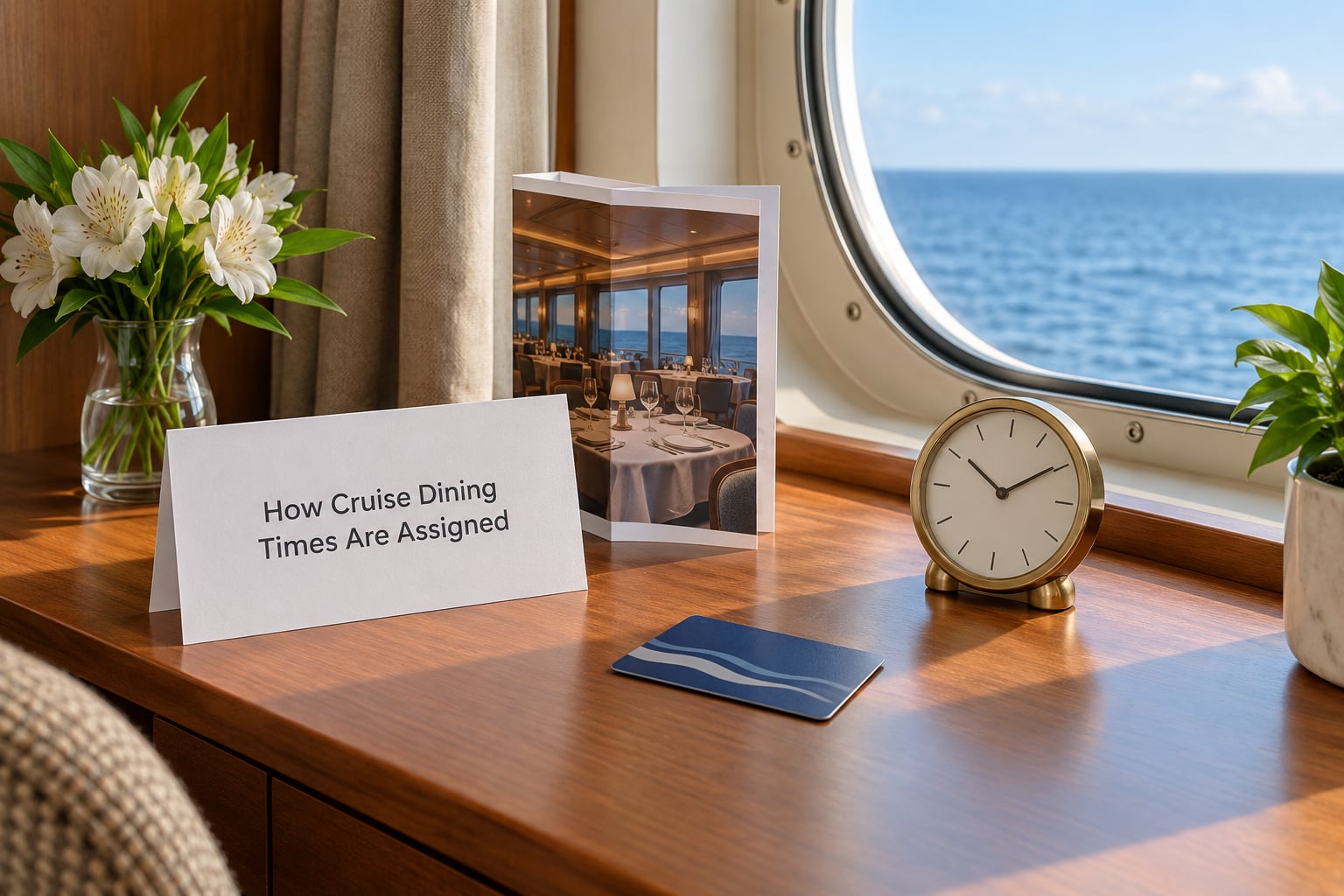
Two separate decisions are being made, and only one of them is yours. The dining time is assigned by the cruise line based on what you select at booking and what inventory is left. The table, its size and its location in the room are assigned onboard by the maître d’.
The four-step assignment flow
The whole process runs in four steps, and it happens across months rather than hours.
- Book. During checkout you select a dining style, and if it is a fixed-time style you select an early or late seating. This is the only step with real choice in it.
- Request. Shortly after booking, the line opens your reservation for changes in the cruise app or through your travel advisor. You can move your seating, switch styles if the line allows it, or join a waitlist.
- Confirm. A few weeks before sailing, the status of your request appears on your reservation or on your Cruise Contract, and then on the cruise app. A request that still shows as pending is not locked in.
- Guest card. When you board, your seating time and table number are printed on the guest card, the sail and shore card, or the equivalent cruise card the line uses. That printout is the operative answer.
What the seating labels actually mean
Labels differ by line, so read the description rather than the word. An assigned or set or traditional seating means one fixed time, the same table, often the same wait staff, every night. A flexible, open, anytime or My Time style means you book a slot inside a window that runs a few hours, and your table can change from night to night.
Some lines let you choose between the two at booking, some default you into one, and some ships only run one style. Royal Caribbean, for example, asks you to choose a single dining style for the whole sailing and will consider a change once, subject to availability.
What Happens During Cruise Booking?
At checkout you are asked for a dining preference before you are asked for almost anything else optional. The booking flow treats dining as a required attribute of the reservation, not an add-on, which is why the screens move so quickly past it.
On a traditional-assignment cruise, the booking screen usually offers two or three fixed times and nothing else. Disney, for instance, sells the Main Seating at 5:45 PM and the Second Seating at 8:15 PM, and you pick one. On an anytime-style cruise, the screen offers a range and you pick a starting point inside it.
Why a preferred time shows as unavailable
Each seating is a finite block of tables with a finite number of seats behind them. The line will not oversell it, because an overbooked dining room turns into a dinner shift nobody enjoys.
Early seating is the block that disappears first. It has fewer tables behind it in most dining rooms, and it is the one people with early-riser habits want, so it books out while later-season inventory is still wide open. By the time a sailing is half full, the second or late seating is often the only thing left to hand out.
Party size matters too. A block of six adjacent tables can disappear faster than six scattered ones, so a large group booking can find a nominally available time that will not seat them together.
Where the confirmation shows up
Confirmation lands in one of three places depending on the line: the cruise app, the online reservation page under a dining or preferences tab, or the Cruise Contract document, which is what Holland America uses for seating request status. If you booked through a travel advisor, the advisor can usually see the same status and change it for you.
Check it in the app a few weeks out and again the week before. A waitlist entry looks nothing like a confirmed seating, and the two get confused constantly.
Does Your Cabin Number Affect Your Dining Time?
Sort of, and less than most people assume. Deck location affects which dining room you are assigned to and can affect which block of tables feeds it, but the time you are given is driven by availability rather than by your cabin number.
What people notice is that guests on nearby decks sometimes end up with the same seating time. That is a side effect of how the dining rooms are fed, not a rule that your cabin dictates your dinner hour.
The distinction matters more on flexible-style cruises. There, the line can be more relaxed about keeping guests in the same room, which means guests from different decks and different cabin categories can end up sharing a table. Holland America states it plainly in its own dining FAQ: table number and table size are assigned by the maître d’ on board, not chosen online.
So the honest answer is that your cabin is a minor input, never a guarantee. If a specific time matters, request it like anyone else would.
Why Can You Be Assigned a Different Time Than Your Choice?
Because a preference is a request against a finite block of inventory. Availability wins every time, and it wins quietly. You will usually get a notification that your original choice was not available and a second option attached to it.
The common reasons, roughly in order of how often they bite:
- You booked late. The early block was full before you looked at it.
- You never chose at all. Skipping the dining step leaves the line to allocate whatever is left, which is usually the last seating. Forum complaints about being handed 8:00 or 8:30 PM almost always trace back to this.
- Party size. Large parties need contiguous tables, and contiguous inventory runs out first.
- Accessibility needs. Guests needing accessible seating are placed deliberately, sometimes away from the requested block, and the line treats that as non-negotiable.
- Dietary or medical requirements. Some meals are prepared only for certain seatings or only after a certain cut-off, so your slot is matched to the kitchen’s production schedule.
- Special events. A formal night, a party, a private dinner or a group block can absorb an entire seating and push affected guests later.
- Occupancy. A fuller ship means tighter blocks and more last seating by default.
- Operational balancing. The line spreads guests across the two seatings evenly to keep both services staffed properly.
That last one is the piece people miss. The line is not trying to give you the time you wanted. It is trying to fill two services with roughly equal numbers of guests, servers and tables.
Typical early and late main dining room times by cruise line
Clock times shift by line, by ship and sometimes by season, so treat these as the shape of the day rather than a promise. Holland America notes that a sailing may adjust times by up to 30 minutes at the ship’s discretion.
| Cruise line | Early or first seating | Late or second seating | Style you choose at booking |
|---|---|---|---|
| Disney Cruise Line | 5:45 PM Main Seating | 8:15 PM Second Seating | Fixed time, one per night |
| Carnival | Typically 5:45 to 6:00 PM | Typically 8:00 to 8:30 PM | Assigned, with anytime also offered on many sailings |
| Royal Caribbean | Often around 5:30 to 6:00 PM | Often around 8:00 PM | Traditional assigned or My Time, one style per sailing |
| Holland America | Early pre-set slot | Late pre-set slot | Classic pre-set or flexible open |
| Celebrity | Earlier assigned slot | Later assigned slot | Assigned or anytime, depends on ship |
| Norwegian | Varies by ship | Varies by ship | Assigned seating or freestyle-style open dining |
| MSC | Earlier slot | Later slot | Assigned seating, with open options on many ships |
The pattern across all of them is the same. Early sits somewhere between 5:15 and 6:00 PM, late sits between 7:30 and 8:30 PM, and the late slot holds more people and stays open longer.
Can You Change Your Cruise Dining Time After Booking?
Yes, usually, and the window that matters is the one before you sail. Cruise lines will happily move a guest up or down for the whole cruise. They are much more guarded about moving a guest for two nights out of seven, because the fixed-seating system depends on a consistent table count.
Changes are free of charge in almost every case. The limit is inventory, not policy.
Where to make the request, line by line
Every major line lets you handle this in its own app, and the path is short once you know it.
- Royal Caribbean. Open My Royal Cruise, find the sailing, enter dining preferences and pick from the available slots. Royal Caribbean recommends reserving before you sail because times fill up. You pick one dining style, and a change is honored once if space exists.
- Carnival. In the Carnival app or on the reservation page, look for dining times under the sailing or the Plan section. Selecting a time there replaces whatever you left blank at booking.
- Disney. Use the Disney Cruise Line app or your travel planner. Seatings show as available, waitlisted or assigned, and a waitlist position means you get the next slot that opens.
- Holland America. Request through the app or your travel advisor, and check status on the Cruise Contract document. Flexible open dining needs no time at all; only classic pre-set needs a request.
- Norwegian, Celebrity and MSC. Each has a dining or reservations section in its app, and each lets you change an assigned slot while inventory remains.
What the line will ask for is simple: the booking reference, the sailing date and the specific time you want. If you are travelling with a group, say how many people and whether you need to sit together, because that is the detail that decides whether a slot is genuinely available to you.
A pending status is not a confirmation. It means the request is in the queue, and if nobody releases a table it may never clear. Check back, and treat anything still pending a week before departure as unresolved. Knowing how cruise dining times are assigned means treating that pending label as a warning rather than a maybe.
What If You Need a Specific Dining Time?
If a time is genuinely important rather than merely nice, be specific and be early. A request written as 6 PM when you need to be in a theatre seat by 7:30 PM gets treated differently from one that names the constraint.
Some steps that work.
- Make the request at booking, not after. The first wave of guests books the early block. Later is a request against leftovers.
- Name the reason if there is one. A mobility need, a dialysis schedule, a child who eats early, a show you have tickets for, or a morning departure where an 8:30 dinner is a problem. Lines handle documented constraints differently from preferences.
- Ask for the whole cruise, not one night. Asking for every night is a cleaner fit for the dining room’s planning than asking to shuffle single nights.
- Join the waitlist if the slot is closed. On fixed-seating lines a waitlist is the normal route to a full block, and if a slot opens you are moved into it. Treat it as genuinely uncertain, because cruisers report plenty of waitlist requests that simply never cleared.
- Watch what happens if you skip the request entirely. Leaving it blank is the single most reliable way to end up with the last seating, because that is the block the line holds in reserve for walk-up demand.
- Keep a backup plan. Know where the late-night food options are on your ship, whether that is a buffet window, a room service charge, or a venue that stays open. It is the safety net when a seating simply cannot move.
Groups need one extra step. Everyone in the party should be on the same reservation where possible, and everyone should pick the same time in the same session. Guests booked on separate reservations can be seated together, but they are far more likely to end up in different blocks.
How Dining Assignments Work Once You’re Onboard
Your guest card is the source of truth. It is printed or activated at embarkation and carries the seating time for the sailing, and on several lines the table number as well. Checking the card first saves a lot of guessing.
Cards get reprinted when something changes, which is why cruisers sometimes arrive at a dining room at an old time and are told the assignment moved. If the card and the app disagree, the card is what the maître d’ is working from.
Fixing a seating time after boarding
Once you are on board, the conversation happens with the maître d’ of your main dining room or with guest services, not with the app.
- Go to the main dining room outside service hours, usually in the late afternoon, and ask the maître d’ whether your seating can be changed.
- Guest services can also take the request and pass it along, which is the better route for anything involving accessibility, dietary needs or a group.
- Bring the specifics. Which nights, which time, why, and how many people. A vague ask gets a vague answer.
- Accept that a partial move is common. Getting two nights moved and losing the rest is a realistic outcome, and holding out for all seven can mean losing all seven.
What you should not expect is a same-night guarantee. On a ship that is already at capacity, the maître d’ can often shift a table within a service, but they cannot conjure a seat that does not exist. Ask early in the cruise rather than on the last night, because by then the dining rooms are running close to a fixed plan.
Specialty restaurants are the other release valve. If your main dining time is wrong but the food genuinely does not matter much, booking a handful of specialty nights and treating the main dining room loosely often produces a better week than fighting the seating chart every evening.
Frequently Asked Questions
Are cruise dining times assigned by cabin number?
Not really. Deck and cabin location can influence which dining room you are placed in and which group of tables it feeds, but the seating time itself comes from availability at the moment you book. Guests on nearby decks sometimes land in the same block, which makes it look like location drives the time. Table number and table size are always assigned onboard by the maitre d’.
When will my cruise dining time be confirmed?
Your confirmed time appears in the cruise line app or on your reservation a few weeks before sailing, and the operative version prints on your guest card when you board. Before that, a request can still show as pending, which means it is queued and not guaranteed. If you never chose a time at booking, the line assigns one and the app will show it once the allocation runs.
Can my family or travel group request the same dining time?
Usually, and it is far more likely if everyone sits on the same reservation or has linked bookings before you pick. Large parties need contiguous tables, and that inventory runs out before single seats do, so groups should choose their time earlier than a couple travelling alone. Guests on separate reservations can be seated together, but they are often placed in different blocks.
Can I change my assigned dining time once I am on the cruise?
Sometimes, and it depends on how full the dining room is. Ask the maitre d’ of your main dining room outside service hours, or take the request to guest services, especially for accessibility or dietary needs. Move requests are more likely early in the sailing than near the end, and a partial move across some nights is a common outcome.
How do dietary restrictions affect cruise dining assignments?
Mostly by producing the same effect as any other request: fewer available slots. Restricted menus are sometimes produced for certain seatings only, or only after a cut-off, so guests with allergies, low-sodium, diabetic, kosher or medical diets can be matched to a specific service rather than floating freely. Register the requirement at booking so it is on file before assignments are generated.
What should I do if I need an early or late dining time?
Ask at booking, in the app shortly afterwards, or through your travel advisor, and say why the time matters rather than only naming it. Join the waitlist if the early block is full, and remember it is not guaranteed. Never leave the field blank, because a blank request defaults to the last seating. Check the confirmed assignment a few weeks before you sail.
Conclusion
The short version of how cruise dining times are assigned: you choose at booking, the line allocates against limited inventory, early seating runs out first, and anything left blank defaults to the last seating of the night.
So record your preference during checkout, check the confirmed status in the app a few weeks before you sail, and contact the cruise line straight away if a specific time is essential. If you are already on board and the time is wrong, ask the maître d’ early in the cruise rather than on the last night.