Wondering why airlines overbook flights? It comes down to one fact: a seat that flies empty can never be resold, while most booked passengers do turn up. Each carrier forecasts its no-show rate for a route, sells that many extra tickets, and relies on fares plus a predictable compensation bill to break even.
It is a lawful practice built into the contract of carriage you accept when you buy a ticket, and on most days the forecast is right. When it is wrong, the airline has to pick someone to leave behind.
Table of Contents
- 1Why Airlines Overbook Flights: The Business Reasons
- 2How Airlines Estimate Passenger Demand
- 3No-Shows and Last-Minute Connections
- 4Aircraft Capacity and Schedule Constraints
- 5What Overbooking Does Not Mean
- 6How Airlines Decide Who May Be Denied Boarding
- 7What Happens When a Passenger Is Bumped
- 8Denied Boarding Compensation at a Glance
- 9Can You Avoid Being Overbooked?
- 10Frequently Asked Questions
- 11Does overbooking mean every airline flight is deliberately crowded?
- 12Can an airline deny me boarding even if I paid for a ticket and checked in on time?
- 13Do I get compensation if I volunteer to take a later flight?
- 14What happens to my luggage if I am bumped from an overbooked flight?
- 15Can I avoid an involuntary bump by choosing a cheaper fare?
- 16What to Do First If Your Flight Is Overbooked
Why Airlines Overbook Flights: The Business Reasons
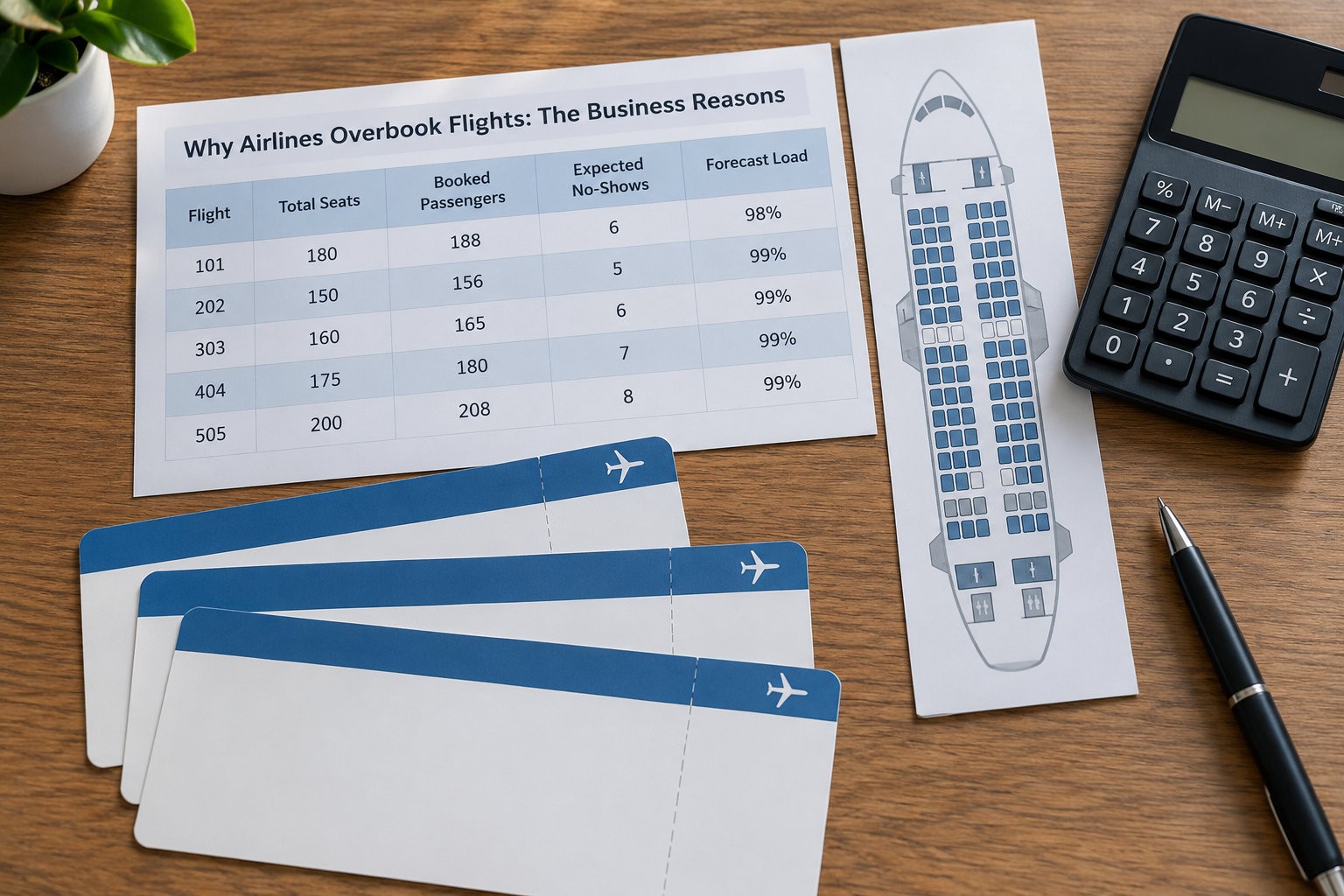
An empty seat is the worst outcome in the business. It pays nothing, costs fuel and crew, and disappears at the moment the door closes. A bumped passenger is expensive too, but the cost is bounded and predictable, which is what makes the gamble worth taking for most carriers.
- Not everyone who books flies. Plans change, connections break, and a share of ticketed passengers never reach the gate.
- A seat cannot be stored. Unlike freight, unsold capacity is gone the moment the aircraft departs.
- Cheap fares fund the system. Discount inventory makes the arithmetic work when load factors run high.
- Weather and cancellations reshuffle demand. A delay upstream sends more people onto the next flight than planned.
- Revenue management systems price the risk. Pricing and overbooking are set together, not separately.
- Connections are unpredictable. A late inbound flight leaves stranded passengers waiting for the next departure.
- Volunteers absorb the variance. Most overbooking problems are solved at the gate by people who agree to travel later.
How Airlines Estimate Passenger Demand
Demand forecasting runs on historical booking data, and the same route produces very different answers depending on the season. Airlines also model the connection pattern, the fare mix, how far ahead people booked, and how many tickets came through codeshare or partner channels.
Forecasts rarely produce one number. They produce a range, and the carrier sells the upper end on a high-demand flight and the lower end on a quiet one. That range is the whole game.
No-Shows and Last-Minute Connections
A no-show is a booked passenger who does not board. Rates vary widely by route, and some short domestic flights and late-night departures carry much higher no-show rates than others.
Connecting passengers make forecasting harder. A passenger booked onto a tight itinerary might not show at all if the inbound leg is delayed, cancelled or diverted. Forum threads on airline and travel boards describe exactly this pattern repeatedly: the booking looks solid, the connection fails, and the seat goes unused while someone with a confirmed ticket is asked to volunteer.
Aircraft Capacity and Schedule Constraints
A seat on the aircraft is a physical fact; a seat assigned to each ticketed passenger is a commercial assumption. One is fixed by the cabin layout and the safety limit on the type, the other floats with demand and pricing.
Schedules add their own pressure. Aircraft rotate between routes, crews and slots are hard to move, and a delay that eats into a later flight hurts more of the network than the single rotation it started on. Adding a departure is not an option that exists in an afternoon, which leaves overselling as one of the few levers left.
What Overbooking Does Not Mean
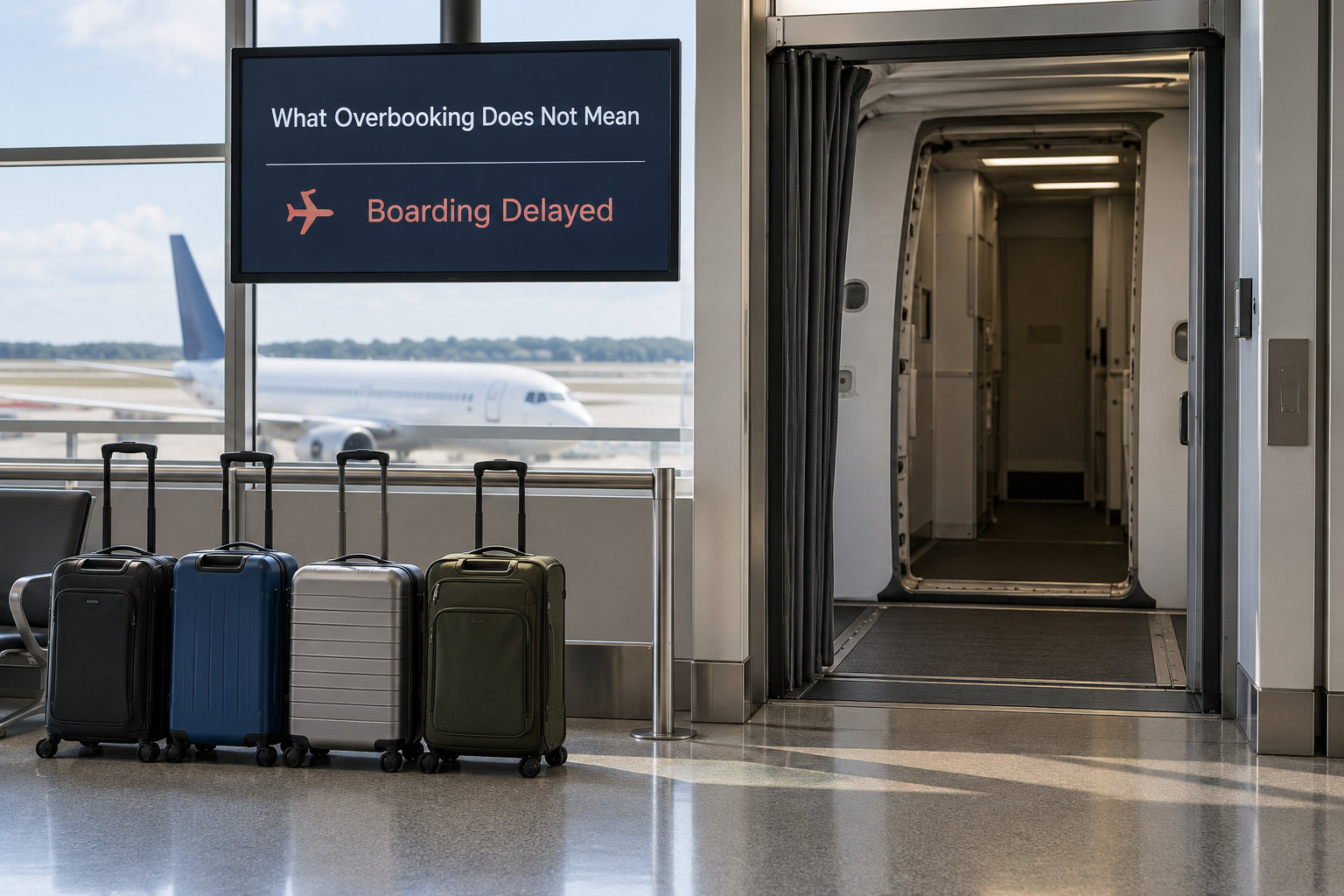
Overbooking does not mean every flight is deliberately packed past its limits. It does not mean a named airline overbooks more than every rival, since carriers do not publish their overbooking rates and most claims circulating online are community opinion rather than data. And it does not mean someone is guaranteed to be denied boarding on a given departure.
In practice, most overbooked flights board completely and nobody notices. Travel forum regulars make the same point: bumping is concentrated on particular routes and times rather than happening constantly.
How Airlines Decide Who May Be Denied Boarding
Airlines ask for volunteers first, and they are not choosing randomly among passengers left on the manifest. Gate agents work through a priority list that, in most carriers, weighs the factors below. The order varies by airline and route, and published policies are summaries rather than the full rule set.
| Factor | Why it matters | Risk if it goes wrong |
|---|---|---|
| Check-in time | Late check-in signals a passenger who may not be at the gate | Highest risk: the first group considered |
| Fare class | Basic and discount fares earn less and protect less | High, especially on unassigned-seat fares |
| Seat assignment | Passengers without an assigned seat are easier to move | High |
| Elite status and cabin | Loyalty members and premium cabins are protected | Low |
| Connecting itinerary | A later onward flight is easier to re-accommodate than a missed cruise | Medium, and deliberately used |
| Willingness to volunteer | People who want to travel later can be settled quickly | Depends on what is on offer |
The uncomfortable part for most travellers is that a later connection is treated as an advantage. Someone who still needs to be at a hotel, a cruise terminal or a meeting by morning is easier to move than a passenger going home for dinner.
What Happens When a Passenger Is Bumped
The process is the same almost everywhere: the gate agent announces that the flight is oversold, volunteers are asked for, and the airline only begins selecting passengers to deny boarding if the voluntary list is too short. Voluntary travellers get compensation in exchange for the seat and a confirmed seat on the next flight.
- The oversold flight is announced and the agent asks for volunteers, sometimes through the airline app or a board listing a destination and an inducement.
- Compensation is offered in the form of a later flight, a travel credit, a voucher, and sometimes meals and a hotel for an overnight delay.
- The gate works the priority list if nobody volunteers or not enough people step forward, starting with the lowest-ranked passengers.
- Boarding is denied last, and the passenger is put on the carrier’s list for the next available flight rather than simply left behind.
- Written confirmation is issued, naming the reason, the compensation and the onward booking. Ask for this document before you leave the gate.
In the United States, carriers that fall under the U.S. Department of Transportation oversales rule (14 CFR Part 250) must provide compensation for an involuntary denied boarding, and the amounts are framed as a percentage of the fare with a ceiling. Rules differ on international itineraries, where the Montreal Convention and the airline’s own conditions of carriage usually govern instead.
Denied Boarding Compensation at a Glance
The single most important distinction is whether you agreed to give up the seat. That choice changes the money, the paperwork and, in the United States, whether the payment is treated as taxable income.
| Point | Voluntary | Involuntary |
|---|---|---|
| What happened | You accepted a later flight in exchange for compensation | You were denied boarding after the airline chose you |
| Compensation | Whatever the airline offers: a voucher, travel credit or a free ticket, plus meals or a hotel | Defined by the applicable rules or the carrier’s policy, plus meals and a hotel for an overnight |
| Tax treatment in the US | Voluntary payments are generally treated as taxable income | Involuntary compensation is generally not taxable |
| Documents | Offer accepted in writing | Written statement of the reason and of what is owed |
| Choice | You can refuse and keep your seat | No choice; the seat is gone |
Departing from an EU airport changes the framework. EU Regulation 261/2004 sets fixed compensation for denied boarding of up to 600 EUR for long flights, 400 EUR for medium and long flights, and 250 EUR for short flights, plus care such as meals and a hotel and a right to reimbursement.
The widely repeated claim that EU261 pays 3,000 percent of your ticket price is a distortion. The amounts are fixed, not a percentage of what you paid, so the ratio only looks enormous when the ticket was extremely cheap. A separate US comparison is worth keeping in view:
| Point | United States | Departing the EU (EU261) |
|---|---|---|
| Legal basis | 14 CFR Part 250 and the contract of carriage | EU Regulation 261/2004 |
| Compensation basis | Percentage of the fare, capped | Fixed amounts of 250, 400 or 600 EUR |
| Voluntary volunteers | Offer-based, generally taxable | Full compensation even when you volunteer, in most cases |
| Claim route | Carrier first, then a complaint to the U.S. DOT | Carrier first, then a national enforcement body or a court claim |
| Typical deadline | Short; complaints to the DOT are time-limited | Usually up to three years under national law |
Rules vary by country and by carrier and change over time, so treat this as orientation rather than a legal answer. Travel insurance that covers trip interruption or missed connections is worth checking before a big itinerary.
Can You Avoid Being Overbooked?
Nobody can guarantee a seat on a flight that is oversold by a miscount, but a few habits reduce your odds of ending up at the bottom of the priority list.
- Check in as early as your fare allows. Check-in time is one of the strongest signals in every published priority policy, and early check-in is free.
- Avoid unassigned-seat basic fares if your schedule is tight. Passengers without a seat are the easiest to move.
- Leave generous connection times. A protected onward reservation is harder to re-accommodate on short notice, but a tight one makes you the obvious candidate.
- Keep your app open on travel day. Several carriers push volunteer offers through the app before boarding, and the first to accept often takes the better option.
- Watch the flight status from the morning. A delay earlier in the day pushes more people onto your flight.
- Volunteer only with the terms in writing. Ask which flight you are on, what the compensation is, and what happens to your bag before you say yes.
- Ask for the written denied boarding statement before you leave the gate. Forum users say it is the document that makes a claim move later.
Frequently Asked Questions
Does overbooking mean every airline flight is deliberately crowded?
No. Overbooking is a forecasting decision applied per route and flight, and most flights that sell more seats than they hold still board everybody. The forecast only becomes visible when it fails. Bumping is concentrated on particular routes and times rather than happening on every departure, which is why regular flyers often go years without hearing an agent ask for volunteers.
Can an airline deny me boarding even if I paid for a ticket and checked in on time?
Yes, though it is the last option and not a random one. The airline must first ask for volunteers and only then select passengers using its priority rules, which commonly consider check-in time, fare class, seat assignment and elite status. Being denied boarding despite a paid ticket and a confirmed seat is permitted under the contract of carriage, and compensation rules then apply.
Do I get compensation if I volunteer to take a later flight?
You get whatever the airline offers, and the offers vary widely: a confirmed seat on a later flight, a travel credit, a voucher or a future ticket, sometimes with meals and a hotel for an overnight delay. In the United States, voluntary payments are generally treated as taxable income while involuntary compensation is not. If you are flying out of an EU airport, EU261 generally pays full compensation even when you volunteer.
What happens to my luggage if I am bumped from an overbooked flight?
Checked bags are normally transferred automatically to the new flight, so your bag follows your itinerary rather than your original seat. The risk is a bag that arrives after you do, which matters most on short connections or multi-city trips where you are changing hotels. Carry-on items come with you. Confirm the tag number and the new flight at the gate before you leave, and keep essentials in your personal item.
Can I avoid an involuntary bump by choosing a cheaper fare?
No, quite the opposite. Cheaper fares are the least protected in most airline priority rules, because they earn less and carry no assigned seat, which makes them the easiest to re-accommodate. Paying for a seat assignment, checking in early or holding an elite status all improve your position. The most protective cabin is rarely the one that gives you the most legroom.
What to Do First If Your Flight Is Overbooked
Stay available and stay calm. Approach the gate agent early rather than after the last boarding pass has been scanned, ask directly whether the flight is oversold and what the compensation looks like, and take the written statement naming the reason, the offer and the onward booking before you walk away.
Keep every receipt for a hotel, a meal or a replacement ticket, and note the time of every conversation. If the outcome is unacceptable, ask for the complaint process, and if you are flying out of the EU, look up the national enforcement body before you need it. That is also why airlines overbook flights: it works most days, and on the rare bad day the passenger who speaks up early usually comes out ahead.
Updated for October 2026.