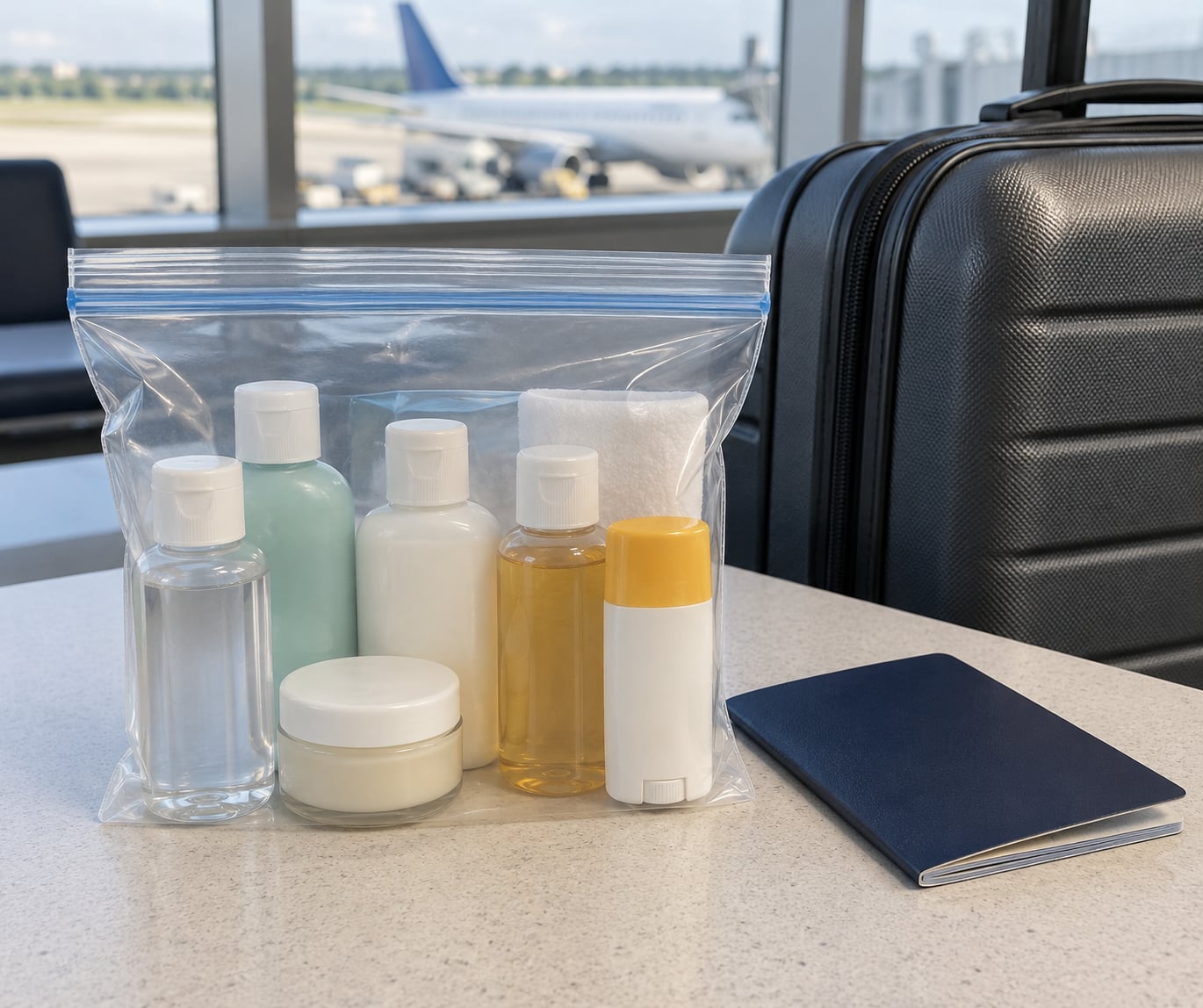
To pack liquids in a carry-on for a U.S. flight, every container must hold 3.4 ounces (100 milliliters) or less, and all of them must fit inside one clear, quart-sized resealable bag, one bag per passenger. The rule is written against the container’s printed capacity, not how full it is. Sorting first and measuring second takes about ten minutes and saves the bin at the checkpoint.
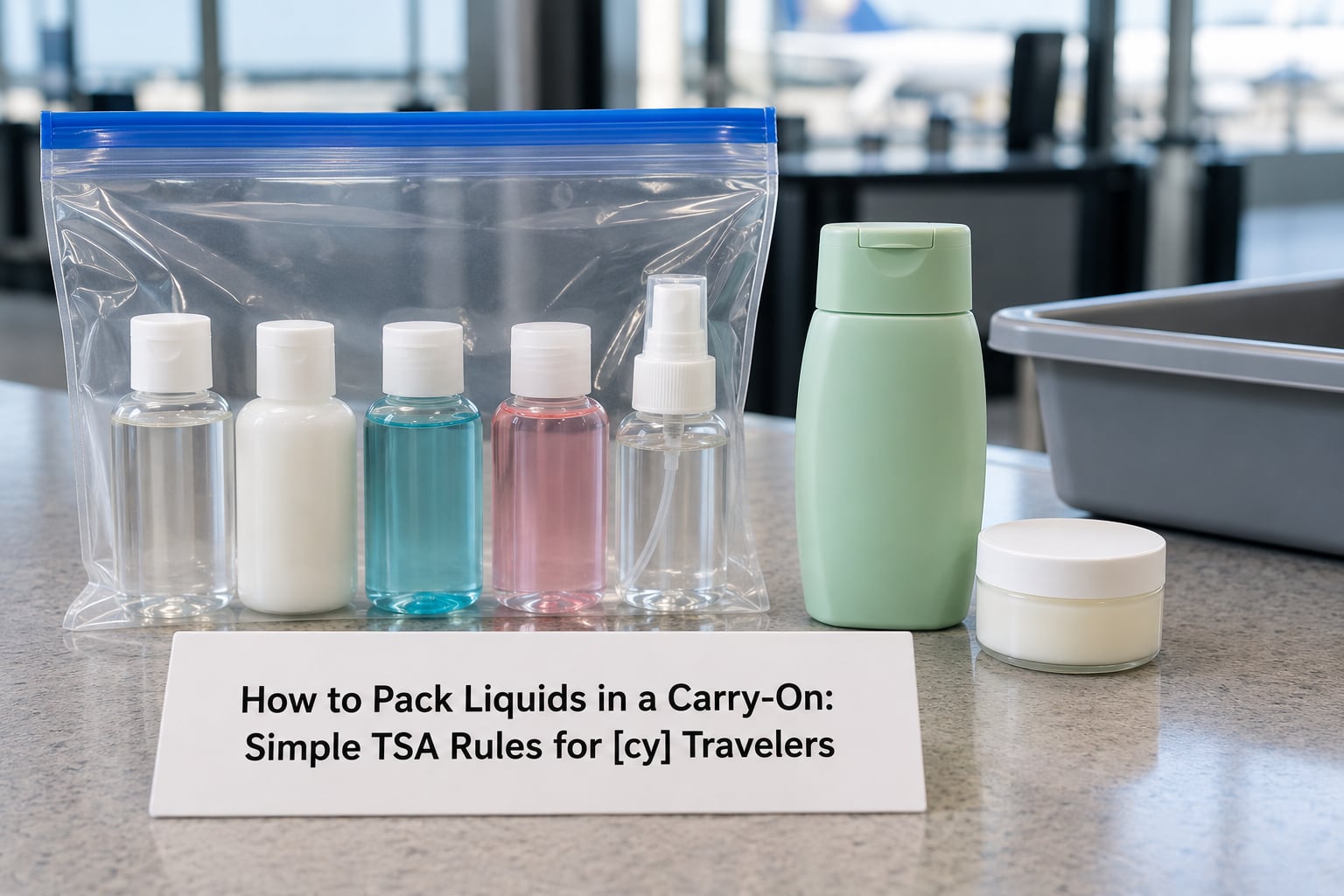
Table of Contents
- 1What You Need
- 2What counts as a liquid
- 3The exceptions, and when you must declare them
- 4Step-by-Step: How to Pack Liquids in a Carry-On
- 5Step 1: Sort Every Liquid Before You Pack
- 6Step 2: Check Each Container Size
- 7Step 3: Use a Clear Quart-Sized Liquids Bag
- 8Step 4: Protect Containers and Keep the Bag Accessible
- 9Step 5: Check Airport and Country Rules Before Travel
- 10Common Mistakes
- 11Frequently Asked Questions
- 12Can I bring a full-size bottle of shampoo in my carry-on?
- 13Does the 3.4-ounce liquid limit apply to the bottle or the liquid inside?
- 14Can I bring liquid medication through airport security?
- 15Are frozen liquid bottles allowed in a carry-on?
- 16Can I take liquids bought after security onto the plane?
- 17Do carry-on liquid rules differ when traveling internationally?
- 18Conclusion
What You Need
You need three things and nothing exotic: a clear, resealable bag that fits inside one quart of volume, containers printed at 3.4 ounces (100 mL) or smaller, and a way to see everything at a glance.
The bag has to be transparent and zip-top. It does not need to be branded, sold as a “travel bag,” or exactly quart-sized, though matching that size keeps the math easy. One bag covers all your liquids, and each passenger gets their own. A child with their own liquids gets their own bag, not a share of yours.
On containers, the printed capacity on the label is what matters. A pump bottle that says 3.4 oz passes even when the bottle is 90% air. A bottle that says 5 oz fails even if you have squeezed the last drop out. If a container has no printed volume, officers use their best judgment, which is not something you want to be testing at 6 a.m.
Labels are optional but genuinely useful. A strip of masking tape with the product name stops an officer from guessing, and it helps you find the sunscreen without dumping the bag at the checkpoint.
Before you travel, know that rules differ outside the United States and at individual airports. Most major airports follow a 100 mL standard, but some run CT scanners that screen larger containers, and a few countries set their own bag sizes. Verify before you pack, not at the gate.
What counts as a liquid
The category is wider than most travelers expect. Anything that flows, spreads or sprays gets treated as a liquid, gel or paste.
- Skincare and makeup: foundation, concealer, mascara, lipstick, gloss, primer, serum, toner, micellar water, facial oils, sheet-mask liquids, and spray tans
- Haircare: shampoo, conditioner, hair gel, hair oil, leave-in treatments, dry shampoo spray, edge control
- Oral care and deodorant: toothpaste, mouthwash, dental rinse, liquid soap, gel soap, deodorant, body spray
- Sun care: lotion, liquid sunscreen, after-sun gel, facial mist, setting spray
- Food and spreads: ketchup, mustard, mayonnaise, salad dressing, peanut butter, soup, oil, vinegar, sauce packets, honey, and anything that takes the shape of its container
- Medical and everyday: contact lens solution, saline, liquid vitamins, hand sanitizer, eye drops, e-cigarettes and their refill liquid
- Souvenirs: snow globes, sand, shells in a jar, anything sealed with visible liquid inside
The surprise items are what cause most checkpoint surprises. Contact lens solution, an unlabeled jar of face cream in a side pocket, and a snow globe from a gift shop all get pulled. Alcohol mini bottles under 3.4 oz clear security fine, though your airline, not the checkpoint, decides whether you may drink them onboard.
The exceptions, and when you must declare them
| Item | Size limit | Declare? | Notes |
|---|---|---|---|
| Prescription medication, liquid | Above 3.4 oz allowed | Yes | Keep in original labelled packaging; larger volumes may trigger extra screening |
| Over-the-counter liquid medicine | Above 3.4 oz allowed | Yes | Useful for long flights and travel-size limits |
| Breast milk | Above 3.4 oz allowed | Yes | Screened separately, often after other passengers |
| Infant formula and baby food | Above 3.4 oz allowed | Yes | Containers may need to be emptied for screening; bring a bottle for refills |
| Duty-free liquids bought after security | Above 3.4 oz allowed | No | Must stay sealed in the tamper-evident bag with the receipt inside, and survive re-screening at a connection |
| Frozen items and ice packs | Frozen solid allowed | No | Must be frozen solid at screening; partly melted slush counts as a liquid |
| Live fish and other live animals in liquid | Rules vary | Yes | Ask at the checkpoint before you pack |
Declaring is free and always worth doing. Officers use discretion, and a clean explanation rarely makes things worse.
Step-by-Step: How to Pack Liquids in a Carry-On
Step 1: Sort Every Liquid Before You Pack
Lay the whole collection out on the bed. Pull out drinks, toiletries, cosmetics, medicine, food, and anything else that could be described as a gel, cream or paste, and put the solids back in the bag. This is the step people skip, and it is the step that turns a checkpoint scramble into a two-minute check. You will catch more than you expect, because half the liquids in a typical bag are not where you remember putting them.
Step 2: Check Each Container Size
Read the printed capacity on every container and compare it against 3.4 ounces (100 mL). One fluid ounce is about 29.6 milliliters, so a container marked 100 ml is exactly the limit and one marked 120 ml is not. Anything over goes into your checked bag, gets replaced with a solid version, or gets left behind. You will know the step worked when every container in front of you is either labelled at or under the limit or has been removed from the pile.
Do not judge by eye. A 4 oz bottle that is a quarter full is still a 4 oz bottle, and this is the single most expensive mistake travelers make, because the product goes in the bin rather than back in your hand.
Step 3: Use a Clear Quart-Sized Liquids Bag
Drop every compliant container into one clear, resealable bag. Pack the fullest bottles first and the flatter pouches last so the bag lies flat and closes without forcing it. How to pack liquids in a carry on works best when that bag zips shut on the first try: if you have to sit on it or wedge the zipper, you are carrying too much. Seal the bag before you put it in the carry-on, and treat the seal as the checkpoint handoff.
Step 4: Protect Containers and Keep the Bag Accessible
Leave a finger of headspace in every bottle. Cabin pressure changes in the air and a filled-to-the-brim container is the one that leaks, which is why leak-proof bottles get tested so often after takeoff. They hold up more often than not, but only if they were not packed wet or drippy.
Seal each cap, then double-bag the group in a zip pouch. Pack the bottles upright in a sealed pouch inside the clear bag so a single loose cap cannot wet your clothes. Rubber-gasket lids are the usual culprit, so give the gasket a firm press closed before the pouch goes in.
Put the liquids bag at the top of your carry-on or in an outer pocket. You should be able to hand it over without unpacking, and light-to-dark ordering lets the officer read the bag in seconds rather than unpacking it on the counter. That is also why the last-minute discovery of a stray bottle in a side pocket ruins good mornings.
Step 5: Check Airport and Country Rules Before Travel
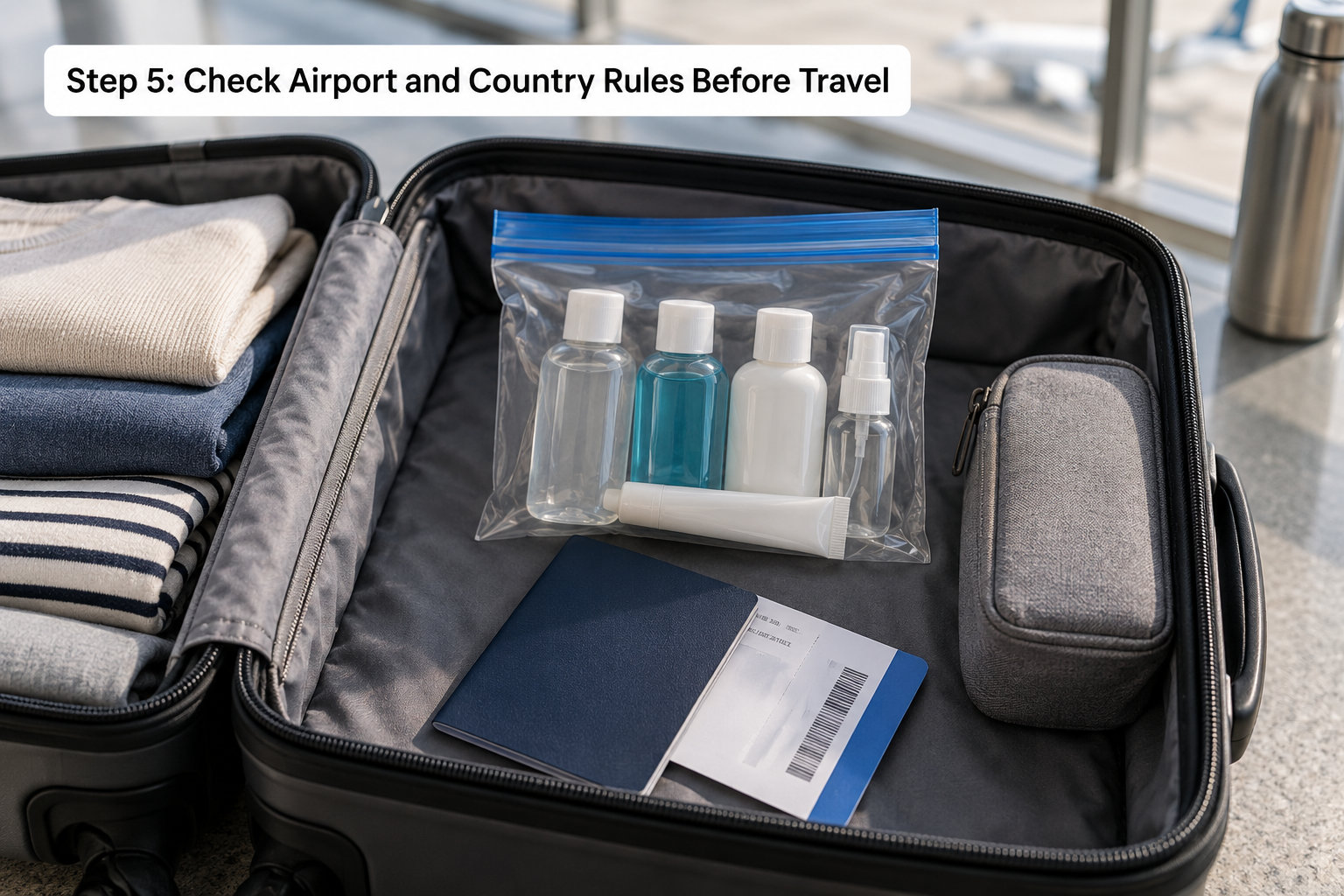
Confirm the rules for your departure airport, every connecting country, and your destination before you leave home. Most countries follow a 100 mL per-container standard, and the bag size varies by region. Canada uses a 1 L total allowance in larger clear bags, and travelers at some airports with CT scanners report being allowed to carry containers up to 2 L in some lanes. Treat those as airport-specific, not as a general rule, and check the airport’s own page rather than a forum post.
Cruises add their own checkpoint, often run by the cruise line, and they publish separate limits. Connections are the riskiest moment for duty-free purchases: sealed liquids bought after security only survive a re-screen if the tamper-evident bag is intact and the receipt is still inside it. Travelers have reported losing those items at a connection anyway, so keep the receipt somewhere other than the bag.
Common Mistakes
Judging liquid volume instead of container size. The fix is to read the printed capacity on every label, not to eyeball the fill level. Half-empty full-size bottles get dumped.
Opaque or wrong-sized bags. The bag must be clear so officers can see everything without unpacking it, and it should hold your liquids within a quart. A branded toiletry pouch that hides its contents slows you down and gets opened more often.
Too many containers. There is no official bottle count, but the bag has to close. If yours will not zip, the honest answer is that half of those bottles did not need to come. Shampoo bars, conditioner bars, solid deodorant, soap bars and lotion sticks are not liquids, and sunscreen sticks are allowed because they are solid even though the lotion next to them is not.
Forgetting medicine, formula or baby items. These are exempt from the 3.4 oz limit, but only if you declare them. Leaving them buried in the bag is how travelers get stopped and unpacked on the floor.
Burrowing the liquids bag at the bottom. Packing it deep means a full repack at the checkpoint in front of a line. Top of the bag or an outer pocket, every time.
Assuming U.S. rules apply everywhere. Bag size, container limits and even enforcement vary by country and by airport. A quick check before a multi-country itinerary prevents the specific frustration of watching your bag fail a second screening in a country you never researched.
Packing full-size liquids in checked bags without protection. This is the most common complaint in travel forums and the least discussed. Cap every bottle, tape the caps, double-bag each one, and stand everything upright in a sealed tub or zip bag inside a plastic bag in the center of the suitcase. Clothes wrapped around a bottle absorb a leak quietly, and electronics do not forgive one.
Two smaller habits help. Bring an empty water bottle through security and fill it at a fountain past the checkpoint, which beats paying airport prices. And if you do get stopped, pull the offending item out yourself rather than waiting to be asked; officers notice a traveler who has done the sorting.
Where rules have blurred, officers use a practical test: if the item takes the shape of its container, it counts as a liquid. That is why peanut butter, hummus and yogurt go in the quart bag, why a solid block of the same spread does not, and why some travelers carry the spread frozen solid.
Frequently Asked Questions
Can I bring a full-size bottle of shampoo in my carry-on?
No. A full-size shampoo bottle is over 3.4 ounces (100 milliliters) and does not pass through security in a carry-on, even if the bottle is nearly empty. Choose a 3.4 oz travel container and refill it, use a shampoo bar, or put the full-size bottle in checked luggage sealed inside a double bag.
Does the 3.4-ounce liquid limit apply to the bottle or the liquid inside?
It applies to the container, not the contents. The rule is written against the printed capacity on the label, so a 4 oz bottle holding a single ounce still fails. Conversely, a 3.4 oz bottle filled to the brim passes. Measure the container while it is still in your hand, before you leave home.
Can I bring liquid medication through airport security?
Yes. Liquid prescription and over-the-counter medicine is exempt from the 3.4 oz limit, but you must declare it to the officer at the checkpoint. Keep it in the original container with the pharmacy label if you can. Larger quantities may be screened separately with vapor analysis, which takes longer, so allow extra time.
Are frozen liquid bottles allowed in a carry-on?
Only if they are frozen solid at the moment of screening. Ice packs and frozen gel packs must be completely solid, and a container that has partly melted into slush is treated as a liquid under the normal rules. If you are not sure, freeze it the night before and travel with an insulated bag as a backup.
Can I take liquids bought after security onto the plane?
Yes. Liquids purchased after the checkpoint or in duty-free have no 3.4 oz limit, but anything carried to a connecting flight must stay sealed in its tamper-evident bag with the receipt inside or it may be confiscated at the second screening. Checked duty-free purchases at the gate must be packed in your checked bag before boarding.
Do carry-on liquid rules differ when traveling internationally?
They can. Most countries use the 100 mL per-container standard, but bag sizes and container limits vary, and some airports with CT scanners allow larger containers up to about 2 L. Canada also permits a 1 L total in larger clear bags. Verify your departure airport, connection and destination before packing rather than assuming U.S. rules apply.
Conclusion
Sort first: lay out every liquid, gel, cream, paste and aerosol you plan to bring, separate them from the solids, and check the printed capacity on each container. Anything above 3.4 ounces (100 mL) leaves the carry-on, whether it is full or nearly empty. What remains goes into one clear quart-size resealable bag, sealed, upright, and near the top of the bag, with medicines, formula and duty-free items declared at the checkpoint. Ten minutes at home beats a repack on the floor at October 2026 departures, and rules do shift, so confirm them for your departure airport and every connection before you leave.