How to travel light without checking a bag comes down to three things: one compliant bag, a short written list, and the discipline to remove a third of what you packed. Carry-on-only travelers skip the bag fee on every leg, walk out of the airport in minutes instead of waiting at baggage claim, and never open a trip to the news that their suitcase landed somewhere else.
This is the method I use. It takes about 20 minutes of planning the night before, and the actual packing is closer to 15. There is a learning curve the first couple of trips, mostly around trusting yourself with less than feels comfortable.
If you want the shortest possible version: check your airline’s published personal-item and carry-on limits, pick one colour palette, pack two or three tops you can mix with one or two bottoms, wear your bulkiest shoes and jacket on the plane, and put everything else into packing cubes. Everything below is the detail behind those five moves.
Table of Contents
- 1What You Need
- 2Step-by-Step: How to Travel Light Without Checking a Bag
- 31. Confirm Your Airline’s Personal-Item Limits
- 42. Build a Simple Two-Week Capsule
- 53. Make a Realistic Wear List
- 64. Pack With the Cube Method
- 75. Choose Wearable and Limited-Use Items
- 86. Limit Liquids, Electronics, and Toiletries
- 97. Weigh, Organize, and Test the Bag
- 10Common Mistakes
- 11Frequently Asked Questions
- 12Can I travel without checking a bag on any airline?
- 13How many days can I pack in a personal item?
- 14What is the best bag for traveling without checking luggage?
- 15Can I bring a full-size toiletry bag through airport security?
- 16How do I pack liquids so they do not leak?
- 17What if my carry-on bag is slightly over the airline limit?
- 18Start Smaller Than Feels Comfortable
What You Need
There is no universal carry-on allowance, and that is the part most first-time light packers get wrong. A bag that flies free on one airline can cost you at the gate on the next one, and codeshare flights can be operated by a carrier with entirely different rules.
Three terms keep coming up, and they are not interchangeable:
- Checked bag goes into the hold and comes out at baggage claim.
- Carry-on goes in the overhead bin and is counted against your fare allowance, which many basic economy tickets do not include.
- Personal item is the small bag that fits under the seat in front of you. It is the one most airlines allow at every fare level, including basic economy.
For a personal-item-only trip you need three physical things: a bag that matches your airline’s published underseat dimensions, a written list you actually build the bag from, and a way to compress soft items. Compression packing cubes are the cheapest upgrade, but a set of ordinary zip pouches works nearly as well if you are not fussy.
Typical published limits look something like this. Treat them as starting points and confirm on your airline’s site before you pack, because carriers change these numbers and enforcement varies by airport and by how full the bins are.
| Carrier type | Carry-on size (typical published) | Personal item (typical published) | Weight notes |
|---|---|---|---|
| US network carriers | 22 x 14 x 9 inches (56 x 36 x 23 cm) | Usually around 18 x 14 x 8 inches | Often no fixed cap, some routes price bags by weight |
| US low-cost carriers | 22 x 14 x 9 inches | Around 18 x 14 x 8 inches, must fit under the seat | Charges vary by fare class |
| European low-cost carriers | Often 55 x 40 x 20 cm with a weight cap | Often 40 x 30 x 20 cm | 7 to 10 kg is a common published range |
| Budget carriers charging for overhead space | Paid add-on, priced per leg | Only the underseat bag is usually included | Some have no weight cap at all |
Note the weight column. Volume is the limit most people picture, but plenty of international carriers enforce a hard weight cap in kilograms, and a densely packed 40-litre backpack can cross that line while still looking half empty. If your trip crosses borders, assume weight matters more than size.
Step-by-Step: How to Travel Light Without Checking a Bag
Work through these in order. Each stage ends with a check, so you catch a problem while the bag is still on your bed rather than at the boarding gate.
1. Confirm Your Airline’s Personal-Item Limits
Open the operating carrier’s baggage page and write down four things: the maximum dimensions for a carry-on, the maximum dimensions for a personal item, any weight cap, and whether your fare class includes an overhead bag.
Look for the words operating carrier on a codeshare itinerary. When you buy through a travel site, the airline flying the leg may not be the airline whose name is on your ticket, and their allowance is the one that counts at the gate.
The check: your bag should fit inside the airline’s own sizer frame with the handle and wheels counted. If you cannot find a published limit, treat the smallest underseat allowance as your ceiling and travel with a personal item only.
Basic economy is the exception worth knowing. Several US carriers sell a fare that includes the personal item but charges for the overhead bin, and the fee is usually higher when you add it at the airport than when you buy it online in advance.
2. Build a Simple Two-Week Capsule
Pick one colour palette and build everything around it. Two neutrals and one accent is plenty. When every top works with every bottom, you stop packing combinations and start packing pieces.
Then decide how many days you are actually dressing for. Two weeks is not fourteen outfits. It is roughly six pieces that repeat, with one laundry cycle mid-trip if the trip is long or the weather is unpredictable.
The check: read your list out loud and ask whether each item is worn twice. Anything that only serves one specific moment is either upgraded into something multi-use or cut.
3. Make a Realistic Wear List
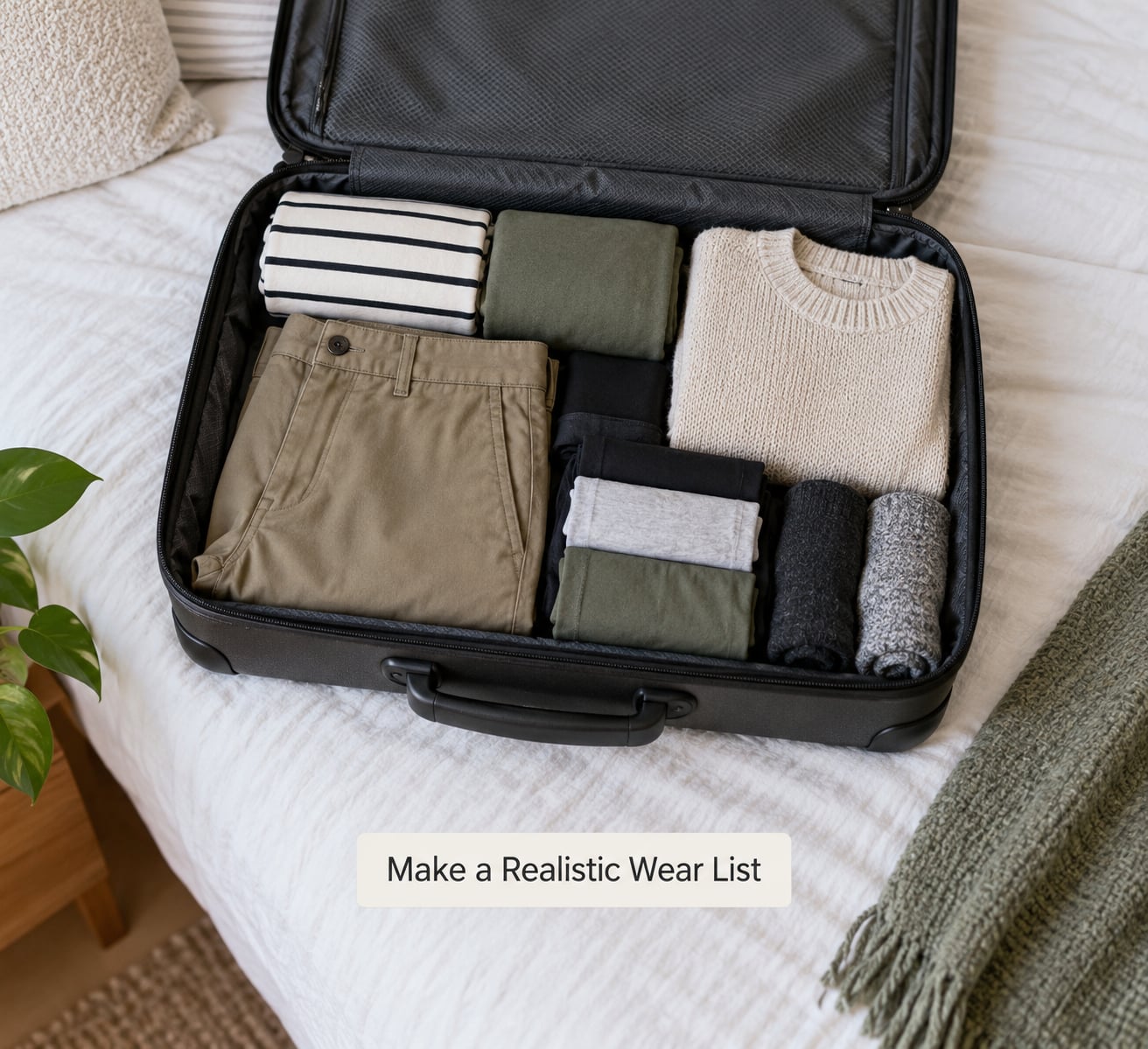
The wear list is the part that actually saves space. Write down only the garments, shoes and accessories you will wear in transit or more than once. Learning how to travel light without checking a bag is mostly the discipline of writing that list before the bag comes out of the closet.
For a week of ordinary sightseeing, a workable core is three tops, two bottoms, five underwear sets, three sock pairs, one light layer, and two pairs of shoes worn or carried. Adjust for dress codes and weather rather than for anxiety.
A pattern people in one-bag communities use: lay every candidate item on the bed two weeks out, pack the bag, then remove about a third. The pile on the floor is almost always the stuff you never wore anyway.
For a trip with real cold, swap the light layer for a packable down layer and expect one laundry cycle rather than more clothes. Volume follows warmth far faster than people expect, and a bulky coat is better worn in transit than packed.
4. Pack With the Cube Method
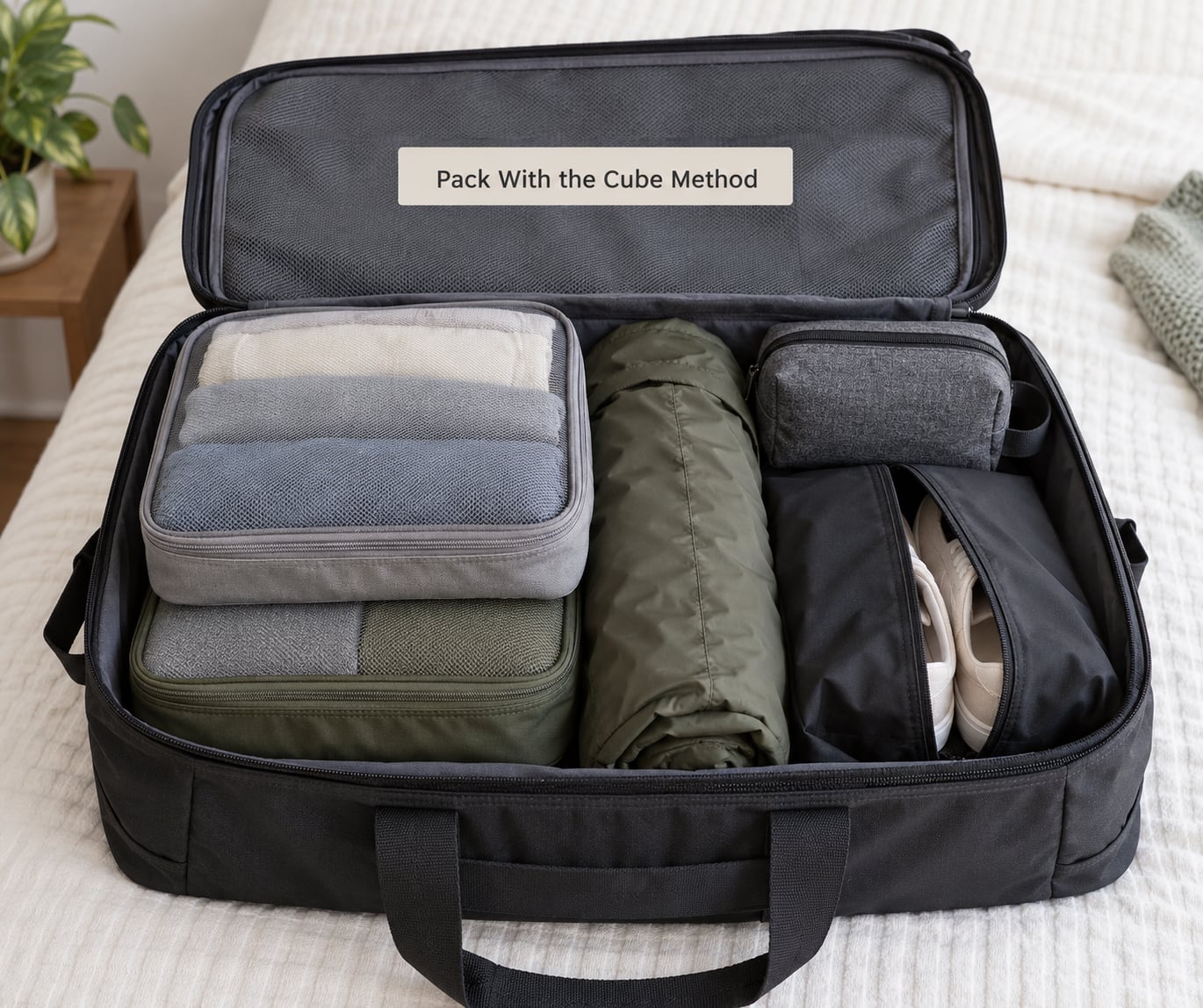
Segmenting the bag into cubes changes the way you pack. Instead of cramming, you decide what belongs in each category first, then fill one section at a time.
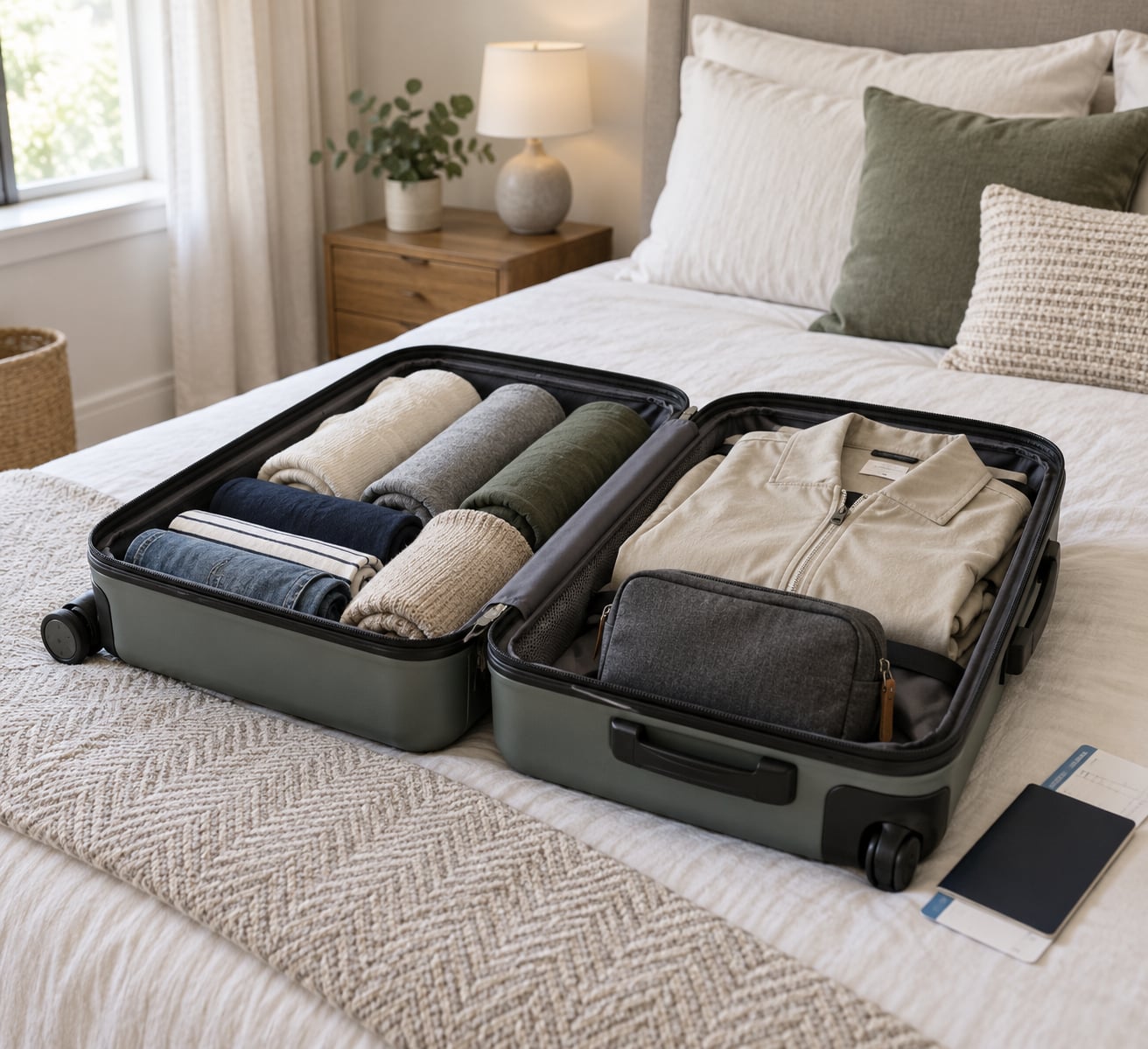
A workable layout: a large cube for tops and layers, a medium cube for bottoms and underwear, a small flat pouch for socks and undergarments, a toiletry pouch, and a flat shoe bag. Rolled items go in first, softer and bulkier things last, near the top.
Cubes also stop overpacking. Once a cube is closed you can see the empty space in the bag instead of feeling it. Compression cubes shrink soft items further, but their benefit drops sharply in a rigid roller where nothing is compressing against anything.
The check: close every zipper and see whether you can still slide a flat hand along the top. If you cannot, you have too much in the bag, not too little structure.
5. Choose Wearable and Limited-Use Items
Shoes eat more volume per item than anything else in the bag. Two pairs is a sane maximum: one worn in transit, one packed flat in a shoe bag with socks or underwear inside to hold the shape.
Wear your bulkiest pair on the plane and pack the lighter one. The same goes for a heavy jacket, a hat and a scarf, which can all live on your body and in your coat pockets rather than in a cube.
Place fragile items where they cannot be crushed. Glasses cases, camera bodies and hard-sided containers go in the middle of the bag surrounded by soft clothing, not against a wall or a zipper seam.
Beyond ten days, laundry stops being optional. Most hotels will hand you a sink, and a handful of detergent sheets or a small bottle of liquid soap gets over a load of underwear, socks and tops in the evening while you watch something on your phone.
6. Limit Liquids, Electronics, and Toiletries
The 3-1-1 liquids rule is the one rule most likely to end your trip at the security queue. Each container must be 3.4 ounces or 100 ml or less, all containers go in one clear resealable bag, and you get one bag per passenger.
Decanting is the practical fix. Transfer what you need into small bottles, label them, and carry a larger empty bottle to refill after security. Solid products, where they exist for what you use, remove the whole problem.
Toothpaste, full-size deodorant and aerosol cans are the usual repeat offenders. Buy them after security when you land, or switch to a bar soap and a solid deodorant that never enters the queue.
Keep medication, documents, valuables and one pair of headphones in the personal item, not in the bag you might have to gate-check. Prescription medication in its original labelled packaging is the safest form to carry, and a photo of the prescription can be a useful backup.
Two things catch people out. Disposable lighters and fuel are not permitted in hand luggage, though a non-disposable lighter is generally allowed in the cabin. And other countries set their own liquid volumes and screening rules, so check the departure country’s security site rather than assuming your home rules apply.
7. Weigh, Organize, and Test the Bag
Put everything in, zip it closed, and put the bag on a bathroom scale. If the airline publishes a weight cap and you are near it, take something out now rather than explaining it to a gate agent later.
Measure it too. Overstuffed soft bags grow when you shove them into a bin, and a personal item that is technically compliant but bulging is the most common reason for a gate check.
Now the realistic test. Keep the bag packed for an evening, carry it around the house, and take a walk with it. You will discover the uncomfortable strap, the heavy corner and the awkward opening long before the jet bridge.
If you get gate-checked anyway, do three things. Take your laptop, documents, medication, valuables and chargers out and move them into your personal item before they load the bag. Ask the agent at the gate if the bag can be tagged at the destination instead, since some airlines will hand it back early. Then pull out anything you can live without, so the decision is smaller than it feels.
Common Mistakes
Trusting the capacity number on the bag. A 40-litre claim usually measures an empty bag held open with the dividers spread wide. Assume you have about two thirds of that in practice, and pack against the airline’s sizer, not the product page.
Packing every colour you own. Two neutrals and one accent give you more outfit combinations than five colours. This is the single fastest way to cut volume without cutting variety.
Bringing full-size liquids. A 6-ounce bottle of lotion can undo a careful pack. Decant, or buy it after security.
Packing bulky shoes instead of wearing them. Wear the heaviest pair on the flight and fill the lighter pair with small items, which also removes dead space.
Buying souvenirs too early. A dense shopping bag in week two is what pushes a working bag over the limit. Keep purchases in a foldable tote inside your personal item, or plan to ship them home.
Ignoring international security rules. Liquid volumes, lighters and medication rules differ by country. Check the departure airport’s authority rather than your home country’s rules.
Skipping the test pack. Two weeks before the trip, lay out everything you might bring and cut a third. Ten minutes then saves a repack at midnight.
One honest limitation: there are trips where carry-on only genuinely does not work. Formal black-tie events, ski gear, scuba equipment and long winter trips with real insulated boots tend to defeat the system. Check a bag for those and use the method everywhere else.
Frequently Asked Questions
Can I travel without checking a bag on any airline?
Almost. Every airline allows a small personal item that fits under the seat, and that is usually included even on basic economy fares. A full carry-on in the overhead bin depends on your fare class and the carrier operating your flight. Some low-cost European carriers charge for overhead space on every fare and cap weight in kilograms, so check the specific airline and route before you pick a bag.
How many days can I pack in a personal item?
A personal item is realistically a three-to-five day trip without laundry, especially for a weekend city break where you wear each outfit twice. With hotel laundry and a capsule wardrobe, one underseat bag covers two weeks for most people. Longer than that and you are choosing between a carry-on roller and accepting that you will wash clothes mid-trip.
What is the best bag for traveling without checking luggage?
It depends on your itinerary. A soft-sided underseat backpack is the most forgiving because it compresses to fit an sizer and survives being stuffed into a bin. A hard-shell carry-on roller works well if you have overhead space on every leg. Whatever you choose, measure the exterior including wheels and handle, and check it against the operating airline’s published dimensions.
Can I bring a full-size toiletry bag through airport security?
Not if the liquids inside exceed the limit. Each container must be 3.4 ounces or 100 ml or less, and all of them must fit inside one clear resealable quart-sized bag per passenger. A full-size toiletry bag is fine as a container as long as what is in it complies. Anything larger gets confiscated at the queue, not at the gate.
How do I pack liquids so they do not leak?
Decant into small screw-top bottles rather than pouring into ziplocks, tighten caps, and put a small square of tape around each neck. Keep the bottles upright inside a sealed toiletry pouch with a zip or roll-top closure, and slip a plastic bag around anything in a glass bottle. Never put a full liquid bottle next to your phone or laptop.
What if my carry-on bag is slightly over the airline limit?
Move the problem before you reach the gate, not at it. Repack into a smaller bag, take one or two items into your personal item, or check the bag online before leaving for the airport, where the fee is usually lower than at the counter. A stuffed bag is also the most common trigger for a free gate check on a full flight, even when it technically complies.
Start Smaller Than Feels Comfortable
Two things to do first. Open the operating airline’s baggage page and note the personal-item dimensions and any weight cap. Then write the wear list, count backwards from the trip length, and stop at a number that feels slightly too low. That is most of how to travel light without checking a bag in practice.
That uncomfortable margin is the whole method. It is where the laundry plan lives, where the second pair of shoes lives, and where the reason you will walk out of the airport in ten minutes instead of forty lives too.