How passenger rights differ in Europe comes down to one question in most cases: which side of a border you left from, and who was actually flying the aircraft. EU261 covers flights leaving the European Union, UK261 covers flights leaving the United Kingdom, and both give you cash compensation, reimbursement and care when things go wrong. Here is how those rules differ, which one applies to your trip, and how to claim what you are owed.
Two things surprise almost everyone. First, citizenship is irrelevant: a traveller flying from Madrid to Rome on a Moroccan airline is covered, while a British passenger flying New York to London on a US carrier may not be. Second, most eligible passengers never claim. European Parliament figures put the recovery rate below 10%, and roughly half of all claims are turned down unlawfully.
This is a general explanation of how the rules work, not legal advice for your specific booking. Regulations change and enforcement varies by country, so check the current position before you travel and before you file anything.
Table of Contents
- 1The Rules That Shape How Passenger Rights Differ in Europe
- 2How passenger rights differ in Europe by type of trip
- 3What Are Your Rights When a European Flight Is Delayed?
- 4What Are Your Rights When a Flight Is Cancelled?
- 5Can You Get a Refund or Another Flight After Disruption?
- 6What Care Can You Receive During a Long Delay?
- 7What Happens If You Miss a Connecting Flight?
- 8How Do Baggage Rights Differ Across European Journeys?
- 9Do Rights Change for Codeshares, Package Holidays, and Tickets Bought From Other Companies?
- 10What About Denied Boarding, Upgrades, and Extra Legroom?
- 11How to Make a European Passenger Rights Claim
- 12Frequently Asked Questions
- 13Does travel insurance cover compensation I am owed under European passenger rights?
- 14Can an airline offer compensation instead of flying me on a later flight?
- 15How long does a European passenger rights claim usually take?
- 16What if my flight was delayed by extreme weather rather than airline error?
- 17How far ahead should I submit my passenger rights claim?
- 18What to Do First When a European Flight Is Disrupted
The Rules That Shape How Passenger Rights Differ in Europe
The differences come down to geography, not nationality. The main frameworks are Regulation (EC) No 261/2004 in the EU, the retained UK261 rules that apply after the UK’s departure from the bloc, national rules in Switzerland that track EU261 closely, and Turkish rules that follow the Montreal Convention rather than either European regime.
Each regime has its own regulator, its own compensation amounts and its own deadlines. The table below is the fastest way to see which applies.
| Regime | Which flights it covers | Cash compensation | Who enforces it |
|---|---|---|---|
| EU261 | All flights departing an EU or EEA airport, plus flights arriving from outside the EU only when the operating carrier is EU-registered | EUR 250, 400 or 600 by distance; reduced for rerouting | The airline first, then the national enforcement body for the country of departure |
| UK261 | All flights departing a UK airport; inbound flights only when the operating carrier is UK-registered | GBP 220, 350 or 520 by distance | The airline, then the Civil Aviation Authority scheme and approved alternative dispute resolution bodies |
| Swiss rules | Flights departing Switzerland, and inbound flights on Swiss-registered carriers; deliberately aligned with EU261 | Similar banded amounts in francs, with the EU-style structure | The Federal Office of Civil Aviation |
| Turkish rules | Flights departing Turkey and inbound flights on Turkish-registered carriers, under the Montreal Convention framework | Fixed amounts set in Turkish law, lower and less predictable than EU bands | The Turkish civil aviation authority, SHY |
| Neither | A flight departing the US, Canada or anywhere outside Europe on a carrier registered outside the EU, UK, Switzerland or Turkey | No statutory compensation; only Montreal Convention remedies for long international delays | No European enforcement body will take the case |
How passenger rights differ in Europe by type of trip
Three factors settle which framework applies: the airport you depart from, the registration of the airline actually flying the aircraft, and whether anyone in the booking arrangement sold it to you.
Picture a round trip from New York to London. On a US carrier, departing New York, EU261 does not apply and UK261 does not apply either, because the flight does not depart the UK. The same itinerary on British Airways is covered by UK261 on the outbound leg, because the return departs London. A passenger on the first itinerary has no statutory compensation route at all.
Airport location beats airline nationality on the way out. A flight from Rome to New York operated by a non-registered airline is covered, because Rome is the departure point. That is the single most useful rule to memorise.
The airline that matters is the operating carrier, not the one whose code appears on your ticket or website. Marketing and operating airlines can be entirely different companies.
What Are Your Rights When a European Flight Is Delayed?
For flights arriving from outside the EU, compensation generally starts at a three-hour delay measured against the scheduled arrival. That threshold comes from a Court of Justice ruling in the Sturgeon v Condor Flugdienst case, which confirmed that a delay at departure and a delay at arrival cannot be counted as separate events.
For flights within the EU, arrival time is not the only measure. The clock effectively starts once the flight is due to depart, so a short flight delayed heavily at the gate can qualify. Arrival time alone governs flights covered by UK261.
| Delay | Flights covered | What you can claim |
|---|---|---|
| Under 3 hours | All | Care such as meals and refreshments if the delay is long enough to make them necessary |
| 3 hours or more | EU261 and UK261 covered flights | Fixed cash compensation plus care |
| Delay with overnight stay | EU261 covered flights | Hotel, transport to and from the hotel, and meals |
| Delay caused by extraordinary circumstances | All | Care still applies, but no cash compensation |
Care applies regardless of the cause. Only the money is affected by extraordinary circumstances, and even then meals, drink and a hotel are owed.
What Are Your Rights When a Flight Is Cancelled?
A confirmed cancellation gives you a choice, not a single entitlement. You may ask for reimbursement of the ticket plus a return flight to your original destination, or you may ask to be rerouted to your final destination at the earliest reasonable opportunity.
The distinction matters because the two routes pay differently. If you take rerouting, the compensation amount is cut by half. If you take reimbursement, you keep the full band. This is a real trade-off, not a technicality.
Cancellation gives you an additional protection that delays do not: if the airline tells you at least two weeks before departure that the flight is cancelled, you can ask for immediate reimbursement of the whole trip, even if you never travel to the airport. That right exists because you had a chance to make other arrangements.
Where a cancellation forces an overnight stay, you are entitled to a hotel, transport between the airport and the hotel, and meals. If you chose a hotel yourself, reasonable limits on cost can apply, so keep every receipt.
Can You Get a Refund or Another Flight After Disruption?
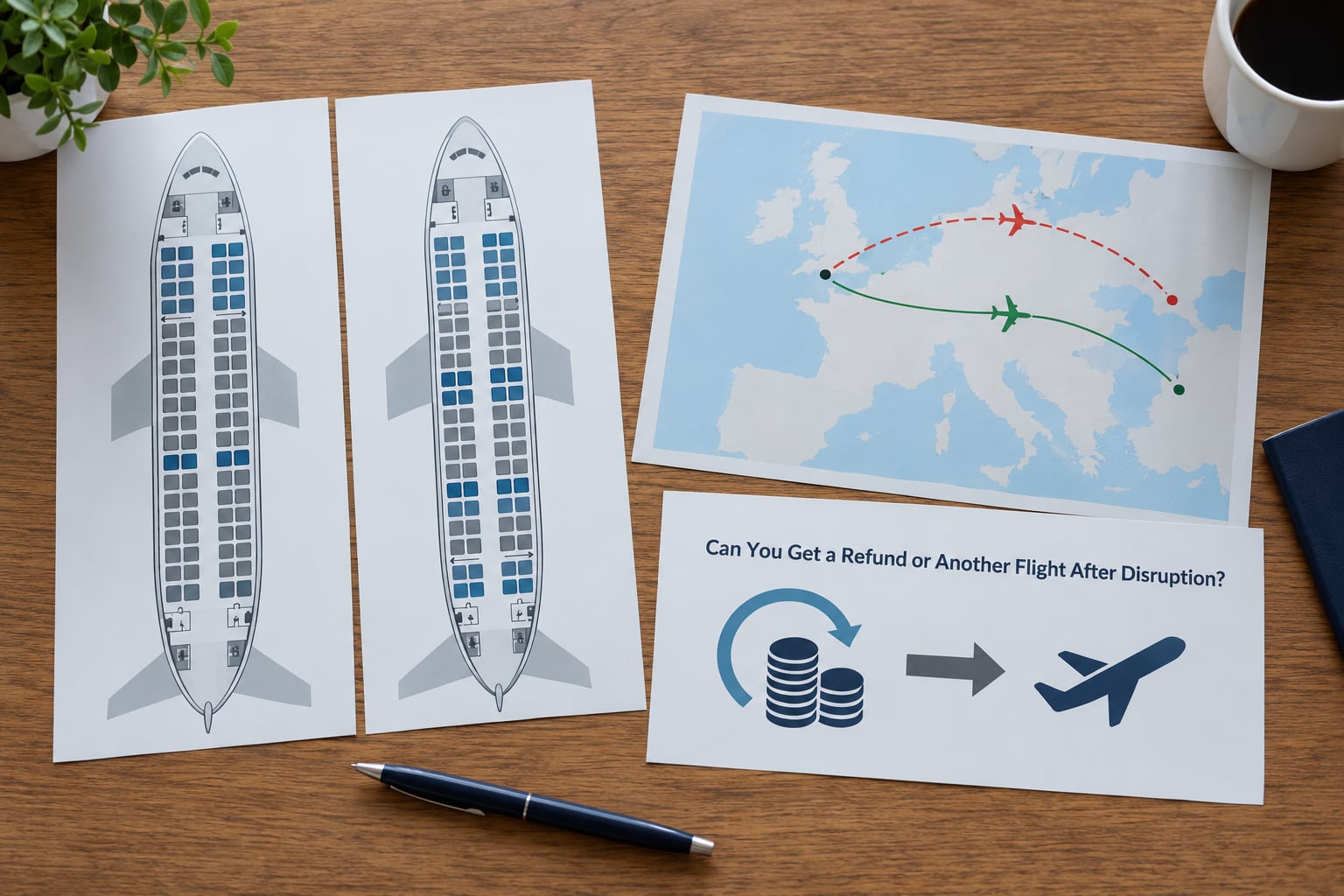
Yes, and the choice is yours to make rather than the airline’s. Rerouting means the carrier finds you a route to your destination and pays for it. Reimbursement means you get the ticket price back and are responsible for making your own way onward, with the carrier obliged to fly you back to your point of departure.
Compensation is reduced by half when you accept rerouting and the new arrival is within a small number of hours of the original schedule. If the rerouted flight gets you there much later than promised, the reduction does not apply.
Refundable and non-refundable fares make no difference to statutory compensation. The airline cannot refuse a statutory payment because your ticket was the cheapest on the menu. The regulation sits alongside the fare conditions, not underneath them.
Where the disruption is not within the carrier’s control, the airline may ask for reimbursement of sums it has already spent on your behalf rather than paying you immediately. That is a set-off, not a refusal.
What Care Can You Receive During a Long Delay?
Care is the part of EU261 passengers underuse. It applies for delays long enough to make food, drink or accommodation necessary, and it does not depend on the delay being the airline’s fault.
The core entitlements are meals and refreshments, two telephone calls or messages if the delay stretches on, hotel accommodation where an overnight stay is unavoidable, and transport between the airport and the hotel. Two hot meals and two drinks is the usual benchmark per passenger for a full day of waiting, though the actual standard varies by flight length and country.
On EU261 flights, the carrier normally covers these costs directly or by handing you a voucher for them. On flights covered only by UK261 or by other regimes, the practice differs: you may be expected to pay first and claim the money back afterwards. Vouchers and reimbursement are separate entitlements, and accepting a meal voucher is not a waiver of your compensation claim.
Many travellers report the same friction: a hotel voucher that only covers a room, with no transport. Ask for the transport leg explicitly, and keep receipts for anything you pay yourself.
What Happens If You Miss a Connecting Flight?
Missing a connection is not itself a separate compensation trigger. What matters is whether the two flights were on a single booking or a protected onward ticket, and why the first leg was delayed.
If both flights were booked together and the delay to the first leg is the airline’s responsibility, the missed connection falls under the same rules as any other disruption. Compensation is calculated on the whole trip, using the distance from your original departure point to your final destination.
If the first leg was cancelled or delayed for extraordinary circumstances, the carrier may argue no compensation is due. Care and rerouting to your final destination still generally apply.
Separate tickets change the picture. A second ticket bought from a different airline is a separate contract, and the first carrier’s duty of care usually stops at the end of its own flight. You remain responsible for the onward segment, though many carriers will still rebook you at no charge as a practical measure.
How Do Baggage Rights Differ Across European Journeys?
Baggage rules split into two parts that are often confused. Delay, damage and loss of checked baggage is governed by the Montreal Convention 1999, which applies almost worldwide and is not part of EU261.
Those baggage claims therefore follow Montreal Convention rules on every route, while EU261 covers the flight itself and never pays out for a missing suitcase. EU261 does entitle you to buy essentials such as clothing and toiletries when items are damaged or lost inside the cabin, but the ceiling is far lower than a cancellation payout, and the airline must cover reasonable living expenses while you wait for a delayed bag.
Excess baggage above the free allowance is a contract matter with no statutory compensation. Cabin baggage is simpler still: a carry-on is included in the fare, and if the airline removes your cabin bag to make room for checked bags, care obligations apply.
The Property Irregularity Report is the document that matters. Get it at the airport before you do anything else, because without it the airline can refuse to accept a claim later. Baggage rules are a separate system from flight compensation, and you file them separately.
One more distinction worth knowing: an airport porter or handler is not the airline. Loss or damage caused by a third party on the apron can create a separate claim against that company, so keep the porter’s claim reference number.
Do Rights Change for Codeshares, Package Holidays, and Tickets Bought From Other Companies?
Often yes, because responsibility splits along the booking chain. File against the airline that issued your ticket, which then deals with its operating partner internally. Do not chase the operating carrier yourself; the airline that sold you the ticket is your point of contact for every EU261 matter.
For package holidays, the tour operator is the contractual seller and must handle your claim, with the airline’s rights flowing through to you. Keep both the booking confirmation and the package travel details handy.
If you bought through a travel agent or a third-party booking site, send the claim to whoever issued the confirmation. They will pass it on, and slow forwarding is the most common reason a claim stalls in the first month.
Insurance is separate again. A policy may cover inconvenience, cancellation costs and loss of earnings that statutory compensation does not, and it sits alongside your airline rights rather than replacing them. Travel insurance can cover passenger rights, but it is worth reading the wording twice.
What About Denied Boarding, Upgrades, and Extra Legroom?
Denied boarding through overbooking has its own band. Compensation depends on the distance of the flight you were booked on, and if you accept the rerouting the airline offers, the amount drops by half again.
Nobody is bumped by accident. The airline must first ask for volunteers, and it cannot pick who by ticket price, status or whether you complained recently. Within that voluntary group, the published order of priority applies, and compensation for the passengers who give up a seat has its own band alongside the rerouting payment.
Compensation is calculated on the distance of the flight you were denied, not the distance of the flight you were moved onto. In practice that can feel harsh when a long flight is swapped for a short one, and the amount is a common point of disagreement.
Where the carrier downgrades you into a lower class instead of bumping you, you can claim 30, 50 or 75% of the ticket price depending on the distance travelled in the lower class. That percentage is the refund for the downgrade, on top of your other rights.
Passengers with a disability or travelling with an assistance animal are carried at no charge and keep their special assistance rights under the rules that sit alongside EU261. They are also boarded first. Upgrades and extra legroom are not things an airline must give you on demand, but carriers do have consent requirements around assistance animals travelling in the cabin, and priority seating is a right rather than a favour.
How to Make a European Passenger Rights Claim
The process follows a fixed escalation ladder, and it works better when you follow the order. European Parliament estimates put the recovery rate for passengers who claim with the airline first at close to half the headline figure, and the reason is simple: claims that skip straight to an enforcement body are frequently rejected for procedural reasons.
Start with evidence. Capture the booking confirmation, your boarding pass or the last boarding pass you did scan, the delay or cancellation message from the airline, the new flight details, receipts for anything you paid, and a note of what staff said at the desk. Screenshots of the airline’s own app messages are stronger than your own notes.
Then write to the airline that issued the ticket. Keep it short: booking reference, flight number and date, what happened, the amount you are claiming, and why extraordinary circumstances do not apply if that is your position. UK261 carriers generally have 28 days to respond, and many EU carriers work to a similar window. Silence is common at four weeks, so follow up in writing.
If the claim is refused, escalate to the national enforcement body for the country the flight departed from. For rail, maritime, bus and coach trips the same ladder exists with different bodies attached. If that fails, alternative dispute resolution is usually free and usually faster than court.
| Country of departure | Where to escalate if the airline refuses |
|---|---|
| Spain | The national consumer authority, alongside the civil aviation authority Aena for airport-related issues |
| Italy | ENAC, the civil aviation authority, or the relevant regional consumer protection office |
| France | The civil aviation authority and the DGCCRF consumer protection directorate |
| Germany | The national civil aviation authority, which routes complaints through the Luftfahrt-Bundesamt |
| United Kingdom | The Civil Aviation Authority complaint scheme or an approved alternative dispute resolution body |
| Switzerland | The Federal Office of Civil Aviation |
Deadlines are shorter than most people expect, and they vary by country from around one year to as long as six. Treat the shortest one that could plausibly apply as your limit. If the airline has gone bankrupt or insolvent, a claim is still valid, but the money is far harder to recover and you should move fast.
Two warnings worth repeating. Third-party claim services advertise heavily on social media and often take a slice of your payout, so nothing is lost by filing directly. And a bargain fare booked weeks in advance does not reduce your rights; the booking price has no bearing on what the regulation owes you.
Frequently Asked Questions
Does travel insurance cover compensation I am owed under European passenger rights?
Usually not. Most travel insurance policies cover the costs and losses that statutory passenger rights do not: the cost of a replacement ticket, a hotel you booked yourself, lost earnings, meals during a delay, and cancellations for personal reasons. Statutory compensation owed to you under EU261 or UK261 is a legal entitlement the airline pays, so an insurer treats it as outside the policy. Some policies do offer a legal-expenses section that will handle a rejected claim for you, which is worth checking before you pay for it.
Can an airline offer compensation instead of flying me on a later flight?
They can offer it, and you can refuse it. If you do not travel, you are normally entitled to reimbursement of your ticket plus a return flight to your point of origin, not a cash settlement at the compensation band alone. Rerouting on a later flight is the option the airline usually prefers, because accepting it cuts the compensation amount in half. Some carriers will negotiate a voucher for future travel as a way to avoid paying you; accepting one does not automatically close your claim, but read anything you sign carefully before you do.
How long does a European passenger rights claim usually take?
With the airline directly, expect four to eight weeks before a real answer, and a written follow-up usually helps at the four-week mark. If it goes to the national enforcement body, three to six months is common and can stretch further. Going to alternative dispute resolution after that is generally faster than court and costs nothing. The single biggest variable is how complete your evidence is. A file with the booking reference, boarding pass and the airline’s own disruption messages usually moves faster than one built from memory.
What if my flight was delayed by extreme weather rather than airline error?
Extreme weather is the textbook example of an extraordinary circumstance, so you lose the cash compensation but keep your care entitlements: meals, refreshments, a hotel if an overnight stay is unavoidable, and transport between the airport and hotel. Weather that affects the departure airport, or a storm or volcanic ash on your route, usually qualifies. Short weather events such as poor visibility at one airport are harder for airlines to rely on, since the Court of Justice has ruled that an airline cannot lean on the same disruption at one airport to excuse delays at others.
How far ahead should I submit my passenger rights claim?
Within two weeks of the disruption if you can. You need your booking reference, the disruption confirmation and, in a denied boarding case, written proof that you volunteered or were involuntarily bumped. Airlines are much harder to deal with once the case is months old, and several will ask you to deal with a claims agency rather than them. Send what you have, then chase. Waiting for a perfect file is the most common reason a claim dies quietly.
What to Do First When a European Flight Is Disrupted
Document the disruption before you leave the airport: booking reference, boarding passes, the airline’s own messages, receipts, and a short written note of what happened. Then ask the airline, in writing, which protection it is applying, what care it is offering, and whether it is treating the case as one of rerouting or reimbursement. Those two answers decide whether you keep the full compensation band or half of it, and it is much harder to undo afterwards.
Do not sign anything that waives your rights in exchange for a voucher or a travel credit until you know what you are giving up. And do not assume you are owed nothing because you bought a cheap fare or flew on a non-European airline out of the US; check the departure airport instead, because that single detail decides your regime. Rules differ by route, by carrier and by country, and the EU framework is under active reform, so confirm the current position before you rely on any figure quoted here.