If you lose your passport abroad, report the loss to your home country’s authorities the same day, file a local police report, then book an emergency appointment at your nearest embassy or consulate. You cannot fly home on the passport you lost, and once it is reported it is cancelled for good, even if it turns up in a hotel safe. Most travellers who move quickly get a limited-validity travel document in one to three business days.
Here is the short version, in the order that actually matters. The steps below cover what to do if you lose your passport abroad, and nothing else in this article is optional reading.
- Search the last three places you were, including hotel safes, coat pockets and taxi seats.
- Report the loss online to your home country’s passport authority, which cancels the document.
- File a police report where the loss happened and keep the reference number.
- Phone your embassy or consulate for a real appointment. Walk-ins are almost never accepted.
- Attend in person with proof of citizenship, a photo, your police report and payment.
One important thing to know up front: a reported passport is permanently invalidated. Travellers often delay the report because they hope to find the document, and then discover weeks later that a full replacement is required anyway. Search for twenty minutes, then report.
Table of Contents
- 1What You Need
- 2Step-by-Step: What to Do Immediately After Losing Your Passport
- 31. Retrace Your Steps and Secure What You Can
- 42. Contact the Local Police or Appropriate Authority
- 53. Contact Your Embassy or Consulate
- 64. Prepare for an Emergency Passport Appointment
- 75. Arrange a Replacement Passport and Safe Return
- 86. Report or Monitor the Lost Document for Identity Fraud
- 9Common Mistakes
- 10Frequently Asked Questions
- 11Can I travel home without a passport after losing mine?
- 12How long does it take to replace a lost passport while abroad?
- 13Do I need a police report if my passport was lost?
- 14Can an embassy issue an emergency travel document?
- 15Will my travel insurance cover a lost passport?
- 16What if I cannot afford the replacement or emergency-document fees?
What You Need
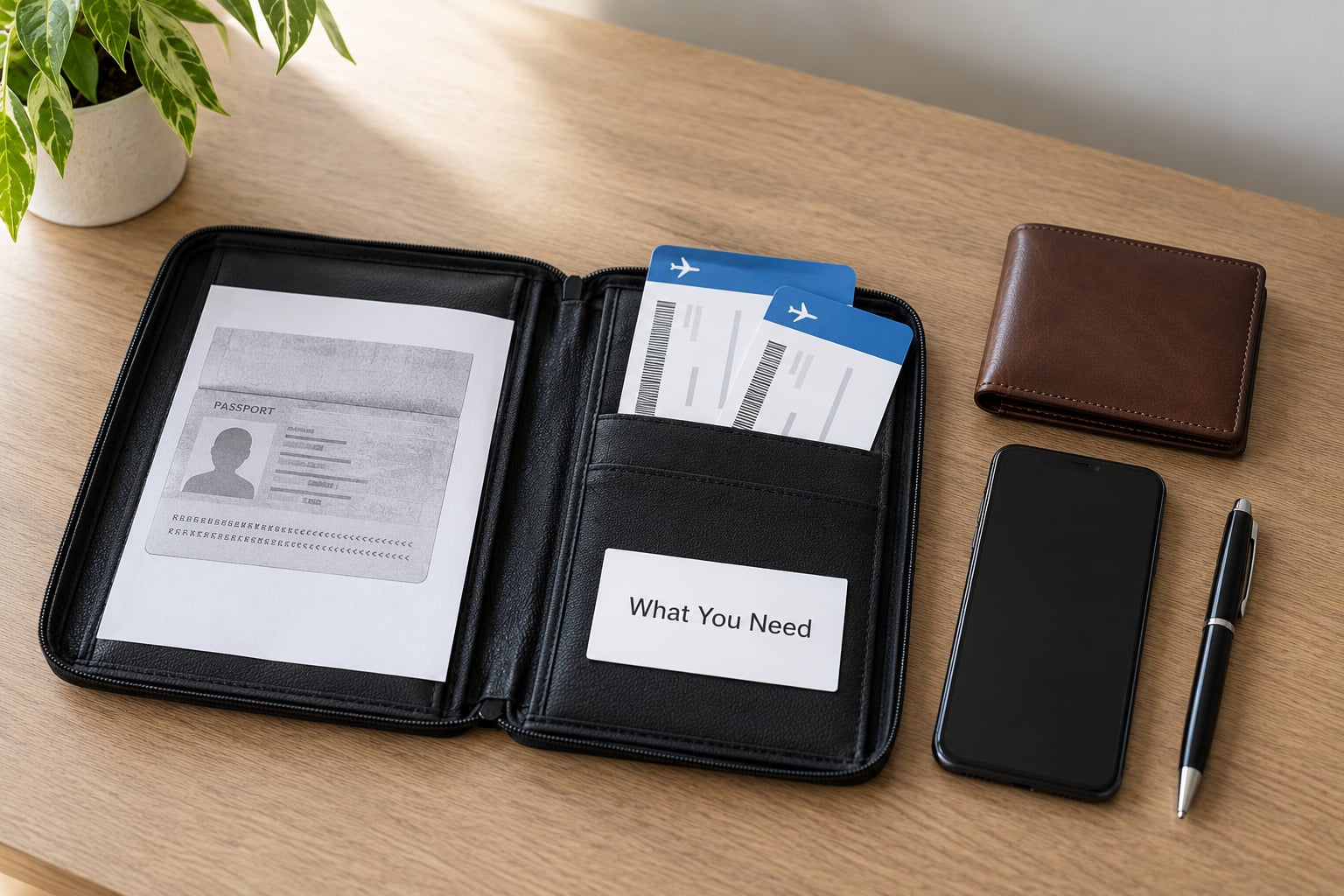
Having these items within reach turns a two-day scramble into a single appointment. Some of them you are carrying, and some you are hoping a cloud storage account holds for you.
- A copy of your passport’s photo page stored in your email or cloud drive. Consular staff and police stations both ask for it, and it speeds up identity checks enormously when no physical ID remains.
- Proof of citizenship you can reach remotely: a birth certificate, naturalisation certificate or consular report of birth, scanned or photographed.
- Two passport photos meeting your mission’s specification. U.S. applicants need 2×2 inch photos, and many other countries use the same size.
- Your travel itinerary, including onward bookings. A documented departure date inside a few days is the single strongest reason an officer will move quickly.
- A working phone and the embassy’s number saved before you need it. Consular sections publish an after-hours duty officer number for citizens stranded far from a mission.
- Payment in the form the embassy accepts. Many missions take cash or local currency and refuse cards, so check the fee page before you queue.
- Your police report reference number written down, plus a witness who can sign a sworn statement if you have lost all photo ID.
Nothing on this list is a substitute for an appointment. Embassies almost universally require an in-person application for an emergency document, with no exceptions for people who are already at the door.
Step-by-Step: What to Do Immediately After Losing Your Passport
1. Retrace Your Steps and Secure What You Can
Most losses happen close to where the document was last used, so work backwards in time rather than forwards. Search the venue you exited, the transport you used, the seat or bench you sat on, and any bag you set down while queuing.
Ask the front desk of your accommodation to check the room safe and to hand the passport to any staff member who might have moved it while cleaning. One traveller in a forum thread found theirs in exactly that place, a day after giving up, which is another reason not to rush the search into an hour.
While you search, move the rest of your valuables somewhere secure. If your wallet went with the passport, see the identity protection step further down, because that changes your order of operations.
2. Contact the Local Police or Appropriate Authority
File a report wherever the loss happened, and do it even when you are convinced the passport is simply mislaid rather than stolen. Consular sections routinely ask for a police report, and your travel insurer will almost certainly require one before any theft claim pays out.
Take a photocopy of the lost passport’s photo page with you to the station. It removes most of the language barrier, because officers can record the document number and issue date without you speaking the local language.
Ask for the written report and the case or reference number on the same visit. Do not leave without it; chasing a report afterwards means a second trip and a second queue.
3. Contact Your Embassy or Consulate
Find the mission responsible for the country you are in, not the nearest one in name. Some countries have several consulates, and the one that covers your arrival point may be a long journey from where you actually are.
Verify the phone number and address on your government’s official travel advice site rather than a search result. Fraudulent “embassy” contact pages exist, and they ask for payment or personal data up front.
Call, explain the loss in two sentences, and ask for an emergency appointment slot. Many missions run a 24/7 emergency line staffed by a duty officer, which is the route to use outside normal opening hours or on a weekend or public holiday.
4. Prepare for an Emergency Passport Appointment
Expect to appear in person, bring a signed form, and pay two separate charges where your mission splits them into an application fee and an execution or issue fee. U.S. applicants file Form DS-11 for the application and Form DS-64 for the lost or stolen statement, and the DS-64 is also what cancels the old passport.
Citizens of other nationalities follow their own equivalents, and the forms are usually available to download and complete in advance rather than filled out in the queue.
Bring photocopies of citizenship evidence, your police report, your itinerary, a photo, and proof of address where relevant. If every piece of photo ID went missing with the passport, a sworn statement from a colleague or host with valid identification can sometimes substitute, though not every mission accepts it.
Ask for a receipt and the document’s validity period when it is issued. An emergency travel document typically carries a shorter validity than a normal passport, often one year, and some countries restrict it to a single journey home.
5. Arrange a Replacement Passport and Safe Return
Check the airline’s and your transit country’s rules before you travel. A limited-validity document is a routing problem, not just a paperwork problem: some destinations, including France, Belgium, the Netherlands and the UAE, have historically refused entry to travellers holding emergency documents, and a few transit points are stricter than the final destination.
If your country’s mission cannot produce a document usable for your route, ask whether returning through a neighbouring country with a different mission is possible, and get the answer in writing.
Once home, apply for a full replacement. Any visas printed in the cancelled passport do not transfer automatically, and several destinations let you carry both the old visa page and the new passport if the old one has a cancelled stamp rather than being destroyed.
Keep the emergency document after you return. Consular staff often want to see it at your next in-person renewal application.
6. Report or Monitor the Lost Document for Identity Fraud
Cancelling the passport is itself a real safeguard, because nobody can board a flight or open an account with a document flagged as invalid. The residual risk is in your other records, not the passport itself.
Freeze or replace bank and payment cards if the wallet went too, and notify your credit card issuers as a group rather than one at a time. Then place a fraud alert or a credit freeze with the credit reporting agencies in your home country.
Keep watching statements and email for months, not weeks. Document fraud involving a stolen passport tends to surface when the criminal tries to use identity data, and you want the alert already in place when that happens.
Common Mistakes
Almost every problem I see in traveller stories traces back to one of these. Each has a straightforward fix, and all of them are avoidable in the first hour.
Waiting to see if the passport turns up. The fix is a time limit. Give yourself twenty minutes of searching, then report. A document recovered after it has been reported is invalid, and you have lost days for nothing.
Turning up at the embassy without an appointment. Consular sections book by appointment, and unannounced visits are routinely turned away, which costs a full day during a crisis. Call first, always.
Assuming a police report is optional for a simple loss. It is not. Insurance claims and consular applications both commonly require it, and it takes an hour.
Paying an unofficial “emergency passport agent.” There is no such service. Documents are issued only by a government mission, and anyone offering a shortcut is running a scam.
Booking a replacement flight before you hold a document. Rebook after you know what you are holding, not before. A fare change fee is cheaper than a flight you cannot board.
Trying to travel on the reported passport. It is cancelled, and attempting to use it is a document offence rather than an administrative mix-up.
The prevention side is short enough to fit on one card. Keep a photocopy of your passport’s photo page in cloud storage and a printed copy in your luggage. Write your mission’s emergency number on paper. Buy two extra photos before you fly. Store your passport in the room safe at each stop, and note the safe combination separately. Take one more copy of your ID than feels reasonable.
Frequently Asked Questions
Can I travel home without a passport after losing mine?
No. You cannot fly home on the passport you lost or on a reported copy of it, since reporting cancels the document. The only lawful route is an emergency travel document issued by your own embassy or consulate. Check whether your destination and any transit country will accept that limited-validity document before you book, because a few countries refuse emergency passports entirely.
How long does it take to replace a lost passport while abroad?
Most missions quote one to three business days for an emergency travel document when you can show travel booked within a few days. Travellers report next-morning issuance in that situation, and around two working days in less urgent cases. Full replacement passports are a separate, much longer process usually handled after you get home. These are typical ranges, not guarantees.
Do I need a police report if my passport was lost?
Usually, yes. Consular sections commonly ask for a police report before they will process an emergency application, and a travel insurer will require one for any theft claim. File the report where the loss occurred, bring a photocopy of the passport’s photo page to help with the language barrier, and ask for the written report plus a case reference number before you leave the station.
Can an embassy issue an emergency travel document?
Yes. Embassies and consulates issue emergency travel documents, also called limited-validity passports, to citizens stranded abroad. The process is normally in person, by appointment, with proof of citizenship, a photo, a police report and payment. Validity is usually around one year and some missions restrict the document to a direct journey home, so check routing rules before you travel.
Will my travel insurance cover a lost passport?
It depends on the wording of your policy. Most cover the cost of an emergency travel document and reasonable replacement expenses, while theft cover for cash and belongings often requires a police report within a set window, sometimes 24 hours. Trip interruption cover may reimburse a missed flight or extra accommodation. Read the exclusions and keep every receipt from the embassy, because claims are usually reimbursed after you return home.
What if I cannot afford the replacement or emergency-document fees?
Tell the consular section at the appointment rather than before. Several missions offer reduced-fee emergency documents, instalment options or fee waivers in genuine hardship, and airlines and charities sometimes run repatriation schemes for stranded travellers. Some embassies also accept local currency or cash where cards are refused, so ask about payment method when you call for your appointment.
Start with the search, then make the report. Everything after that is queueing and paperwork, and both get easier once the loss is officially recorded and your embassy has your appointment in the diary. Rules, documents and fees vary by nationality and change regularly, so confirm the details with your own government travel advice page before you travel, and again the day you lose the document.