To plan a trip to Latin America, work in a fixed order: fix the trip’s central goal, choose a route that does not double back on itself, fly open-jaw into one country and out of another, then build the budget, entry paperwork and daily logistics around those decisions. Most people do it backwards, booking a return flight home first and discovering afterwards that the places they picked are 30 hours apart.
That order matters because Latin America is not one destination. It is more than twenty countries spread across six time zones and every climate zone on the planet, and the distance between two neighbouring capitals can eat a full day of your holiday. Get the route right and the rest is administration.
The steps below take about a weekend of research and a few evenings of actual booking. That is normal. Forums like r/SouthAmericaTravel and r/traveladvice are full of the same question, is this plan realistic for my timeframe, and the honest answer is always the same: it is realistic if you count the travel days, and it is not if you do not.
Table of Contents
- 1What You Need
- 2Step-by-Step: How to Plan a Trip to Latin America
- 3How to plan a trip to Latin America by setting priorities
- 4Choose the right destinations and route
- 5Compare flights and decide where to fly
- 6Select hotels in practical neighborhoods
- 7Build a realistic budget
- 8Check entry requirements and travel health
- 9Plan local transportation and getting around
- 10Prepare for daily travel and confirm the itinerary
- 11Common Mistakes
- 12Frequently Asked Questions
- 13How much time should I spend planning a trip to Latin America?
- 14Is Latin America safe for a first-time traveler?
- 15Should I use a travel agent to plan a Latin America trip?
- 16What is the best way to get between Latin American countries?
- 17Do I need to speak Spanish to travel through Latin America?
- 18How much money should I budget for a trip to Latin America?
- 19Conclusion
What You Need
Before you open a flight search, get these six things settled in writing. Each one is a decision, not a purchase.
Passport and validity. Most countries in the region want six months of validity left and a blank page, and a few want more if you are crossing several borders. Check the expiry date first, because renewing a passport at short notice can cost you more than the trip itself in some cases.
Trip dates and duration. Fixed dates or open-ended? This single choice determines whether you can get cheaper fares and whether you can change a booking later without losing the difference.
A real budget number. Decide what the trip can absorb in total before you split it by country. A figure without a floor is not a budget.
Two or three non-negotiables. The trip you would happily take even if everything else fell through. Everyone has these, and they are the filter that kills bad itineraries later.
Accommodation preference. Hostel dorm, private budget room, or mid-range hotel. This changes your daily number more than any other choice, and it also changes which neighbourhoods you can afford.
Tools you will actually use. Offline maps, a translation app with a downloaded Spanish and Portuguese pack, a currency converter, and a note on your phone for every reservation number and emergency contact. Travelers who plan overland tell us repeatedly that a screenshot folder matters more than any app.
Step-by-Step: How to Plan a Trip to Latin America
How to plan a trip to Latin America by setting priorities
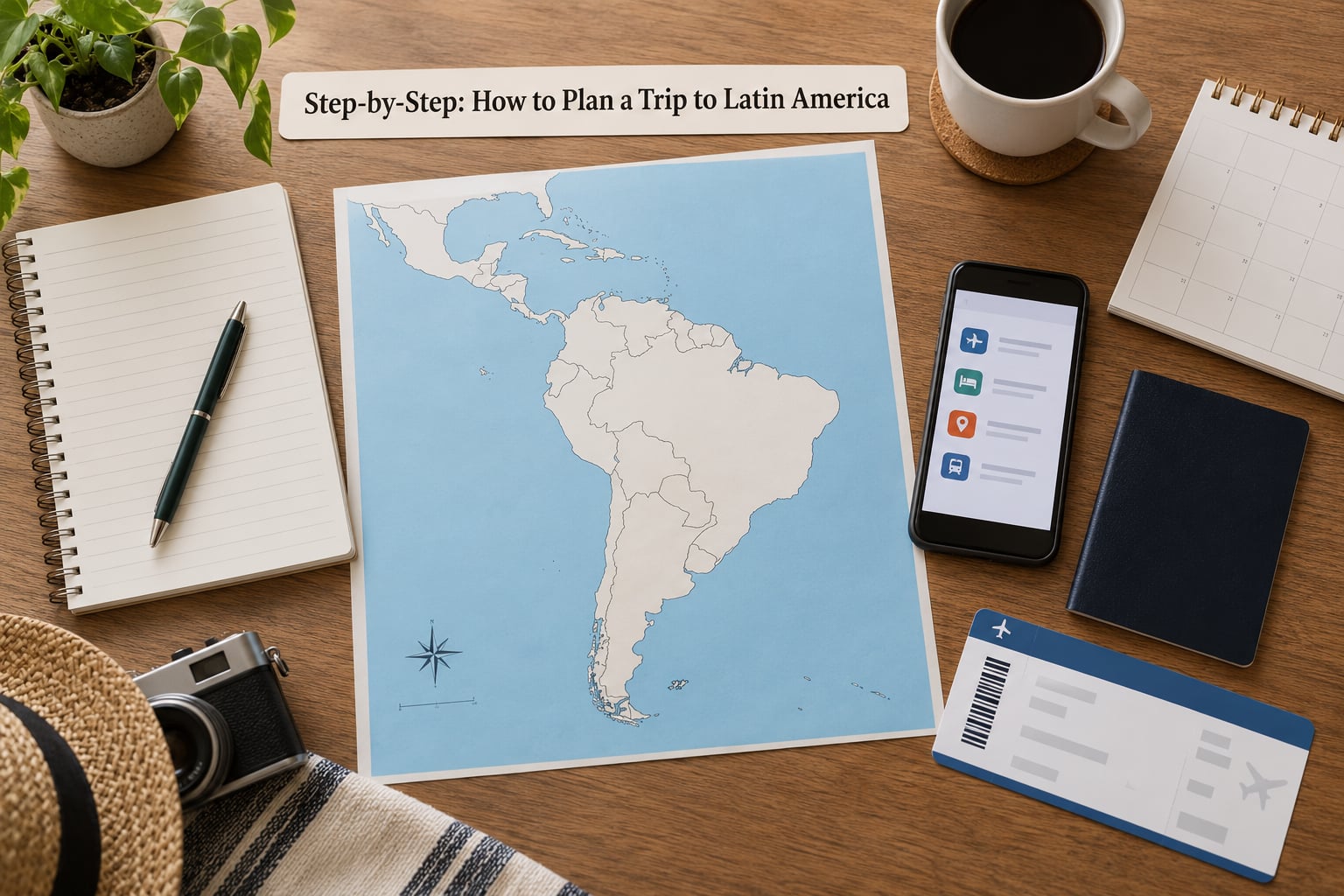
Start with the trip’s central goal, written as one sentence. Beach and ruins, food and cities, trekking and wildlife, or a slow month in one country with a laptop. Everything else is negotiable once that sentence exists.
Then set three filters that decide the route before geography does:
- Pace. Two countries at a real pace, or four at a rushed one. Four rushed countries is the most common version of this trip and the version most people regret.
- Companions. Solo, pair, family with children, or a group. Children under about six change the maths completely, and a solo traveller weighs safety differently than a couple.
- Non-negotiables. Two or three specific experiences. If one of them needs a permit, a guide or a permit-and-guide, it needs to be in the plan before anything else is booked around it.
Test the sentence against reality. If you say wildlife and you have two weeks, the Amazon basin or the Pantanal are realistic and Patagonia is not. If you say food and cities, Buenos Aires, Lima, Mexico City and São Paulo all work. Deciding the goal first saves weeks of arguing with yourself later.
Choose the right destinations and route
Choose destinations by how well they connect, not by how good they are individually. A perfect country that is a 20-hour bus ride from the next one will quietly eat three days of a two-week trip.
Two routing shapes cover almost every good Latin America itinerary. The first is a loop: arrive in one country, cross north or south through two or three more, and leave from a different country than you entered. The second is a single-country trip with one or two side trips by domestic flight, which suits anyone who wants to slow down.
Combinations that tend to hold together well:
- Andean north: Colombia, Ecuador and Peru, linked by overland routes along the spine.
- Andean south plus Patagonia: Peru or Bolivia down into Chile and Argentina, which works well if you want mountains and then cold wind and empty steppe.
- Southern cone: Argentina, Uruguay and southern Chile, compact, well connected and with a long coast road.
- Brazil deep dive: Rio, the Iguazu area and the Amazon or Pantanal gateways, with domestic flights between them.
Check the seasons against the route before you commit. Patagonia and the southern Andes are a summer trip, roughly December to March, with weather that can cancel plans at any time. The Amazon basin and much of Brazil are best in the dry season, roughly June to October. Northern South America has two rainy seasons rather than one.
One hard warning: there is no road connection between North and South America. If your route includes Mexico or Central America, the practical link south is by air, and the overland stretch between Panama and Colombia is a serious gap with real safety considerations. Plan it as a separate flight-and-boat logistics exercise, not a bus hop. Venezuela is a separate decision too, one most travellers now make against.
Compare flights and decide where to fly
Compare total door-to-door time, not the departure time that looks cheapest. An overnight connection that lands at 6am may cost you a hotel night and a wasted morning and still be the better buy.
An open-jaw itinerary, where you fly into one country and out of another, is the single biggest time saver in the region. Entering in Lima and leaving from Buenos Aires turns a backtrack into a straight line. The fare difference is often smaller than people expect, and the hours saved are measured in days, not minutes.
What to compare, in order:
- Journey time including layovers. A connection under two hours is a risk on an unfamiliar route; three is comfortable.
- Where the airports sit. Some are an hour from the city centre by road, which can wreck your first and last day.
- Baggage rules. A checked bag on the final domestic hop can cost more than the whole long-haul segment.
- Separate tickets. If you self-connection with separate tickets, a delay on the first leg means you buy the second yourself. One through ticket protects you; two tickets do not.
- Change rules. Flexibility is worth real money on a multi-country trip where one strike or one protest can move your whole sequence.
Book the long-haul flights first, since everything else hangs off the arrival date. Then leave domestic legs until you have confirmed that you will really be in that country long enough to need them.
Select hotels in practical neighborhoods
Pick a neighbourhood before you pick a property, then search inside it. A cheap room in the wrong district eats the saving in taxis and lost evenings, which is exactly the complaint long-stay travelers keep repeating on hostel forums.
The checks worth running before you book:
- Distance to what you actually do. Walk to a restaurant at your normal evening hour, or ride it in daylight, and time it.
- Transport links. Is the neighbourhood on a metro line, or does it mean a bus at midnight with nothing running after 22:00?
- Tax and fee structure. Ask for the total with taxes. Some countries add national tourism levies charged at the property, and they are not in the headline rate.
- Breakfast. If you eat out, skip the room rate and pick somewhere local. If you are on a tight schedule or travelling with children, included breakfast is worth paying for.
- Reviews filtered for recency and for solo travellers if that is your situation. Old reviews tell you about a hotel that has since changed staff.
For the first two or three nights in a new city, pay for convenience. You will be tired, the streets will be wrong, and a hotel near the transport hub buys you a calmer first day. Once you know how the city works, move to something cheaper and more central to your actual plans.
Build a realistic budget
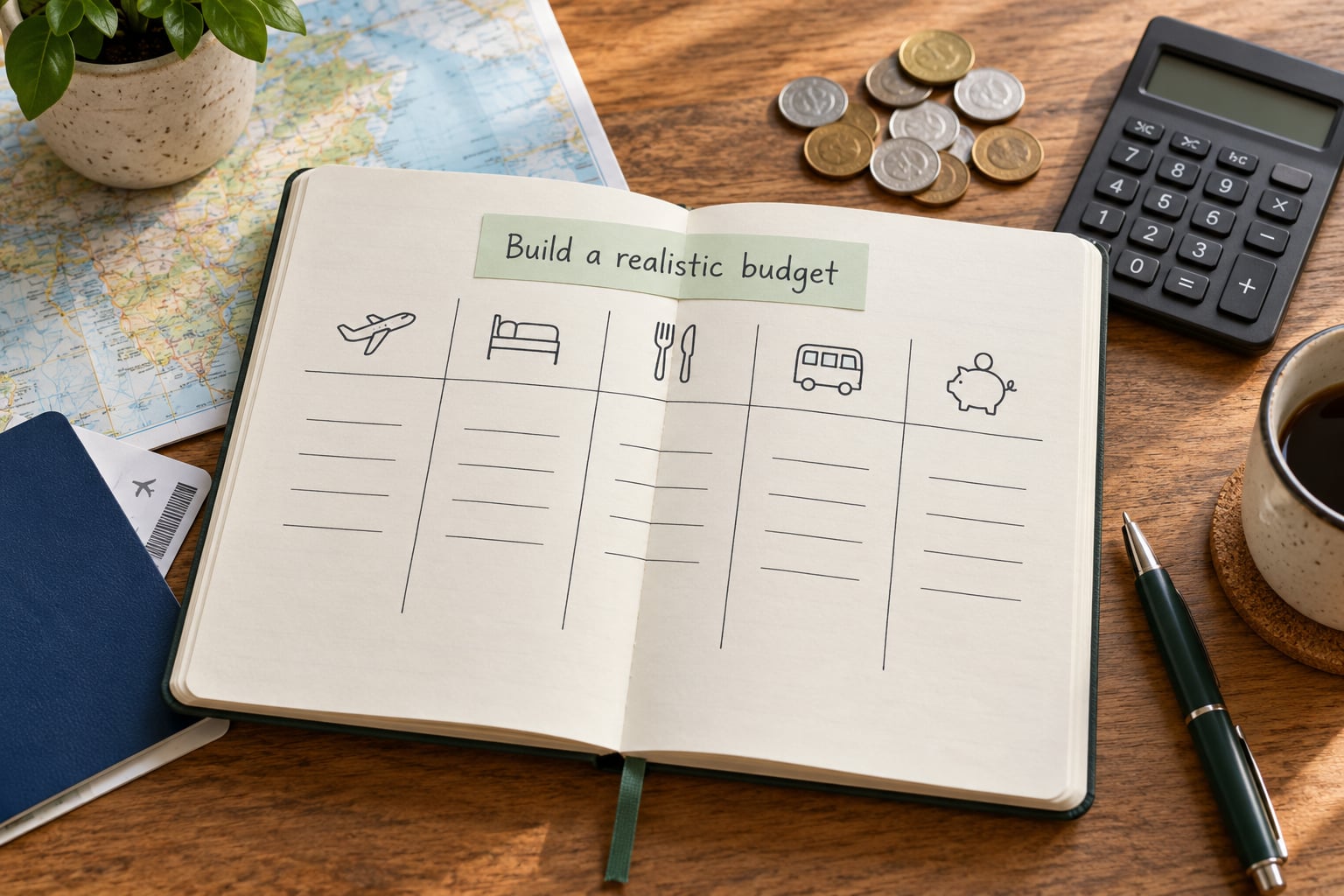
Split your total into categories and give each one a percentage, then check whether the percentages still look right for your style. Exact amounts go stale fast here, since exchange rates and local prices move constantly and a guide with hard numbers ages badly within months.
A workable split for a mid-range multi-country trip looks like this:
- International flights: 25 to 30 percent. Usually the single biggest line and the one you can control least.
- Accommodation: 25 to 30 percent. Hostel dorms at one end, mid-range private rooms at the other.
- Food and drink: 15 to 20 percent. Set-dinner menus and street food at the lower end.
- Ground transport: 10 to 15 percent, and higher if your route crosses several countries by bus.
- Activities and guides: 10 percent, and much more if trekking is on the list.
- Insurance, visas and vaccinations: 3 to 5 percent.
- Communication, tips and small buys: 3 to 5 percent.
- Emergency reserve: 10 percent, untouched. This is the row people skip and then wish they had.
Budget by country tier rather than by continent average. South America stretches from one of the most expensive countries on the planet to some of the cheapest, and an average tells you nothing useful. Cheaper daily costs usually cluster in Bolivia, Paraguay, Peru away from the tourist trail, and parts of Colombia and Ecuador. Chile, Uruguay and most of Argentina sit at the top of the regional range, and Argentina’s currency advantage has narrowed a great deal as inflation and official exchange rates have shifted. Travellers on forums still carry cash in a widely used hard currency for border crossings and small towns where cards fail, so keep a modest amount split across two places.
Do the multiplication per country, not per continent. Two weeks in three countries is three short stays with two transfer days, and short stays cost more per night than long ones because you pay the transfer twice.
Check entry requirements and travel health
Entry rules change, so verify every destination and every transit country on official government and embassy pages rather than blogs. Three things to confirm for each country on your route:
- Passport validity and blank pages, sometimes with a stricter rule if you are arriving overland rather than by air.
- Visa or tourist-card rules, including whether you must show proof of onward travel, accommodation or funds at the border.
- Vaccination and health certificates. Yellow fever vaccination is required or strongly recommended for several countries, and the certificate is often checked at the border. Requirements for malaria prophylaxis in lowland Amazon areas are worth checking with a travel clinic well ahead.
Travel insurance is the other half of this step, and generic policies frequently exclude the thing you are going to do. If your route includes La Paz, Cusco, Quito or Bogotá, check that trekking above 3,000 metres is covered, because many policies cap altitude far lower than a high-altitude route goes.
Altitude deserves its own paragraph. It is not a paperwork item, it is the thing most people worry about. Acclimatise by arriving at altitude and resting for a day or two before doing anything strenuous, keep water intake high, and speak to a doctor before you travel about whether you need preventive medication. Know that symptoms can be mild and can worsen quickly, and that the correct response to worsening symptoms is descent, not a stronger painkiller.
Pack prescriptions in their original packaging with a doctor’s letter, and save the number for an English-speaking clinic in your first city in case you need it.
Plan local transportation and getting around
Decide how you will move between cities before you book hotels, because it changes which cities are sensible stops. Overland buses and overnight buses are the backbone of the region and are excellent value on long routes, but they take real hours, so schedule them as travel days rather than as lost days.
Bus class is worth understanding: a regular seat, semi-cama with reclining seats and a blanket, and cama with a proper lie-flat berth for night routes. Six hours of regular seating is a different experience from six hours of cama, and the price gap between them is modest. Book overnight departures online when you can and at the terminal shortly before departure when the route allows.
Use a route comparison tool to sanity-check any connection you have invented yourself, since it will show you the realistic door-to-door time including a missed-connection scenario. Domestic flights save hours on the Andean spine and across Brazil, but only make sense when the flight is genuinely faster than the bus after you add both airports.
Inside a city, plan on a mix of walking, city buses or metro, and official taxis or a rideshare app where it operates reliably. Two habits protect you: keep a share of your bookings and your live location with someone at home, and always build a buffer into the day before a booked flight, tour or bus. Region-wide strikes and protests do disrupt road and air travel in several countries, so the buffer is not paranoia.
Prepare for daily travel and confirm the itinerary
Packing for Latin America means packing for climates that do not belong in the same trip. On a single route you can go from tropical heat to high desert cold to wet mountain forest in one week.
- Base layer plus warm mid-layer plus rain shell, carried rather than worn. Cotton is a poor choice for a damp climb; synthetics or wool dry faster.
- Sun protection used every day, including at altitude and in cloud forest, where the sun is stronger than it feels.
- Sturdy closed shoes and a second pair, plus dry bags for electronics and one day’s clothing.
- Refillable bottle, purification tablets or filter, and sunscreen you use rather than one that sits in your bag for three months.
- Copies of everything, passport, insurance, vaccination certificate, and every reservation confirmation.
Then run the final check, ideally two weeks out: opening days and whether anything needs a permit; local public holidays that fall mid-trip; that every booked activity matches the date on your reservation; that you have offline maps for the areas with no signal; that your bank knows you are travelling, because a card frozen abroad is a bad afternoon.
Finally, re-check the one or two items that are hard to fix later. Entry paperwork, insurance altitude cover, and any guided trek or restricted permit are the ones that bite.
Common Mistakes
Overpacking the itinerary. Four countries in two weeks sounds efficient and usually is not. The fix is to count travel days, not nights, and to cut one country. If you want Peru, Colombia and Chile, give yourself three weeks minimum.
Booking a tight connection. A ninety-minute self-connection on an unfamiliar route is a coin flip, and with separate tickets you own the risk. Give yourself three hours, and see it as a free tour of an airport you will get to know well.
Choosing a hotel outside your planned area. Cheap by the nightly rate, expensive in taxis and in evenings you spend indoors. Fix: pick the neighbourhood first, then filter inside it.
Ignoring local holidays and long weekends. National holiday weekends can close border posts, buses and attractions simultaneously. Check the calendar for every country on the route before you commit to a travel day.
Relying on one payment method. Cards fail in small towns, at borders and when the network drops. Carry two different cards from different networks plus a cash reserve in a widely used currency.
Underestimating airport transfers. Count from arrival to the front door of your accommodation, including waiting for bags and traffic, and add a buffer. On the day of a long flight, book the first transfer of the day rather than the last.
Leaving no reserve. Ten percent of the budget, unspent, is the difference between a rerouted trip and a ruined one. Set it aside in a separate account the day you get paid.
Buying everything in advance. Lock the long-haul flights, the first week of accommodation and anything needing a permit. Leave the rest open, because the best parts of these trips are usually the ones you did not plan.
Skipping the slow parts of a fast country. Peru deserves more than a rushed Cusco and a flight home. The regret people describe afterwards is almost never about the thing they did not see.
If you take one thing from this list, take the counting-travel-days rule. Nearly every other mistake on the list follows from an itinerary that quietly assumed you can be in two cities on the same afternoon.
Frequently Asked Questions
How much time should I spend planning a trip to Latin America?
Two full weekends is realistic for a two-to-four country trip: one for the route, budget and flights, and one for entry requirements, insurance and accommodation. Add a third weekend if you are booking guided treks or anything permit-controlled, since those sell out months ahead. Solo travellers and anyone organising money for others can comfortably stretch that to a month, and the extra time is almost always better spent on route decisions than on reading more blogs.
Is Latin America safe for a first-time traveler?
Most of the region is manageable with ordinary precautions, and millions of visitors travel it every year without incident. The honest answer is that safety varies enormously by country, city and neighbourhood, and by time of day. Violent crime against tourists is rare, while opportunistic crime, taxi overcharging and distraction theft are common in cities. Check your government’s current advisory, stay in established tourist districts, use official taxis at night, and pick accommodation with recent reviews mentioning solo travellers.
Should I use a travel agent to plan a Latin America trip?
For a first trip built around a specific route, a good agent can save you days of research on border procedures, internal transfers and seasonal timing. They cost more, and the value drops if your trip is simple or you already know the region well. Booking flights and accommodation yourself is usually cheaper. A middle path works well: ask an agent to review your route before you pay for anything, then book independently.
What is the best way to get between Latin American countries?
Long-distance overnight buses are the standard for neighbouring countries and are reliable when booked properly, with semi-cama or cama classes for night routes. Domestic flights make more sense when the journey is over six hours and both airports sit close to the city. Multi-country travellers often mix both, flying over the long jumps and taking buses inside a country. There is no road link between North and South America, so any Central America to South America route needs air.
Do I need to speak Spanish to travel through Latin America?
You can get through the main tourist routes with English and a translation app, but the trip improves quickly with even basic Spanish. Outside tourist areas, in smaller towns, at markets and when something goes wrong, it is close to essential. Thirty minutes a day for a couple of months gives you greetings, numbers, asking prices and apologising, which is most of what you need. Portuguese is worth learning separately for Brazil, where Spanish does nothing for you.
How much money should I budget for a trip to Latin America?
Work it out per country rather than per continent, because daily costs here range from genuinely cheap to among the most expensive on the planet. Build a total for flights, accommodation, food, ground transport, activities and insurance, then add a ten percent reserve you do not plan to spend. Check current figures from a currency converter and a live cost-of-living database for each stop, since rates and local prices shift quickly.
Conclusion
Planning a trip to Latin America comes down to four decisions made in the right order: what the trip is about, where it goes, how you get in and out, and how much it costs. The paperwork, insurance and packing all follow from those four, and none of them work if you do them first.
Start now with three actions. Write your one-sentence goal and your three non-negotiables. Put a real ceiling on the budget, then split it into categories and one reserve. And before you book any flight, verify passport validity and entry requirements for every country on the route, including the ones you only pass through.
Everything after that is refinement. The continent is large and the distances are honest about it, so give yourself permission to choose four things to do well rather than nine things to rush.