Hurricane season affects Caribbean travel through disruptions rather than constant bad weather. The official Atlantic hurricane season runs June 1 to November 30, activity peaks from mid-August through October, and the only trips that really suffer are the ones whose flights, ports or resort happen to sit under a storm track.
Most people picture six months of chaos. In practice the season is mostly ordinary beach weather punctuated by short, specific headaches: a cancelled flight, a swapped port of call, a resort asking you to move rooms for two nights.
Table of Contents
- 1How Hurricane Season Affects Caribbean Travel Plans
- 2Why September and October carry the most risk
- 3Which Caribbean islands sit outside the hurricane belt
- 4What a seasonal outlook does and does not tell you
- 5What Happens to Flights and Airports During a Storm
- 6How Cruise Lines and Ferry Services Respond
- 7What Travelers Should Know About Hotels and Resorts
- 8How to Decide Whether to Cancel or Rebook
- 9Frequently Asked Questions
- 10What months should I avoid the Caribbean?
- 11Are hurricanes more likely in September or October?
- 12Which Caribbean island is least affected by hurricanes?
- 13What happens if I book a cruise during hurricane season?
- 14Does cruise insurance cover hurricanes?
- 15Is the current hurricane season going to be bad?
- 16Conclusion
How Hurricane Season Affects Caribbean Travel Plans
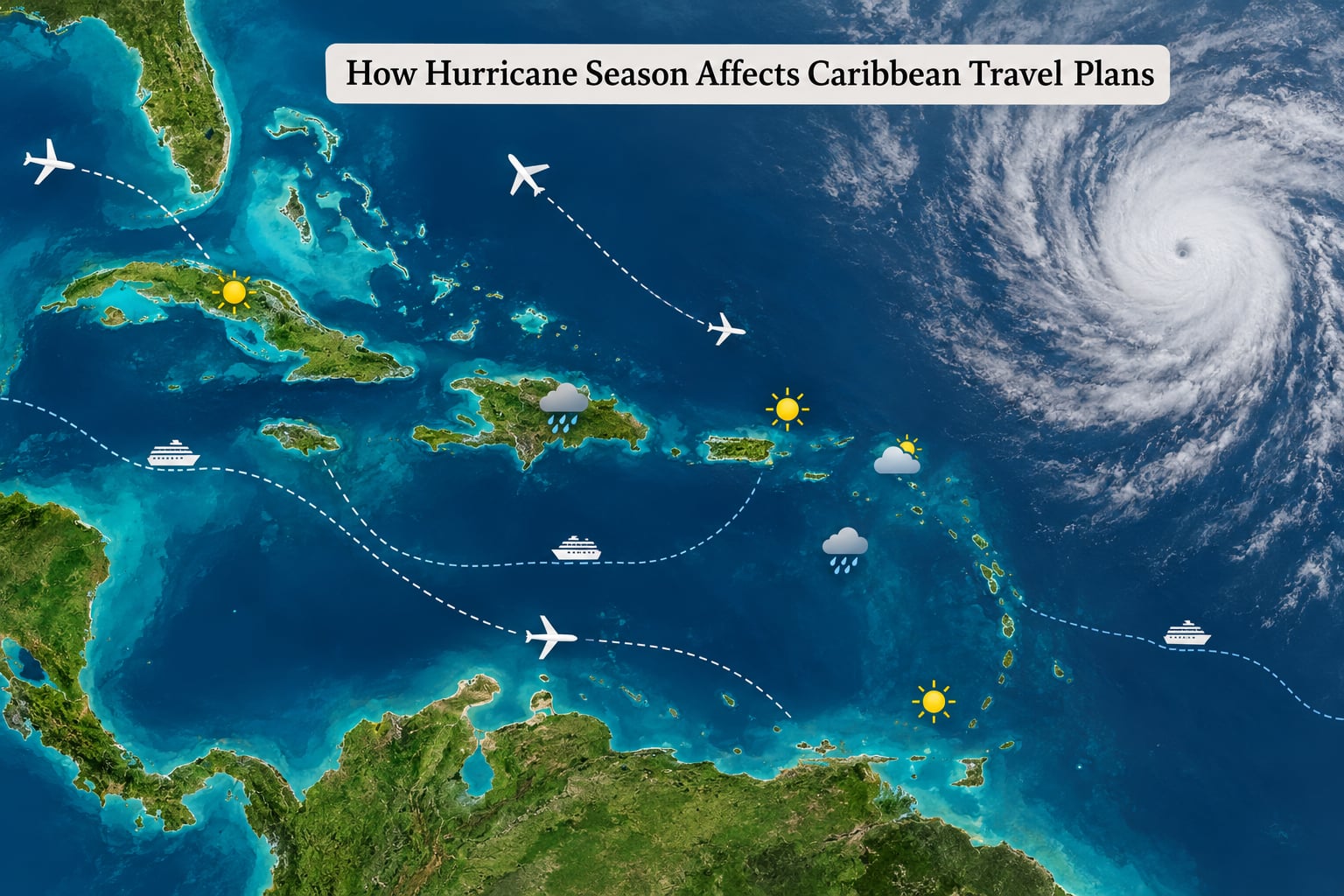
Hurricane season changes travel plans in three ways: the odds that a flight gets cancelled, the odds that a cruise changes its itinerary, and the odds that a resort has to close for a day or two. It rarely changes whether you enjoy the trip, and most travelers who go in September or October have a good one.
Two facts do most of the work. Storms rarely park themselves over the islands for days; they pass through. And the six-month window is far longer than the number of days that hurricanes are actually active in the Caribbean, which is why the season feels far longer than the risk.
| Month | Risk level | What to expect | Booking advice |
|---|---|---|---|
| June | Low | The season opens quietly, with a few early systems in the western Atlantic | A good window for flexible, low-panic planning |
| July | Low to moderate | Activity picks up, mostly short-lived tropical storms | Fine for most travelers; buy insurance |
| August | Moderate to high | Activity rises noticeably, and heat makes any delay feel longer | Book flexible rates and avoid tight onward connections |
| September | Highest | Statistical peak of the season, and the month with the largest share of major hurricanes | Most cautious window, and shoulder-season rates usually begin here |
| October | High | Activity tapers, but late-season systems can still reach major strength | Similar caution to September; more resorts start maintenance closures |
| November | Low | Season officially closes on November 30; a handful of systems can still form late in the month | Typically the quietest weeks of the run |
Why September and October carry the most risk
September is the statistical peak because Atlantic water is at its warmest and the atmosphere above it is least stable, which is the combination storms need to intensify quickly.
October usually has fewer systems than September but a comparable share of major hurricanes, because late-season systems tend to form in warm water with time to grow before turning toward land. October trips also tend to be harder to rescue at short notice, since fewer travelers are rebooking and replacement flights and rooms are in shorter supply.
Which Caribbean islands sit outside the hurricane belt
Geography does most of the work here, and it is more reliable than any seasonal forecast. The islands south and east of the main storm track are historically the least affected.
| Region | Typical exposure | What it means for planning |
|---|---|---|
| ABC islands (Aruba, Bonaire, Curaçao) | Below the main hurricane belt, south of the usual storm track | Lowest disruption risk in the region; water and airlift stay open most of the year |
| Southern Caribbean (Barbados, St. Lucia, Grenada, Trinidad and Tobago) | South and east of the belt, though storms still pass through | Resort and marina infrastructure built for tropical weather; schedules rarely cancelled |
| Greater Antilles and the northern Leeward (Puerto Rico, Hispaniola, Jamaica, Cuba, St. Maarten, the BVI) | Inside the belt; historically the most affected part of the region | Highest chance of flight diversions, port changes and resort closures during a named storm |
If your dates are locked into September or October and the destination is flexible, moving to the southern Caribbean or the ABC islands is a bigger risk reduction than any insurance policy you can buy.
What a seasonal outlook does and does not tell you
A seasonal outlook is a probability, not a promise. NOAA’s outlook for the 2026 Atlantic season, as published each spring and updated through August, has been running in the range of roughly 8 to 14 named storms, 3 to 6 hurricanes and 1 to 3 major hurricanes, with a better-than-even chance of a below-average season.
A below-average season can still ruin one specific week in one specific place. The same goes in reverse: an above-average season with every system turning north leaves your itinerary untouched. El Niño conditions tend to suppress Atlantic activity by weakening the trade winds storms feed on; La Niña conditions do the opposite.
Track the National Hurricane Center for anything storm-specific and use the seasonal outlook only as background noise. Forecasts beyond about five to seven days are not reliable enough to cancel on.
What Happens to Flights and Airports During a Storm
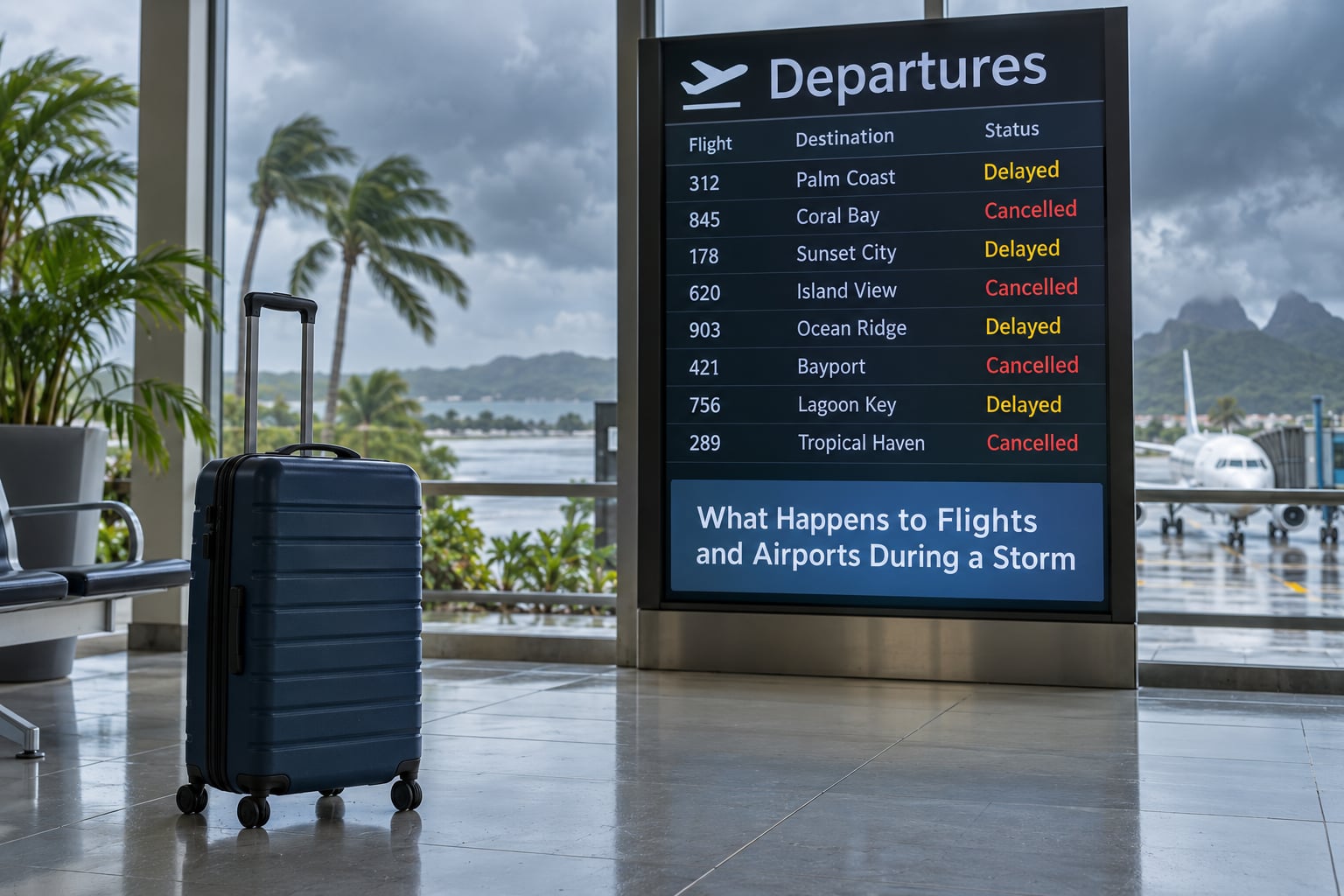
A hurricane rarely closes a Caribbean airport outright. What it does is slow everything down: fewer aircraft get repositioned, crews run out of legal hours, and the airport operates on a reduced schedule until the airspace reopens.
Before the storm arrives you usually get delays and cancellations first, because the airline has already decided to reposition its aircraft elsewhere. After it passes, the first flights out are full and go to different destinations than the one you bought.
What that looks like in practice:
- Cancellation. Your flight was removed from the schedule. You get rebooking or a voucher under airline policy, and the practical question is whether you can reach your connection.
- Diversion. The aircraft flew and could not land, so it goes to another airport. You may wait many hours or overnight before a bus or ferry moves you the rest of the way.
- Misrouting. You land somewhere nearby and your return ticket no longer lines up with a flight that exists. This is the disruption that costs travelers the most time.
- Baggage. Checked bags frequently miss the flight when an aircraft is repositioned and the hold is unloaded. Pack medication, documents and one change of clothes in your carry-on.
If you are stranded, the airline controls your rebooking but not your hotel. Keep your booking confirmations in a screenshot or a cloud folder, not just an email you may not be able to open without data. Buy travel insurance that covers trip delay and interruption, not just cancellation, because a missed connection after a diversion is an interruption problem more often than a cancellation problem.
Two habits remove most of the pain: leave a buffer day between your island arrival and any onward international flight, and avoid a same-day connection home from a small island airport. Both are simple insurance against a weather event nobody could have predicted a week ahead.
How Cruise Lines and Ferry Services Respond
Cruises run in the Caribbean all year, including through the peak, because a vessel can move. Rerouting and timing are what operators manage; closing a season is what they avoid.
What actually happens falls into three categories, and your passenger contract treats each one differently. This is the fine print most travelers never read.
| Outcome | What it looks like | What you are usually owed |
|---|---|---|
| Itinerary change | One port swapped, added or dropped; the sailing still happens | Generally nothing, unless the line substitutes a port of similar value or issues a credit |
| Cancelled port call | The vessel anchors outside the harbour and you lose the day ashore | Refunds for that day’s port excursions and onboard charges are the common practice |
| Cancelled sailing | The line terminates the voyage before or during the route | A refund of the cruise fare, or a re-accommodation on a later sailing of your choice |
Contract language matters enormously here. Some passenger contracts give the line the right to change the itinerary whenever it judges conditions unsafe, and say plainly that a changed itinerary is not a cancelled voyage. Others commit to a refund or an alternative port. Read your specific line’s terms before you sail, not after.
Across cruise forums the advice is consistent on one point: buy insurance from a third party rather than from the cruise line, because the line’s own protection tends to be narrower and more expensive. The same forum threads are just as consistent that people who cruised in late August and September described it as ordinary, with the occasional rough sea day and the occasional port skipped for weather.
Ferries and small island air services follow similar logic. High-speed and inter-island operators cancel sailings earlier than cruise lines because the vessels are smaller, the routes shorter and there is no itinerary to reroute around.
One thing that strands bookings more often than weather: some islands and resorts shut for repairs in September and October, the shoulder season. Confirm the property is open for your exact dates before you rebook around a storm, because a quiet resort may be quiet because it has no staff.
What Travelers Should Know About Hotels and Resorts
Resorts handle tropical weather as routine business. Most Caribbean properties are built by people who have weathered decades of storms, and they post guest updates before, during and after an event.
What changes for you in practice:
- Temporary evacuation. Staff move guests to an interior or purpose-built shelter for a few hours or a night. You get your room back afterwards; you do not get a refund.
- Property closure. The resort shuts until authorities clear it, sometimes for several days. This is the scenario that triggers insurance, and it usually starts after sustained wind damage rather than after a tropical storm warning.
- Service interruptions. Power, water and sewage fail first, then come back in an unpredictable order. Restaurants close, pools shut, and rooms lose air conditioning while they are still perfectly comfortable to sleep in.
- Room moves. If your building takes damage you may be relocated, sometimes with a meal plan you did not sign up for. Ask in advance what the property does for displaced guests.
When choosing where to stay, ask two specific questions before you book: does the property have a certified hurricane shelter, and does it have generator backup for water and power? Both are normal in well-built Caribbean resorts and both tell you how the last storm went.
Pack as if you might lose power for a day. That means a headlamp rather than a phone light, a power bank, copies of your passport and insurance documents in a waterproof pouch, a few days of any medication in hand luggage, and cash in small denominations since card terminals need power too. Keep a container of water and know that ordinary tap water may be unsafe for days after flooding, so treat drinking water separately until local authorities say otherwise.
The 48 hours after a storm passes are their own hazard. Roads flood, debris makes them dangerous, and standing water turns into a sanitation problem that affects stomachs and cuts. Stay indoors until officials say it is safe, wear shoes with closed toes, and wash or cover any cuts. Take first-aid and post-storm health guidance from the resort or the local health authority rather than from a forum thread.
How to Decide Whether to Cancel or Rebook
Cancel on information, not on a headline. The useful information window is about five to seven days, and before that a forecast is a guess about a guess.
Work through this in order:
- Check the National Hurricane Center track, not the news. A cone of uncertainty drawn five days out tells you which coastlines are plausibly in play, not that a strike is coming.
- Look at where your dates and your destination sit against the cone. A storm tracking well north of your island is a delay risk, not a cancellation trigger.
- Ask your airline and your hotel what happens under each scenario. You want to know the change fee, the credit rules and the last date a free change is allowed, before you need it.
- Check your policy wording for the named-storm trigger. Many policies only pay out when a storm is officially named and your travel window falls inside it.
- Compare the cost of changing now against the cost of waiting. Waiting risks a last-minute replacement that may not exist; acting early often costs only a change fee. This is the one step where your own budget decides the answer.
The insurance timing rule catches people out more than any other detail. Policies bought after a storm has been named or a watch has been issued for your destination may not cover it at all, or may carry a waiting period. Buying protection the morning you see alarming coverage is often buying the wrong thing at full price.
Cancel for any reason coverage is the blunt option. It pays for almost any reason you declare, but it costs noticeably more than standard trip cancellation insurance and usually requires you to cancel a defined number of days ahead. It suits travelers whose real problem is a nervous month of September, not a specific forecast.
And be honest about the upside. Low-season island rates, smaller crowds, emptier excursions and often calmer water are why experienced Caribbean travelers book the peak months on purpose. Travelers on cruise forums describe late August and September sailings as normal, and part of that is that the sailings still happen while other travelers have already cancelled.
Frequently Asked Questions
What months should I avoid the Caribbean?
Most travelers treat September and October as the months to approach carefully, with August close behind, because that is where Atlantic activity peaks. June, July and November carry lower risk, though storms can form in any month of the season. Avoiding a month entirely is only necessary if your dates are fixed and your destination is in the hurricane belt; the ABC islands and the southern Caribbean see far less disruption in those same months.
Are hurricanes more likely in September or October?
September has more named systems on average, which makes it the statistical peak of the season. October usually produces fewer storms, but a larger share of them reach major hurricane strength because they form in very warm water with time to intensify. Money-wise, October can hurt more, since rebooking a cancelled October flight or room at short notice is harder than in September.
Which Caribbean island is least affected by hurricanes?
The ABC islands, Aruba, Bonaire and Curacao, sit below the main hurricane belt and have the lowest disruption record of the region. Barbados and the southern Caribbean islands such as St. Lucia, Grenada and Trinidad are also outside the belt and rarely see their ports or airports closed. The Greater Antilles and the northern Leeward islands, including St. Maarten and the British Virgin Islands, carry the most exposure.
What happens if I book a cruise during hurricane season?
The sailing almost always happens. Cruise lines reposition the ship, change or drop ports and keep sailing, because the vessel can move out of a storm’s path. Your contract decides what you are owed: a changed itinerary usually pays nothing, a cancelled port call normally refunds that day’s excursions and onboard charges, and a cancelled sailing triggers a fare refund or a free re-accommodation on a later sailing.
Does cruise insurance cover hurricanes?
Usually, but only when specific wording is met. Standard trip cancellation cover pays when a named storm is officially declared and falls inside your travel window, and delay or interruption cover handles missed connections. Two rules catch people out: policies bought after a storm has been named may not apply, and acts-of-God language can narrow what counts. Cruise-line insurance is usually narrower and pricier than a third-party policy.
Is the current hurricane season going to be bad?
Seasonal outlooks are probabilities, not guarantees. NOAA’s outlook for this season has been in the range of roughly 8 to 14 named storms, 3 to 6 hurricanes and 1 to 3 major hurricanes, with a better-than-even chance of a below-average season. El Nino conditions tend to suppress Atlantic activity. Even a quiet season can produce one landfalling storm that ruins a single week, so plan for flexibility rather than for a forecast.
Conclusion
Hurricane season affects Caribbean travel mostly through scheduling, not through ruined holidays. Start with the National Hurricane Center, use the five-to-seven-day window as the real decision horizon, and treat a seasonal outlook as background rather than as news.
Before you go, confirm cancellation and change terms with your airline and hotel, buy insurance before any storm is named, and leave a buffer day around any onward international connection. Keep documents, medication and a power bank in your carry-on, and know your hotel’s shelter plan before you need it.
That preparation costs almost nothing and covers the overwhelming majority of what a season can throw at a trip.