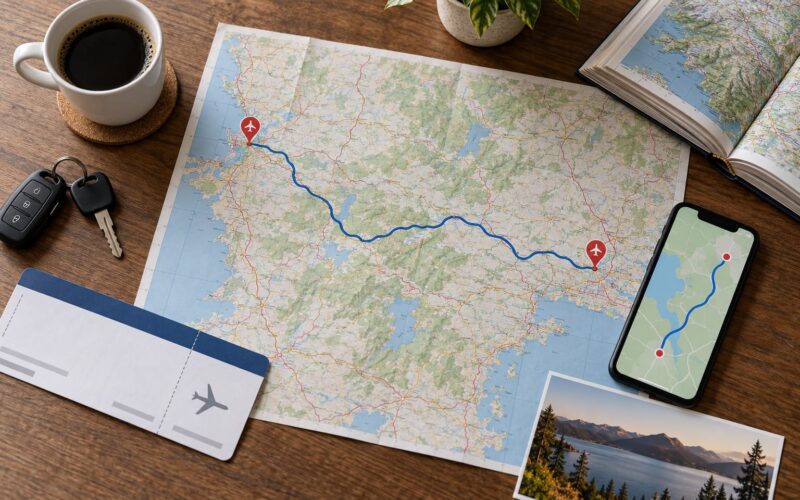
Travelling more sustainably comes down to four things: cut the emissions from getting there, stay longer in one place, spend with people who live there, and leave the place better than you found it. None of that requires a perfect trip or a huge budget. Pick two or three changes that fit your holiday and most of the benefit arrives immediately.
Sustainable travel is usually described as making conscious choices that reduce the negative environmental, social and economic impact of a trip while increasing the positive parts. In practice that means a shorter journey, a locally owned guesthouse instead of a large resort, a market instead of a hotel buffet, and a reusable bottle instead of six plastic ones a day.
There is a guilt trap here that I would rather skip. Flights are sometimes the only practical option, and nobody is going to take a nine-hour bus because a blog told them to. The useful version of this guide is the one where you lower the impact of the trip you were already planning.
Table of Contents
- 1What You Need
- 2Step-by-Step
- 3Choose lower-impact transportation first
- 4Book more thoughtfully
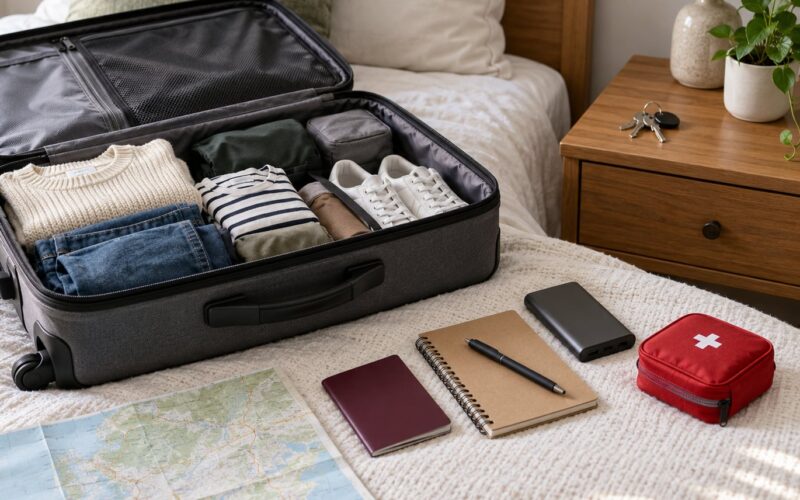
- 5Pack less and choose reusable items
- 6Eat and spend locally
- 7Travel respectfully at the destination
- 8Review the trip and improve next time
- 9Common Mistakes
- 10Frequently Asked Questions
- 11Does flying rule out sustainable travel?
- 12What is the most environmentally friendly way to travel?
- 13Which sustainable travel habits make the biggest difference?
- 14How do I check whether a hotel’s eco claims are real?
- 15How can I lower my impact and my costs at the same time?
- 16Start With the Biggest Change
What You Need
You need very little to start. A bit of planning and a small set of habits do more than any gear.
- Two clear priorities. Pick the two things that matter most to you, such as transport and food. Trying to fix everything at once is how people give up by the second day.
- Flexible dates. Shifting a trip by a day or two often moves you onto a cheaper, emptier, more rail-friendly option and gives you a better room rate.
- A reusable kit. A refillable bottle, a tote or foldable bag, and solid toiletries in small containers. This is the single highest-return packing list there is.
- Accurate destination information. Local rules on protected areas, water, wildlife and cultural sites change, so check the official park or municipal guidance rather than relying on a five-year-old forum post.
- A realistic budget for responsible options. Train travel, locally run stays and independent tours often cost less than the package holiday they replace. Set aside the difference for a longer stay instead of a shopping trip.
A few honest numbers help. Most of a holiday footprint is decided before you leave the house, by how far you go and how you get there. Packing choices and meal choices matter, but they are second in line.
Step-by-Step
Work through this in order, from the booking stage to the flight home. Each step has a quick check at the end so you can tell whether it actually worked.
Choose lower-impact transportation first
Start with the biggest lever you have: how you move between places. If you are learning how to travel more sustainably, transport is where the numbers live.
Typical carbon dioxide emissions per passenger-kilometre, roughly averaged across short and medium distances:
| Mode of transport | Approx. g CO2e per passenger-km | Best used for |
|---|---|---|
| Walking and cycling | Close to zero, mainly food and equipment | Short distances in town |
| Night train or sleeper | About 10 to 40 | Journeys up to roughly 1,000 km |
| Coach or intercity bus | About 20 to 40 | Regional and cross-border legs |
| Electric or high-speed train | About 20 to 60 | City pairs with fast rail |
| Hybrid or petrol car | About 100 to 180 | Remote areas with no transit |
| Short-haul flight | About 150 to 250 | Only when nothing else works |
| Long-haul flight | About 250 to 400 | Intercontinental trips |
Figures shift with load factor, fuel source and route, so treat them as a ranking rather than a receipt. The pattern holds: rail and coach sit at the bottom, aviation at the top.
A few rules of thumb that hold up in practice. Book direct flights, because take-off and landing burn disproportionately and every connection adds a second journey. Choose a nonstop over a two-stop itinerary even when the saving looks tempting. At the destination, use the local metro, tram, bus or bike share instead of a car hire for the whole week. And night trains are underrated: they save a hotel night, they arrive in the morning, and the sleeper cabins feel like a slow holiday in themselves.
How to tell it worked: your chosen mode matches the actual distance and you did not add a leg you did not need. If a two-hour hop took three connections, the rail network lost.
Book more thoughtfully
Bookings are where a surprising amount of impact and money get decided, and this step is pure logistics.
- Search rail before air. Open the train operator’s site before the airline’s. Compare journey time door to door, not terminal to terminal.
- Stay longer, see less. Three nights in one town beats three one-night stops. Slow travel lowers transport emissions per day and usually cuts your spending too.
- Favour locally operated stays. A family-run guesthouse sends money to people who live in the area rather than to a distant parent company.
- Look at cancellation terms. Flexible terms let you adapt when a rail strike or a weather warning disrupts the plan.
- Read the sustainability claim, not the badge. “Solar powers 40 percent of hot water” is a measurable claim. “Eco-friendly” is not.
When you do want third-party verification, look for labels that require on-site assessment and published standards, such as GSTC-aligned certification, Green Key, EarthCheck or a B Corp score. The verification method is simple: open the operator’s own sustainability page and find the underlying standard or the certification body’s name. If neither exists, the label is decoration.
How to tell it worked: you can name the standard behind every green claim you relied on, and your booking had more than one night in each place.
Pack less and choose reusable items
Packing light is the change with the widest reach. A carry-on means fewer bags, less dead weight in the hold, and often a fare without a checked bag.
- Refillable bottle, always. It is the item that removes the most plastic per trip. Refill points exist at airports, hotels and fountains.
- Solid toiletries. Shampoo bars, soap bars and a bamboo toothbrush replace three bottles that are guaranteed to be single use.
- A tote that folds flat. Markets, bakeries and pharmacies hand out plastic; a bag already in your pack ends the debate.
- Refillable containers. A small jar for snacks or sauces means you skip the packaged ones at the airport counter.
- Reusable cutlery and a cloth napkin. Handy on long train journeys and city trips with street food.
- Skip the “just in case” layer. Most of us carry clothes we never wear. Laundry in a guesthouse costs less attention than overpacking demands.
For sun and water activities, reef-safe mineral sunscreens avoid the oxybenzone and octinoxate formulations that damage coral in warm water. If you are packing swim gear, a quick rinse of sand off before you enter the sea keeps it out of the water and out of the filter.
How to tell it worked: you finished the trip with the same small reusable kit you started with and produced very little single-use waste. Note how many plastic bottles you avoided, because that number keeps you motivated.
Eat and spend locally
Food is where a travel budget and a travel footprint overlap nicely. Markets and street stalls are usually cheaper than tourist restaurants and often use produce grown nearby.
- Eat where your money keeps you. The family-run place with a handwritten menu beats the international chain on both counts.
- Go plant-forward. Plant-heavy meals carry a lighter footprint than meat-heavy ones. It is not all or nothing; a few meat-free days per week adds up without ruining the holiday.
- Choose seasonal and regional items. If the menu lists a short local supply, ask about it. Out-of-season imports travel a long way.
- Order only what you will finish. Street food is usually served in portions you choose yourself, which makes food waste easy to avoid.
- Buy fewer, better souvenirs. Locally made crafts last longer than mass-produced trinkets and keep money with local artisans. Cash in small notes helps the person in front of you.
Hire a local guide for a day rather than only visiting the main viewpoint. You support a working knowledge of the place and often get to eat or buy somewhere outside the visitor strip. Community-based tourism co-operatives in rural areas are worth a search before you book, because the money stays with the community by design rather than by promise.
How to tell it worked: you can list what you bought, where it came from, what you ate and what you threw away. If the list of purchases is short and the list of leftovers is empty, the habit stuck.
Travel respectfully at the destination
Low-impact travel is only half of it. Impact on people matters as much as impact on the atmosphere.
- Read the local rules first. Protected areas, closed reefs, dress codes at temples, restrictions on drones, limits on camping. Check the official site before you arrive.
- Ask before photographing people. Especially children, religious ceremonies and people in their own homes. A polite question avoids a lasting bad impression.
- Learn a few words of the language. Greetings and a thank-you go a surprisingly long way.
- Stay on marked paths. Off-path shortcuts in dunes, reefs and alpine meadows kill the vegetation you came to see.
- Pick wildlife operators with care. Avoid anywhere that offers touching, riding, staged photos or hand-feeding wild animals. Choose places where animals behave naturally and breeding is part of the plan.
- Pack out everything you brought in. Carry a small bag and use it in places with no bins. This also applies to cigarette butts, which are the most common litter on trails worldwide.
- Keep to one-time visitor sites in season. If a trail is temporarily closed to protect nesting or recovery, the closure is the conservation measure, not an inconvenience.
Choose activities with a conservation fee that is actually earmarked for site management. Ask where the fee goes before you pay it.
How to tell it worked: the people you met seemed fine with you there, and the site looked the same or better than when you arrived. If guides politely correct your technique, you were doing it right.
Review the trip and improve next time
The review is a five-minute habit and it is what turns one good trip into a pattern. Before you file the booking confirmations away, write down three things.
- One transport decision. What you took, what the alternative would have cost you in time, and what you would repeat.
- One accommodation decision. Whether the place matched its claims, and whether staying longer would have been better value.
- One habit to repeat. The reusable kit, the market breakfast, the no-photography-without-asking rule. Keep exactly one so you actually do it again.
You also now have the numbers for a footprint estimate for next time. Air travel calculators are widely available, and several airline search tools offer a lower-emission option in their results, so a change of aircraft or route can show up before you book.
How to tell it worked: you have three notes instead of a vague feeling, and next trip already has one better default.
Common Mistakes
Most failed attempts at low-impact travel come from the same handful of errors. Each has a straightforward fix.
- Trusting a vague green claim. “Eco-friendly resort” tells you nothing. Fix: look for a percentage, a standard or a certification body. Measurable claims survive scrutiny; adjectives do not.
- Buying souvenirs instead of memories. Cheap mass-produced items cost money twice, once for you and once for the landfill. Fix: set a small cash budget for locally made goods and stop there.
- Treating a flight as automatically worse than everything. A three-hour flight can beat a nine-hour drive with two nights in transit. Fix: compare door-to-door time and emissions, not the label on the mode.
- Packing for an imaginary version of yourself. Full-size bottles and a heavy checked bag undo the rest of the list. Fix: lay out everything, remove a third, then check what fits in the cabin allowance.
- Chasing activities built on animal contact. Elephant rides, drugged photo props and selfie-trained monkeys harm the animals and the business. Fix: ask how the animals behave when no visitor is present, and choose an operator where the answer is specific.
- Ignoring local customs and rules. Beach closures, dress rules and photography etiquette are not bureaucracy. Fix: spend ten minutes on official site guidance before you leave.
- Trying to fix everything at once. Perfection is how people quit in week one. Fix: commit to two habits, then add a third only once the first two feel normal.
One tip worth repeating: measure nothing and you improve nothing, but measure too much and you travel less. Three notes per trip is enough. A reusable bottle and a direct flight, that is all most trips need.
Frequently Asked Questions
Does flying rule out sustainable travel?
No. Flying is the largest single source of emissions on most long trips, which is why it is worth reducing first, not why you should stop travelling. Book direct routes, pick economy over premium, and fly only when the distance makes rail impractical. When a flight is unavoidable, a verified offset or sustainable aviation fuel option reduces the impact without pretending the trip was carbon free.
What is the most environmentally friendly way to travel?
Walking and cycling sit at the bottom of the list, followed by night trains and intercity coaches, then high-speed rail, then cars, then flights. For a trip of any length the practical answer is to cover as much distance as possible on rail or coach, keep flights to the legs where no reasonable alternative exists, and use local transit once you arrive.
Which sustainable travel habits make the biggest difference?
In order of impact: how far you travel and how you get there, then how long you stay, then where you spend your money. Staying longer in fewer places cuts transport emissions per day and usually cuts the budget too. Packing light, avoiding single-use plastic and eating plant-forward meals come after those three and are still worth doing.
How do I check whether a hotel’s eco claims are real?
Search the property’s own sustainability page for specifics such as a share of renewable energy or a water reduction figure. Then check whether an independent body is named, such as GSTC-aligned certification, Green Key, EarthCheck or a B Corp score. Vague wording like green or eco-friendly with no standard attached is a marketing label, not a measurement.
How can I lower my impact and my costs at the same time?
Travelling by rail or coach, staying longer in one place and eating at markets instead of tourist restaurants usually cost less than short flights, multiple hotels and restaurant meals. Travelling outside peak dates also improves availability and rates. Carrying a reusable kit stops small purchases accumulating, and free city walking and cycling routes replace paid tours that add little.
Start With the Biggest Change
Pick one change for your next trip and leave the rest alone. If you travel by plane, start there: fly direct, in economy, and compare a rail alternative for the leg that is under about six hours. If you already fly rarely, start with trip length and take three nights in one place instead of three one-night stops. If those feel handled, choose a locally owned stay or swap one airport bottle for the refillable one in your bag.
Two changes, applied every trip, will do more for your footprint than twenty intentions made once.