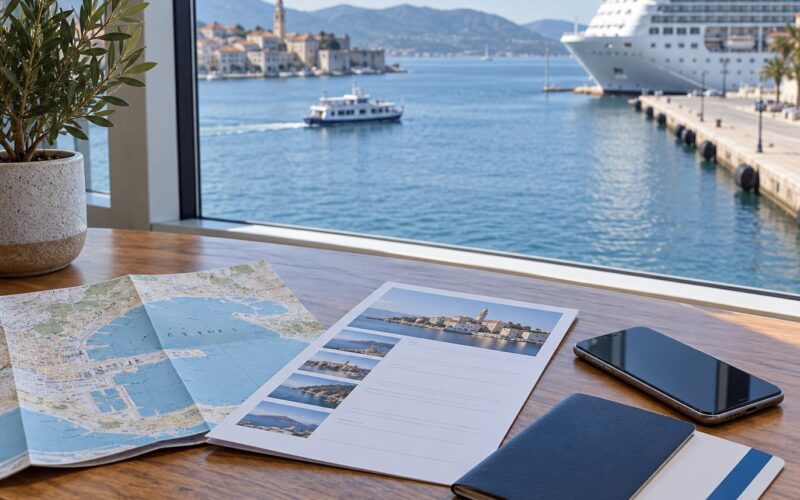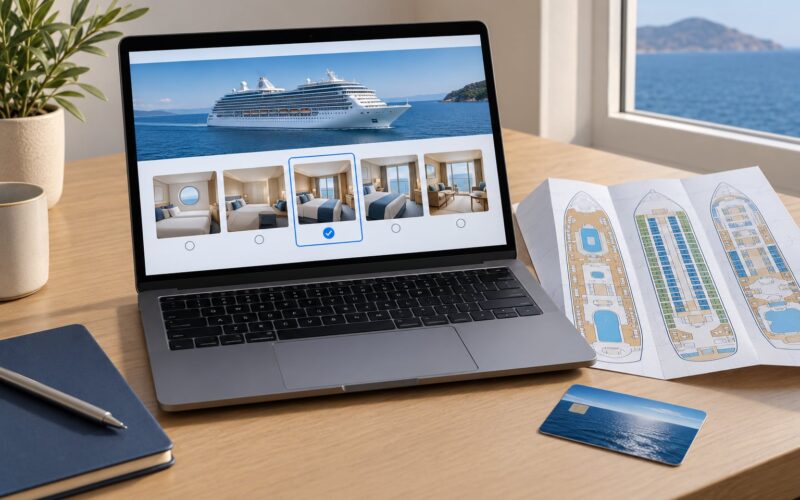
Embarkation day is the stretch of time between arriving at the cruise terminal and the ship leaving the berth. You drop off your big bags, clear security, get your cruise card, wait for your boarding group, step aboard, report to your muster station and settle into your cabin before all-aboard time and sailaway.
The confusing part for a first-timer is that there are three different times in play, and they are not the same thing. Your check-in window is a slot assigned to you. All-aboard time is the hard deadline when the ship must be sealed. Sailaway is when the lines come off. Knowing which is which removes most of the stress.
Table of Contents
- 1What Is Cruise Embarkation Day?
- 2How Cruise Embarkation Day Works From Check-In to Sailing
- 3What time does a cruise ship start boarding?
- 4What Documents and Information Do You Need?
- 5What Happens When You Arrive at the Cruise Terminal?
- 6How Long Does Embarkation Take?
- 7Where Do You Go After Boarding?
- 8What Happens to Your Luggage?
- 9What Should You Do Before Embarkation?
- 10Frequently Asked Questions
- 11How early should I arrive for a cruise?
- 12Do cruise lines deliver checked luggage to my cabin?
- 13What identification is required to board a cruise?
- 14Can I board a cruise and go straight to my cabin?
- 15Is a safety muster drill required on the first day?
- 16What should I pack for cruise embarkation day?
What Is Cruise Embarkation Day?
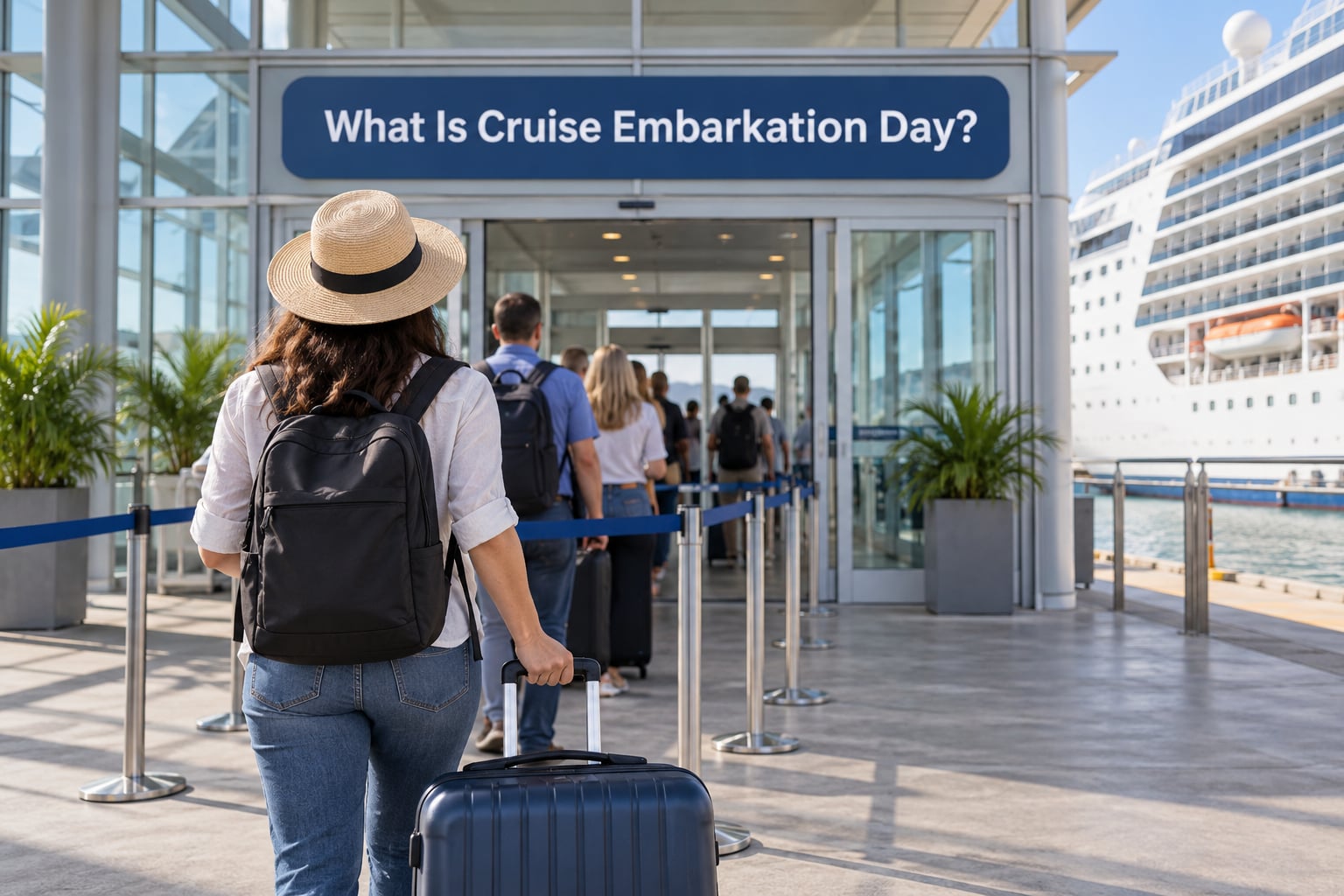
Cruise embarkation day is the day you board, and it covers every step from the terminal door to the gangway and beyond. That includes online check-in, luggage drop, security screening, document checks, the boarding group call, finding your stateroom and the safety briefing.
It usually runs four to six hours for most guests. Families with young children and anyone flying in that morning should plan for the longer end of that range.
One thing worth knowing up front: boarding rarely starts at 9 a.m. The previous sailing has to empty out first, cabins need cleaning, supplies get loaded and the crew needs a turnover window. That turnaround is why most terminals open somewhere around 10:30 a.m. to noon, depending on the port and the ship.
How Cruise Embarkation Day Works From Check-In to Sailing
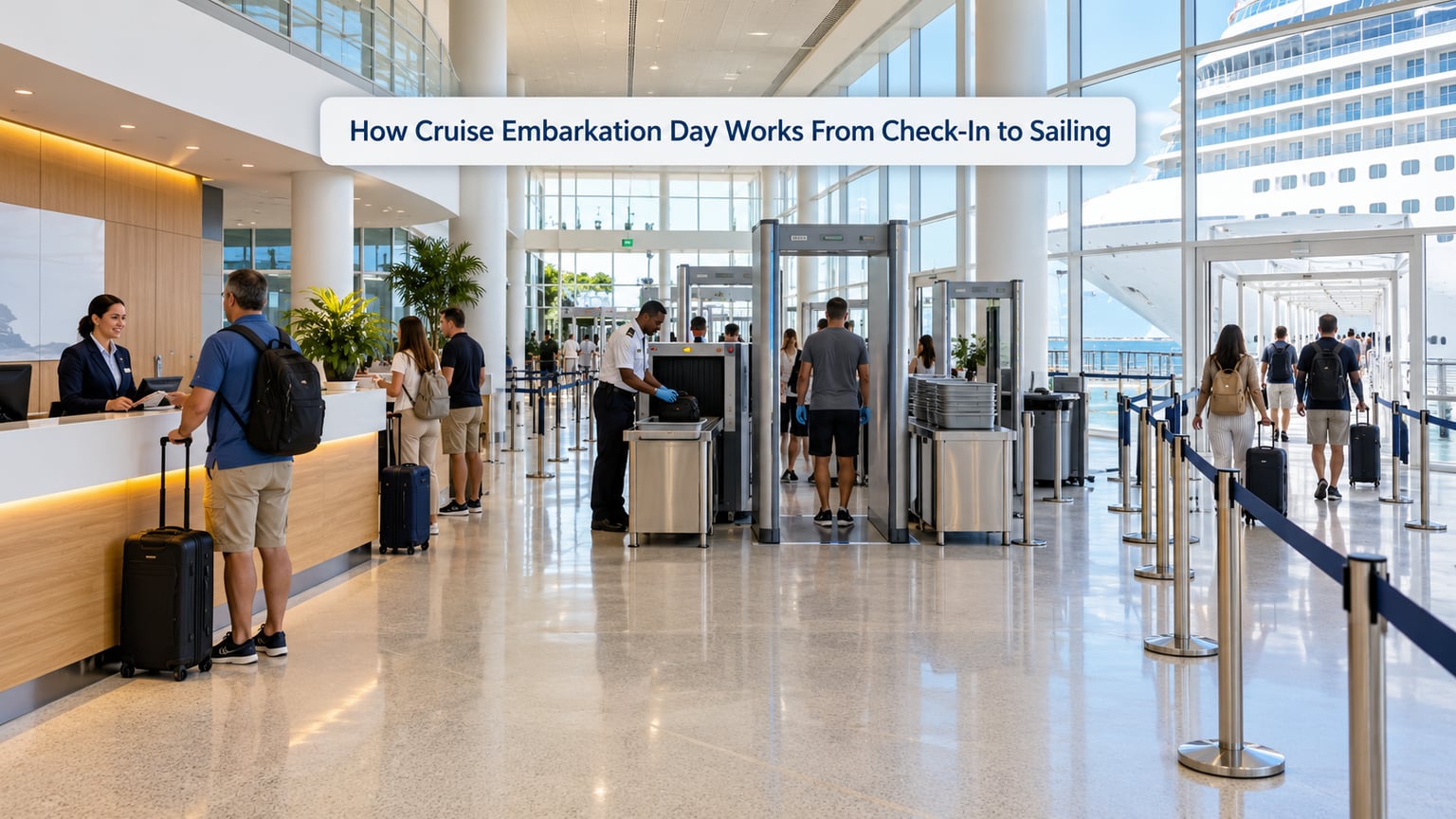
Here is the whole sequence in the order it happens. Online check-in comes days or weeks ahead, then everything below unfolds on the day itself.
What time does a cruise ship start boarding?
Most lines open check-in between about 10:30 a.m. and 12:30 p.m., and boarding runs in staggered groups through the early afternoon. Virgin Voyages is the notable outlier and routinely starts closer to 1:30 p.m. to 2:15 p.m. at some ports. Sailaway is commonly 5 p.m. to 7 p.m. from a home port, with all-aboard called 60 to 90 minutes before that.
| Typical time | What is happening |
|---|---|
| 1 to 3 days before | Online check-in, boarding pass, printed or digital luggage tags |
| 9:00 a.m. to 10:30 a.m. | Terminal opens, porter lines form, bag drop begins |
| 10:30 a.m. to 12:30 p.m. | Check-in windows open by group; security screening and document checks |
| 12:30 p.m. to 3:00 p.m. | Waiting in the terminal, boarding groups called, guests walk the gangway |
| 1:00 p.m. onward | Muster station check-in, safety video, cabin hunt, first meal |
| 1 to 4 hours after boarding | Checked bags delivered to the stateroom door |
| Sailaway minus 60 to 90 min | All-aboard announcement, final guest count |
| 5:00 p.m. to 7:00 p.m. | Sailaway, with a loud horn and a lot of phones pointed at it |
That table is a typical profile, not a guarantee. Turnaround ports in the Caribbean often board more slowly than a home port because the ship has just crossed the ocean and there is more to service.
What Documents and Information Do You Need?
Start with your passport. It has to be valid for the length of your sailing plus a buffer that varies by destination, and many lines now ask for six months beyond your trip. A birth certificate and a photocopy of the passport page work for most closed-loop US sailings that leave and return to the same port. Any itinerary touching Canada, Mexico, the Caribbean or Europe requires a passport, and sometimes a visa.
Alongside that you need your boarding pass or booking confirmation, your cruise card details, your luggage tags and your emergency contact information. Keep all of it in your phone’s wallet app and, if your signal is unreliable at the port, a paper copy in your carry-on.
Requirements depend on the cruise line, the itinerary and your nationality, and they change. Read your own cruise line’s travel documents page rather than trusting a generic checklist.
What Happens When You Arrive at the Cruise Terminal?
Terminals handle thousands of people in a few hours, and the steps below are the standard order. CruiseCritic boards describe staff lining guests up by check-in time, with suites, key-card groups and loyalty tiers moving first.
- Find your line. Look for your cruise line and deck-plan signage. Porters in vests usually take your larger bags curbside.
- Attach your luggage tags. Tags are printed during online check-in or available at the terminal. Write your stateroom number on the tag yourself if the printer smudged.
- Tip the porter and walk on. A small cash tip per bag is the local custom. Keep your passport, phone, wallet, medication and a change of clothes with you.
- Clear security screening. Bags go through a scanner, you walk through a detector, and laptops and liquids get pulled aside.
- Reach terminal check-in. An agent verifies your documents, takes your photo for the ship’s records and explains how your cruise card works as both your room key and your onboard charge card.
- Look for the screens and staff announcements. These show boarding group numbers and whether the ship is boarding yet. Many terminals have food stalls and water stations here, which matters during a long wait.
- Wait until your group is called. Some lines hand out a boarding pass number and call them over the terminal PA. If you miss it, staff will usually let you rejoin the queue.
- Walk the gangway and find your muster station. Your muster station is printed on the cruise card. Beeline there so the safety video can be finished before all-aboard.
A repeated piece of first-timer advice on Reddit’s r/Cruise is to keep identity documents, electronics, medication and valuables on your person the entire time. It sounds obvious until you have watched someone dig through a bag of checked luggage at security.
How Long Does Embarkation Take?
Security and terminal check-in usually run 20 to 60 minutes, and that figure moves with the port, the sailing and the size of the ship. Large home-port terminals with Saturday departures can push past an hour on the busiest sailings. Waiting for your boarding group adds another 30 to 90 minutes, and getting to your stateroom and finding a working cabin takes a few minutes once the gangway is flowing.
Then there is luggage. A realistic delivery window is one to four hours after you board, which means you could be sailing past the coastline before your suitcase shows up. Cabin cleaning has to finish before a room is released, and crew work through staterooms in order, so early boarders in later-numbered cabins often wait longest.
Port traffic, security procedures, cruise-line policies and the size of the sailing all shape the experience. Treat any time you were given in advance as a target rather than a guarantee.
Where Do You Go After Boarding?
Four things happen in the first ninety minutes, and doing them in order saves an afternoon.
Go straight to your muster station. Check in with the crew at your station on the card. This is a SOLAS safety requirement, and the ship genuinely cannot leave port until every guest is accounted for. Once the station registers you, you are free to go.
Watch the safety video. Most lines now run the drill on the in-room TV and app rather than gathering everyone on deck. A few still do a live presentation, so read the daily program rather than assuming.
Open the daily program. It lists sailing time, dinner seating times, the muster briefing if there is one, show times and what is open. Cruisers on r/royalcaribbean recommend scanning it now so you do not spend the first evening walking into closed venues.
Hunt for your cabin. Lifters and status guests usually get rooms first. If your stateroom is not ready, the crew will give you a rough time and point you to somewhere to wait. Lobbies, the buffet and the pool deck are all fair game.
Dinner on embarkation day depends on the line. CruiseCritic notes that Norwegian’s main dining rooms open until 13:30, which is unusually long. Most other lines start service in the evening, so grab something light in the terminal before you board if you will arrive hungry.
What Happens to Your Luggage?
Your carry-on stays with you the whole time. Checked bags are collected at the terminal, moved through a sort area and delivered to your stateroom door by crew, usually in a few hours. You do not go and get them; they come to you.
That split dictates what goes where. Keep in the carry-on everything you cannot replace before the bag arrives: medication, glasses, chargers, a phone battery pack, swimsuit, change of clothes, sunscreen, travel documents and the keycard case for a rental car you are returning. Everything else goes in a checked bag.
On r/CarnivalCruiseFans the standard tip is a few dollars per bag handed over at the curb, and the standard advice is not to keep valuables in the big bag at all.
What Should You Do Before Embarkation?
Two weeks out, complete online check-in. It assigns your boarding window, produces your boarding pass and lets you print luggage tags at home. Guests who skip it end up in a slower manual line.
A week out, check passport validity against your itinerary and note any visa requirement. Download the cruise line app and sign in, because that is where your cruise card, muster station and boarding pass live.
Two days out, plan the transport to the port. Parking, shuttles from remote lots, rideshare drop points and pre-cruise hotel transfers all have their own arrival times, and remote lots mean a bus ride before you ever reach the terminal.
The night before, keep your documents somewhere you cannot lose them, put the first day’s clothes in your carry-on and set two alarms.
On the morning itself, arrive close to your assigned window rather than hours early. A repeat cruiser on Quora reported showing up exactly on a 12:00 slot at Southampton and never waiting more than ten minutes. If you do arrive early, you will spend the gap in a terminal lounge rather than in your cabin.
If your flight is delayed, call the cruise line as soon as you know. Missing check-in is recoverable; the ship does not sail without you, but it does sail on time.
Frequently Asked Questions
How early should I arrive for a cruise?
Aim for your assigned check-in window rather than hours early. Most lines open check-in between about 10:30 a.m. and 12:30 p.m., and arriving early just means standing in a terminal lounge. Leave enough margin to reach the port from a remote parking lot or a flight, and never build a connection that lands less than a few hours before your slot.
Do cruise lines deliver checked luggage to my cabin?
Yes. Porters take your large bags at the terminal curbside, and crew deliver them to your stateroom door later. The realistic window is one to four hours after you board, and sometimes longer if your cabin is still being cleaned. Keep medication, travel documents, valuables and a change of clothes in your carry-on so you are covered while you wait.
What identification is required to board a cruise?
A passport valid beyond your sailing date is the standard requirement. Closed-loop US sailings that leave and return to the same port usually accept a birth certificate plus a photocopy of the passport photo page. Any itinerary calling at Canada, Mexico, the Caribbean or Europe needs a real passport and sometimes a visa. Your own cruise line’s travel documents page is the final word.
Can I board a cruise and go straight to my cabin?
Not always. Your stateroom may still be occupied or being cleaned when you step aboard, because crew turn cabins over in order after the previous guests leave. If it is not ready you will get a rough estimate and a place to wait. Check in at your muster station first, then explore the ship while your room is finished.
Is a safety muster drill required on the first day?
Yes. Every guest must check in at their muster station before the ship can leave port, and this is a maritime safety requirement, not a formality. Most lines now deliver the drill as a video on the in-room TV and app, though some still hold a live presentation. Your muster station is printed on your cruise card, so find it before you do anything else onboard.
What should I pack for cruise embarkation day?
Pack light layers you can wear all day, since terminals and gangways are often warm outdoors and cold inside. Bring your documents, medication, chargers, sunscreen, a swimsuit and one change of clothes in your carry-on. Comfortable shoes matter more than anything else, because you will cover more walking distance than you expect before your cabin is ready.
If you only do three things, complete online check-in early, arrive at your assigned window, and keep your documents and medication on your person. Get those right and cruise embarkation day stops being a maze and becomes the first afternoon of your holiday.