
How to avoid hotel resort fees? You cannot simply refuse one once you check in. It is a mandatory charge bolted to the room rate, and refusing means losing the room rather than the fee. What you can do is avoid it earlier: compare the final total rather than the headline rate, pick a property or room type that carries no fee, and ask for an itemized list of every charge before you hand over a card.
Resort fees in the US commonly run from the low twenties to the mid fifties a night, with luxury Las Vegas and New York properties higher. A week-long stay can quietly cost several hundred more than the search result implied, which is often the difference between a good trip and a great one.
One important caveat before the steps: what counts as a resort fee varies by country. Much of Europe, and all-inclusive Caribbean resorts, fold taxes and service into the advertised rate instead of adding them at the desk. Updated for October 2026; policies change, so confirm with the property before you rely on anything below.
Table of Contents
- 1What You Need
- 2How to Avoid Hotel Resort Fees: Step-by-Step
- 3How to avoid hotel resort fees by comparing the final total
- 4Check whether the resort fee is mandatory or optional
- 5How to avoid hotel resort fees by booking the right room type
- 6Use a refundable or transparent rate when the terms are unclear
- 7How to avoid hotel resort fees by asking the hotel directly
- 8Check the confirmation and ask for an itemized folio at check-in
- 9Negotiate, dispute, or dispute only unclear charges
- 10Common Mistakes
- 11Frequently Asked Questions
- 12Can you refuse to pay resort fees?
- 13How do I get a resort fee waived?
- 14Do hotels charge resort fees when you book with points?
- 15How much is a typical hotel resort fee?
- 16What can I do if a fee appears that I was never told about?
- 17Are resort fees legal?
- 18Conclusion
What You Need
Collecting the right information first is what makes the later checks fast. Before you open any booking site, have these seven things settled:
- Exact dates and occupancy. Rates and fees shift with the season, and fees are charged per room per night, so a one-night shift can change everything.
- The room type and view. A standard king and a suite at the same property can be treated very differently on fees.
- The complete displayed total, not the nightly rate. Look for a price breakdown or tax and fee line, and expand any link that says details, breakdown or full price.
- Cancellation terms. The deadline, the penalty, and whether a prepaid rate is nonrefundable at any point.
- The list of other charges that could follow you: parking, meals or meal plans, Wi-Fi, resort or destination fees, facility charges, cleaning fees, and any co-branded card requirements.
- Your loyalty status and points balance if you hold any, because a fee waiver tied to status or an award stay changes the arithmetic completely.
- A way to compare like for like: the same room, same dates, same number of guests, same cancellation conditions, across the hotel’s own site and at least two third-party channels.
Keep all of it in one place. A simple note or a screenshot of the full price breakdown is often the difference between a calm dispute and an argument at a hotel desk at ten at night.
How to Avoid Hotel Resort Fees: Step-by-Step
How to avoid hotel resort fees by comparing the final total
Most fee surprises start with one number: the advertised nightly rate. Search sites are built to show you that figure first and bury the rest, so the first habit to build is comparing the total you will actually pay.
Open the same room, the same dates and the same occupancy on the hotel’s own site and on two third-party sites. On each, expand the price breakdown until you can see taxes, any destination or facility fee, and any resort fee listed separately. Then compare the final number on your screen, not the rate in the search results.
Check the math too. If the nightly rate plus the mandatory charges does not produce the total displayed at checkout, something was left out, and that something is usually what appears on a separate sheet at the front desk.
How you know it worked: three quotes for the identical room and dates show the same total, or you have a written breakdown explaining exactly why they differ.
Check whether the resort fee is mandatory or optional
Not every charge with a similar name is mandatory. Resort, destination, facility and amenity fees are typically compulsory once you check in, bundled together whether or not you use the pool, the gym or the Wi-Fi. Parking, breakfast, minibar items, laundry, phone calls, luggage storage, mail handling and late checkout are different animals. Those are optional and you simply decline them.
Confusing the two is what turns a small extra charge into a fight. Voluntary purchases should never appear on a folio you did not authorise, so tell the desk immediately if they do.
Disclosure usually lives in predictable places: the price breakdown near the rate, a fee disclosure link, the property’s terms and conditions page, and the fine print of the confirmation email. Read the terms once with a specific question in mind. Is the fee charged per night, per room or per stay, and does it apply to every room type at the property?
How you know it worked: you can name each mandatory charge, its amount per night, and where the property discloses it, in writing.
How to avoid hotel resort fees by booking the right room type
Some properties apply fees by brand, tower, wing, rate plan or room category rather than to every key in the building. A hotel with two connected properties can charge one of them. Rate plan names carry meaning too: a prepaid, member or package rate may behave differently from a flexible one, and package bookings sometimes advertise a waived mandatory resort fee with conditions attached.
Before you book, read the exact room name and rate plan name as they appear in the confirmation, not just the headline description. Look for what is bundled into the rate: if breakfast, parking or a facility charge is included, the effective cost is often lower than a room whose fee you ignored.
Two rooms described almost identically can be treated completely differently on fees, so never assume based on similarity. When the description says king room, check whether it means the base category or an upgraded one.
How you know it worked: the room code and rate plan name in your confirmation match what you read on the fees section of the property’s site.
Use a refundable or transparent rate when the terms are unclear
When a property will not spell out the fees, refundable becomes your safety net. A refundable rate costs a little more and gives you an exit if the bill at check-in does not match what you were told. A prepaid rate locks in a lower rate and locks you into the terms, including the fees, with no way out.
Read the cancellation deadline carefully. Some bookings are free to cancel until a cutoff, others charge the full stay as a penalty, and no-shows are treated differently again. Check whether the deadline is local property time, since a cutoff can effectively be the previous evening for you.
You can also read the room total back to yourself before you pay. If taxes and mandatory fees only appear after you select a room and press continue, you have not yet seen the price you will pay.
How you know it worked: the full total, including taxes and every mandatory fee, is displayed before you enter payment details, and the rate remains refundable through a date you will recognise.
How to avoid hotel resort fees by asking the hotel directly
Email beats the phone because the answer is in writing and you can forward it to whoever else is involved. Ask before booking, and ask four specific questions rather than whether there are fees.
Try something like: “I am considering the standard king from the 12th to the 15th for two adults. Could you confirm the total cost for the stay including taxes, resort or destination fees, parking and Wi-Fi? Please also confirm whether those fees apply to this room type and these dates, and whether the rate is refundable.”
Add a request to include anything being waived in the booking notes or the confirmation, so it is not down to a front-desk worker’s memory three months later.
How you know it worked: the reply states specific amounts and inclusions, and the confirmation reflects the same things.
Check the confirmation and ask for an itemized folio at check-in
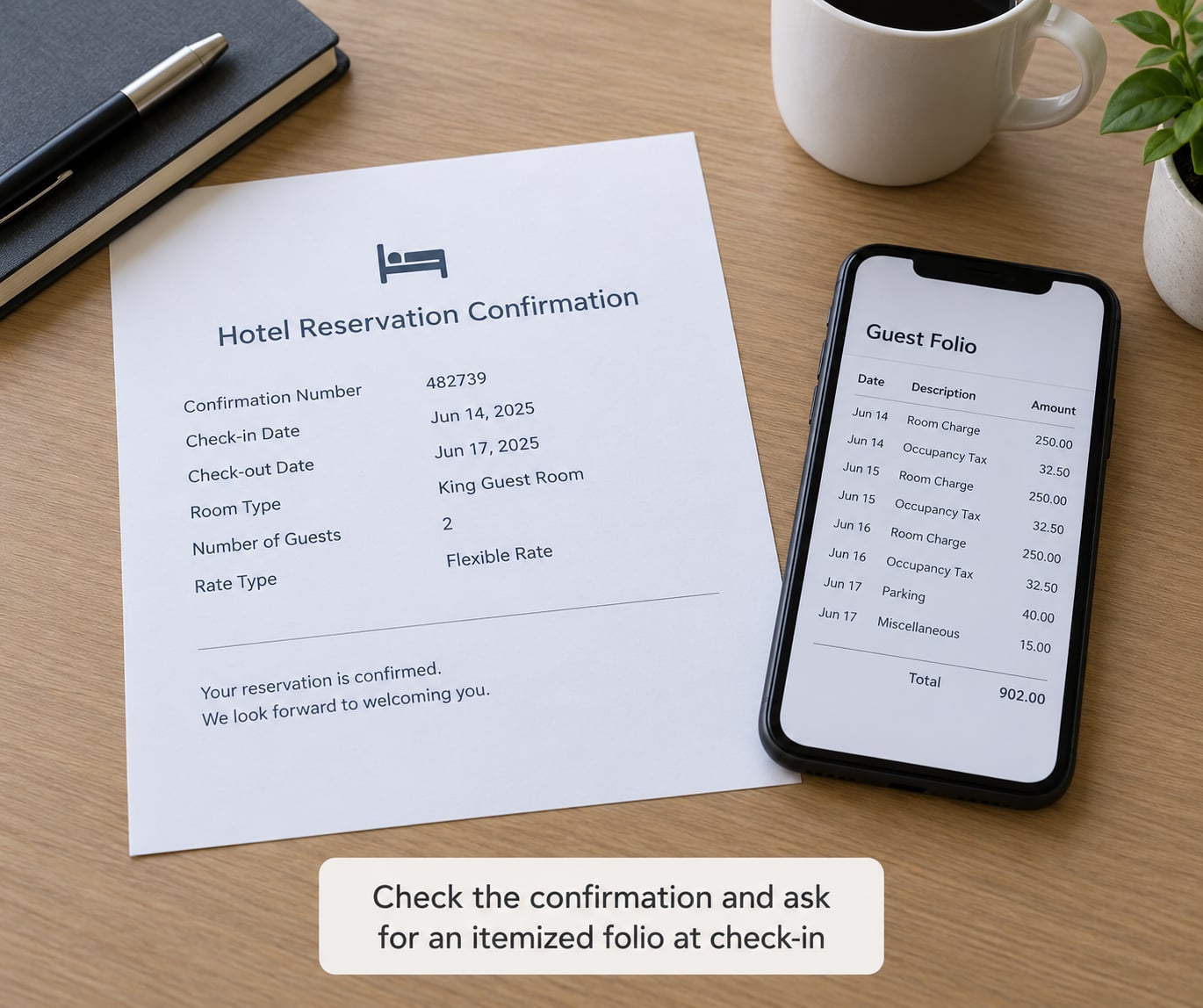
The confirmation email is the cheapest place to catch a problem, because it is the last document that exists purely on paper rather than in someone’s hands. Read it against your notes: room type, dates, number of nights, rate plan, cancellation terms, and every fee named anywhere.
At check-in, ask for the folio or a rate detail printout rather than accepting a summary. You want line items for the room, taxes, each mandatory fee, and each optional purchase. Photograph the folio before you leave the desk, and keep the final folio from check-out until the charge clears your statement.
Ask about incidental card holds while you are still at the desk. They are temporary, but they are worth asking about so the amount and the release are not a surprise a week later.
How you know it worked: every line on the folio matches what you were quoted before arrival, and any difference is raised at the desk rather than after you have left.
Negotiate, dispute, or dispute only unclear charges
There is a line here worth stating plainly. Refusing to pay a legitimate fee at check-in does not get the fee removed; it gets your room. Nobody wins that, and most front desks cannot authorise a waiver anyway.
What does work is disputing a specific charge with a specific reason. A duplicated resort fee line, a fee that does not appear on the confirmation, a minibar charge for an item you never took, a parking charge for a night you did not park, or a charge applied to a room type that is not the one you booked are all worth raising calmly and in writing.
Work through it in four steps. State the charge and why it looks wrong. Ask the desk to look at the reservation notes and your earlier correspondence. If the person cannot change it, ask for the manager who can, without making it personal. Then follow up by email so there is a paper trail if the item is still on your statement.
Travelers report that a polite ask at check-out frequently works, whether that means a fee removed or a small goodwill gesture such as bonus points, so the request is reasonable rather than rude. Save any promise made before you arrive, and keep the confirmation and folio for verification afterwards.
If a charge was never disclosed at booking, keep your screenshots, contact the hotel in writing first, and escalate to your card issuer’s dispute process only after that. Consumer-protection regulators in your own state or country also take undisclosed fees seriously, and rules vary, so check what applies where you live.
How you know it worked: the disputed line is corrected or explained in writing, and everything else on the bill stays untouched.
Common Mistakes
Almost every avoidable resort fee comes down to one of these six missteps:
- Comparing headline rates only. A cheaper-looking room loses the moment a mandatory fee is added. Correction: compare final totals for the identical room and dates, every time.
- Assuming a third-party booking has the same inclusions. Packages, member rates and bundled bookings can carry different terms from the same property’s direct rate. Correction: read the rate plan name and ask what is included.
- Overlooking taxes and destination fees. A resort fee is only one of several mandatory charges. Correction: expand the full breakdown before you judge the cost.
- Booking a room type that carries different terms. Fees can apply by category, brand or tower. Correction: verify the exact room code in the confirmation.
- Treating a refundable rate as a luxury. Refundable rates are the cheap insurance policy when terms are unclear. Correction: accept a small rate difference for an exit.
- Failing to verify the folio. Charges surface at check-out and are hard to challenge later. Correction: ask for the itemized folio at check-in, photograph it, and read the final one before you leave.
A few habits cover most of the rest. Save the full price breakdown at the moment you book, keep screenshots of the terms page, and deal with any mismatch while you are still at the desk. Ten minutes there beats a dispute from three time zones away.
Frequently Asked Questions
Can you refuse to pay resort fees?
No. A resort fee disclosed at booking is a mandatory condition of the reservation, and refusing to pay it means losing the room rather than the fee. What you can do is ask politely for a goodwill waiver, dispute a charge that was never disclosed or duplicated, or appeal the charge in writing after checkout. Legitimate fees are payable.
How do I get a resort fee waived?
Ask before booking by email, then ask again at check-in or check-out, calmly and with one specific request. Have the property’s fee disclosure page, your confirmation and your booking notes in hand. Some chains waive fees for elite members or on award stays, and goodwill gestures such as bonus points are common. Never refuse payment of a legitimate fee outright.
Do hotels charge resort fees when you book with points?
It depends on the chain and on how you pay. Several major programs waive mandatory resort and destination fees on redemptions booked entirely with points, while the same booking split into points and cash usually keeps the fee. Elite tiers may get waivers on paid stays too. Check the specific property’s policy, since each hotel sets its own fee amount.
How much is a typical hotel resort fee?
In the US, resort fees commonly fall between the low twenties and the mid fifties per night per room, with luxury Las Vegas and New York properties charging considerably more. Fees are usually charged per night, so a seven-night stay multiplies the total. Outside the US, many properties fold taxes and service into the advertised rate instead of adding them later.
What can I do if a fee appears that I was never told about?
Photograph the itemized folio at check-out and dispute the line in writing within a few days, attaching the booking confirmation and the terms page as they appeared when you booked. Ask for the manager if the desk cannot resolve it. If the hotel does not respond, escalate through your card issuer’s dispute process, and report undisclosed fees to your consumer-protection regulator.
Are resort fees legal?
In most US jurisdictions they are, provided they are disclosed clearly and consistently before booking. Regulators have pursued hotels that bury fees in fine print or present a headline rate that omits mandatory charges, and disclosure expectations have tightened over time. Rules differ by country and state and change often, so check the current position before assuming a fee is unlawful.
Conclusion
The first action that actually reduces your bill takes five minutes: ask the hotel, in writing, for the complete final price and an itemized list of every fee before you book. That single step catches most of what the seven steps above are built on. After it, keep the confirmation, request the itemized folio at check-in, and raise any unclear line while you are still at the desk.