A boutique hotel is a small, independent, design-led property — usually with fewer than 100 rooms — that offers personal service and distinctive interiors instead of the standardized rooms and corporate amenities of a chain. That is the short answer. The long answer is messier, because the word “boutique” has no legal definition anywhere, which means you have to judge the property rather than the label.
That matters more than it sounds. A traveler booking a weekend city break cares about whether the room is quiet, whether there is a lift, whether breakfast is included, and whether the staff can fix a taxi problem at 7am. None of that is decided by the word on the booking page. Here is how the term actually gets used, where it goes wrong, and what to check before you pay for a stay.
Table of Contents
- 1What Is a Boutique Hotel?
- 2How Boutique Hotels Differ From Other Types of Hotels
- 3What Makes a Boutique Hotel Distinctive?
- 4How to Tell What Is a Boutique Hotel in Practice
- 5Does a Boutique Hotel Have to Be Small?
- 6Are Boutique Hotels Better for Every Traveler?
- 7How to Choose and Book the Right Boutique Hotel
- 8Frequently Asked Questions
- 9Is a boutique hotel the same as a small hotel?
- 10Are boutique hotels expensive?
- 11Do boutique hotels have restaurants and full hotel services?
- 12Is a boutique hotel suitable for families with children?
- 13How can I find a genuine boutique hotel near my destination?
- 14Should I book a boutique hotel directly or through an online travel agency?
- 15Conclusion
What Is a Boutique Hotel?
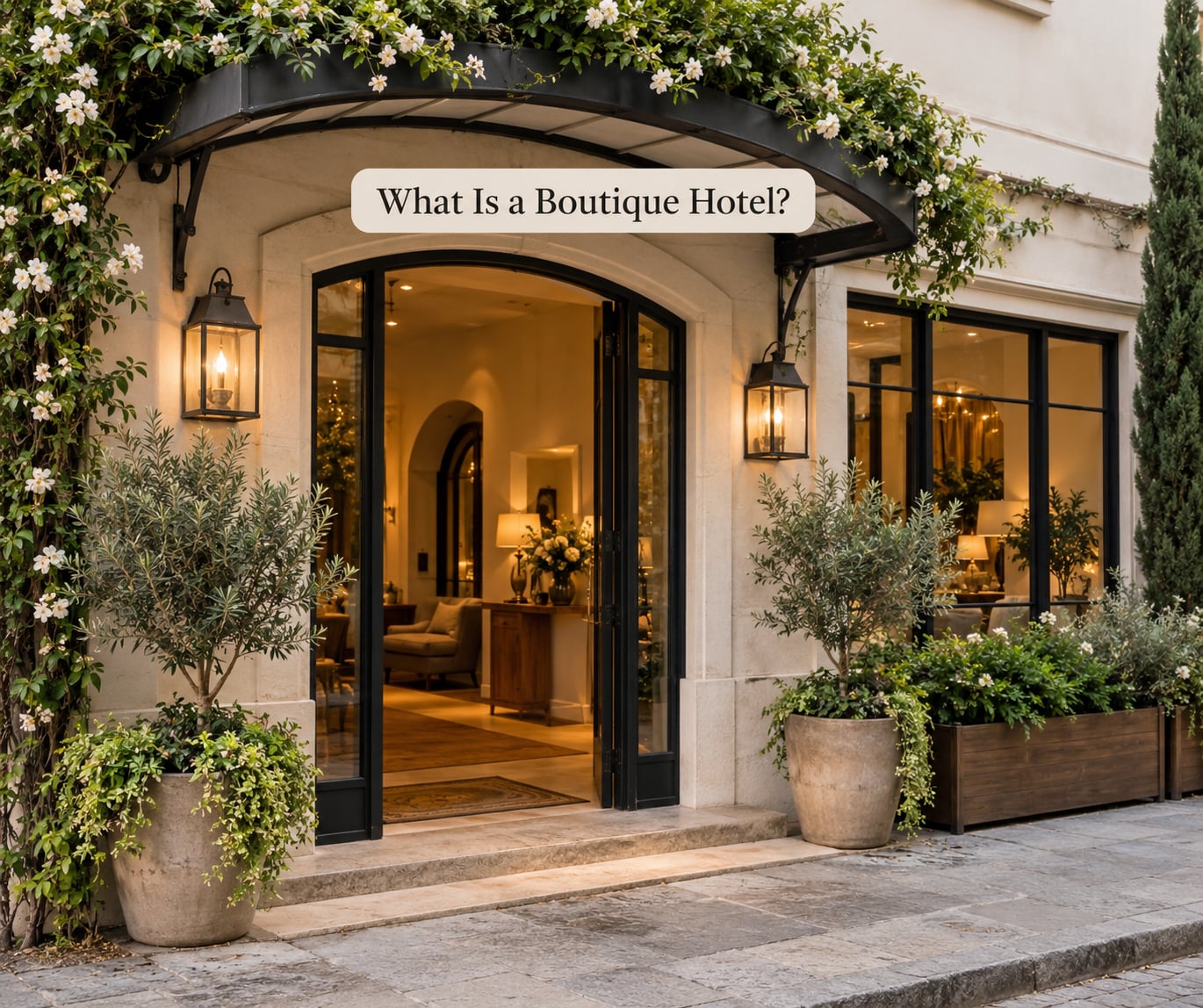
A boutique hotel is an independently owned lodging business that competes on personality rather than scale. Rooms are fewer, interiors are designed around a specific idea, service is delivered by a small team who know the neighborhood, and the on-site facilities are usually limited to what the building can hold.
There is no single legal or regulatory standard behind the term. Rating agencies classify hotels by stars, which measures facilities and service levels; “boutique” describes a business model and a mood. A property can call itself boutique and still have two hundred rooms and a banquet hall, and a thirty-room guesthouse in a converted warehouse can be a textbook boutique hotel with no interest in the word at all.
Size is the most cited feature and the least reliable one. The figure that comes up again and again is fewer than 100 rooms, and some curated lists stretch that to 150. Both conventions describe the same intention: stay small enough that the staff-to-guest ratio stays high, because personal service is impossible when one front desk worker covers a hundred rooms at midnight. Treat the room count as a useful signal, not a rule.
If you read listings in Spanish, the same idea usually appears as hotel boutique, and the criteria are identical. The word travels well because the business model does.
How Boutique Hotels Differ From Other Types of Hotels
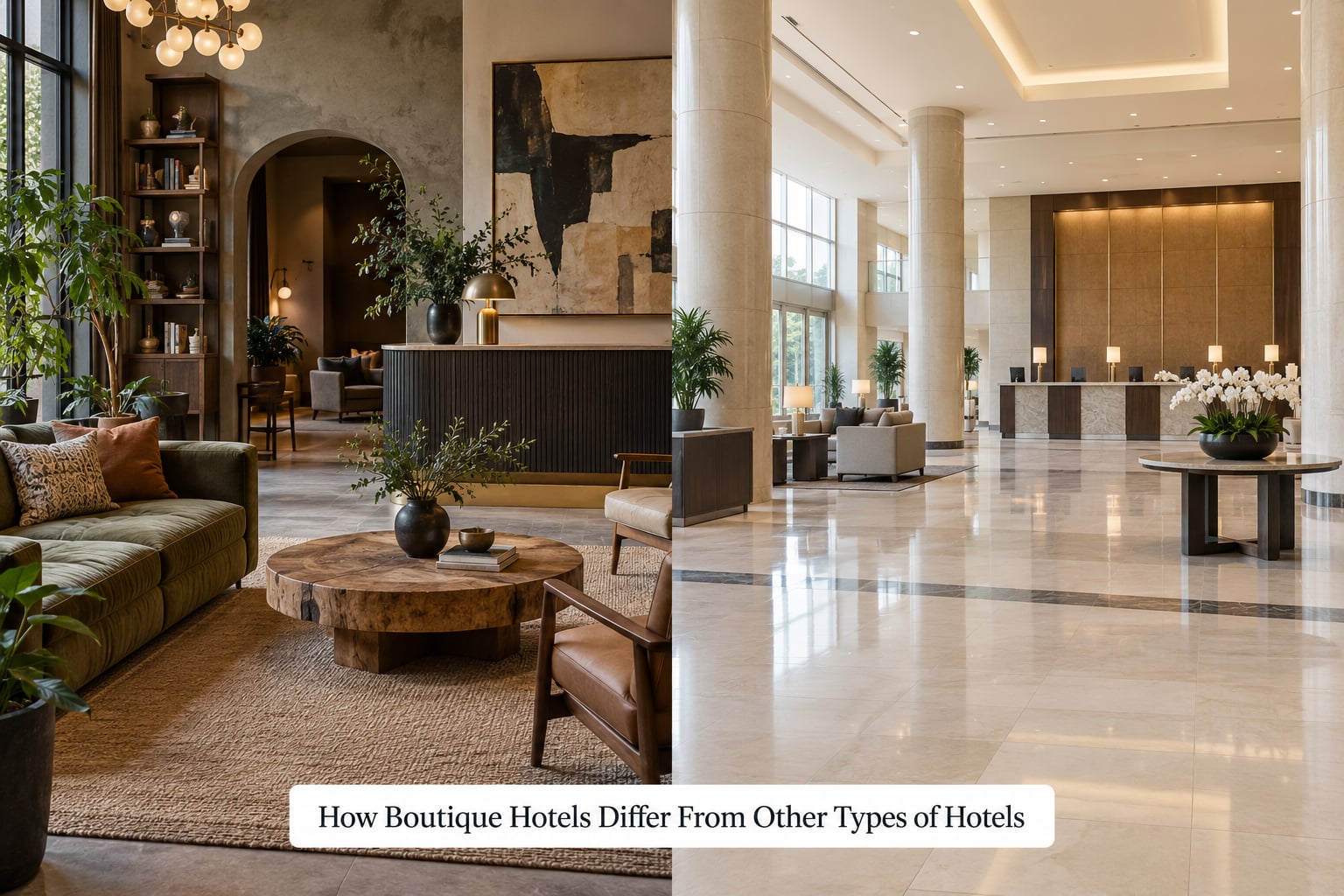
A chain hotel sells predictability. A boutique hotel sells a point of view. A bed-and-breakfast sells a host. A large resort sells facilities. Once you line them up by independence, atmosphere, service, facilities and consistency, the differences stop being about taste and start being about what you get on arrival.
| Criterion | Boutique hotel | Chain hotel | Inn or bed-and-breakfast | Large resort |
|---|---|---|---|---|
| Ownership | Usually independent or a small group | Corporate or franchised | Private owner | Corporate, often a brand portfolio |
| Typical size | Often under 100 rooms | Dozens to hundreds of rooms | Under 20 rooms | Hundreds of rooms and villas |
| Design | One-of-a-kind interiors, local references | Standardized brand template | Homely, house-style | Large-scale, resort-standard |
| Service | Small team, personalized, name-recognition | Rotating staff, protocol-driven | Host-led, highly personal | Full department structure |
| Facilities | Restaurant, bar or small spa at most | Lobby, business centre, gym, pool | Breakfast room only | Multiple pools, kids club, conference halls |
| Consistency | Varies widely between properties | Highly consistent across locations | Entirely owner-dependent | Consistent within the brand |
| Best for | Couples, solo travelers, short design-led stays | Business trips, loyalty points, reliability | Budget travelers who want local hosts | Families and groups wanting activities on site |
Two of those rows deserve emphasis. Consistency is the chain’s real product: a room in one city will look like a room in another. With independent properties, two boutique hotels on the same street can differ in light, noise, mattress quality and how breakfast is served, so recent reviews for the exact property are worth more than any description the owner writes.
The facilities row is where the trade-off bites. What you gain in intimacy you often give up in convenience, and the next section spells that out.
What Makes a Boutique Hotel Distinctive?
The properties that genuinely feel like boutique hotels tend to share a handful of traits, whether or not anyone has ever used the label on their website:
- Independent identity. A named owner or a small operator makes the design, menu and rules. Nobody has to match a corporate template.
- Personalized service. Smaller teams mean staff often know your name by day two and can book tables, arrange transfers or store luggage without a ticket number.
- Thoughtful design. Interiors are chosen rather than ordered, with local materials, artwork or furniture that you will not find in a chain property down the road.
- Local character. The neighborhood feeds the property: menus built around local producers, staff hired nearby, events tied to what the city actually does.
- A limited, edited facilities list. A small restaurant, a bar, maybe a treatment room. The absence of a gym, business center or banquet hall is often deliberate.
- An intimate atmosphere. Fewer guests, quieter public spaces, and lobby areas that function as living rooms rather than transit zones.
- A higher staff-to-guest ratio. This is the mechanism behind nearly every other item on the list, and the first thing you should ask about.
- Smaller-scale sustainability claims. Refillable amenities, local sourcing and reduced housekeeping are common. Treat any certification claim as something to verify rather than assume.
How to Tell What Is a Boutique Hotel in Practice
You can get a fair answer before you book by reading the property page the way a skeptic would. Look for a named owner or operator, a design story with specifics, and a staff count or team introduction on the careers or about pages. If the website only sells atmosphere with no mention of who runs the place, you are reading marketing copy.
Then check the practical evidence. How many rooms are there really? Read the occupancy limit and the bed configuration for your specific room, not the “double room” headline. Look at photos of the actual room type you are booking, and find at least one review from the last few months that mentions noise, hot water, air conditioning and check-in time.
Finally, hunt the fine print. Adults-only policies, minimum-stay rules, resort or destination fees, breakfast that costs extra, and no connecting rooms all appear at the bottom of the policy section. Small properties decide these things quickly, and most will tell you plainly on email if you ask before booking.
Does a Boutique Hotel Have to Be Small?
No, and the term is used far more loosely than its reputation suggests. Some properties of a hundred rooms or more describe themselves as boutique because the design, ownership and service model match, and membership in a curated collection does not automatically disqualify a hotel.
Two misconceptions are worth clearing up. First, boutique does not mean cheap. Design, staffing ratios and limited supply in a good neighborhood all push rates up, and a boutique property in a resort town can cost more per night than a large chain hotel nearby. Second, boutique does not mean tiny either. A converted warehouse with sixty rooms and a staff of twenty may feel more boutique than a twenty-room guesthouse where the owner is also the receptionist.
What actually drives the rate is location, season and scarcity, not the label. A boutique hotel in a quiet neighborhood in shoulder season can cost less than the chain property across the river at peak dates.
Are Boutique Hotels Better for Every Traveler?
They are not, and the drawbacks show up earlier than the marketing suggests. Rooms are frequently smaller, because the building is an older property with awkward dimensions rather than a purpose-built tower. There may be no lift, which matters badly with heavy luggage or a mobility need. Getting two rooms next door, or two beds and a connecting door, can be impossible at any price.
Service hours are another one. A nine-room property does not run a twenty-four-hour front desk the way a two-hundred-room chain does, so late arrivals need confirming and early departures need planning. On-site food may be a small breakfast counter rather than a restaurant that serves dinner. Entertainment, kids clubs and business facilities are usually absent by design.
Consistency is the subtler risk. Because there is no brand standard holding the property to a template, a weak property can be marketed as boutique and deliver a thin experience. Conversely, an excellent one can exceed a chain stay by a wide margin. Frequent travelers tend to book on specific property reviews rather than on category, and that is the honest version of the boutique promise: more character, less certainty.
A larger hotel suits you better when you need extensive facilities, predictable services, group or family space, connecting rooms, round-the-clock staffing, or entertainment that does not require leaving the property.
How to Choose and Book the Right Boutique Hotel
Work through these checks in order, before you compare any two properties with each other. Comparing first wastes time, because the differences that matter are inside the description.
- Confirm the neighborhood fits your trip. Small properties sit in residential streets and old towns where you will hear normal city life. Walking distance to sights matters more here than usual.
- Check the real room size and occupancy limit. Square meters and the maximum number of guests are on the property page. Two people in a small double is a different booking from two people in a king.
- Read recent reviews about sleep. Street noise, thin walls, a bar downstairs and air conditioning are the four things that decide whether a small room feels charming or exhausting.
- Check accessibility and stairs. If anyone in the party cannot manage stairs or needs step-free access, confirm it by email before paying.
- Work out transport and parking. Independent buildings rarely have a large car park. Research parking restrictions and the nearest public transport stop before you commit to a car-based stay.
- Establish what meals are included. Breakfast at a small property may be a continental counter with fixed hours, or it may cost extra. A restaurant on site may not serve dinner, or may close on certain nights.
- List the facilities you genuinely need. Gym, spa, business center, lift, connecting rooms, crib. Check each one, because none of them is assumed.
- Read the fees. Destination, resort and amenity charges appear at checkout rather than in the headline rate, and city taxes vary widely.
- Book on recent property reviews, not brand reviews. Look at the last six months and weight detailed reviews above short ones.
- Compare direct booking with an online travel agency. The property may offer a better rate or a small credit; an agency gives you easier cancellation and a 24-hour line when something breaks.
Send one email before you book if anything is unclear. Independent properties answer fast, and the answer tells you a lot about how the stay will run.
Frequently Asked Questions
Is a boutique hotel the same as a small hotel?
No. Small describes size, boutique describes how a hotel operates and what it sells. A small chain property can have forty rooms and still run a standardized brand template, set shifts and a franchise loyalty program. A boutique hotel usually shares those small numbers, but adds independent ownership, deliberate design and a high staff-to-guest ratio. Look at who owns it and how it is designed, not at the room count alone.
Are boutique hotels expensive?
Boutique does not mean expensive, and it does not mean cheap either. Rates are driven by location, season and how few rooms exist to sell, not by the label. A design-led property in a good neighborhood will often cost more than a chain hotel nearby, while a boutique property in shoulder season or a secondary city can undercut comparable chains. Compare like-for-like dates and check what the rate excludes before concluding anything.
Do boutique hotels have restaurants and full hotel services?
Usually not the full-service version. Many have a small restaurant, a bar or a breakfast counter, sometimes a treatment room, and often nothing else. There is rarely a lobby, a business center, a gym, a kids club or a twenty-four-hour front desk. If you depend on any of those, confirm them with the property in writing before booking, because independent hotels rarely build facilities they have no demand for.
Is a boutique hotel suitable for families with children?
It can be, but it needs checking. Some properties welcome families and have connecting rooms or extra space; others are adults-only, have a maximum stay of a few nights, or sit in neighborhoods with little to do after dark. Small rooms, no elevator and no on-site entertainment are the practical constraints. Read the policy section and recent family reviews before booking rather than assuming a nice hotel suits children.
How can I find a genuine boutique hotel near my destination?
Search by neighborhood rather than by the word boutique, then apply the checks yourself. Read the about page for a named owner and a design story, count the rooms, look at photos of the exact room type, and read reviews from the last few months. Filter for independent properties or curated boutique collections, then confirm the details that matter to you by email. The label is used loosely enough that your own checks are more reliable than any filter.
Should I book a boutique hotel directly or through an online travel agency?
Both work, and the better option depends on the booking. Booking direct can mean a better rate, added extras such as breakfast or a late checkout, and direct contact with the owner. Booking through an online travel agency often gives easier free cancellation, a 24-hour contact line and a broader refund policy for prepaid stays. Check the cancellation terms on both sides carefully, then pick whichever gives you the flexibility your plans actually need.
Conclusion
A boutique hotel is a small, independently run, design-led property that trades scale for character and personal service. The label itself promises nothing enforceable, so start your search by confirming four things on the property page: the neighborhood suits your plans, the room size and occupancy fit who is travelling, the facilities you depend on are actually there, and recent reviews describe the stay you want.
Get those right and the rest is preference. If that balance sounds better than a standard room and a predictable floor plan, 2026 has plenty of properties worth looking at — just judge the hotel, not the word on the button.