
Working out how vacation rentals differ from hotels comes down to one question: do you want to rent someone’s home, or a room inside a business that runs around the clock? A vacation rental gives you a whole property — kitchen, laundry, doors that lock, nobody next door. A hotel gives you a staffed desk, daily housekeeping and shared amenities already on site. Everything else follows from that, including the price you actually pay.
I’ve booked both on the same trips, and the comparison people usually make — nightly rate versus nightly rate — is the wrong one. A rental’s headline rate hides fixed costs that barely move with the length of your stay, and a hotel’s rate quietly omits things a rental usually includes for free. Here’s the honest breakdown, updated for 2026.
Table of Contents
- 1How Vacation Rentals Differ from Hotels at a Glance
- 2Space and Layout
- 3When layout matters more than square metres
- 4Service and Daily Convenience
- 5Privacy and Social Experience
- 6Cost and Value
- 7Why a cleaning fee exists at all — and why it irritates people
- 8Amenities and Location
- 9Booking, Housekeeping, and Reliability
- 10How Vacation Rentals Differ from Hotels for Different Trips
- 11Which Should You Choose?
- 12Frequently Asked Questions
- 13Are vacation rentals cheaper than hotels?
- 14Is a vacation rental better for a family with children?
- 15Do vacation rentals have housekeeping and front-desk service?
- 16Which is better for a long stay: a vacation rental or a hotel?
- 17Are vacation rentals safer or more private than hotels?
- 18What should I check before booking a vacation rental?
- 19Conclusion
How Vacation Rentals Differ from Hotels at a Glance
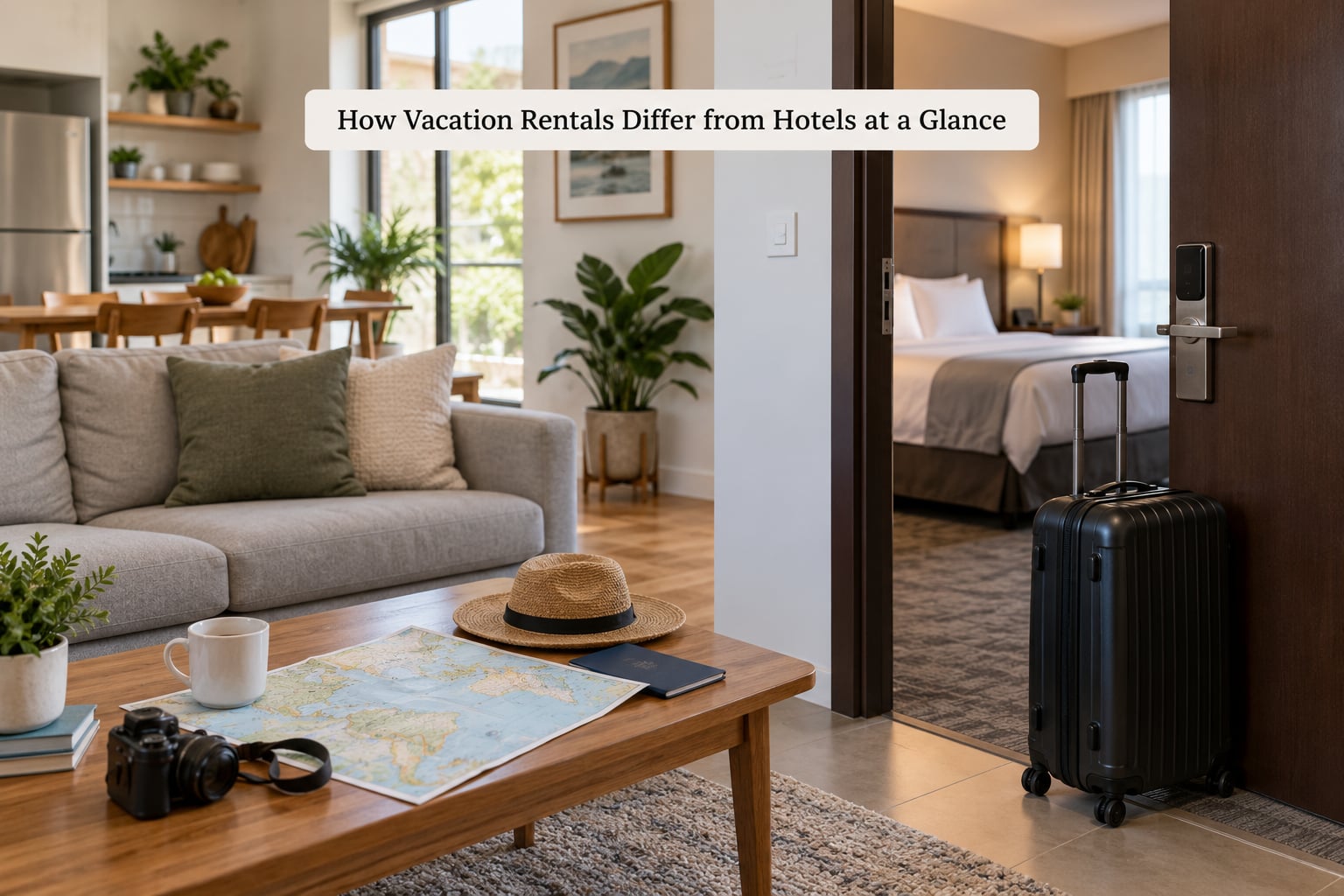
A vacation rental is a privately owned home, apartment or villa booked by the night or week, usually through a platform such as Airbnb or VRBO, where you get the entire space to yourself. A hotel is a commercially operated property with a reception desk, on-site staff, daily housekeeping, shared amenities and services included in the rate. One is a home with a booking attached; the other is a service business with rooms attached.
| Criterion | Vacation rental | Hotel |
|---|---|---|
| Space you control | Whole home: bedrooms, kitchen, living areas, often a yard or pool | One or two rooms off a shared corridor, sized around a bed and a desk |
| Privacy | Nobody else in the property unless you bring them | Shared entrances, lifts, hallways and often a public bar or pool deck |
| Service model | Host or property manager, often off-site and sometimes only by message | Reception, concierge, bell staff and maintenance on the property |
| Arrival | Self check-in with a code or lockbox, at almost any hour | Front desk, with luggage storage if you arrive early |
| Cost structure | Low nightly rate plus cleaning, service and pet fees that barely scale with nights | Room rate plus destination, resort or parking fees that stack at checkout |
| Food | Full kitchen; you cook, shop and clean | Restaurant, room service or nothing included depending on the property |
| Housekeeping | Turnover clean between guests, sometimes an on-call option mid-stay | Daily service, fresh towels and linen on request |
| Booking | Platform or direct with an owner or management company | Direct, an online travel agency, or a loyalty programme |
| Rules | House rules, minimum night stays, quiet hours, deposits | Property policy, resort fees, minimum-stay dates during events |
| Suits best | Groups, families, pets, week-plus stays, residential trips | Solo travel, short city breaks, convenience-first and business trips |
Space and Layout
This is the biggest practical difference, and the one a search result rarely quantifies. A standard hotel room gives you a bed, a desk, a wardrobe and a bathroom, with the hallway outside it shared with strangers. A two-bedroom rental gives you a kitchen with a table, a living room with a sofa, a washer and dryer, and doors that close.
That extra space changes behaviour rather than just comfort. Groups that would sit in a hotel room talking end up in separate rooms. Families get a working kitchen instead of a corridor of takeaway food. Wet swimsuits go in an in-unit washer at 9pm instead of into a bag that stays damp until checkout.
The trade is real, though. A rental’s square footage sits across multiple rooms and bathrooms, so bedrooms tend to be smaller than a hotel’s, and you will be the one cleaning them. Hotels also concentrate things: a gym, a pool, a restaurant and a business centre are all inside one building, often a few minutes apart by lift. In a rental, the nearest equivalent might be a gym membership at a club across town.
When layout matters more than square metres
Multi-generational groups, anyone travelling with a baby or a teenager, and longer trips all benefit from the extra rooms more than couples do. For a weekend in a city, a compact hotel room in a central location usually beats a large apartment three neighbourhoods out.
Service and Daily Convenience
A hotel is a service business. Someone is physically at the desk at 3am, there is usually a housekeeper in the corridor before noon, and if the air conditioning fails you describe the problem once and someone arrives with a ladder.
A vacation rental removes that layer. You may be dealing with an individual owner who lives three time zones away, a property management company that answers messages in the evening, or a smart lock that will not accept the code at midnight. When something breaks, there is no bellhop to call — you message the host and wait for a reply, or you pay a contractor yourself.
This is the part that decides the trip for a lot of people. Forum threads about going back to hotels after short-term rentals keep landing on the same detail: not the price, but what happens when something goes wrong at an hour when nobody’s awake to answer.
Two rental categories soften this. A professionally managed rental, where a company handles check-in, cleaning and maintenance for many properties, behaves much closer to a small hotel. And any booking platform worth using gives you a support line and, for qualifying cases, a relocation if the property is unavailable.
Privacy and Social Experience
A whole-home rental is genuinely private in a way a hotel almost never is. There’s no adjoining room, no shared lift, no breakfast queue where you overhear someone’s argument. Groups that want to talk late, keep the kids up, or bring their dog usually mean it literally when they list a private place.
Hotels lean the other way, and not always badly. A small property in a wine town or a ski village may be calmer than a big rental on a noisy street. Larger hotels add a social layer that some people specifically want: a lobby bar, a pool with attendants, a kids club, a business centre full of people working.
Two subtleties. A rental inside an apartment building still has neighbours, a lobby and shared access — you get the unit, not the whole building. And a hotel’s housekeeping staff entering your room every morning, however discreet, is a difference in kind from a cleaner coming once between guests.
Cost and Value
Compare the all-in total, not the nightly rate. Both sides carry costs the headline number hides.
On a rental, the cleaning fee is fixed per stay. Three nights and two weeks pay the same cleaning charge, so the effective per-night cost drops sharply as the stay lengthens. Platform service fees, taxes and a pet fee stack on top. The odd one out is a hotel resort or urban property with a destination fee, parking charge and amenity fees billed per night — those scale with every night you stay.
Kitchens shift the other direction. A rental lets you cook, which turns three restaurant meals a day into groceries. For a family of five that difference is real, and it grows with the group size, since a rental kitchen is shared while hotel rooms rarely have one at all.
Why a cleaning fee exists at all — and why it irritates people
A rental has to be cleaned and reset after every guest, so the cost is real. Guests object to something else: paying that fee while also being asked to strip the beds, wash towels and take out the bins. That combination comes up more than any other complaint in traveller forums about short-term rentals, and it’s a fair one. Checking the checkout instructions before you book is the only way to know in advance whether you’ll be doing both.
Amenities and Location
Hotels are more predictable. If you book a property with a pool, a gym, a restaurant and a business centre, they exist, they open on schedule, and someone maintains them. For a single traveller working remotely, or anyone who wants dinner without planning it, that predictability has real value.
Rentals trade predictability for surroundings. You get a neighbourhood rather than a lobby: a residential street, a village, a building with a supermarket two minutes away. For a week in a place where you intend to cook, run, walk a dog or actually live like a local, that’s a different trip entirely.
Location cuts both ways. City hotels cluster near transit and walkable restaurants; a cheap rental can sit far out where you spend the trip on transport. Beach and ski lodges are the reverse — the whole point is being away from the centre, and a rental there often beats the alternatives.
Booking, Housekeeping, and Reliability
Booking a hotel is a solved problem. You book the property, arrive at a desk, and check out later. Booking a rental means choosing among three different channels, and the choice affects price and accountability.
- A platform such as Airbnb or VRBO gives the widest selection, verified reviews and payment protection, plus a service fee.
- Direct with a property management company often costs less and gives you a phone number for a real local office, usually with more accountability when something fails.
- Direct with an individual owner can be cheapest and most personal, with the least backup if the property becomes unavailable.
Rentals also carry conditions hotels rarely impose: minimum night stays, quiet hours, limits on guests, deposits, and cancellation windows that can be strict. Read the cancellation policy before the fee breakdown. Some hotel rates are fully refundable up to the day before arrival; some rental payments are non-refundable from the day you book, and that difference matters most when plans change.
Reliability is where rentals split most sharply. A professionally cleaned, professionally managed property with a responsive contact and a backup unit is dependable. An owner-managed listing with vague photos, no recent reviews and a check-in that depends on one lockbox is a gamble. Read the most recent reviews rather than the overall score — look for what people say about cleanliness, how check-in went, and how fast the host answered when something was wrong.
How Vacation Rentals Differ from Hotels for Different Trips

The right answer changes completely with the trip, and the same person can reasonably pick opposite options two years running.
Short city breaks. Hotels win. Central location, a desk to work at, luggage storage when you land early, and no shopping to unpack when you leave.
Solo travel. Hotels, usually. Safety, predictable arrivals and staff who notice when something’s off. Rentals work for a solo traveller who wants to live in one neighbourhood for a week.
Couples. Roughly even. A hotel wins on effort and service; a rental wins on a kitchen, privacy and space that feels like being at home.
Families with small children. Split decision. A rental gives you a kitchen, laundry space and a room where a cot fits without blocking a suitcase. A hotel gives you a pool, a kids club, a lift and someone to take a stroller off your hands. Plenty of parents have stopped using rentals for young children entirely and moved to mid-budget chain hotels for exactly those reasons.
Teens and multi-generational groups. Rentals. Separate bedrooms remove the negotiation over shared space, and everyone still gathers in the kitchen or living room in the evening.
Travelling with pets. Rentals, where the listing permits them, often comfortably. Hotels that allow pets usually restrict size and charge a separate pet fee, and some refuse them outright.
A week or more. Rentals pull ahead. Fixed costs like cleaning and service fees get amortised, and the kitchen pays for itself quickly.
A month or more. It flips again. Long stays usually attract weekly or monthly rates and extended-stay amenities — kitchens, laundry, parking — that many hotels only offer as an apartment-style property. Check local short-term rental rules before assuming you can stay that long.
Business travel. Hotels, almost always. Reliable Wi-Fi, a desk, a business centre, invoice-friendly billing and points.
Which Should You Choose?
Choose a vacation rental if you need a kitchen, more than two bedrooms, a fenced yard, pet access, or a neighbourhood rather than a central address. Choose one for a stay of a week or more, or when the group is large enough that you’d otherwise book three hotel rooms.
Choose a hotel if you’re travelling alone, if you have fewer than four nights, if the trip is about being somewhere rather than living there for a while, or if anything in your itinerary depends on a pool, a restaurant, a business centre or a 24-hour desk. Choose a hotel if you want to check in and out without thinking about it.
Don’t forget the third option. A professionally managed rental, with cleaning, an on-call contact and a backup property, sits between the two and suits people who want space without giving up support.
Frequently Asked Questions
Are vacation rentals cheaper than hotels?
Sometimes, but only after you add up everything. A rental’s nightly rate sits below a comparable hotel room, yet a fixed cleaning fee, platform service fees and taxes narrow or erase the gap on short stays. Rentals usually win on trips of a week or more, when those fixed costs spread across more nights, and for groups that would otherwise book several rooms. Hotels win on short city trips, where a destination or resort fee is added per night.
Is a vacation rental better for a family with children?
It depends on what you need most. A rental gives you a real kitchen, an in-unit washer and dryer, extra bedrooms for kids or grandparents, and often a yard. A hotel gives you a pool, a kids club, a lift, and staff who handle equipment and cleaning. Families with small children often value that predictable, serviced setup most, while groups of teens or multiple generations usually prefer the space and privacy of a rental.
Do vacation rentals have housekeeping and front-desk service?
Usually not in the hotel sense. Most rentals include a turnover clean between guests rather than daily service during your stay, and fresh towels are fetched yourself or ordered through the platform. There is no front desk, no concierge and no bell staff. Some professionally managed rentals offer scheduled or on-call cleaning, and every major booking platform runs a support line, but on-site help during a stay is uncommon outside the hotel model.
Which is better for a long stay: a vacation rental or a hotel?
For about a week, a rental usually costs less once the fixed cleaning and service fees are spread out, and the kitchen saves money on meals. Past roughly a month the comparison shifts again: many hotels offer apartment-style extended-stay rates with laundry and kitchens, and some destinations regulate or cap short-term rentals, so a month-long booking may not be permitted. Check local rules and ask the property about monthly rates before assuming a rental is cheaper.
Are vacation rentals safer or more private than hotels?
Privacy, yes. A whole-home rental means no neighbours, no shared corridor and no staff entering while you’re out, though a rental inside an apartment building still has shared access and other residents. Safety is harder to generalise. Hotels typically have staffed reception, on-site security and cameras; rentals may have fewer locks, no staff nearby and an isolated location. A professionally managed rental with an on-call contact and a responsive host narrows the gap considerably.
What should I check before booking a vacation rental?
Read the recent reviews first, especially comments about cleanliness, check-in and how fast the host responded to problems. Then confirm the total price including cleaning fee, service fees, taxes, any pet fee and parking. Check the cancellation policy, the minimum night stay, the number of guests allowed, what the checkout list requires, and whether the property is managed by a company with a backup unit. Photograph the space on arrival and report anything inaccurate straight away.
Conclusion
A vacation rental is somebody’s home, with all the freedom and none of the support. A hotel is a service business, with all the support and a smaller slice of the building. Once you know how vacation rentals differ from hotels on cost and space, the choice gets easy: start by totalling the full cost of each option, then check whether your trip needs a kitchen, extra bedrooms or a central address. Whichever wins on those two questions is the one to book.