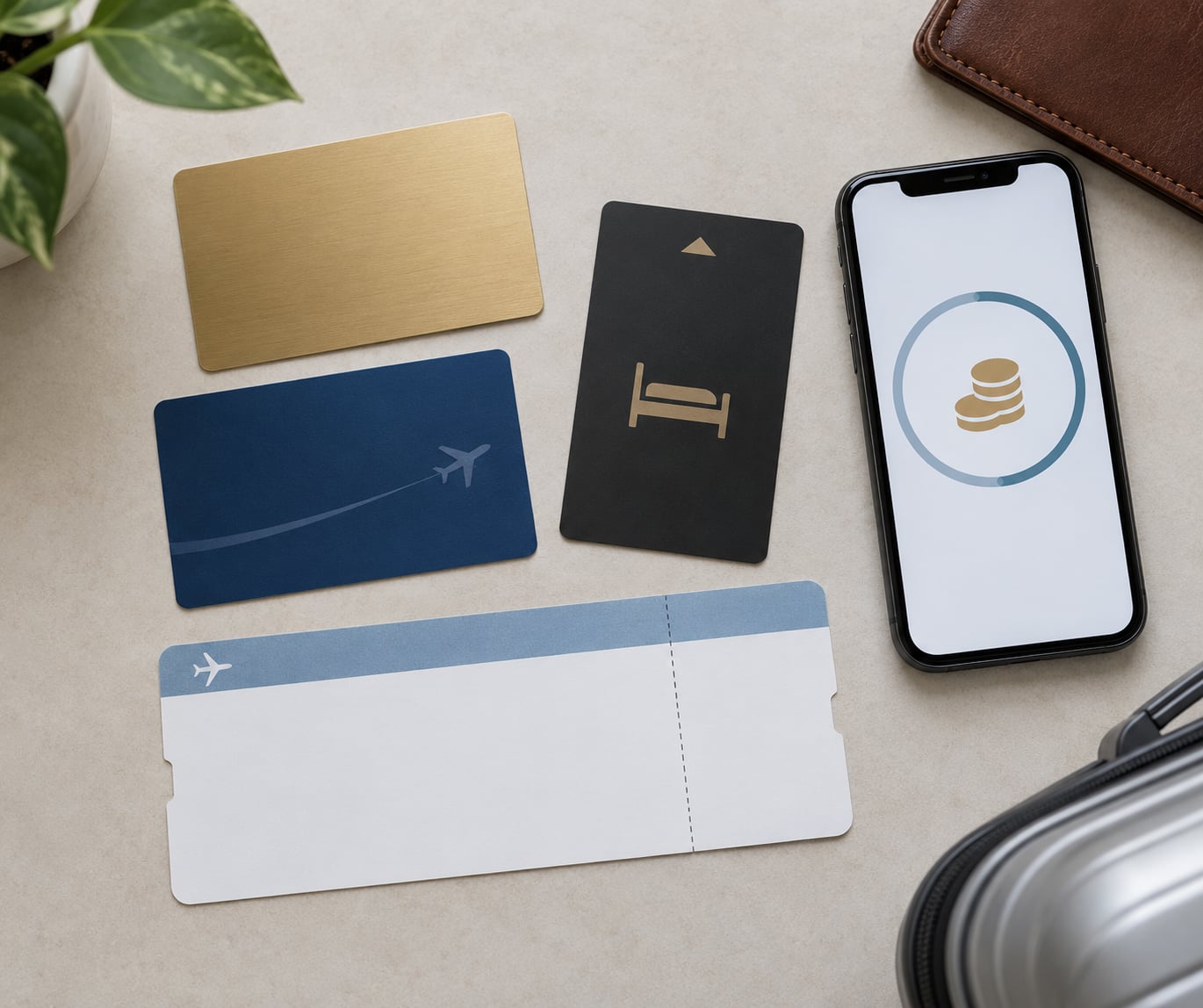
Hotel points and airline miles are two separate currencies with no exchange rate between them. Hotel points come from staying in one chain’s rooms and pay for that chain’s rooms. Airline miles come from flying and pay for seats. Neither one has a built-in dollar value, and that is the single most important thing to understand before you start counting balances.
Understanding how hotel points differ from airline miles takes about five minutes, and it saves you from the most common beginner mistake: treating a pile of points as if it is already money. The two systems behave differently in ways that affect how you earn, how fast you can actually use the balance, and what you still have to pay out of pocket after a free redemption.
Last updated for 2026. Program rules change often, so treat every figure here as a range rather than a promise, and check your own program’s terms before you book.
Table of Contents
- 1How Hotel Points Differ from Airline Miles at a Glance
- 2What Are Hotel Points and Airline Miles?
- 3How Earning Works: Hotel Points vs Airline Miles
- 4Direct bookings earn the most, third-party bookings earn least
- 5Credit cards change the earn math completely
- 6Status and promotions multiply the base rate
- 7Transferable bank points are the bridge
- 8How Redemption Value Differs
- 9Hotels still publish charts, airlines mostly do not
- 10How many points a free night costs
- 11How many miles a free flight costs
- 12The cents-per-point method that settles every argument
- 13Expiration, Transferability, and Family Benefits
- 14Expiry works the same way on both sides
- 15Transferability is the real structural gap
- 16Can you convert hotel points into airline miles?
- 17Family pooling behaves differently too
- 18Fees, Taxes, and Hidden Redemption Costs
- 19On the hotel side: fees at the property
- 20On the airline side: fees on the ticket and the bag
- 21Which Should You Choose?
- 22Hotel points fit these trips
- 23Airline miles fit these trips
- 24A balanced split usually wins
- 25Frequently Asked Questions
- 26Are hotel points better than airline miles?
- 27Which loyalty program should I use if I travel more by plane than by hotel?
- 28Do hotel points expire faster than airline miles?
- 29Can I transfer hotel points to airline miles?
- 30How do I calculate the value of hotel points and airline miles?
- 31Is it better to earn points or miles from credit-card spending?
- 32Conclusion: Start With the Trip You Actually Take
How Hotel Points Differ from Airline Miles at a Glance

The table below sets the two side by side across the ten differences that actually change how you use a balance. Every row is a structural rule, not a preference.
| Factor | Hotel points | Airline miles |
|---|---|---|
| What the unit measures | A stay, a room category, or sometimes an experience | Distance flown, or a fare class within a distance band |
| Pricing model | Published award charts by category, with peak and off-peak tiers | Dynamic pricing set per flight and per fare class |
| Typical earn rate | Around 5 to 10 points per dollar on a chain card, often with bonuses | About 1 mile per dollar on a carrier card, more with promotions |
| Typical value when used well | Roughly 0.5 to 1 cent per point at large programs, 2.5 to 3 cents at small high-value ones | Roughly 0.5 to 2 cents per mile on mainline carriers, higher on some international ones |
| How predictable the cost is | High. A category 1 to 5 night usually costs a known number of points | Low. The same route can swing by several thousand miles day to day |
| Availability | Broad. Award rooms are usually available at most properties | Uneven. Premium cabin and even some main seats sell out weeks early |
| Booking window | Rooms often appear 6 to 12 months out, many closer to check-in | Seats often load 9 to 11 months out and are gone in hours |
| Extra costs on a free booking | Resort fees, parking, taxes and tips, waived at some programs | Carrier-imposed charges, baggage, seat fees, change fees |
| Expiry rule | Often 12 to 24 months of inactivity, extended by small activity | Often 18 to 24 months, with paid activity counting |
| Elite credits on a redemption | Generally not earned on point bookings | Generally not earned on award tickets |
What Are Hotel Points and Airline Miles?
Hotel points are loyalty units issued by a hotel chain or group. You earn them by staying in its properties, and you spend them on rooms at those same properties, sometimes on things like a fifth night free, suite upgrades, or club lounge access.
Airline miles are loyalty units issued by an airline. You earn them by flying, and you spend them on tickets, seat upgrades, extra baggage, or lounge access. The mile count itself is largely decorative. A mile is not a mile, because the fare class and the route decide what it costs.
Neither currency has inherent value. A point is worth what the redemption delivers, which is why the same balance can be a bargain in one month and a waste in another.
One more distinction trips people up: bank points. A flexible credit card point, such as one from a bank rewards program, is a third currency. It converts into hotel points or airline miles at a set ratio. Chain and carrier points are locked to their own program, and that lock is what makes their value swing.
How Earning Works: Hotel Points vs Airline Miles

Direct bookings earn the most, third-party bookings earn least
Booking a room through a third-party comparison site usually earns you nothing at either program. Direct bookings earn the full rate, and status members earn a bonus multiplier on top. If you plan to earn, book direct from the chain or carrier site.
Credit cards change the earn math completely
This is where the two systems diverge most. A hotel co-branded card typically earns five to ten points per dollar, sometimes with a bonus category on dining or fuel. An airline card typically earns one mile per dollar, sometimes two on partner purchases.
The dollar-per-point difference exists because one dollar of hotel spend and one dollar of airfare are different amounts of money. A room night costs several hundred dollars; a domestic flight costs a couple hundred. The point reflects the underlying purchase, not the unit you choose.
Status and promotions multiply the base rate
Elite members get a bonus multiplier on stays and flights, so your per-dollar earn rises as your status climbs. Welcome bonuses are the other big multiplier, and they usually require a large spend over a set window. In both currencies a signup bonus can equal months of ordinary earning, which is why chasing a bonus that does not fit your normal spending is usually a bad trade.
Transferable bank points are the bridge
Flexible bank points can usually move to several hotel and airline programs at a fixed ratio, often one to one, sometimes with a transfer bonus. That flexibility is worth real money precisely because it gives you options later. Award-travel regulars almost always say transferring beats redeeming through a bank travel portal, which typically prices redemptions at a flat rate and rarely at your program’s best value.
How Redemption Value Differs
Hotels still publish charts, airlines mostly do not
A published award chart means a standard room costs a known number of points by category and season. You can plan a trip eight months ahead with reasonable confidence. A handful of hotel programs still publish full charts; most do not publish complete ones but keep category tiers.
Almost no airline publishes a usable chart anymore. Every seat carries its own price, and the same route can cost two or three times more on a Saturday in peak season than on a Tuesday shoulder week. This is the single biggest practical difference between the two currencies, and it is the reason airline redemptions feel like a skill while hotel redemptions do not.
How many points a free night costs
A standard night ranges widely: roughly 5,000 to 12,000 points at a large program, and often 5,000 to 10,000 at a smaller high-value one. Peak-season resort nights and suites cost far more than the base category, sometimes several times the standard rate.
How many miles a free flight costs
A short domestic one-way award often sits around 7,000 to 15,000 miles. A long-haul business or first class ticket can run well past 100,000. With dynamic pricing, the number you see when you search is the number you pay, and it can move several thousand miles in a day.
The cents-per-point method that settles every argument
Stop comparing points to miles. Convert both to money. Take the cash price of the booking, divide by the points or miles required, and you have the value of the redemption in cents per point.
Say a room costs 240 in cash and you are spending 40,000 points. That is 0.6 cents per point. Say a hotel night normally redeems at 0.7 cents, so you did slightly worse than average. Say an airline seat costs 300 in cash for 20,000 miles, which is 1.5 cents per mile, a good result for that program.
Illustrative ranges as of 2026, and they drift with demand:
- Small high-value hotel programs: about 2.5 to 3 cents per point on aspirational redemptions.
- Large hotel programs: about 0.5 to 0.8 cents per point, sometimes higher on peak nights.
- Mainline airline programs: about 0.5 to 2 cents per mile.
- International and alliance programs: about 1.5 to 2.5 cents per mile, sometimes more in premium cabins.
- Bank travel portals: about 1 to 1.5 cents per point, usually below a good transfer.
If you only remember one mechanic from this guide, make it this one. It works on any balance in either currency, and it ends the arguments.
Expiration, Transferability, and Family Benefits
Expiry works the same way on both sides
Most programs expire a balance after a set period of inactivity, often 12 to 24 months for hotels and 18 to 24 for airlines. Nearly all of them extend the deadline after any qualifying activity, and that activity can be tiny: a small purchase through a partner portal, or a single cheap booking.
This is where beginners lose balances without realizing it. Award-travel communities repeatedly describe the same pile: tens of thousands of points, no plan, quietly wiped out. If you cannot commit to a redemption, redeem something small and cheap on a shopping portal so the clock resets.
Transferability is the real structural gap
Airline programs transfer miles to partner airlines, which is genuinely useful for a specific flight. Hotel programs transfer far less often, and where they do it is usually into airline programs rather than to other hotel chains.
The bridge most people actually use runs the other way. Flexible bank points convert into either hotel points or airline miles at a set ratio, so they can reach both worlds. If you want optionality, keep a balance in the bank currency and convert at redemption time rather than committing early to one locked program.
Can you convert hotel points into airline miles?
Sometimes. Certain hotel programs transfer directly to airline partners, usually one point to one mile or with a bonus. The reverse is rarer, since airlines rarely hand miles to a hotel chain.
Two practical warnings. Transfer partners vary by program and change without notice, so verify the list before you assume a route exists. And transfers can take days, sometimes weeks, so if a points-required booking needs to be cancelled before points land, do not count on getting them back. Several hotel chains do let you book a room on points before your balance posts, which is one of the most underrated features in the whole industry.
Family pooling behaves differently too
Both program types usually let you combine balances with household members. The difference shows up on the day you book. Family members competing for a limited number of premium award seats burn through that inventory fast, as people on points forums point out repeatedly. Rooms do not run out the same way, so a hotel-heavy family trip is far easier to plan on points.
Fees, Taxes, and Hidden Redemption Costs
A free booking is rarely free. Here is where the two currencies hide costs in different places.
On the hotel side: fees at the property
- Resort and destination fees, sometimes adding a meaningful amount per night to what looked like a free room.
- Parking charges, which matter most on trips where you have a car.
- Taxes and any local tourism levies.
- Tips, incidentals and in-room dining, all paid in cash as usual.
Some hotel programs waive resort fees on point bookings, which turns a mediocre redemption into a good one. Always check whether your program does before you compare redemption values.
On the airline side: fees on the ticket and the bag
- Carrier-imposed charges and government taxes on award tickets, which vary by route.
- Baggage fees, a real cost for a family of four with checked bags.
- Seat selection fees if you want an extra-legroom seat.
- Change and cancellation fees, where redepositing a mile-based fare is often harsher than rebooking a hotel night.
The practical test is simple. Compare the all-in cost of the points booking against the all-in cash price for the same trip, not against the room rate or the base fare. A points stay at a resort with fees can cost more than paying cash, and an award ticket with four bags and change fees can land in the same place.
Which Should You Choose?
Hotel points fit these trips
If your travel is hotel-heavy, concentrate on hotel points. Families on multi-night trips, road trips, and travelers with kids who need a free breakfast or a pool are the clearest cases. A single hotel chain often covers more of a leisure itinerary than a single airline does, and rooms stay available.
Hotel points also suit beginners. A predictable chart, an inventory pool that does not vanish overnight, and activity rules that are forgiving all reduce the effort. If your routine is uncertain, this is the lower-stress place to start.
Airline miles fit these trips
Concentrate on airline miles if flying is the expensive part of your life. Business travelers chasing status, anyone targeting business or first class, and people taking long-haul trips will find miles worth far more than a free room.
Miles are harder. Expect to learn seasonality, region rules, and transfer sweet spots. Expect to lose status credits on award bookings, which is the complaint that surfaces most often in frequent-flyer forums, and treat credit cards with fast-track status as the workaround. Expect to book earlier than for a hotel.
A balanced split usually wins
Rather than an all-in bet, many regulars keep flexible bank points as the core and convert into whichever currency the next trip needs. That avoids devaluation anxiety, which is a legitimate fear since both hotel and airline programs have repriced their award charts more than once.
A simple starting point: pick the currency that matches the trip you are actually taking next, use it, then decide where the next block of effort goes. Programs that mix cash and points give you a middle path when a chart price looks wrong.
Frequently Asked Questions
Are hotel points better than airline miles?
Neither is better in general. Hotel points are easier to use because award charts still exist and rooms stay available, while airline miles can be worth far more when a program has premium-cabin inventory. Value your balance in cents per point before deciding: hotel points at large programs often land near half a cent, small high-value hotel programs near three cents, and airline programs usually between half a cent and two cents.
Which loyalty program should I use if I travel more by plane than by hotel?
Concentrate on airline miles, and pair them with a card that offers fast-track status if you fly enough to care about elite benefits. Flights are usually the bigger line item for a frequent flyer, and premium-cabin redemptions can be worth two to three times what a standard room is. Just plan further ahead, since award seats release earlier and disappear faster than hotel rooms.
Do hotel points expire faster than airline miles?
Often slightly, yes. Hotel programs commonly run 12 to 24 months of inactivity, while airline programs often give 18 to 24. Almost every program extends the clock after any small qualifying activity, such as a purchase through a partner shopping portal. The practical fix is to redeem something small and cheap once or twice a year instead of letting a large balance lapse.
Can I transfer hotel points to airline miles?
Sometimes, and it depends entirely on the program. Certain hotel chains transfer points directly to airline partners, usually one to one or with a promotional bonus, while airlines almost never transfer miles to hotel programs. The more common route is the reverse: hold flexible bank credit card points and convert those into either hotel points or airline miles whenever a trip needs them.
How do I calculate the value of hotel points and airline miles?
Divide the all-in cash price of the booking by the points or miles you would spend, then multiply by 100. A room costing 240 in cash and 40,000 points gives 0.6 cents per point. A 300-dollar-equivalent ticket costing 20,000 miles gives 1.5 cents per mile. Compare those two numbers instead of comparing the raw balances.
Is it better to earn points or miles from credit-card spending?
Earn whichever currency matches your next real trip, and avoid signing up for a bonus you cannot reach with your normal spending. If your travel is mixed, a flexible bank card usually wins, because you can convert those points into either hotel points or airline miles at redemption time. A co-branded hotel or airline card earns faster but locks you into one program.
Conclusion: Start With the Trip You Actually Take
Hotel points buy rooms with a price you can look up in advance. Airline miles buy seats with a price nobody publishes. Once you know that difference, the rest is arithmetic: price a real upcoming stay and a real upcoming flight in cash, divide by what each would cost in points or miles, and let the cents per point tell you which balance to spend.
Concentrate where the trip is concentrated. Hotel-heavy itineraries, family trips and beginners are better served by hotel points. Flyers chasing premium cabins or status are better served by airline miles. And if you cannot decide, hold flexible bank points and convert when you know what you need.