Here is the short version of how hotel upgrades work at check in: the front desk agent can only move you up if a better room is unsold for every night of your stay, there is a real step up to take, and something about your booking ranks you above other arrivals. Miss any one of those and the answer is no, no matter how politely you ask.
Most travelers treat this as a game of charm at the desk. It isn’t. The decision was mostly made hours earlier, by a rooms controller and a shift supervisor working from an arrivals list. Understanding that sequence tells you when an upgrade is even possible and when your request is just noise on a busy afternoon.
I’ve read the front-desk forums and insider blogs closely enough to describe what happens behind the counter, and it explains almost every disappointing check-in story I see in comments. So let’s walk through the mechanics first, then the actual words to use.
Table of Contents
- 1What Happens During a Hotel Upgrade?
- 2Who Qualifies for a Hotel Upgrade?
- 3How Hotel Upgrades Are Assigned at Check-In
- 4What Affects Your Chances of Getting an Upgrade?
- 5Which Types of Hotel Upgrades Are Available?
- 6How to Ask for an Upgrade at Check-In
- 7What If the Hotel Says No?
- 8Frequently Asked Questions
- 9How do I get a hotel room upgrade?
- 10Are hotel upgrades guaranteed for loyalty-program members?
- 11When should I ask for a hotel upgrade?
- 12Can I pay to upgrade my hotel room?
- 13What does a hotel room upgrade include?
- 14Why did the hotel deny my upgrade request?
- 15Conclusion: What to Do First at Check-In
What Happens During a Hotel Upgrade?
An upgrade is any move to something better than the room category printed on your reservation. Hotels use the phrase for several different things, and knowing which one you’re chasing matters.
A room move within your category is the most common and least dramatic. You booked a king on the fourth floor; you get a corner king on the ninth. Nobody upgraded your rate, but the room genuinely is better and it costs the hotel nothing.
A category step is a move from a standard room to a deluxe, from deluxe to a junior suite, or from junior suite to full suite. This is the one most people picture, and the one most often sold out at the exact moment you want it.
A view or amenity upgrade changes the room without changing the category: ocean side instead of courtyard, balcony instead of no balcony, club floor access, a larger bathroom. These are the easiest wins because the property has far more of them than it has suites.
A points-based upgrade is a separate mechanism entirely. You redeem points or an elite award, the hotel confirms it in writing, and it becomes part of your reservation rather than a favor. Confirmed awards are honored even when the room shows as sold out online.
Nothing in that list is automatic. A request is a request until the agent finds a key that works for every night.
Who Qualifies for a Hotel Upgrade?
Three conditions have to be true at the same time. If any one fails, the upgrade does not happen.
1. A better room is unsold for every night. One open night is not enough. A room free on Tuesday but occupied Wednesday night gives you nothing, because you would be moving hotels mid-stay.
2. There is a rung above you on the ladder. Suites are not always one category up. At plenty of properties a standard room and a junior suite share the same physical footprint, and the booking system won’t let the agent move you sideways.
3. Something ranks you. Status, direct booking, a property credit, an occasion, a referral from a colleague, or simply being a person the agent likes dealing with. First-time guests with no status can absolutely qualify, but they need one of the softer reasons.
Here is how the main routes compare:
| Route | Who controls it | Cost to you | How reliable |
|---|---|---|---|
| Elite status guarantee | The program’s terms | Nothing extra | High, but written into your confirmation |
| Redeemed points award | The property, per night | Points or an annual award | Highest, because inventory is held for you |
| Direct booking courtesy | Front desk discretion | Nothing extra | Moderate and varies by property |
| Repeat guest recognition | Front desk discretion | Nothing extra | Moderate at independent properties |
| Property credit or promo package | The rate you booked | Already in what you paid | High, because it is written in |
| Paid upgrade at the desk | Front desk discretion | Rates vary widely by night | High if the room exists at all |
| Third-party booking | Front desk discretion | Nothing extra | Lowest of the complimentary routes |
Booking direct is the one lever almost everyone can pull. A reservation made through the hotel’s own channel carries a profile, a history, and a card on file, so the agent can see who you are without reading it off a screen.
How Hotel Upgrades Are Assigned at Check-In
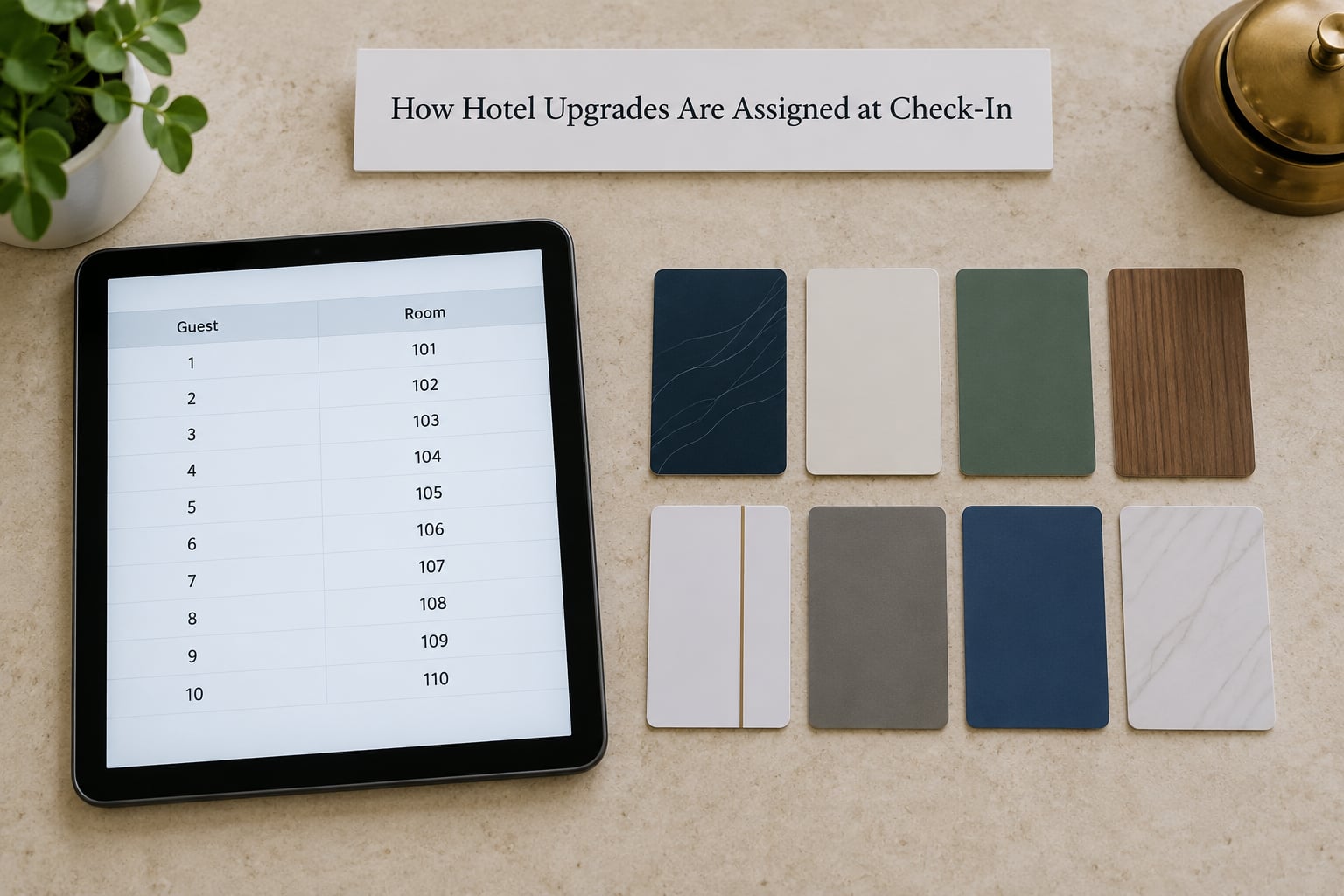
Hotel rooms are assigned before most guests arrive, and this is the single fact that explains why early check-in demands usually fail.
The rooms controller is the person whose whole job is the physical inventory. The night before you arrive, they build the next day’s arrivals list and see what is genuinely open. At the start of each shift, a senior agent or duty manager works that list and pre-assigns keys to guests they expect to arrive.
Housekeeping then shapes what is really sellable. A room still occupied, a room being cleaned, a room held for maintenance and a room blocked for a group all look different in the system, but they all read as unavailable to the guest standing at the desk.
So the sequence runs like this:
- The night before. The rooms controller builds the arrivals list and flags VIPs, groups, accessibility needs and room blocks.
- Shift start. A supervisor pre-assigns keys to arrivals they’ll see today, giving priority to status holders, repeat guests and complications.
- Mid-afternoon. Housekeeping reports progress. Rooms that were blocked often get released here, which is when discretionary inventory appears.
- You arrive. The agent opens your profile, sees the rate, the booking channel, your status and any notes from a pre-arrival email.
- They check inventory. They look for higher categories free across all your nights, and for amenities within your category.
- They decide. A discretionary move, a paid offer, or a polite no. That call takes a few seconds; the work behind it took a day.
This is why the “I booked yesterday, so nice rooms must still be open” argument doesn’t hold. Yesterday’s inventory has already been assigned.
What Affects Your Chances of Getting an Upgrade?
Some factors are yours to control. Most are not, and confusing the two wastes your energy at the desk.
How you booked. Direct reservations get recognized. A booking through an online travel agency arrives as a referral with no history and no loyalty profile attached, which is why third-party guests report feeling like second-class arrivals. It’s not malice; it’s a missing file.
Your status. Elite tiers that guarantee an upgrade do so in writing, and that written guarantee is handled differently from a request. Tiers with only space-available benefits get no promise at all.
Timing. Forum consensus is consistent on this: a slow desk beats a busy one. Mid-afternoon arrivals and off-peak check-in windows give the agent time to think. Saturday evenings at a full property are the worst possible slot.
Your flexibility. A room move within category is far easier when you don’t care about a particular floor or bed type. Say what you’d accept, and you’ll often get something.
How you ask. One clear request, delivered cheerfully, accepted graciously. Repeat asking turns a preference into a complaint.
The factors outside your control: how full the property is, whether your rate is promotional or corporate, which groups are in house, housekeeping speed, whether the better rooms exist as a category at all, and whether someone more senior already claimed them at shift start.
Honest expectations help. Guests at full-service and luxury properties typically land in the higher categories more often than guests at mid-scale chains, simply because there are more rungs and more unsold rooms. Nobody publishes a reliable industry-wide upgrade rate, and anyone quoting you a precise percentage is making it up.
Which Types of Hotel Upgrades Are Available?
The ladder usually starts with a small move and ends with a suite. Most upgrades are one rung, not five.
| Rung | What you actually get | Who decides |
|---|---|---|
| Better room number | Corner unit, away from the elevator or ice machine, quieter side of the building | Front desk, usually discretionary |
| Better view | Ocean side, city skyline, higher floor facing the right direction | Front desk, easier than a category step |
| Higher category | Deluxe instead of standard, often with a bigger bathroom or a sitting area | Front desk or revenue team |
| Junior suite | Separate sitting space, sometimes a fold-out sofa for a family | Front desk, availability dependent |
| Full suite | Multiple rooms, often reserved for elite awards and special occasions | Usually pre-assigned, rarely offered cold |
| Late checkout | A few extra hours, plus sometimes a same-day amenity credit | Front desk, driven by the morning’s departures |
| Breakfast or parking | A benefit add-on rather than a room change | Property, often part of the rate or status tier |
Named programmes work the same way underneath. A World of Hyatt suite upgrade award and a Marriott Bonvoy Nightly upgrade award are both confirmed awards held for you in advance. A Hilton Honors Diamond guarantee is written into the terms for eligible stays. These differ from a courtesy upgrade in exactly one way: inventory is reserved before you arrive.
Watch the language. Hotels often describe any free upgrade as a “complimentary upgrade.” If your confirmation says complimentary, it is binding. If a website says “subject to availability,” it is a request, not a promise.
How to Ask for an Upgrade at Check-In
Asking is not rude. Front desk agents expect it several times a shift, and insiders say the people who get moved up are usually the ones who ask clearly and take a no gracefully.
Wait until your keys are in hand or the agent has confirmed your room. That is the moment the conversation is least disruptive and most likely to be heard.
Then say something specific and easy to act on:
“I booked the standard king. If anything above that is free for my whole stay, I’d love it — otherwise I’m genuinely happy with what I have.”
Add one useful detail if you have one. “I work nights, so a quiet room away from the elevator would be perfect” gives the agent a reason to move you inside your category, which is far easier than a category step.
Do not claim status you do not have, do not say you read somewhere that the hotel always upgrades people, and do not ask twice. If the answer is no, “No problem at all, thanks for checking” is the whole recovery.
| Factor | App or mobile check-in | Check-in at the desk |
|---|---|---|
| Room assignment | Locks in a specific room early | Assigned when the agent has time |
| Conversation | Usually no conversation happens | Easy to ask, easy to be remembered |
| Upgrade odds | Neutral; app availability can shift minute to minute | Neutral, better when the desk is quiet |
| Best for | Fast arrivals, late check-ins | Anyone actually wanting something |
Neither route is meaningfully better for upgrades. Regulars on the major loyalty forums agree on both sides, which is a rare consensus. If you check in on your phone, the upgrade conversation simply never happens.
You can also try before you arrive. A short note to the hotel, sent to the address on your confirmation, does reach a person who can write a note on the reservation:
“Checking in [dates] for [name], reservation [number]. We’re celebrating an anniversary and would be grateful for any upgrade that is available for the full stay. Happy with the standard room either way.”
Two notes on this. Replies from a generic address often just say to ask at reception, so treat it as a request. And an email promising an upgrade that the desk later shrugs at is worth escalating to the manager on duty rather than arguing at the counter.
What If the Hotel Says No?
A no is normal, and the reason is almost always inventory rather than judgement. The suite you wanted is genuinely occupied every night, or your standard room and the junior suite are the same room in the booking system.
There are four useful recoveries, in order of how often they work.
Ask for the view instead. A different orientation, a higher floor within your category, a corner unit. These are cheap for the hotel and often available when the category step isn’t.
Ask for something that isn’t a room. Late checkout, a same-day amenity credit, a quieter floor. The agent has more flexibility here than on room inventory.
Check your points before you leave the desk. If the front desk has inventory nobody saw, redeeming points on the spot sometimes works. Availability changes minute by minute, so a “no” is not always final for the whole evening.
Escalate politely. If a programme guarantee was in your confirmation and you didn’t get it, ask for the manager on duty and reference the terms. Confirmed benefits are contractual; courtesy upgrades are not.
One more case worth knowing: on longer stays, the odds improve on day two or three. When the property wants to resell your entry-level room, an upgrade suddenly becomes worth something to the business.
Frequently Asked Questions
How do I get a hotel room upgrade?
Book direct, add your loyalty number, and ask once at the desk with a specific request rather than a vague one. Your best odds come from a quiet arrival time and flexibility about what counts as better. Ask for a view or a quiet room inside your category if a category step is unlikely, and accept a no without argument so the agent remembers you well.
Are hotel upgrades guaranteed for loyalty-program members?
Only some tiers get a written guarantee, and those arrivals are honored as part of your reservation. Space-available benefits carry no promise at all. If the guarantee was in your confirmation at booking, you are entitled to it, so ask the manager on duty to look at the terms. A courtesy upgrade and a guaranteed one are not the same thing.
When should I ask for a hotel upgrade?
Ask after your keys are handed over or your room is confirmed, when the agent has time and the conversation does not block the queue. Mid-afternoon arrivals and off-peak check-in windows work better than a busy Saturday evening. Arriving hours early and demanding an upgrade often backfires, because keys were pre-assigned at shift start.
Can I pay to upgrade my hotel room?
Yes, at many properties a paid upgrade is simply a sale at the desk, and the rate may differ night to night within one stay. Ask what the charge is for the specific dates, and check whether your existing rate or points package already includes something similar before paying. Refunds are easier when you upgrade before checking in rather than after.
What does a hotel room upgrade include?
A room upgrade means a better room number, view, floor or category. Benefits like late checkout, breakfast, parking or a property credit are separate add-ons and are often controlled by your rate or status tier instead of room inventory. Read your confirmation for the word complimentary, which is binding, versus subject to availability, which is only a request.
Why did the hotel deny my upgrade request?
Most denials are inventory, not attitude. A better room was occupied on at least one night of your stay, the higher category shares a footprint with yours, or a supervisor claimed it at shift start. Third-party bookings also rank lower because the reservation arrives with no profile. You can still ask for a view, a different floor or a late checkout.
Conclusion: What to Do First at Check-In
How hotel upgrades work at check in comes down to three checks that happen before anyone speaks to you: is a better room unsold for every night, does a real step up exist, and does anything rank you. You influence the third one and can only guess at the first two.
So check your booking terms before you arrive, book direct if you can, reach the desk once your room is confirmed, make one specific request, and take a no without complaint. On a long stay, ask again on day two. That is the whole playbook.