All-inclusive bundles your room, meals, drinks and usually activities into one nightly rate. European Plan is room only: no meals, no drinks, nothing else. The first suits families and heavy drinkers who stay on property; the second suits food-focused travellers, city trips and anyone eating out most nights.
So which one is better for all inclusive vs european plan hotels? Almost always the plan that matches how you will actually spend your days, not the one with the higher number at the top of the search results. Families on a pool all day gain more from all-inclusive. Anyone whose itinerary includes dinner in town, a week of museums or a ten-night stay gains more from European Plan. Total trip cost is the deciding factor, and the two plans hide costs in opposite places.
Updated for 2026.
Table of Contents
- 1All Inclusive vs European Plan Hotels at a Glance
- 2What Is an All-Inclusive Hotel?
- 3What Is a European Plan Hotel?
- 4Hotel Meal Plan Codes You Will See on Booking Sites
- 5How Do Prices and Extra Costs Compare?
- 6Food and Drinks: Which Plan Offers Better Value?
- 7Choosing Between All Inclusive vs European Plan Hotels for Food
- 8Activities and Entertainment
- 9Flexibility Outside the Resort
- 10Which Plan Is Best for Different Travelers?
- 11How to Compare Hotel Prices Correctly
- 12Frequently Asked Questions
- 13Does European Plan always mean breakfast is included?
- 14Do all-inclusive hotels charge extra for anything?
- 15Which is cheaper, all-inclusive or European Plan?
- 16Which plan is better for families with kids?
- 17Do I need to compare resort fees and booking conditions for both plans?
- 18Conclusion
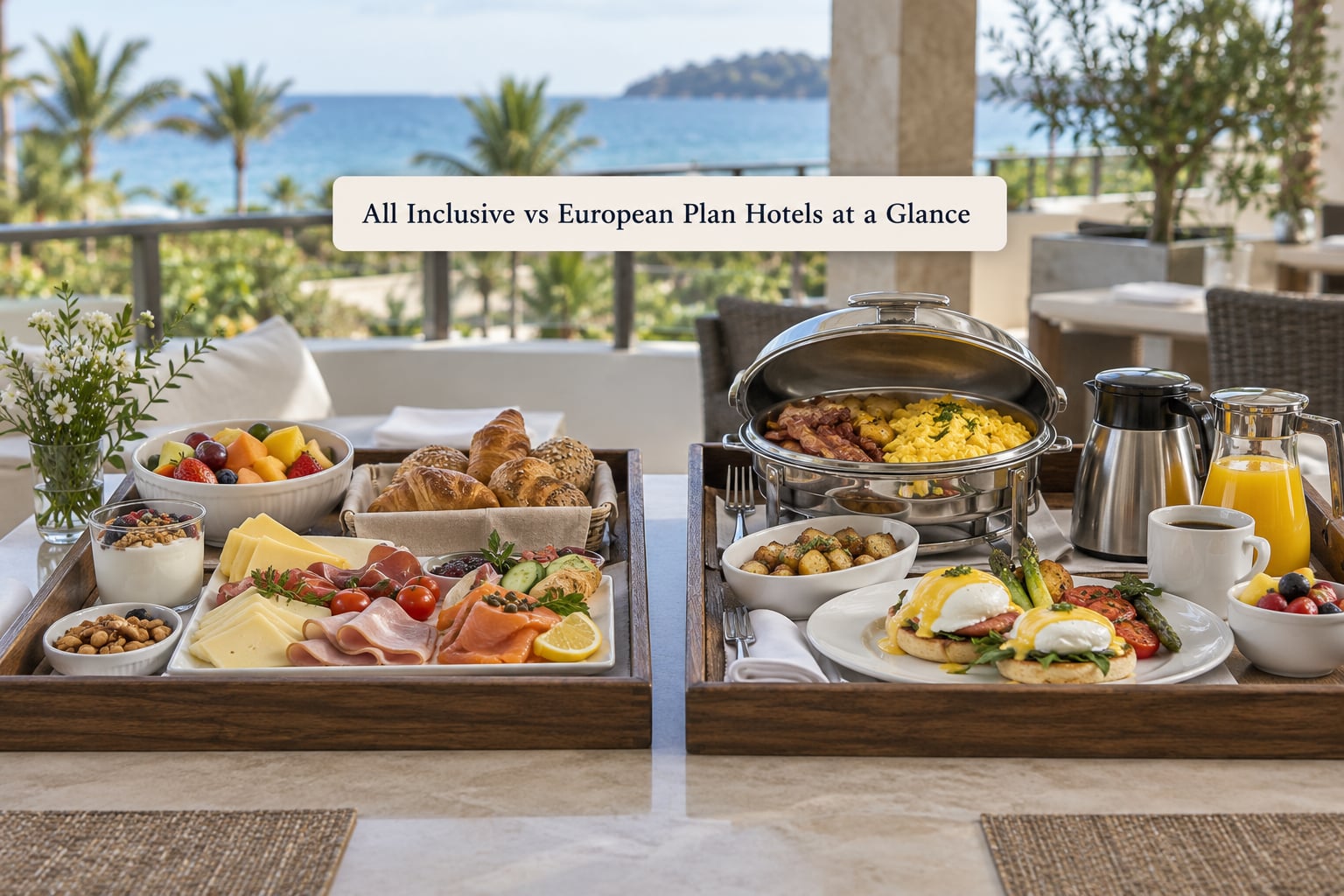
All Inclusive vs European Plan Hotels at a Glance
| What the rate covers | All-Inclusive | European Plan |
|---|---|---|
| Room | Included | Included |
| Breakfast | Included | Charged separately unless the rate is labelled CP or BP |
| Lunch and dinner | Included at the main buffet and most specialty restaurants | Charged separately, wherever you eat |
| Local drinks, water, soft drinks | Usually included | Charged separately |
| Premium alcohol and imported wine | Often extra at some properties | Extra everywhere |
| Pool, fitness facilities, kids club | Usually included | Extra, or covered by a club or resort fee |
| Evening entertainment and sport | Usually included, with some limits | Extra or a la carte |
| Room service | Varies by property | Extra |
| Spa treatments and off-site excursions | Extra, sometimes with a credit allowance | Extra |
| Tips and taxes | Service charges vary; taxes are usually extra | Tipping is on you, often a fifth of the bill |
| Resort or club fee | Sometimes folded in, sometimes separate | Frequently charged daily and often disclosed late |
| Price transparency | One predictable figure | Low room rate, open-ended spending |
| Best for | Families, couples on property, longer resort stays | Foodies, city trips, light drinkers, long stays |
Two things decide the real total. Resort fees, taxes, premium dining and excursions sit outside both headline rates, and at an all-inclusive you can pay for a package you barely touch, while on a European Plan rate you can spend three times the room price on drinks and taxis without noticing until the statement arrives.
What Is an All-Inclusive Hotel?
An all-inclusive rate folds your room, all meals from the main restaurant, local drinks, and usually the pool, gym, kids club and evening entertainment into a single figure. You pay once at the start and the property takes care of the rest, which is why so many families book it.
What is not universally included matters more than what is. Premium à la carte restaurants, premium spirits and imported wine, spa treatments, off-property tours, photo packages and motorized water sports usually carry a charge even at an all-inclusive. A guest answering questions in a Tripadvisor thread about a Bahamian property pointed out that even there the room had no snacks, no sodas and no room service, so terms vary sharply between properties using the same label.
Tipping is the other loose end. Some Caribbean and Mexican properties add a service charge to cover it, some include nothing and expect you to leave cash for the bar and housekeeping, and some European and African resorts state plainly that gratuities are not included. Check the property’s own terms rather than assuming.
What Is a European Plan Hotel?
A European Plan rate covers your room and nothing else. The name comes from how European hotels once worked: guests ate in taverns, inns and pensions off property, so the quoted rate was lodging only and the hotel had no restaurant to subsidise. That definition is still the industry standard, and “room only” or “lodging only” on a booking site means the same thing.
Breakfast is not automatically part of it. When a property includes breakfast in the nightly rate, the listing usually says so, and many use a different code entirely. Half board, full board and self-catering apartments are sold as separate rates at the same property, so you can often move up a step without changing hotels.
Hotel Meal Plan Codes You Will See on Booking Sites
| Code | What it includes | Where you see it |
|---|---|---|
| EP or European Plan | Room only, no meals | City hotels, European resorts, Caribbean properties selling condo-style stays |
| CP, Continental Plan, or BP, Breakfast Plan | Room plus breakfast, usually continental or buffet | Most European and North American hotels |
| MAP, Modified American Plan | Room, breakfast and one main meal | Resorts and ski lodges in the Americas |
| AP, American Plan, or full board | Room plus all three meals | Historic term, still used in older properties |
| HB, half board | Room, breakfast and dinner | Standard across southern Europe |
| AI, all-inclusive | Room, meals, most drinks, often activities and tips | Mexico, the Caribbean, Egypt, Turkey, Tunisia |
Read the rate terms before you read the photo. “Room only” on a resort can still carry a daily resort or club fee, taxes on top, and a charge for the gym, the kids club or a pool towel. That disclosure is often buried in a small dropdown near the price rather than in the headline, and travellers repeatedly mention finding it at checkout instead.
How Do Prices and Extra Costs Compare?
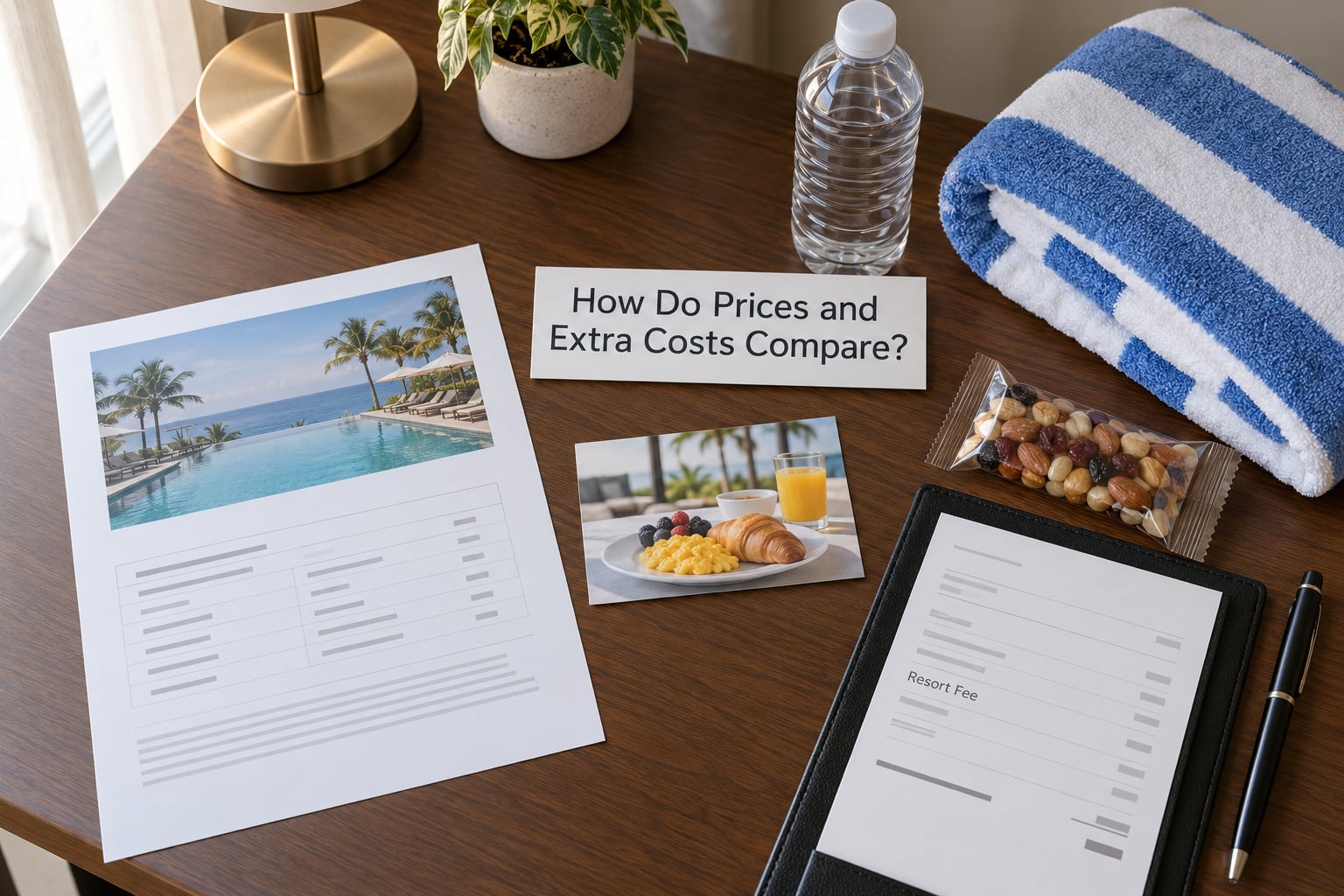
Neither plan is automatically cheaper. All-inclusive rates carry more up front and most of that spend is locked in, while a European Plan rate looks cheap and leaves every meal, drink, taxi and tip to you. Comparing the two headline numbers is comparing two different things.
| Cost variable | On an all-inclusive | On a European Plan |
|---|---|---|
| Meals | Covered, aside from premium restaurants | Every meal charged, on property or off |
| Drinks | Local spirits, water and soft drinks usually covered | Each drink charged, and resort prices are steep |
| Resort or club fee | Sometimes included in the rate | Commonly a daily add-on at beachfront resorts |
| Taxes | Usually added at checkout | Usually added at checkout |
| Childcare and kids club | Often included, sometimes with age limits | Charged per session or per day |
| Activities and excursions | Some included, off-site tours extra | Everything extra |
| Transport | Sometimes included at some properties | Airport transfers and taxis on you |
| Tipping | Service charge at many properties, cash still appreciated | Your own tips on every meal, bar and taxi |
Drinking volume is the single biggest variable, and the breakeven is roughly three drinks per person per day. Below that, a European Plan usually wins on a beach resort because you are not using enough of the package. Above it, plus a couple of meals a day, the all-inclusive rate overtakes the pile of restaurant bills. That threshold drops in expensive resort zones and rises in destinations with cheap street food, and a Tripadvisor regular in Cancun put it plainly: daily food and drink in those zones runs well past what most people budget, and hunting for cheap meals cancels out the point of relaxing.
Stays of ten nights or more change the picture again. Travellers talk about all-inclusive fatigue, where the buffet stops being interesting around day ten and the prepaid meals go to waste. On a long stay, a European Plan rate with a kitchen or a nearby restaurant block can be both cheaper and better, and nobody complains about a buffet on night twelve.
Food and Drinks: Which Plan Offers Better Value?
All-inclusive wins on predictability and volume. A family of four on a beach holiday eats roughly twenty-eight person-meals a week plus constant snacks, and having those covered removes a decision from every single one of those days. It also removes the argument about where to eat and the taxi ride back.
European Plan wins on quality and choice. You can eat at the steakhouse your hotel does not have, order what you actually want at lunch, or find a bakery two streets away with better coffee than the hotel will ever serve. For a traveller who eats for pleasure rather than fuel, that difference is worth paying for.
Choosing Between All Inclusive vs European Plan Hotels for Food
Meal variety at an all-inclusive depends on the property and your tier. Budget properties often run one buffet, and reviewers there complain about watery cocktails, frozen drinks and repetitive dinners. Mid and high tiers add several specialty restaurants, table service and a wider wine list, though premium labels still cost extra.
Included beverages are where the all-inclusive promise gets fuzzy. Soft drinks, water and local spirits are standard, but imported spirits and good wine are usually not, and several properties cap drinks per guest per day or restrict the all-inclusive bars to certain hours. If your evening depends on a specific bottle, buy it yourself or check the liquor list first.
Dietary needs deserve a direct email before you pay a deposit. Buffet properties can usually handle vegetarian, halal or gluten-free requests with notice. A European Plan property with one restaurant and no in-house kitchen has far more room to get it wrong, though an apartment with a kitchen removes the problem entirely.
Reservations are the quiet difference. At a busy all-inclusive, guests book tables and sun loungers days ahead. On a European Plan stay, the same restaurant may not even accept hotel guests, which was a live question in a Reddit thread about Playa del Carmen, and the local restaurants fill up fast too.
A workable compromise appears again and again in traveller threads: use the all-inclusive for breakfast and lunch while you are at the pool, and pay for dinner in town. Several people in the Puerto Vallarta and Cancun forums recommend exactly that, and the new Vallarta resorts that sell all-inclusive sit far enough from downtown dining that you need a taxi for every meal out.
Activities and Entertainment
An all-inclusive rate usually folds in the pool, the fitness facilities, the kids club, daytime sport like tennis or beach volleyball, and a nightly entertainment programme. That is a lot of free use of facilities you would otherwise pay a day fee for, and for a family with small children it is the difference between a workable holiday and a day of managing boredom.
It does not mean everything is free. Spa treatments, golf, tennis coaching, scuba, jet skis, motorised water sports, premium fitness programmes, excursions off the property and photo packages are usually charged. Some adults-only properties keep the gym out of the package too, so the words “all-inclusive resort” need reading rather than trusting.
A European Plan property often gives you fewer included activities but more freedom. The gym, the court or the spa session is priced openly, and small hotels and independent places schedule less fixed programming, which means your day bends around what you feel like doing. Travellers who value a walk into town over a supervised craft hour tend to prefer that.
Flexibility Outside the Resort
This is where European Plan earns its name. Independent dining, sightseeing, business travel and short city breaks all suit a room-only rate, because the plan is a base to sleep in rather than a place to be trapped. You can take a train, eat where the food is good and change your plans without a resort schedule in the way.
The trade-off in all inclusive vs european plan hotels runs both ways. With all-inclusive you pay for benefits you may never touch, which stings if the property sits far from anywhere worth walking to. With European Plan you control spending one item at a time, which rewards control and punishes impulse. Neither is the safer default; they are different bets on your own behaviour.
Several properties sell both plans, which makes a split stay easy. One Cancun resort discussed on Reddit r/AllInclusiveResorts offers European Plan and all-inclusive bookings, and the same pattern shows up across Los Cabos, Puerto Vallarta, Aruba and Barbados. Book the beach nights on the all-inclusive rate and the food nights on European Plan, and you get the bundle where it works without paying for it where you do not.
Which Plan Is Best for Different Travelers?
Match the plan to the traveller, not to the destination. The table below is the short version of the reasoning in the rest of this guide.
| Traveller | Usually better fit | Why |
|---|---|---|
| Family with young children | All-inclusive | Meals and kids club covered, no daily logistics |
| Couples on a beach week | All-inclusive | Uses most of the bundle, keeps the budget fixed |
| Heavy drinkers | All-inclusive | Bar tabs at resorts erase the saving quickly |
| Light drinkers | European Plan | You will not use the drinks you paid for |
| Food-focused traveller | European Plan | Local kitchens beat a buffet after two nights |
| Solo traveller | Either | All-inclusive for safety and ease, European Plan for a city |
| Stay of ten nights or more | European Plan | Avoids buffet fatigue and pays for variety |
| Short city break | European Plan | The plan exists for exactly this trip |
| Dietary or accessibility needs | Ask before booking | Kitchen facilities and staff training decide it, not the plan name |
| Tight budget | Compare all-in totals | The lower room rate is often the more expensive trip |
Whichever direction you lean, run the same trip both ways before you commit. Build a day for the all-inclusive property and a day for the European Plan one using the same number of meals, drinks, taxis and excursions, then compare the two totals for the whole stay. It takes ten minutes and it settles most arguments that a search results page cannot.
How to Compare Hotel Prices Correctly
Most price comparisons are unfair because the two quotes are for two different trips. Work through this list in order, and the right answer usually appears on its own.
- Hold the dates and room type fixed. A different week or a room one category up changes everything, so compare like with like.
- Fix the occupancy and the travel party. Prices are per person, per room or per child, and children are often charged at a fraction of the adult rate or not at all. Two adults and two children is a different trip from two adults.
- Read the plan code in the rate terms. EP, CP, MAP and room only are not interchangeable, and the default selection on a booking engine is rarely the one you want.
- Check the cancellation terms on both quotes. A flexible all-inclusive booking and a non-refundable room-only rate are not comparable at all.
- Add the mandatory extras to each side. Resort fee, club fee, taxes, airport transfer, parking and any charge for the gym or kids club.
- Estimate your own meals, drinks and tips against the all-inclusive rate. Use your real habits, including the coffee and water you would buy rather than the drinks you might wish you had.
- Price the activities you will actually do. One sunset cruise or a week of golf can flip the calculation on its own.
- Decide who is driving the day. If the plan dictates the schedule, all-inclusive wins on stress. If you want to wander, European Plan wins on flexibility.
One more booking tactic worth knowing: arriving on a European Plan and upgrading at the front desk can sometimes cost less than booking the all-inclusive upfront, particularly late in the season or when occupancy is low. It is a negotiation, so ask what the per-night upgrade costs, whether it applies to the whole stay or the remaining nights, and what it includes. The same question in reverse, at an all-inclusive property, sometimes wins you a cheaper total with the flexibility of dining out.
The reason this matters is simple. The lowest visible rate is rarely the cheapest complete trip, and on a resort the gap between the two is often the whole difference between a comfortable week and a stingy one.
Frequently Asked Questions
Does European Plan always mean breakfast is included?
No. European Plan means room only, with no meals included. Where breakfast is part of the rate, listings usually label it Continental Plan, Breakfast Plan or simply state that breakfast is included. Breakfast on a European Plan stay is typically continental or a buffet, and the same property often sells half board and full board rates, so you can add meals before you arrive rather than at the desk.
Do all-inclusive hotels charge extra for anything?
Almost always, yes. Premium restaurants, premium spirits and imported wine, spa treatments, off-property excursions, photo packages, motorised water sports, room service at some properties and tips at others all carry charges. Inclusions also differ sharply between properties, so a guest at one Bahamian all-inclusive found no snacks, sodas or room service at all. Read the specific property’s inclusion list rather than relying on the label.
Which is cheaper, all-inclusive or European Plan?
On a beach resort, all-inclusive usually costs less for families, couples and heavier drinkers. European Plan usually costs less for light drinkers, food-focused travellers, anyone spending ten nights or more, and city trips. The breakeven sits near three drinks per person per day, and resort fees, taxes, taxis and tipping can move that line either way, so compare the all-in total for your own trip.
Which plan is better for families with kids?
All-inclusive, in most cases. It covers meals, snacks and often the kids club, which removes the daily problem of finding food a child will eat and paying for childcare while you eat your own. Families who plan to leave the property daily for sightseeing or who stay ten nights or more may prefer European Plan, since the prepaid meals and club hours go unused.
Do I need to compare resort fees and booking conditions for both plans?
Yes. A room-only rate at a beachfront resort often carries a daily resort or club fee that appears late in checkout, while an all-inclusive rate may still add taxes and premium dining charges. Compare the same dates, room type, occupancy, meal plan and cancellation terms on both quotes, then add mandatory fees, taxes, transfers and parking to each side before choosing.
Conclusion
Choose all-inclusive when you will use the bundle: days by the pool, kids in the club, several drinks most evenings, and no intention of leaving the property for dinner. The total is fixed, the decisions disappear and the cost shock arrives at booking rather than at checkout.
Choose European Plan when the trip is about the place rather than the property: a city, a food trip, a light-drinking holiday, or a stay long enough that a buffet would bore you by day ten. Then price the whole thing before you commit, including resort fees, taxes, meals, drinks and tips on both sides, and remember the core distinction behind all inclusive vs european plan hotels. One plan bundles everything and charges you for it up front. The other bundles nothing and leaves every decision, and every bill, to you.